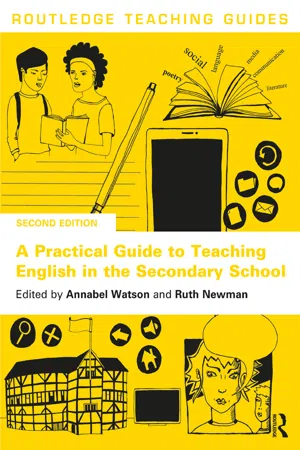
A Practical Guide to Teaching English in the Secondary School offers straightforward advice, inspiration and a wide range of tried and tested approaches to help you find success in the secondary English classroom. Covering all aspects of English teaching, it is designed for you to dip in and out of, and enable you to focus on specific areas of teaching, your programme or pupils' learning.
Fully updated to reflect what student and early career teachers see and experience when they enter the classroom, the second edition supports trainee and practicing teachers to teach in imaginative and creative ways to promote learning in English. Packed with ideas, resources, practical teaching activities and underpinned by the latest research into how children learn, the book examines the core areas of reading, writing and spoken English including:
• Plays, poetry, non-fiction, myths and legends, drama and Shakespeare
• Developing writing
• Creative grammar
• Talk and classroom dialogue
• Media and digital writing
• English across the curriculum
• Well-being through writing
• Literature and language post-16.
Including tools to support critical reflection, A Practical Guide to Teaching English in the Secondary School is an essential companion for all training and newly qualified English teachers.
Trusted by 375,005 students
Access to over 1.5 million titles for a fair monthly price.
Chapter 1The English curriculum in context: A conversation through time
Lorna Smith
DOI: 10.4324/9781003093060-2
Introduction
This book aims to support you in becoming an inspiring, engaging, expert English teacher, with each chapter containing suggestions to help you develop your subject knowledge, pedagogy and practice. Yet before heading into the future in this way, we want to start by taking you back in time. You are joining a community with a rich history. Understanding some of that history – and the debates that have taken place throughout – provides you with a basis for reflection, and so begins to nurture the English teacher you aspire to be.
For the purposes of this chapter, the focus is on secondary English in England. If you are based in Northern Ireland, Scotland or Wales, it would be interesting to investigate how the history of subject English in your jurisdiction led to the current Northern Ireland Curriculum (CCEA, 2007), Curriculum for Excellence (Education Scotland, 2010) or Curriculum for Wales (Hwb, 2020) respectively. Indeed, comparing and contrasting the national curricula across – and even beyond – the four countries of the United Kingdom provides an indication of some of the inherent tensions about what English is and what it is for.
The chapter begins, then, with a summary of how the subject of secondary English in England has evolved and been influenced by key historical, cultural, social, political and economic factors across the past 150 years, through the lens of government documents. These include major reports and guidance to teachers (1905–88), followed by the six iterations of the National Curriculum (1989–2014). Together, these policy documents are important indicators of how English was (and is) ‘officially’ seen and valued. Of course, the official view only tells part of the story – there are hundreds of publications written by teachers, academics and other interested parties that provide more depth and nuance, many of which you will become familiar with over the course of your training and beyond. However, the official view is an important starting point, not least because it indicates what has been sanctioned and publicly funded.
At the end of this chapter you should be able to:
articulate your own understanding of the purpose of English;
understand how curriculum policy is a product of its time that informs subject content and influences how the role of English is perceived;
respond to some of the debates around speaking, listening, reading and writing that have been rehearsed over the decades.
Activity 1.1: What is English for?
Before reading on, jot down 10–12 quick-fire responses to the question What is English for? (Imagine how you might respond if a pupil asks you this in a classroom: it is a query you will undoubtedly be faced with sooner or later.) Write each point on a separately sticky note or jot them into a whiteboard app that enables each point to be moved independently.
For example: studying English enables you …
If you wish, revise or add to the list as you read the following historical overview. We return to your responses later in the chapter.
The 1900s–1930s: sowing the seeds – the beginnings of subject English
If you are asked to imagine a lesson in Victorian England, you might think of Charles Dickens’ Mr M’Choakumchild and his boss, Mr Gradgrind, who aimed to fill their ‘little pitchers […] full of facts’ (1854, n.p.). Seeing such scenarios played out in life inspired the work of Matthew Arnold (1822–88), a respected inspector of government schools and critically recognised poet. Having observed first-hand the impact of payment-by-results, when the Revised Code of 1862 effectively forced Victorian teachers to practise learning by rote (as caricatured by Dickens), Arnold spent much of the rest of his life lobbying for all children in England – particularly the working class – to be culturally educated. He saw that ‘[i]t is in making endless additions to itself […] in endless growth in wisdom and beauty, that the spirit of the human race finds its ideal’ (1869, p.47), and argued that if people could appreciate beauty through reading literature, they would become alive to opportunity, nourish their best selves and put the common good above personal gain; accordingly, appreciating culture is a means of ‘growing and becoming’ (1869, p.94) as individuals and a society. Arnold’s beliefs inspired the development of the subject that became ‘English’.
Around the turn of the twentieth century – in no small measure due to Arnold’s work – the government recognised education as a national priority. The resulting Education Act of 1902 sought to strengthen the system for the local funding of elementary schools – the forerunners of the maintained system that served the majority working class – to ensure universal provision, and the school-leaving age was raised from 11 to 14 (although no distinction was initially made between primary and secondary phases). Elementary schools were free to develop their own curriculum (Shayer, 1972; Gillard, 2018). Meanwhile, middle- and upper-class children were educated in self-governing grammar or independent schools.
English was at that time gaining status as a university subject. Oxford opened a School of English in 1893; Cambridge followed suit in 1917 (Medway et al., 2014). Both offered English Literature; some graduates went on to teach English. However, English was mostly taught by generalist teachers without a university degree, particularly in the elementary schools. Official advice to support them was offered by the Board of Education in a new publication, Suggestions for the Consideration of Teachers and Others Concerned in the Work of the Public Elementary Schools (BoE, 1905/1912). It was emphasised that the advice given was tentative: it was for the teacher, as a trusted professional, to decide what was in the best interests of their pupils. The guidance promotes a child-centred, liberal approach, suggesting a teacher should promote ‘active curiosity’ and should ‘know […] and sympathise’ with their pupils to ‘adjust his (sic) mind to theirs’ (BoE, 1912, p.11). In terms of English, it recommends that pupils be granted the ‘liberty of free expression’ (BoE, 1905/1912, p.12). It argues that confidence in oracy leads to a love of reading, and that freedom of choice of reading matter broadens pupils’ perspectives. Decontextualised textbook written exercises are rejected in favour of written composition developed in parallel with the pupils’ abilities and interests (BoE, 1905/1912). These approaches imply recognition of a link between creative practice, independent critical thought and the personal growth of individuals. The publication was so successful that it was frequently reprinted and launched a series. Nevertheless, the pedagogy that the Suggestions series advocated may not have been universally embraced, nor always effective: a letter to The Times complained ‘The English boy cannot write English’ (Fowler, 1910, p.1), and some were found to leave school functionally illiterate (Newbolt, 1921).
Many children educated in these early elementary schools would have become victims of the First World War (1914–18) which cost the lives of two million British soldiers (and wounded untold others) (Herbert, 2018). Yet, at its close, a more democratic society gradually emerged: women were finally given the vote, the strict class hierarchy began to dissolve, and white-collar jobs became available to the working class. The coalition government commissioned a report to consider ‘the requirements of a liberal education, the needs of business, the professions, and public services, and the relation of English to other studies’ (1921, p.4) as Britain began to rebuild. Sir Henry Newbolt, poet and civil servant, chaired the committee that led to the publication of The Teaching of English inEngland (1921). His report follows the humane approach of Arnold and the Board of Education in arguing that the most important result of education is not knowledge but ‘experiences of human beings which are gained by contact with human beings’ (1921, p.8). Newbolt places English as the ‘keystone’ (1921, p.6) in the centre of the educational arch, claiming English, an ‘art, a means of creative expression, a record of human experience’ (1921, p.11) is ‘the true starting point and foundation from which all the rest [of the curriculum] must spring’ (1921, p.14). He recommends a child-centred curriculum in which pupils are encouraged to question, engage in discussion, practise Drama. He encourages bilingualism, whereby pupils speak their local dialect (an important marker of personal identity) with confidence as well as become proficient in standard English. Pupils should read freely books chosen themselves, both canonical and contemporary – with guidance from the teacher, where necessary – and write critically and imaginatively for a real purpose and audience. The focus was on ‘growing’ the individual as a means of developing a cohesive society: Newbolt’s aspiration was that future warfare could be prevented through enriched human understanding.
The 1940s–1980s: continuing to cultivate
Newbolt’s optimism was sadly misplaced, as the Second World War (1939–45) began less than 20 years later. At its close, the Education Act of 1944 introduced the tripartite system (primary, secondary, further education), intended to rebuild the nation once again. There was no new subject guidance: individual schools continued to set their own curriculum. Evidence suggests that, in terms of English, Newbolt’s recommendations were rarely practised: an His Majesty’s Inspectorate report from 1951 found ‘English in both grammar and modern schools to be competent but dull’ (Medway et al., 2014, p.38). Textbooks and abstract grammar lessons dominated, perhaps because pupils at grammar or independent schools sat Ordinary levels (O levels) that were near-indistinguishable from those of the 1920s (Shayer, 1972); while the majority, destined for manual employment, did not sit school-leaving examinations at all. There was little pressure on teachers to inspire or pupils to achieve.
However, at around this same time, despite (or because of) a lack of official steer, practice in English developed markedly in some quarters. This post-war period saw the founding of the grass-roots London Association for the Teaching of English (LATE) in 1947 (Gibbons, 2013). LATE teachers – daringly – taught modern as well as nineteenth-century novels and began to publish pupil-friendly textbooks to replace formal grammar books (Medway et al., 2014). The movement spread: the National Association for the Teaching of English (NATE) was born in 1963.
The view that subject English should centre around the personal growth of the individual whilst developing their literacy skills was given fresh impetus in the 1960s when the incoming Labour government abolished the 11+ in most areas and introduced the Certificate of Secondary Education (CSE) for those not destined for O level. This resulted in the reinvigoration of the secondary English curriculum as all pupils (and teachers) had a tangible goal. Publications arising from a major international conference, including Growth through English (Dixon, 1967) and Creativity in English (Summerfield, 1968) – the titles of which indicate their child-centred, liberal perspective – became seminal texts for English teachers.
Nevertheless, despite the interest shown by educationalists in creative, c...
Table of contents
Cover
Half-Title Page
Series Page
Title Page
Copyright Page
Contents
List of figures
List of tables
List of contributors
Acknowledgements
List of abbreviations
Introduction
Chapter 1 The English curriculum in context: A conversation through time
Chapter 2 Spoken language and talk for learning
Chapter 3 Sharing a class reader
Chapter 4 Talk about texts: Discussion of literature in the English classroom
Chapter 5 Reading comprehension
Chapter 6 Teaching the process of writing
Chapter 7 Creative grammar for creative teachers
Chapter 8 Reading and writing poetry
Chapter 9 Teaching non-fiction reading and writing
Chapter 10 Shakespeare
Chapter 11 Teaching plays
Chapter 12 Drama in English
Chapter 13 Storytelling, myths and legends
Chapter 14 Media in English
Chapter 15 Digital and multimodal writing
Chapter 16 Post-16 literature
Chapter 17 Post-16 language
Chapter 18 English across the curriculum
Chapter 19 Writing well-being: Using reflective diary-writing to support English teacher well-being
References
Index
Frequently asked questions
Yes, you can cancel anytime from the Subscription tab in your account settings on the Perlego website. Your subscription will stay active until the end of your current billing period. Learn how to cancel your subscription
No, books cannot be downloaded as external files, such as PDFs, for use outside of Perlego. However, you can download books within the Perlego app for offline reading on mobile or tablet. Learn how to download books offline
Perlego offers two plans: Essential and Complete
Essential is ideal for learners and professionals who enjoy exploring a wide range of subjects. Access the Essential Library with 800,000+ trusted titles and best-sellers across business, personal growth, and the humanities. Includes unlimited reading time and Standard Read Aloud voice.
Complete: Perfect for advanced learners and researchers needing full, unrestricted access. Unlock 1.5M+ books across hundreds of subjects, including academic and specialized titles. The Complete Plan also includes advanced features like Premium Read Aloud and Research Assistant.
Both plans are available with monthly, semester, or annual billing cycles.
We are an online textbook subscription service, where you can get access to an entire online library for less than the price of a single book per month. With over 1.5 million books across 990+ topics, we’ve got you covered! Learn about our mission
Look out for the read-aloud symbol on your next book to see if you can listen to it. The read-aloud tool reads text aloud for you, highlighting the text as it is being read. You can pause it, speed it up and slow it down. Learn more about Read Aloud
Yes! You can use the Perlego app on both iOS and Android devices to read anytime, anywhere — even offline. Perfect for commutes or when you’re on the go. Please note we cannot support devices running on iOS 13 and Android 7 or earlier. Learn more about using the app
Yes, you can access A Practical Guide to Teaching English in the Secondary School by ANNABEL WATSON, Ruth G Newman, Annabel Watson,Ruth G Newman,Ruth Newman, Annabel Watson, Ruth Newman in PDF and/or ePUB format, as well as other popular books in Education & Education General. We have over 1.5 million books available in our catalogue for you to explore.