During the first years of life, before a child's first words, preverbal communication and engagement between children and their caregivers build an essential foundation for language and learning across domains. Many children with disabilities and their families struggle to connect early in life and need support developing early communication skills—and now there's a comprehensive resource to help birth-to-three practitioners deliver that critical support to young children with disabilities and their families.
The product of more than three decades of research and clinical work, this accessible guidebook will help professionals harness the power of Triadic Gaze Intervention (TGI), an evidence-based strategy that supports the development of early communication behaviors—gaze, gestures, and vocalizations—in young children with disabilities. Through a straightforward protocol, practitioners will learn powerful techniques for helping caregivers engage young children during everyday routines and build their preverbal communication skills. In-depth practical guidance—enhanced with tip sheets, case examples, photos, and demonstration videos—make the protocol easy to learn and put into action with families and children.
A must for early interventionists, speech-language pathologists, occupational therapists, physical therapists, and other practitioners, this book is the key to helping young children with disabilities learn to successfully communicate, bond with their families, and engage with their world.
READERS WILL:
Learn about the six elements of the authors' PoWRRS-Connect protocol for implementing TGI: providing opportunity, waiting, recognizing, responding, shaping, and connecting
Use the protocol to help children make progress toward IFSP goals related to communication and engagement
Tailor the protocol for individual children with a range of disabilities and needs, including motor, sensory, or social impairments
Embed opportunities for communication and engagement into each family's authentic routines and activities
Facilitate stronger collaborative partnerships with caregivers
Discover how to monitor small measures of progress in engagement and communication through the lens of TGI
Learn from four parents of children with complex communication needs, who share their success stories with TGI and describe their children's current communication methods and abilities
PRACTICAL MATERIALS: Easily implement the PoWRRS-Connect protocol in families' daily routines with the downloads available online, including handouts for caregivers, a communication checklist for assessment, and 19 brief demonstration videos.
Trusted by 375,005 students
Access to over 1.5 million titles for a fair monthly price.
The Child–Adult Dance and the Gift of Engagement and Communication
The first year of life is instinctively dominated by nurturing moments between babies and families, filled with holding, feeding, and socializing. Imagine the beautiful dance that takes place between adult and child as they become finely tuned partners learning to engage and communicate with each other. Children grow and thrive in the context of close and dependable relationships that provide a safe and predictable environment and encourage exploration (National Research Council & Institute of Medicine, 2000). Research has overwhelmingly demonstrated the importance of these first relationships to build a strong foundation for children’s future social-emotional, language, and cognitive learning (Bakeman & Brown, 1980; Brazelton, 1982, 1988; Bruner, 1983; Kelly et al., 2008). The fundamental ingredient for these early moments is the reciprocal interaction (i.e., turn taking) that takes place between adult and child.
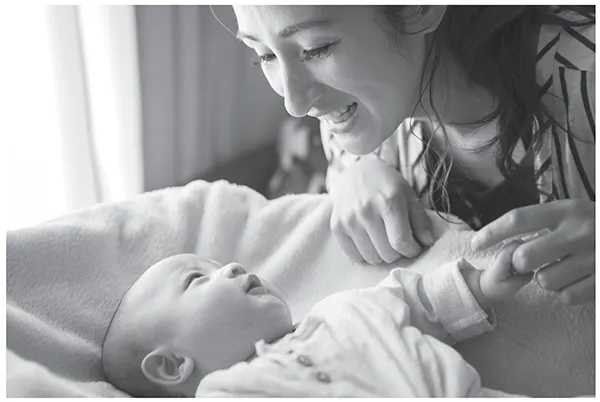
As the adult and child get to know each other, they become exquisite dance partners interacting throughout the day in all types of activities and situations. Arnold Sameroff and colleagues have described this dynamic back-and-forth behavior between child and adult in their well-accepted Transactional Model (Fiese & Sameroff, 1989; Sameroff, 1987; Sameroff & Fiese, 1990). The connection established between the adult and child, as shown in the photo in Figure 1.1, sets the stage and provides the context for all kinds of future learning. Regardless of the child’s age, or the circumstances, these types of interactions capture the gift of engagement.
Figure 1.1. Early communication as illustrated by the eye contact and engagement between mother and infant.
This chapter briefly describes the natural emergence of engagement and the development of early communication during the first year of life. The way in which child–adult interactions form the context for early learning is explained, including how the nature of these interactions supports not only communication but also learning across developmental domains. The chapter then describes in detail children’s early communication, defining specific, conventional preverbal behaviors (i.e., gaze, gestures, vocalizations) that become intentional forms of communication. So much happens before children talk; this chapter ends with a discussion of how preverbal communication emerges and leads to first words and word combinations.
EARLY ENGAGEMENT: THE CONTEXT FOR LEARNING
The context for early engagement, learning to communicate, and in fact, all future learning, is naturally present from birth. The caregiver holds the infant, and the stage is set. Engagement begins with the infant’s first cries and whimpers; they serve to immediately engage the adult. These early reflexive behaviors effectively grab the adult and set up the context for interaction. As the days and weeks go by, these critically important exchanges continue. Gradually the adult begins to give meaning to the infant’s behaviors of crying, cooing, gazing, and early smiling, responding to them consistently and, in turn, setting up dependable back-and-forth routines that the baby can trust (Adamson & Dimitrova, 2014).
These interactive routines will occur throughout all kinds of activities, including feeding, bath time, and social play, which then serve as natural opportunities for supporting engagement and shared attention between adult and child (Bruner, 1999; Dunst et al., 2000). Routines start simply via mutual exchange of gaze between the adult and infant as the infant is held. The adult gradually adds more to the interaction by starting to socially play with the infant, for example, by making sounds, tickling, and kissing. The adult eventually will introduce objects (e.g., food items, toys) during activities. Once this happens, the interaction between adult and child becomes more complicated and sophisticated, as the child has the opportunity to coordinate their attention to both adult and object (Adamson et al., 2014).
During these early interactions, the adult is structuring the environment to encourage engagement and communication, and also is paying attention and responding to the child’s efforts to connect. These profound interactions occur long before spoken language emerges; yet, they are the very interactions that support language development. During these interactive contexts, the child is learning to pay attention to people, objects, and relationships between them. They are also learning to listen and map the adult words onto these objects and actions. In fact, research has clearly shown that early engagement of these kinds, and specifically those involving coordinated joint attention among child, adult, and objects, is associated with later social-emotional, cognitive, and language development. (See Adamson & Dimitrova, 2014, and Mundy & Newell, 2007, for thorough reviews of this research.)
Engaged interactions between adult and child are critical for learning. The adult brings the necessary structure, providing opportunities for engagement but also skills for recognizing the child’s signals of attention and interpreting the child’s wants and needs. Of course, the adult needs a partner; research has shown the adult will only continue to engage if the child is an active participant in the exchange (Murray & Trevarthen, 1986). Let’s turn now to examining more closely what the child brings to this learning environment and how these behaviors rope in the adult to create a magnificent turn-taking dance between child and adult, which shapes development.
CHILD BEHAVIORS AND THE EMERGENCE OF INTENTIONAL COMMUNICATION
Early communication behaviors produced by infants and toddlers begin long before first words. These preverbal communication behaviors typically include gaze, gestures, and vocalizations and emerge along a communication continuum in three phases: preintentional, intentional, and symbolic communication (e.g., Bates et al., 1975; Locke, 1993; Thomasello, 1999). Brady and colleagues (Brady et al., 2012; Salley et al., 2019) delineated this continuum of behaviors in the Communication Complexity Scale (CCS; 2012). The CCS was designed to observe and assess specific prelinguistic forms of communication in children and adults who are nonverbal. With this purpose, the CCS defines a sequence of conventionally recognizable preverbal behaviors (i.e., gaze, gestures, and vocalizations) that have been documented as preceding symbolic language (i.e., first words, signs, or symbols; word, sign, and/or symbol combinations).
Reminder: A lot happens before first words!
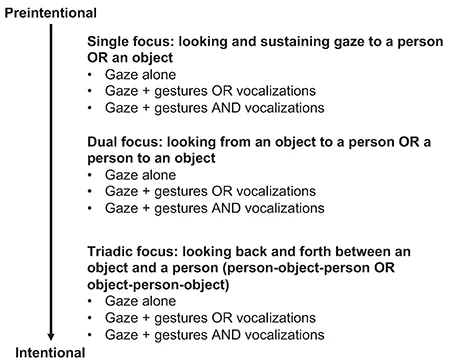
Gaze, because of its powerful and definitive interactive signal, serves as the anchor behavior in the continuum, moving from single focus, to dual focus, to triadic focus. As will be described, gaze can be accompanied by gestures and vocalizations to further clarify the engagement and message. As children develop, frequency and complexity of these behaviors increase (Salley et al., 2019). Figure 1.2 illustrates the continuum of preverbal behaviors, which will serve to guide the following description of early communication, from preintentional, to intentional, to symbolic.
Figure 1.2. Preverbal communication behaviors: Foundation for first words. (Adapted from Brady et al., 2012.) Republished with permission of American Speech-Language-Hearing Association, from Development of the Communication Complexity Scale, Brady, N., Fleming, K., Thiemann-Bourke, K, Olswang, L., Dowden, P., & Saunders, M., 21(1), 2012; permission conveyed through Copyright Clearance Center, Inc.
Preintentional Communication: Single Focus
An infant’s very first behaviors are reflexive behaviors and include eye gaze, body orientation and movements, and bodily noises that suggest engaged and disengaged infant states (Kelly et al., 2008). During the first 3 months of life, the engaged behaviors include, for example, having eyes open, looking intently, feeding, or making sounds of contentment. Disengaged behaviors, in contrast, might include grimacing, squealing, crying, or turning away. Lots of guessing occurs during these early months as parents try to determine their children’s wants and needs. Over time, the infant becomes more organized in response to the environment, and gross movements become increasingly more precise as motor control develops.
As children naturally develop, their behaviors become more distinct and recognizable. As such they are more purposeful. Emerging first is a clear single focus orientation and gaze to an adult and then gradually to objects. This can be observed as early as age 4 months as children develop increased head control. The child will begin to move from being oriented to an adult, to glancing at the adult, to sustaining a gaze with the adult. Think about how a child will begin staring at the adult’s face. This single focus, which is an early form of social joint attention between child and adult, gradually begins to include objects (e.g., bottle, rattle): quickly or passively glancing at objects and eventually maintaining an active look toward them. By around 5 months of age, a child’s trunk control allows for more purposeful and regulated gazing, even accompanied by gestures (e.g., leaning, reaching) and vocalizations (e.g., vowel sounds, consonant-like sounds). However, the child at this stage does not link the adult to the object. Consider how a child might begin paying attention to the pet dog or staring at the mobile above their crib. The child might make sounds and try to reach, but the focus is clearly on only the object or the adult, one at a time. These are certainly purposeful behaviors, but they do not yet indicate intentional communication.
Preintentional Communication: Dual Focus
Single focus gradually moves to the child purposefully following the adult’s gaze to other people or objects. This emerging expression of joint attention is always exciting as it appears the child is noticing more about their world. The child will increasingly and more definitively reach, at first to the adult and then to others, including objects. Think about a child reaching for the bottle during feeding or splashing the water during bath time. This has been termed dual focus. Note how the gaze becomes more complex as shown in Figure 1.2. Gaze and gestures will increasingly be accompanied by vocalizations, which too are becoming more complex (e.g., consonant–vowel combinations).
Between 8 and 10 months, children’s production of these behaviors noticeably increases in frequency and complexity, which in turn expands their social, joint attention moments with others. These behaviors, although becoming more and more frequent and purposeful, are not necessarily meant to intentionally communicate with others; yet, they serve to make interactions more readable and gratifying. Consider a child gazing at a mobile and trying to reach for it while having their diaper changed. The parent might regard this as a comment on the mobile or a request for it, but there is really no evidence for intentional communication on the child’s part. Yet, the adult will typically acknowledge these behaviors with an attentive remark. As described previously, these are the early forms that build a child’s ability to engage with others. As the child increases their behavioral repertoire, the adult will find these potentially communicative behaviors easier to recognize and interpret.
Families will respond more frequently to discrete, clear behaviors and less frequently to the more global, hard-to-read ones, thereby shaping the infant’s more refined communicative attempts. For example, families will more readily interpret a child’s looking at a bottle and vocalizing “uh uh uh” while reaching toward it as a request for wanting a drink than they will interpret a child’s quickly looking at the bottle while arching their back and fussing as a request. As the child gains and uses more conventional and readable behaviors (more intent gazes, more definitive gestures, and more varied vocalizations), the adult will be more consistent in responding. Through this back-and-forth, the child begins to learn that these early behaviors cause the adult to do something. This is the magical turn-taking dance between adult and child that provides the structure of language learning. Meanwhile, the child is also becoming increasingly interested in objects in the environment and bringing them into the interaction.
During this period of development, children are more purposely acting on their environment (people and objects) but are not yet linking the two as is necessary in intentional communication. Not until the child begins to knowingly direct their behaviors to another person, for the purpose of influencing that person, is the child said to be communicating with intentionality (Bakeman & Adamson, 1984; Bates et al., 1975; Locke, 1993; Thomasello, 1999). What does intentional communication look like?
Intentional Communication: Triadic Focus
Some time around 9–10 months of age, a dramatic milestone can be observed; the child begins shifting their gaze back and forth between an adult and an object or event of interest; this is called triadic focus, as indicated in Figure 1.2. The significance of triadic gaze, defined by a clear three-point gaze shift, or back-and-forth looking (often accompanied by gestures and vocalizations), between an adult and an object or event of interest, is the behavioral indication that the child is linking the adult to an action or object for the purpose of getting the adult to act in some way. This has been described as intentional communication prior to first words (Bakeman & Adamson, 1984; Bates et al., 1975; Locke, 1993; Trevarthen & Hubley, 1978).
As a child is moving from dual to triadic focus, they are also experiencing many opportunities to explore and act on objects, gaining knowledge about making things happen, and learning about their power to cause an effect on the world (i.e., means–ends relationships). This ob...
Table of contents
About the Video Clips and Downloads
About the Authors
Preface
Foreword Susan R. Sandall
Acknowledgments
Section I Understanding Early Communication Development and Triadic Gaze Intervention
Chapter 1 The Child–Adult Dance and the Gift of Engagement and Communication
Chapter 2 When the Dance Is Interrupted: Young Children With Disabilities and Intervention
Chapter 3 How Triadic Gaze Intervention Evolved in the Context of Early Intervention
Section II Implementing Triadic Gaze Intervention
Chapter 4 Introduction to the Triadic Gaze Intervention: What, Who, Where, When, and Why
Chapter 5 Integrating Triadic Gaze Intervention Into Practice: Determining the Appropriateness of TGI for Children and Families
Chapter 6 The Essential Elements of PoWRRS-Connect: Delivery Guidelines
Chapter 7 Putting PoWRRS-Connect Into Action With Families
Chapter 8 Tips for Tailoring Triadic Gaze Intervention and PoWRRS-Connect With Families
Chapter 9 Monitoring Progress
Section III Following the Triadic Gaze Intervention Journey With Children and Families
Chapter 10 Triadic Gaze Intervention and Beyond: The Journey for Children and Families Continues
Appendix A Triadic Gaze Intervention Research Program and Supporting Evidence
Appendix B Checklist of Early Communication Behaviors
Appendix C Video Exemplars of PoWRRS-Connect
Appendix D Handouts for Families
Glossary
References
Index
Frequently asked questions
Yes, you can cancel anytime from the Subscription tab in your account settings on the Perlego website. Your subscription will stay active until the end of your current billing period. Learn how to cancel your subscription
No, books cannot be downloaded as external files, such as PDFs, for use outside of Perlego. However, you can download books within the Perlego app for offline reading on mobile or tablet. Learn how to download books offline
Perlego offers two plans: Essential and Complete
Essential is ideal for learners and professionals who enjoy exploring a wide range of subjects. Access the Essential Library with 800,000+ trusted titles and best-sellers across business, personal growth, and the humanities. Includes unlimited reading time and Standard Read Aloud voice.
Complete: Perfect for advanced learners and researchers needing full, unrestricted access. Unlock 1.5M+ books across hundreds of subjects, including academic and specialized titles. The Complete Plan also includes advanced features like Premium Read Aloud and Research Assistant.
Both plans are available with monthly, semester, or annual billing cycles.
We are an online textbook subscription service, where you can get access to an entire online library for less than the price of a single book per month. With over 1.5 million books across 990+ topics, we’ve got you covered! Learn about our mission
Look out for the read-aloud symbol on your next book to see if you can listen to it. The read-aloud tool reads text aloud for you, highlighting the text as it is being read. You can pause it, speed it up and slow it down. Learn more about Read Aloud
Yes! You can use the Perlego app on both iOS and Android devices to read anytime, anywhere — even offline. Perfect for commutes or when you’re on the go. Please note we cannot support devices running on iOS 13 and Android 7 or earlier. Learn more about using the app
Yes, you can access Building Preverbal Communication & Engagement by Lesley B Olswang,Julie L Feuerstein,Gay Lloyd Pinder in PDF and/or ePUB format, as well as other popular books in Didattica & Didattica inclusiva. We have over 1.5 million books available in our catalogue for you to explore.