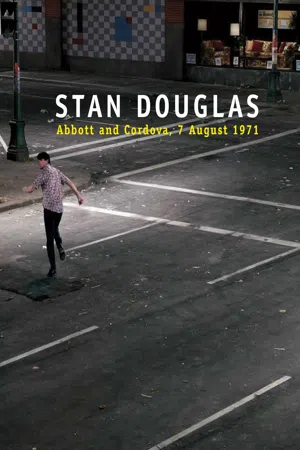
Immediately to the left of Stan Douglas’s Abbott & Cordova, 7 August 1971, a series of posters featuring portraits and quotations proposes an interpretation of the Woodward’s site and its historical significance. Adorning the entrance to one of the chain stores, they depict local residents and their answers to questions such as, “What do you think of the changes going on in the area?” and “What do you think about the Woodward’s development?” Considering that the piece was created by the developers, it is unsurprising that it offers a sunny interpretation. The carefully chosen faces of marginalized Downtown Eastside residents, new middle-class arrivals, and community leaders all speak of the positive impacts of the new development and the ongoing gentrification of the neighbourhood. Couched in the language of “social mix,” their quotations extol the virtues of “diversity,” misleadingly implying that the Downtown Eastside—one of the most diverse neighbourhoods in the city—somehow lacked diversity in the past. The quotes trumpet the social housing component of Woodward’s, even though the number of housing units is a fraction of what community groups argued was necessary. And they make fallacious claims that the new businesses are employing Downtown Eastside residents and helping them to “get off the streets”—as if the problem of poverty in the Downtown Eastside was the result of too few minimum-wage jobs.
Writing on Douglas’s piece in The Walrus, Leigh Kamping-Carder1 remarks that real-estate developers often forget that neighbourhoods like the Downtown Eastside are palimpsests—spaces continuously written over by different social groups throughout their history. Pace Kamping-Carder, what texts like those described in the previous paragraph suggest is that developers are in fact acutely aware of the histories of the places they seek to remake, at least insofar as it helps them sell condominiums. The quotations attributed to this all-too-perfect collection of faces are uncanny precisely because they seem to address every facet of the public discourse around Woodward’s, seeking to reassure new property-owners that not only is their investment secure but that their very presence is beneficial to the community. The ideological centre of the text is found in a quote from “Ali,” who, in giving his thoughts on how the neighbourhood will change, jokes, “[I]n five years, I won’t be able to afford a coffee here.” To the newly-arrived middle class being hailed by this discourse, the message is clear: Don’t sweat the bad reputation; this place is going to be worth a fortune.
It is in this politically contested space that we encounter Stan Douglas’s Abbott & Cordova, a depiction of a 1971 riot in which police attacked a group of hippies protesting marijuana prohibition. It is a somewhat frivolous protest compared to the
1Leigh Kamping-Carder, “At the Gastown Riot,” in The Walrus (July-August, 2009); http://www.walrusmagazine.com/ articles/2009.07-profile-at-the-gastown-riot-stan-douglas-walrus-vancouver-art/.