As teaching practices adapt to changing technologies, budgetary constraints, new student populations, and changing employment practices, writing programs remain full of people dedicated to helping students improve their writing. This edited volume offers strategies for implementing large- and small-scale changes in writing programs by focusing on transformations—the institutional, programmatic, curricular, and labor practices that work together to shape our teaching and learning experiences of writing and rhetoric in higher education.
The collection includes chapters from multiple award-winning writing programs, including the recipients of the Two-Year College Association's Outstanding Programs in English Award and the Conference on College Composition and Communication's Writing Program Certificate of Excellence. These authors offer perspectives that demonstrate the deep work of transformation in writing programs and practices writ large, confirm the ways in which writing programs are connected to and situated within larger institutional and disciplinary contexts, and outline successful methods for navigating these contexts in order to transform the work.
In using the prism of transformation as the organizing principle for the collection, Transformations offers a range of strategies for adapting writing programs so that they meet the needs of students and teachers in service of creating equitable, ethical literacy instruction in a range of postsecondary contexts.
Contributors: Leah Anderst, Cynthia Baer, Ruth Benander, Mwangi Alex Chege, Jaclyn Fiscus-Cannaday, Joanne Giordano, Rachel Hall Buck, Sarah Henderson Lee, Allison Hutchinson, Lynee Lewis Gaillet, Jennifer Maloy, Neil Meyer, Susan Miller-Cochran, Ruth Osorio, Lori Ostergaard, Shyam Pandey, Cassie Phillips, Brenda Refaei, Heather Robinson, Shelley Rodrigo, Julia Romberger, Tiffany Rousculp, Megan Schoen, Paulette Stevenson
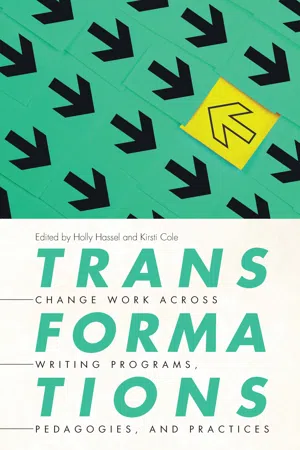
eBook - ePub
Transformations
Change Work across Writing Programs, Pedagogies, and Practices
- English
- ePUB (mobile friendly)
- Available on iOS & Android
eBook - ePub
Transformations
Change Work across Writing Programs, Pedagogies, and Practices
About this book
Trusted by 375,005 students
Access to over 1.5 million titles for a fair monthly price.
Study more efficiently using our study tools.
Information
Part 1
Transforming Labor
The worst-kept secret in academia is exploitative labor practices. In fact, it is not a secret at all. Precarious labor is simply our reality. We talk about the labor problems haunting our field at length but in reality, we do little to combat them. There are a number of reasons for exploitative labor, and in writing studies we are familiar with them all: cheap labor in high demand to meet curriculum requirements, administrative bloat, increasingly little monetary support from state and federal legislative bodies, neoliberalism, and American anti-intellectualism that posits all teachers as simultaneously out of touch with the needs of the public and disconnected from mainstream values.
In writing studies, in particular, labor inequities are amplified by an increasing class of faculty with training in writing studies who take on primary material and intellectual responsibility for writing programs—and an apprentice model that staffs courses taught to first-year students with minimally prepared graduate students and poorly supported contingent faculty, in part because assertions about the “disciplinarity” of writing studies and its establishment as a field have not been aligned with the reality of what and whom we teach.
For us, it was imperative that any collection focused on change work in writing studies start by acknowledging the problems and by demonstrating that there are ways to work within the system to positively improve the labor conditions of everyone. In Part 1, “Transforming Labor,” contributing authors highlight work done by graduate students, non-tenure-track faculty, and tenured allies to improve working conditions in writing programs. These are powerful chapters and powerful voices that do not simply succumb to the tales of neoliberalism haunting our institutions. These chapters give us disciplinary, institutional, departmental, and programmatic strategies to make a difference. The authors demand that we face the stories of the people who do the support work, often unacknowledged and always underpaid, in our departments. They also reflect the voices of those who do the vast majority of the teaching of first-year writing—graduate students and contingent faculty.
By shining a light on our systemic labor problems, each chapter poses a set of strategies that, with some organizing and collaboration, could work in most contexts. Stories matter. But perhaps these chapters reveal the shortfalls of relying only on stories without action. These chapters show us how to take action, powerfully, to create more equitable labor practices.
1
Braiding Stories, Taking Action
A Narrative of Graduate Worker–Led Change Work
Ruth Osorio, Jaclyn Fiscus-Cannaday, and Allison Hutchison
“I know I’m at one of the better universities in the country, so I find it depressing that I have to continue to take out loans because I don’t make enough. I can’t even fathom how I would survive with less of a stipend or without health insurance. My department fights for my rights, but it’s a constant battle against the university.”
“Women’s or trans procedures barely or not covered [by healthcare offered to grad workers]; insurance over the summer is an extra $600 on top of the academic yearly $1,400 for two people.”
“Having children is also a blessing, but personally it puts me at a disadvantage when it comes to my teaching preparation and research. There is little to no support to mitigate this, and our university yanked dependent coverage from us last year which put more of a strain on our finances and time.”
“As far as I know, the only mental healthcare we have access to is the resources available to us as students—and that usually means talking to someone who’s getting a master’s in clinical psychology instead of speaking to a licensed medical practitioner.”
“I understand why the suicide rate is so high. These are inhumane conditions.”
We collected these stories as part of a 2017 nationwide survey about the labor conditions of graduate student workers in writing programs (LCTF 2019).1 These stories both shocked us and felt familiar. As grad workers at the time, we had so many of our own stories that we experienced, observed, or overhead. If you work in a writing program, you probably do, too. The goal of our survey was to gather data that would shine light into the systemic exploitation of grad labor. We did so as graduate students, workers, and researchers on the Labor Census Task Force (LCTF) within the Writing Program Administration Graduate Organization (WPA-GO). In response to the University of Missouri healthcare crisis in summer 2015, Ruth worked with the WPA-GO to begin our group, and Allison and Jaclyn joined when the LCTF officially began its work in summer 2016. Inspired by the depth of adjunct organizing in the field of writing studies, we designed, circulated, and analyzed a nationwide survey about the labor and labor conditions of graduate workers in writing programs together with ten other people (see figure 1.1).

Figure 1.1. Timeline of Labor Census Task Force activities.
Our LCTF quantitative findings tell a compelling story: 71.6 percent of the 344 grad workers surveyed declared that their stipends did not adequately cover their basic needs, 36 percent expressed that their university’s health plans did not adequately cover their health needs, and 62.8 percent reported working more than their contracted hours. The LCTF circulated these data to the WPA-L (the central listserv for folks interested in writing program administration) and social media on March 20, 2019, as a six-page PDF report titled “Report on Graduate Student Instructor Labor Conditions in Writing Program.” We hoped that the data would change the status quo of grad workers in writing programs. The response was electric: leading scholars in the field of writing studies replied with dismay and outrage, expressing solidarity with grad workers at their institutions. Grad workers responded as well, telling us that they were using the document to initiate negotiations for higher pay and better benefits at their home institution.
The stories, data, and responses to the survey highlight the liminal space graduate workers occupy in writing programs. As Tressie McMillan Cottom so bluntly states when she criticizes the inequity of the graduate student experience, “In the academic hierarchy, [graduate students] are units of labor. They can be students but not just students. They are academics in the making” (2019, 2). As both students and workers, graduate students perform essential work for the campus by teaching introduction classes, running labs, supporting administrative work, and more. And the struggles described in the stories above emphasize that often the biggest barriers faced by graduate students are tied to their status as workers: low pay, limited benefits, little to no support for parents and caregivers—the same issues that unite the larger labor movement in the United States. Even though the National Labor Relations Board ruled that grad workers at private universities are indeed employees in 2016, university administrators and some faculty insist that grad workers are students first and apprentices second. Such framing allows universities to benefit from the cheap labor of graduate workers, especially in a time of underfunding for the humanities (Chaput 2000, 184). In particular, writing programs depend on grad workers, with grad workers teaching nearly 40 percent of first-year writing sections at PhD-granting institutions and 15 percent at MA-granting institutions (“MLA Survey of Departmental Staffing” 2014). Therefore, we ask ourselves and our readers: What are writing programs, pedagogies, and practices doing to change the status quo of graduate worker exploitation?
We—Ruth, Jaclyn, and Allison—believe that the story of the LCTF’s behind-the-scenes work of developing, distributing, and analyzing the study illustrates the power that graduate students can hold as leaders of institutional change, especially regarding issues of diversity, equity, and labor. We all served as chair or co-chair of the LCTF at some point in the task force’s tenure, shepherding the project from brainstorming sessions to IRB approval to survey circulation to analysis to reporting. As graduate students at the task force’s formation, we joined for a variety of reasons, but one motivation united us: a belief in the potential for grad workers to enact structural change in their departments, universities, and disciplines. If institutions truly value diversity, equity, and labor, they should support grad-worker-led initiatives. And, because Writing Programs are often fueled by grad worker labor, we argue the field of writing studies is a ripe site for supporting graduate-student-led initiatives that will reshape labor practices.
Just as we began the chapter with stories, we move onto our own stories of leading this study. Following cultural and feminist rhetorics methodologies, we evoke storytelling as our method of theory making (Ahmed 2017; Cottom 2018; Powell et al. 2014; Royster and Kirsch 2012). In the following two sections, we focus on two feminist rhetorical practices that fueled our work: (1) honoring lived experiences as sources of knowledge and (2) creating equitable models of collaborative leadership. In each section, we speak in a collective voice to situate the following stories in larger conversations within writing studies, and include our own reflections on the work. We hope that sharing our stories will function as a theoretical tool for inspiring other transformational change work led by graduate workers. Not only did the graduate students of LCTF function as academics reporting their own research, but we also validated graduate workers as knowledge makers by centering them as research subjects. We hope that in sharing our stories about our LCTF experience, we reveal the power of grad workers to research, organize, and lead the way in transforming the labor practices of writing studies.
Creating Change by Centering Graduate Worker Epistemology
Feminists have long argued that the “personal is political,” using it not only as a rallying cry but also a method for incorporating lived experiences as evidence: “for black and Chicana feminists, as for white feminists in women’s liberation, personal experience was the beginning point for their critical resistance to masculine ideologies” (Hesford 2013, 13). Because we too are intersectional feminists who value personal experience as evidence for systemic oppression, the lived experiences of graduate students served as the catalyst for our research study. Each of us seemed to know innately that our labor conditions as graduate student workers—and for Allison, as a former adjunct college writing and reading instructor—were less than ideal, but we didn’t necessarily have any empirical evidence. We knew, though, that our own personal experiences could do the important work of guiding us in designing our LCTF survey, gathering the evidence we needed for change work done for graduate labor practices.
We see our work at LCTF and our reliance on graduate student epistemology as influenced by the work of feminist scholars such as Jacqueline Jones Royster, who argued in her influential article on rhetorical history that “in recognizing knowledge as an interpretive enterprise, a social construction, the imperative becomes the task of connecting theory with scholarly action in order to both theorize and engage in other scholarly activities more systematically” (2003, 149). While Royster was addressing what constitutes knowledge in rhetorical studies, we would like to extend her point that “other views participate kaleidoscopically in the knowledge-making process” (149) to our own work leading the LCTF. We support the view that narrative and perspective are both an epistemological orientation and a research method. Like Deborah Journet (2012), we believe that “it is important to articulate what qualities of observation, analysis, or representation we require if we are to accept any particular narrative account as a persuasive instance of research” (17). However, our project in this chapter is not necessarily to distribute knowledge generated from our survey, but rather to offer knowledge we have generated on instituting programmatic change as graduate student leaders and researchers in writing studies.
Ruth:I first saw the story on Facebook in 2015: the University of Missouri had abruptly canceled its health insurance plans for graduate workers. I was states away, attending the University of Maryland, College Park, as a PhD student. I had no connection to Mizzou. But still, I shared the outrage, shock, and sense of betrayal the grad workers were expressing on social media. In a news article about Mizzou grad worker organizing, I saw a picture of a pregnant grad worker; how could she afford prenatal, labor and delivery, postpartum, and newborn care without insurance?These questions were fresh on my mind because I had just had my first child, and the medical care had been almost entirely covered by my insurance from the University of Maryland. I chose my PhD program based on the same things other prospective students think about: my potential advisor, job placement statistics, and opportunities for professional development. But I also prioritized programs that offered quality, affordable healthcare and paid parental leave. I wasn’t a mom yet, but I knew I wanted to be one and soon.I joined the Facebook group for Mizzou grad workers organizing in the hopes to help in any way I could. They wanted to know how other grad programs do grad student healthcare, so they could sharpen their demands to the university. What they needed was information, but that information was largely unavailable. There was no easy-to-find census of grad student labor conditions.At the same time, I emailed all the professional organizations I belonged to at the time, asking them to make a statement about the crisis at Mizzou. They all declined, saying that they don’t take positions in political matters. I was frustrated because so many of these organizations had been writing about the relationship between labor conditions and writing instruction, but they didn’t seem interested or concerned about grad workers en masse losing healthcare. That’s when I realized that any response to Mizzou had to come from grad students. I was lucky enough to be on the WPA-GO Committee, and my grad student colleagues agreed with me: we also saw how quickly a university could threaten the health of its grad workers, and we were afraid and pissed off.Eventually, because of fierce and dedicated grad worker organizing, Mizzou restored its health insurance plan for grad students. But the fact remained: grad workers don’t know what we don’t know. What is the status of grad worker pay, insurance, and leave? How do grad workers feel about their labor conditions? How do they think programs can do better? With the support of the WPA-GO committee, I put together a pilot survey and circulated it among the committee members. When I talked about the study, which highlighted the concerns our committee members had about their pay and benefits, we decided to create a task force dedicated to a national survey of grad worker labor conditions.
Ruth’s narrative highlights how valuable grad worker emotions can be in evaluating fairness, equity, and diversity in the profession—and, thus, how those emotions can be key in changing the profession. Feminist scholars have long argued for the epistemological richness of lived experiences, particularly emotions; thanks to the work of Sara Ahmed, Laura Micciche, Shari ...
Table of contents
- Cover
- Title Page
- Copyright Page
- Dedication
- Contents
- Acknowledgments
- Introduction: Transformations in a Changing Landscape
- Part 1: Transforming Labor
- Part 2: Transforming Institutions
- Part 3: Transforming Curriculum
- Index
- About the Authors
Frequently asked questions
Yes, you can cancel anytime from the Subscription tab in your account settings on the Perlego website. Your subscription will stay active until the end of your current billing period. Learn how to cancel your subscription
No, books cannot be downloaded as external files, such as PDFs, for use outside of Perlego. However, you can download books within the Perlego app for offline reading on mobile or tablet. Learn how to download books offline
Perlego offers two plans: Essential and Complete
- Essential is ideal for learners and professionals who enjoy exploring a wide range of subjects. Access the Essential Library with 800,000+ trusted titles and best-sellers across business, personal growth, and the humanities. Includes unlimited reading time and Standard Read Aloud voice.
- Complete: Perfect for advanced learners and researchers needing full, unrestricted access. Unlock 1.5M+ books across hundreds of subjects, including academic and specialized titles. The Complete Plan also includes advanced features like Premium Read Aloud and Research Assistant.
We are an online textbook subscription service, where you can get access to an entire online library for less than the price of a single book per month. With over 1.5 million books across 990+ topics, we’ve got you covered! Learn about our mission
Look out for the read-aloud symbol on your next book to see if you can listen to it. The read-aloud tool reads text aloud for you, highlighting the text as it is being read. You can pause it, speed it up and slow it down. Learn more about Read Aloud
Yes! You can use the Perlego app on both iOS and Android devices to read anytime, anywhere — even offline. Perfect for commutes or when you’re on the go.
Please note we cannot support devices running on iOS 13 and Android 7 or earlier. Learn more about using the app
Please note we cannot support devices running on iOS 13 and Android 7 or earlier. Learn more about using the app
Yes, you can access Transformations by Holly Hassel, Kristi Cole, Holly Hassel,Kristi Cole in PDF and/or ePUB format, as well as other popular books in Languages & Linguistics & Linguistics. We have over 1.5 million books available in our catalogue for you to explore.