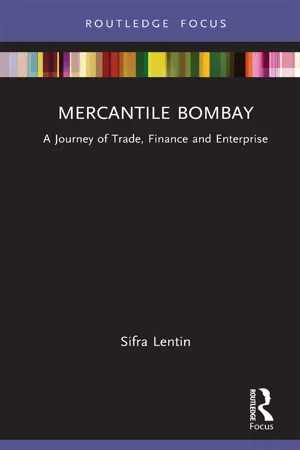
This volume reclaims Mumbai's legacy as a global financial centre of the 19th to the first half of the 20th century. It shows how Mumbai, or erstwhile Bombay, once served as a central node in global networks of trade, finance, commercial institutions and most importantly trading communities. In doing so it highlights that this city more than any other Indian city still possesses all these virtuous elements making it an appropriate location for a financial special economic zone (SEZ) – an idea shelved temporarily.
The book explores how the city flourished in its heyday as a trading, financial, commercial and manufacturing hub in a globalised colonial world. While the city's importance as a nodal financial hub in the global economy ebbed post India's Independence and the Second World War, the multi-cultural city found renewed importance following the forex crisis of 1991. Institutions (the RBI, SEBI and State Bank of India headquarters), capacities, experiences, communities and talent centred in Mumbai revived its position, while managing the transition to a more open economy. Though Mumbai is not yet an international financial centre (financial SEZ) like London, New York, Dubai, Singapore, Hong Kong, this volume explores why it has all the essential elements to become one today, and looks at the city as a trading city, a global financial centre, and a city of enterprise.
An introspective read on India's financial capital, this volume will be essential for scholars and researchers of economics, business studies and commerce. It will be of great interest to policy makers, city-headquartered business houses, financial institutions and its people.
Trusted by 375,005 students
Access to over 1.5 million titles for a fair monthly price.
1 How Bombay became the confluence of commerce and culture
DOI 10.4324/9781003182894-1
Five hundred years ago, the seven islands of Bombay – Colaba & Old Woman’s Island, Bombay, Worli, Parel, Mahim, Mazagaon and Sion itself – till they were raised from the seas through reclamations, were non-descript, rocky outcrops separated from each other during low tide by shallow marshy creeks. The largest in this seven-island group was the H-shaped island of Bombay (locally known as Mumbaaiee after the Island’s patron goddess Mumbadevi). There was nothing to commend the islands as an attractive destination for trade, commerce and enterprise, except for the fact that it was located on an arterial Indian Ocean shipping route leading to the pepper coast of Malabar and beyond to the spice islands of South East Asia, and then onwards to the Far East – China and Japan. The same route on its westward trajectory would take you to the Persian Gulf region – with its ports of Muscat, Basra and Gombroon (Bandar Abbas) – the Red Sea ports and the coast of East Africa.
Though Bombay was geo-strategically well situated, it was only when the Islands were leased by the English Crown on 27 March 1668 to the world’s first joint stock company – the Governor and Company of Merchants of London trading into the East Indies1 (in short, the EEIC) that an effort was made to develop the islands expansive open sea, sheltered, harbour into a port city. The sole objective being the acceleration of English trade in the North Arabian Sea.
There were many reasons why the Islands were not viewed favourably for development earlier, although Portuguese authorities in India did realise its potential, even if belatedly.
First, Bombay possessed an ‘open’ sea harbour, albeit a sheltered one sandwiched between its hilly eastern foreshore and the mainland. Smaller sailing ships with a shallow draught – a norm during the medieval and early modern period – favoured the shelter provided by riverine harbours especially during the monsoon months. Its harbour anchorages were known for centuries to local and intra-Asian shipping. The foremost port in the vicinity of Bombay was the medieval Mughal port of Surat on the River Tapi.2 It was only when the construction of larger sailing ships with a deeper draught became the norm, that the advantages of Bombay’s sheltered open sea harbour drew the attention of the Surat factors (merchants) of the EEIC. Their reason was simple. Bombay had the advantage of proximity to as well as relative distance from – the contentious politics and security issues in – the port city of Surat. This made it an ideal location for an auxiliary outpost, a fact pointed out by the EEIC Surat council as early as 1652 in a letter to the then British head of state Oliver Cromwell.
Second, the Islands faced insurmountable geo-economic challenges. It did not possess a hinterland – a prerequisite for any port city. A hinterland performs two functions: it is a source of surplus exportable goods and commodities, and it is a market for imports. The lack of a productive hinterland under its control and sphere of political influence was a practical difficulty Bombay faced. Bombay islands in 1665 – when the English expeditionary force wrested control of them from the Portuguese – were located at the remote southern tip of a larger and more productive island, Salsette (Sashti).
Salsette was not only controlled by the adversarial Portuguese but it also was traditionally a source of basic supplies – like milch livestock – for Bombay. Unlike Portuguese-occupied Salsette, Bombay islands did not produce any saleable surplus besides dried fish, salt, coconuts and coir. Salsette was also for centuries Bombay’s linkage with land and sea-based trading routes. Since ancient times, the ports of Salsette, one of them Thana (famous for its Roman trade dating to the 4th century), were the terminal points of the southern branch of the ancient Silk Route.
Third, and related to Bombay’s hinterland challenges, was that the H-shaped island of Bombay was not a secure location for a port as it was notorious as a ‘pirate’s isle’. The islands – a part of an archipelago of 25 islands referred to by Ptolemy in the 1st century as Heptanesia – were located on the North Konkan Coast, a region that suffered from endemic piracy. Piracy on the Subcontinent’s west coast was suppressed by colonial navies only as late as the early 19th century.
The only remnant in Bombay of this buccaneering past is Malabar Hill, among the most expensive real estate in the city today. Its name points to the hill’s history. This hill – a 280-foot basaltic formation fronting the open Arabian Sea – is named incongruently after the ‘original’ Malabar (coast),3 a region hundreds of kilometres to its south and once notorious as home to the Malabar pirates. During the 9th –13th centuries, when the islands were ruled by the Silāharā chieftains of the Konkan, the famous Venetian merchant traveller Marco Polo4 wrote in his The Travels of Marco Polo of the `sea-robbers and corsairs’ in Bombay harbour at the close of the 13th century. The account that quotes Marco Polo specifically refers to Malabar Hill: `one of the many bands of pirates who harassed the coast-trade from Gujarat southwards and later gave their name to the hill and promontory of our island’ (Edwardes 1909).
Bombay was because of the aforementioned reasons an untenable location for a port city. This fact is borne out by history too. It took close to 100 years for the city to become a viable alternative to the Mughal port of Surat – in spite of Surat’s irreversible decline after the death of Mughal Emperor Aurangzeb in 1707.
But Bombay’s time had arrived. A key foundational event in Bombay’s geo-strategic and political history was the shifting of the Company’s naval force from Surat to Bombay in 1687 – also the year when Bombay became the headquarters of the Company on the Subcontinent’s west coast.
This move was triggered by insecurity at Surat and the political harassment of the Company’s trade and merchants there. But it proved a fortuitous one. It gave the new governor and council at Bombay an opportunity to establish maritime domain control and awareness not only of Bombay’s territorial seas but also in littoral regions overseas. It was this EEIC navy – renamed the Bombay Marine in 1687 itself – which through its many subsequent avatars as the Indian Navy, Royal Indian Navy,5 Royal Indian Marine, independent India’s Indian Navy, and finally India’s Western Fleet (still headquartered in Mumbai) not just protected Bombay and its trade BUT also projected the city’s naval power overseas and acted as a bridgehead for territorial expansion. It is to the early successes of the Bombay Marine before it began recruiting in the early 19th century the very same locals from the North Konkan Coast it had once fought, that one sees Bombay the global port and international financial and commercial city taking shape (Figure 1.1).
Figure1.1 An early 18th C map of Bombay and the harbour islands.
Source: From the collection of Jehangir Sorabjee.
The Bombay Marine: security, armed diplomacy and territorial acquisitions
The Bombay Marine and its hydrographic surveys of the Arabian Sea can be largely credited with the increasing sphere of influence and territory of the Presidency of Bombay (1708–1936).6 The city was designated in 1708 as the capital of a presidency named after it – which brought all the Company’s outposts on the subcontinent’s west coast under its purview. This made its governor and council answerable only to the Court of Directors in London, but only initially. In 1773, the Presidency of Bombay was subordinated to Bengal.7
It was the city’s Bombay Marine that established and secured the EEIC’s interests not only on the subcontinent’s west coast but often on its east coast too, making it the Company’s primary naval force. It often teamed up with the Royal Navy on major expeditions and anti-slavery and anti-piracy patrols in the Indian Ocean. This naval force traces its roots to the original marine service consisting of a squadron of four ships – Dragon, Hoseander, James and Solomon – that voyaged from England to Surat under the command of Captain Thomas Best to establish an English factory (a trading establishment in a foreign port) in Surat.
This Squadron arrived on 5 September 1612, which is regarded as the founding date of the Bombay Marine. Earlier attempts had been made by the Company – from 1601 to 1608 – to establish a factory at Surat but they failed because of Portuguese naval resistance at Surat.
In a naval battle at Swally – downriver from Surat – in 1612, the English squadron finally overcame the Portuguese fleet to establish English naval supremacy, at least for the time being. This victory enabled Sir Thomas Roe’s mission of 1615–1618, envoy of King James II, to make his way to Delhi to acquire the Mughal Emperor’s firman for trading privileges. In its early years, the Bombay Marine’s main duties revolved around securing the trade of the EEIC against the dangers of piracy and attacks by other local rulers and European competitors, like the Portuguese, the Dutch and the French.
It was only after its headquarters were relocated to Bombay, did the role of the Bombay Marine evolve and become more calibrated. Due to the compulsions of trade in these early years, the Company had to use the Bombay Marine to secure its political and economic interests especially in regions like Kutch, Kathiawar, Gulf of Cambay (Khambhat), Canara, Malabar and the Gulf, from where it sourced its goods.
The Marine proved effective – as a naval fleet with a corps of soldiers who could fight on land and sea. They packed the hardest punch with the minimum number of men. This was a difficult feat to achieve, given the endemic disciplinary problems this Marine force faced. The officers as well as sailors of the Marine were regularly recruited from England – a motley group, many of who had been released from jails in England and given their freedom after they promised to serve in the Bombay Marine. No one else was willing to serve in Bombay preferring Calcutta, as the lifetime of an Englishman here was often no more than two monsoons. A large number of recruits were also renegades from English and European merchant vessels. All this translated into problems like drunkenness, fights and unruliness in the numerous taverns in the fortified town of Bombay. Despite the waywardness of its crews in the 17th and 18th centuries, the Marine played a critical role in securing and expanding the trade, territories and influence of this city.
Staking out territorial seas: mare liberum versus mare clausum
Most contemporary historians agree that piracy in the Indian Ocean region was a vocation that most coastal communities took to, often with the explicit support of their chief or king. This was the case with most, so called, piratical people, whether the fierce Malabar pirates who owed their loyalty to the Zamorin of Calicut or the various bands of Kutch pirates, the Vaddellas and Sungannas, the Sanganians of Beyt and Dwarka, the Koli rovers of Gujarat, the Warrals of Diu and Gogo (Gogha) all to the north of Bombay. To the south of the island the Mallwans (60 miles north of Goa), various Maratha coastal communities near Sawantwadi and Vengurla also took to piracy (Maloni 1992) (Biddulp n.d.). Then there were the Muscat Arabs and the Qawasim tribes of the Persian...
Table of contents
Cover
Half Title
Series Page
Title Page
Copyright Page
Dedication
Contents
List of figures
List of tables
Acknowledgements
Introduction
1 How Bombay became the confluence of commerce and culture
2 The port and the city
3 Migrants in the city and their overseas networks
4 Émigrés of the Bombay Presidency
5 Finance, desi and videshi
6 Mercantile and a multicultural city
Index
Frequently asked questions
Yes, you can cancel anytime from the Subscription tab in your account settings on the Perlego website. Your subscription will stay active until the end of your current billing period. Learn how to cancel your subscription
No, books cannot be downloaded as external files, such as PDFs, for use outside of Perlego. However, you can download books within the Perlego app for offline reading on mobile or tablet. Learn how to download books offline
Perlego offers two plans: Essential and Complete
Essential is ideal for learners and professionals who enjoy exploring a wide range of subjects. Access the Essential Library with 800,000+ trusted titles and best-sellers across business, personal growth, and the humanities. Includes unlimited reading time and Standard Read Aloud voice.
Complete: Perfect for advanced learners and researchers needing full, unrestricted access. Unlock 1.5M+ books across hundreds of subjects, including academic and specialized titles. The Complete Plan also includes advanced features like Premium Read Aloud and Research Assistant.
Both plans are available with monthly, semester, or annual billing cycles.
We are an online textbook subscription service, where you can get access to an entire online library for less than the price of a single book per month. With over 1.5 million books across 990+ topics, we’ve got you covered! Learn about our mission
Look out for the read-aloud symbol on your next book to see if you can listen to it. The read-aloud tool reads text aloud for you, highlighting the text as it is being read. You can pause it, speed it up and slow it down. Learn more about Read Aloud
Yes! You can use the Perlego app on both iOS and Android devices to read anytime, anywhere — even offline. Perfect for commutes or when you’re on the go. Please note we cannot support devices running on iOS 13 and Android 7 or earlier. Learn more about using the app
Yes, you can access Mercantile Bombay by Sifra Lentin in PDF and/or ePUB format, as well as other popular books in Economics & Business General. We have over 1.5 million books available in our catalogue for you to explore.