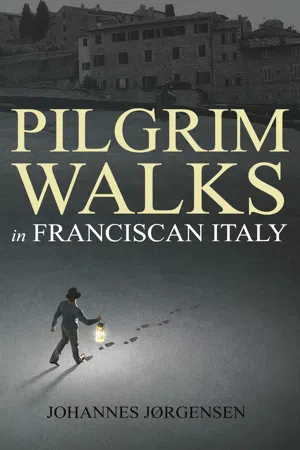
Johannes Jørgensen was nominated for the Nobel Prize in Literature FIVE times, in this book he takes you along the journey which converted him to Catholicism.Jørgensen's sublime sense of language, lively description, and first person narrative puts you in his perspective while he traveled through Italy. As you read, you'll be drawn into the pages and teleported to the Basilica of San Francesco d'Assisi, to the holy Mount Alverna, and to the monasteries of Greccio. "The fairest region of fair Italy, hallowed by the footsteps of the saint, rich in historical and legendary lore."The book puts you in a divine spiritual state while you witness "the beautiful prayer which St Francis wrote two years before his death" and "the mystic crucifixion on La Verna.""I think I may say that in the course of my life I have met with much that was out of the common and affecting, yet scarcely ever with anything that impressed me so profoundly as those minutes."
- 64 pages
- English
- ePUB (mobile friendly)
- Available on iOS & Android
eBook - ePub
Pilgrim Walks in Franciscan Italy
About this book
Trusted by 375,005 students
Access to over 1.5 million titles for a fair monthly price.
Study more efficiently using our study tools.
Information
Topic
Theology & ReligionSubtopic
Christian DenominationsIII
Fonte Colombo : La Foresta :
A Sabine Festival
In the afternoon of the day on which my visit to Greccio ended, I started on a fresh pilgrimage, my destination being the monastery of Monte, or Fonte Colombo. The mountain was originally known as Monte Rainerio, on account of the many clear, cold springs that take their rise there; but St Francis, foreseeing that a great number of his sons would draw water from those springs, called the place Fons Columbarum (Fount of Doves); and the monastery he founded there bears that name to this day.
It was two o’clock when I passed out of the Porta Romana, in Rieti. At a short distance from the town I turned off to the right, following a road which led me first along the foot of high, barren, precipitous limestone rocks; then upward, over wooded heights, where blue anemones and purple violets grew in profusion between the tree trunks. I asked my way of different people, and gradually got higher up among the mountains. Soon I left hamlets and fields behind me. The way led over a barren space of pebbles and flint stones, and over wide, rough, rugged places; tiny rivulets, clear as crystal, welled out of the ground. The narrow, stony path ran along the verge of a deep gorge, at the bottom of which a mountain stream, swollen by the rain, was rushing noisily. On the other side of the gorge rose another mountain, clothed with forest; on its summit were buildings and a small bell tower. It was Fonte Colombo.
I walked on, following the path mechanically. The whole mountain overflowed now with clear, trickling streams. There was nothing for it but to wade through them. This was in very truth a mount of springs—Fonte Colombo!
I paused a moment and looked back. From the crest which I had reached I could see, far down below, the lesser crags, the verdure-clad plain intersected by white roads, the grey towers of Rieti; and behind Rieti, the lofty Abruzzi, partly shrouded in indigo-coloured clouds, partly glinting in sharply defined sunbeams. In the vast solitude, not a sound was to be heard except the gurgling of the stream at the foot of the declivity.
The road descended all the way to that stream, and then ascended again on the other side. A flight of steps out in the mountain-side somewhat facilitated the last steep ascent; and, after having walked continuously for two hours, I at last found myself standing before the convent, on a wide green space hedged round with box, in the centre of which was a wooden cross painted red—the Franciscan cross, such as one always sees in front of the houses of the Grey Friars.
I stood still for a few minutes to take breath and look about me. At the left of the monastery I descried a closed gate, which apparently takes to the rear of the building; over it is a Latin inscription—the words which Jehovah spoke to Moses out of the burning bush: “Put off the shoes from thy feet; for the place whereon thou standest is holy ground.” The impression made by the sight of these words was so forcible, so solemn, in the midst of this wild, desolate solitude, high up between the vast mountains, that I felt as if I must obey the command. Those who have travelled in mountainous regions will understand me; for there is something about the grandeur of the mountains which impresses one with a sense of the majesty and greatness of God more strongly than anything else in nature. No wonder that Francis of Assisi returned ever and anon to the mountain solitudes, to hold converse with the Almighty.
I had ample leisure to make these reflections; for although I rang the monastery bell repeatedly, I could not gain admittance. The Brothers must surely have been taking their siesta. At length, however, I heard the familiar sound of the wooden sandals on the flagstones. I rang again—rang loudly. In a few minutes I was seated in the refectory, taking some refreshment which the vivacious, smiling, young Father Guardian, Padre Giovanni da Greccio, offered me.
As soon as I had appeased my hunger, the Father Guardian proposed that we should visit the Sanctuarium, the hallowed spot where Francis prayed, fasted, and wrote the Rule. We passed through the door over which I had seen the inscription; a narrow path led alongside the monastery walk, on which the Stations of the Cross were erected; on the side overlooking the declivity, the path is protected by a low parapet.
We stopped first at a small Gothic chapel, said to be the oratory dedicated in honour of the Blessed Virgin, mentioned in the old chronicle; within it are the remains of some fresco paintings. We then descended, by some zigzag steps, to the hallowed spot itself. The steep rock hangs over the abyss. On a level with the tops of the trees—evergreen oaks, elms, and maples—which grow in the chasm below, are the entrances to two grottoes (the one inhabited formerly by Brother Leo, the other by St Francis), which reach into the interior of the rock.
A wooden balcony projecting over the abyss leads into St Francis’ hermitage. First comes a small chapel, one side of which is the live rock. A strong stone wall of rough masonry protects the narrow ledge of rock which constituted the Saint’s sleeping place. A trapdoor in the ground conducts down to his oratory—his most private, secret chamber. It is simply a chasm in the rock, open at both ends, and so narrow that one touches both walls at every movement.
The farther end opens out upon the valley; the declivity is abrupt and precipitous, till the mountain-side is lost to sight in the depths of the forest below. Almost involuntarily one keeps still in this place, the solemn silence of the solitude is so impressive. We stood there motionless for some time. Outside, the wind roared in the forest; one heard the river rushing below, and the splash of the falling rain—the same three voices which Francis heard during the nights and days he spent there in solitary prayer, nearly seven hundred years ago.
We ascended again to the convent, and the Father Guardian locked the door through which we passed. Pointing to the words above it, he said with a smile: “Pope Sixtus IV. obeyed that admonition literally. He was a Franciscan himself, so to go barefoot was no novelty to him.”
Our visit to the grottoes in the rock took rather a long time; the afternoon sun, nearing the horizon, poured its golden light on the space before the house. Two white goats were feeding there; one of them went up to the Father Guardian, bleating gently, to be caressed.
After night prayers and supper, I took my seat with the four Fathers of the monastery for the accustomed hour of recreation. It seems not to be the custom here, as at Greccio, to assemble round the fire, but in the Father Guardian’s cell. It was a good-sized room, and there was space for us all. The monastery of Fonte Colombo is on a much a larger scale than that of Greccio; for it is one of the novitiates of the Order. I saw the novices while we were at supper, sitting by the old brown walls of the refectory, in two long rows, their eyes piously cast down. What nice faces they had! I looked at them well as they passed out, two and two together, close to where I was sitting. What youthful purity and innocence!
The evening passed in conversation with the Fathers. When ten o’clock struck, I was alone in my room. It was a dark night; white, lustreless clouds hung over the mountains. Not a sound was heard but the gurgle of the stream in the ravine below.
Part of the following morning was passed indoors, studying one of the vellum-bound books in which Sabatier writes of the “Poverello,” the Poor Man of Assisi. Later on, I was out of doors, under the fairest of skies enjoying the bright sunshine, watching the shadows of the clouds as they flitted over the limestone rocks, deepening the already dark shades of the woods on the mountain-side—the only sombre spots in the landscape. In the far distance, I could descry the belfry of the town of Greccio; and yet farther away, the white walls of its solitary monastery. Meanwhile I was sitting with my back against a huge block of moss-grown rock. About me forget-me-nots and anemones rose out of the moss and turf. On the summits of the mountains was the glitter of freshly fallen snow, yet where I was sitting the sun was almost hot.
In the afternoon I again visited St Francis’ Grotto in the company of all the inmates of the monastery. It was Saturday, and it is the custom at Fonte Colombo on that day, shortly before sunset, to commemorate “the passing away of St Francis.”
In remembrance of his last hour, we all—Old and young, Fathers and novices, lay-brothers, and myself, a stranger—went from the church to the little chapel over St Francis’ rocky cell. Two and two the long line of brown-habited figures filed along the path beside the monastery wall, and descended the long flight of steps. The Father Guardian was immediately in front of me; with his clear, powerful voice he led the singing, which was taken up by the strong young voices. The melody was a peculiar one—at the same time mournful and jubilant. The Latin words were very simple.
At length we reached the sanctuary. It was completely filled, as was also the Wooden gallery before it. Everyone knelt. Presently, amid dead silence, while the wind whispered in the tops of the trees in the glen below, the Father Guardian raised his voice, pronouncing every word distinctly and carefully, as if no syllable must be lost: “Voce mea ad Dominum clamavi.” It was the same psalm that Francis recited on his deathbed. The Brothers responded, reciting the verses alternately with the Guardian. After the last verse. “Me expectant justi,” solemn, impressive silence again prevailed, until the voices of all present joined in chanting the beautiful antiphon in honour of St Francis:
“Hail, holy Father, light of thy country, pattern of the Friars Minor, mirror of virtue, path of justice, rule of life, lead us from the exile of the body unto the kingdom of heaven!”
Then the procession filed back to the church, in the tranquil eventide, up the steps, alongside the wall, across the greensward, the whole scene flooded with the golden radiance of the setting sun. In the twilight of the church, where all knelt, the Litany of the Blessed Virgin was sung, concluding with the hymn of praise which long centuries ago the Franciscans were wont to recite in honour of the Immaculate Mother of God:
“Tota pulchra es, Maria,” chanted the deep voices from one side of the choir.
“Tota pulchra es, Maria,” responded the clear boyish voices on the other side. Thus each versicle is chanted to the end:
“Intercede pro nobis ad Dominum Jesum Christum.”
The next morning, which was Sunday, I arose at a very early hour. As I crossed the courtyard of the monastery on my way to the church, the paving-stones where still wet with the dew of night. I heard Mass amongst a crowd of peasants, whose countenances were like rough sketches, carved in wood, of the Fathers and novices, before the master-hand had begun to finish his work, to idealize and refine the features and expression.
At half-past nine, after standing for some time on the balcony before my room, gazing on the lovely view, I took my departure from Fonte Colombo. On the greensward outside the church and monastery, groups of peasants, who had come up for a later Mass, were sitting or standing about and chatting. The Father Guardian accompanied me a little way beyond the gate, and pointed out the distant goals of my next pilgrimages on the other side of the valley—there the Convent of La Foresta; and yonder, high up in the mountains, the lonely hermitage of Poggio Buscone.
Then I bade him farewell, and went on my way down the steep, stony paths into the valley, and up again on the opposite side. All round me the grey mountains rose; in the foreground was the glittering crest of Monte Terminillo, almost the highest in Italy. At a turn in the road, I looked back and cast a last glance at Fonte Colombo, with its monastery, which I had just left, perched on the highest peak of the thickly wooded mountain. The little bell turret stood out sharply against the sky. In the glen, the river flowed at the foot of the wood which surrounds the sanctuary, Il Bosco Sacro—“The Holy Wood,” as the people call it. The atmosphere was warm and soft. I was once more down in the valley, amongst the habitations of men.
The next goal of my pilgrimage was La Foresta, which is about five miles from Rieti, and situated in the midst of a beautiful, extensive forest of oaks and chestnuts. This hallowed spot was the scene of the famous miracle of the multiplication of the grapes. Thither I now directed my steps.
It was noontide; the sun was scorching; a hot haze rested on the mountains. I left the highroad and took a side-path, following the course of a mountain stream which had hollowed out a bed for itself deep down between high earth-banks. Then I went through a valley exposed to the full blaze of the noonday sun; in it were leafless oaks, and great masses of bluish rock projecting out of the red earth and green grass; the path was a continual ascent. Thinking I must have nearly reached my destination, I inquired of some labourers, and heard that it was still distant. The road winds round a mountain, affording extensive views over the plain. At last I met a kindly peasant who undertook to act as my guide.
The way now led through a forest of oak trees by the side of a sheltered, grass-grown slope. At a turn in the road my companion pointed out Poggio Buscone, a dark spot among the distant mountains. Presently the path grew less steep, and before long we came in sight of a low, much-dilapidated wall, behind which was the monastery of La Foresta.
Under the monastery porch I took lea...
Table of contents
- I Greccio
- II A Day in the Monastery
- III Fonte Colombo : La Foresta : A Sabine Festival
- IV Assisi
- V Cortona. On the Way to Mount Alverna
- VI The Holy Mountain
Frequently asked questions
Yes, you can cancel anytime from the Subscription tab in your account settings on the Perlego website. Your subscription will stay active until the end of your current billing period. Learn how to cancel your subscription
No, books cannot be downloaded as external files, such as PDFs, for use outside of Perlego. However, you can download books within the Perlego app for offline reading on mobile or tablet. Learn how to download books offline
Perlego offers two plans: Essential and Complete
- Essential is ideal for learners and professionals who enjoy exploring a wide range of subjects. Access the Essential Library with 800,000+ trusted titles and best-sellers across business, personal growth, and the humanities. Includes unlimited reading time and Standard Read Aloud voice.
- Complete: Perfect for advanced learners and researchers needing full, unrestricted access. Unlock 1.5M+ books across hundreds of subjects, including academic and specialized titles. The Complete Plan also includes advanced features like Premium Read Aloud and Research Assistant.
We are an online textbook subscription service, where you can get access to an entire online library for less than the price of a single book per month. With over 1.5 million books across 990+ topics, we’ve got you covered! Learn about our mission
Look out for the read-aloud symbol on your next book to see if you can listen to it. The read-aloud tool reads text aloud for you, highlighting the text as it is being read. You can pause it, speed it up and slow it down. Learn more about Read Aloud
Yes! You can use the Perlego app on both iOS and Android devices to read anytime, anywhere — even offline. Perfect for commutes or when you’re on the go.
Please note we cannot support devices running on iOS 13 and Android 7 or earlier. Learn more about using the app
Please note we cannot support devices running on iOS 13 and Android 7 or earlier. Learn more about using the app
Yes, you can access Pilgrim Walks in Franciscan Italy by Johannes Jørgensen in PDF and/or ePUB format, as well as other popular books in Theology & Religion & Christian Denominations. We have over 1.5 million books available in our catalogue for you to explore.