eBook - ePub
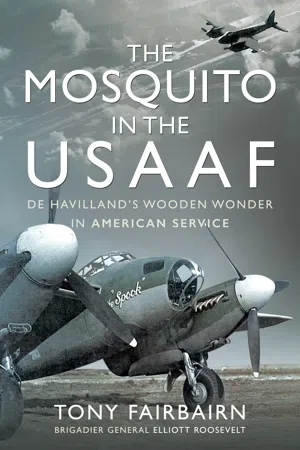
The Mosquito in the USAAF
De Havilland's Wooden Wonder in American Service
- 256 pages
- English
- ePUB (mobile friendly)
- Available on iOS & Android
eBook - ePub
About this book
This history of the US's British aircraft acquisition "examin[es] the role [the USSAF] played in reconnaissance, special operations, and night fighting." —
Air & Space Power History
On 20 April 1941, a group of distinguished Americans visited the de Havilland Aircraft Company's airfield at Hatfield, England. The party was there ostensibly to gain an insight into how various US aircraft supplied to Britain were performing, as well as to observe some of the latest British products being put through their paces. The eighteen types on display included both US and British bombers and fighters. But the star of the day was undoubtedly the de Havilland Mosquito.
Having first flown only a few months earlier, the aircraft was demonstrated by none other than Geoffrey de Havilland. Striving to impress the trans-Atlantic visitors, de Havilland provided an outstanding display of speed and manoeuvrability. It was a routine that left the Americans in no doubt as to the Mosquito's abilities.
Following America's entry into WWII, formal requests for Mosquitoes began in earnest. A steady flow of the photographic reconnaissance version were provided to what would become the USAAF's 25th Bomb Group at Watton, England. There they served with distinction in a variety of specialist roles. A number of these Mosquitoes served with the 492nd Bomb Group at Harrington and were involved in the so-called "Joan-Eleanor" project. Finally, in 1945, the USAAF received much-anticipated night fighter Mosquitoes which enjoyed combat success with the 416th Night Fighter Squadron in Italy.
In this highly illustrated work, the author explores the full story of why the Americans wanted Mosquitoes, how they went about obtaining them, and their noted success and popularity with USAAF units.
On 20 April 1941, a group of distinguished Americans visited the de Havilland Aircraft Company's airfield at Hatfield, England. The party was there ostensibly to gain an insight into how various US aircraft supplied to Britain were performing, as well as to observe some of the latest British products being put through their paces. The eighteen types on display included both US and British bombers and fighters. But the star of the day was undoubtedly the de Havilland Mosquito.
Having first flown only a few months earlier, the aircraft was demonstrated by none other than Geoffrey de Havilland. Striving to impress the trans-Atlantic visitors, de Havilland provided an outstanding display of speed and manoeuvrability. It was a routine that left the Americans in no doubt as to the Mosquito's abilities.
Following America's entry into WWII, formal requests for Mosquitoes began in earnest. A steady flow of the photographic reconnaissance version were provided to what would become the USAAF's 25th Bomb Group at Watton, England. There they served with distinction in a variety of specialist roles. A number of these Mosquitoes served with the 492nd Bomb Group at Harrington and were involved in the so-called "Joan-Eleanor" project. Finally, in 1945, the USAAF received much-anticipated night fighter Mosquitoes which enjoyed combat success with the 416th Night Fighter Squadron in Italy.
In this highly illustrated work, the author explores the full story of why the Americans wanted Mosquitoes, how they went about obtaining them, and their noted success and popularity with USAAF units.
Tools to learn more effectively

Saving Books

Keyword Search

Annotating Text

Listen to it instead
Information
Chapter 1
The Roosevelt Thread
Born in 1910, the son of the future President of the United States, Elliott Roosevelt’s (ER) military career has rightly been described as meteoric. Enlisting in the USAAC in 1940 as a captain, he left five years later as a brigadier general. He is a key figure – arguably the key figure – in the USAAF’s energetic quest for Mosquitoes in particular and for helping to shape that service’s forthcoming aerial reconnaissance policy and operations as a whole. Ironically, though, he began life in uniform as a humble procurement officer at Wright Field, Dayton, Ohio, the hub for Air Corps research, development and materiel. While there he met Maj. George Goddard, the Air Corps’ acknowledged expert in aerial photography. Goddard’s work impressed ER and probably marks the very start of his interest in reconnaissance throughout the war.
Active involvement in survey and reconnaissance work soon followed for ER and some years later he recalled the details of his assignment:
I was at Wright Field up until March of 1941, and then I was transferred over to Bolling Field [SE Washington, DC] for a special intelligence course under Captain Lauris Norstad, who is now one of the high-ranking generals in the Army, to serve as an intelligence officer of the 21st Reconnaissance Squadron, which had been assigned to Newfoundland to do anti-submarine patrols of the North Atlantic waters, and to guard our shipping lanes against German submarine activity. We arrived in Newfoundland and I received an additional assignment from Washington ordering me to take charge of all planning and execution of the survey of the North Atlantic possibilities for establishment of bases across the North Atlantic for the delivery of fighter and bomber aircraft to England.
Based at Gander with Douglas B-18 Bolos, the work took in Labrador, Iceland, Baffin Island (lying between Greenland and the Canadian mainland), and Greenland itself. ER’s name crops up in the survey of what would become a major transatlantic staging post – Goose Bay, Labrador – recommendations for the construction of which were passed to the Canadian Government in August 1941. Of his time in what he termed ‘woebegone’ Newfoundland he added:
I was required to learn by the hardest way, which was through the taking of photographs of the terrain and the establishment of whether that terrain would be satisfactory for bases, and after the pictures were developed then we had to go back and go ashore from PBY aircraft and land on those areas and survey them on foot. That was my first contact with photographic survey work.
During his time in Newfoundland the crucial part played by the weather and its forecasting in the movement of transatlantic air and sea traffic stood him in good stead when some three years later he would command weather reconnaissance units. A survey flight to East Greenland in August 1941 was ER’s last task and in September the 21st Recon Sqn returned to the USA.
Back on home soil, ER received orders to attend a navigation course at Kelly Field on 10 September, followed by an aerial navigation course at Brooks Field, both in Texas. Later in the year, on 15 December, he was posted to the 6th Recon Sqn at Muroc Dry Lake, California, flying B-18 Bolos. He describes subsequent events:
Until late in January [1942], I served first with the 6th and then the 2nd [Recon Sqns] then, unexpectedly, secret orders came through directing that I report to the commander of the 1st Mapping Group at Bolling Field in Washington. There was so much secrecy surrounding my orders and the nature of my future assignment, that my hopes were really soaring. Must be something big and important. Surely some sort of overseas assignment …
He was certainly correct about the location of his next assignment.
Before setting off on his new appointment ER had a chance, or perhaps engineered, encounter with a certain Col Dwight Eisenhower, then chief of staff of the Sixth Army in Texas, but who in November 1942 would be appointed Supreme Commander Allied Expeditionary Force, North African Theatre. Eisenhower asked ER to visit him and took a keen interest in the latter’s survey work in the frozen north. It would not be long before their paths crossed on the African continent.
Meanwhile, in February 1942, ER’s work with the 1st Mapping Gp turned out to be the Special Reconnaissance Mission to Africa. ‘I was due off to North Africa, one of two navigators assigned to the photographic mapping of the terrain as part of something identified as Project RUSTY,’ he later recalled. The assignment was a sensible use of the experience he had gained in Newfoundland and would occupy him from March until May 1942.
The objectives of Project Rusty were summarised in an Air Staff memo for General Arnold dated 28 April 1942:
The object of the RUSTY project is photographic reconnaissance of the Cape Verde Islands, Dakar, and the French West African coast. Its base is at ACCRA [on the British Gold Coast, now Ghana] and its present equipment consists of one B-17B which is not in operational condition. The Director of Photography has suggested to Col Cullen, Commanding Officer of RUSTY, that P-38s be sent to ACCRA for his use. This proposal is replied to unfavourably … and request is made that three pilots from the 7th Photographic Squadron be flown to ACCRA with planes to follow as soon as possible.
No P-38s were authorised (the 7th Photo Sqn was an operational training unit at Colorado Springs) but two specially modified B-17s were allotted to the project and George Goddard describes their equipment and their work:
They were stripped down and equipped with the latest navigational aids and three wide angle mapping cameras locked together to form a single tri-lens camera. Under suitable weather conditions, Elliott’s expedition could make photographic strips from horizon to horizon for hundreds of miles in a day. And they did just that, although one of the B-17s disappeared on a flight between Puerto Rico and Trinidad and was never found. The other, with Elliott on board, went on down the coast of South America to Natal, Brazil, then across the ocean to Liberia. From there they spanned the African continent.
Conditions for aerial survey in Africa for the B-17 (nicknamed Blue Goose because of its colour scheme) proved challenging ‘owing to inaccurate maps, poor weather data and low visibility’ stated a classified project report back to Gen. Arnold in Washington. Blue Goose was worked hard and did fine work until damaged beyond repair in a crash landing. Despite losing two aircraft, Rusty was rated a success and in April ER could celebrate his promotion to major.
Returning to the USA in early summer 1942, ER spent some recovering from amoebic dysentery contracted in Africa, but on 11 July he took over command of the 3rd Photographic Group from Maj. Harry Eidson, equipped with F-4 and F-5 Lightnings, at Colorado Springs, and earmarked for overseas operations. The group comprised the 5th, 12th, 13th, 14th and 15th PR Sqns, the latter with B-17s. In August the group began moving to England, calling first at Membury, Berkshire, and then consolidating at Steeple Morden, Cambridgeshire. Here the group split up, the 13th and 14th Sqns remaining in England (Mount Farm, then Chalgrove) for the rest of the war while the 5th, 12th and 15th Sqns flew out to North Africa via Gibraltar over the period late November–early December. ER’s 3rd Photo Gp was officially located at La Senia, Algeria, on 10 December 1942. On Christmas Day 1942 a move was made to Algiers, where the unit would remain for six months. Assigned to the 12th Air Force, the group followed closely in the footsteps of the Operation Torch landings of 8 November. It would also undergo some changes of designation, as follows:

B-17 41-24440 I Got Spurs of 15th Recon & Mapping Sqn, 3rd Photo Gp. (AAM)
May 43 – 3rd Photographic Reconnaissance & Mapping Group
Nov 43 – 3rd Photographic Group (Reconnaissance)
May 45 – 3rd Reconnaissance Group
While in North Africa the group provided photographic intelligence in support of the campaigns for Tunisia, Pantelleria, Sardinia and Sicily. Between November 1942 and the ending of the North African campaign in May 1943 ER’s Group lost five F-4s to enemy action.
At this point it is timely to introduce ER’s initial ‘hands on’ experience of the Mosquito. In his foreword to this book he claims to have taken delivery of one at Benson and flown it to Algiers after Operation Torch. He goes on to say that a second machine was delivered to him in North Africa that was subsequently used for PR missions in the months leading up to the invasion of Italy. Sharp and Bowyer in Mosquito state that in May 1943: ‘A Mk IV was in American hands at Algiers, and on its nose was inscribed “Pilot – Colonel Roosevelt”. The President’s son thought very highly of the aeroplane, but it was dogged by engine trouble. Another Mk IV in American hands was lost on a flight to Britain for major overhaul.’ Unfortunately, it is difficult to be precise about which airframes ER had access to but there are one or two clues. The record card for DZ368 states: ‘Mk IV, taken on charge by USAAF 6.11.42. Preparation for USAAF via Benson, Cat “E” 20.5.43’.

B-17 41-24440 of 15th Recon & Mapping Sqn. Nickname has been altered from I Got Spurs to I Had Spurs. Behind is a P-38/F-4 Lightning. (usmilitariaforum)
Chris Hansen, ER’s biographer, says that the 5th PRS Lightnings and 15th Mapping Sqn’s Flying Fortresses:
were augmented by a single Mosquito Mk IV that Elliott Roosevelt and Harry Eidson (crewing as pilot) borrowed from the RAF in Gibraltar on the way. There were three on the peninsula, and it seems remarkable that Elliott was able to finagle one without worrying excessively about transition training or other finer points. Elliott and Eidson used that Mosquito to fly the first three missions over hostile territory – the Lightnings were having trouble getting established. Roosevelt said later that Eidson was the first pilot to survive five missions, and the sortie list suggests most of these were flown with Roosevelt in the borrowed Mosquito during November and December. The Mosquito ‘proved itself wonderful for the work it was to do’ and so began Roosevelt’s long quest for more.’
Other references say that the 3rd Photo Gp ‘carried out some intensive survey work over the Sardinian coastline in January 1943 with two PR Mosquitoes borrowed from the 544 Sqn detachment at Gibraltar. Despite appeals from 544 Sqn for the return of their aircraft, the US 3rd Photo Gp held on to them throughout the winter. ER let it be known that he would willingly exchange his Lockheed Lightnings for PR Mosquitoes.’ This is all quite possible because 544 Sqn certainly had a Gibraltar detachment from October 1942 onwards, but pinpointing which individual aircraft were involved is elusive.
From the time of the Torch landings in November 1942 and the surrender of the Axis forces in May 1943 there were five USAAF P-38 Groups operating in North Africa, three in the fighter role (1st, 14th and 82nd) and two (ER’s 3rd and 5th) on photo reconnaissance work. Initially things did not go well for the Lightnings and historian Jerry Scutts describes the situation at the end of January 1943 when the 14th FG was withdrawn from combat for a rest and retraini...
Table of contents
- Cover
- Title
- Copyright
- Contents
- Foreword
- Author’s Note
- Chapter 1: The Roosevelt Thread
- Chapter 2: 25th Bombardment Group
- Chapter 3: 416th Night Fighter Squadron
- Chapter 4: 492nd Bombardment Group
- Chapter 5: The F-8 Saga
- Chapter 6: Mosquitoes with the US Navy
- Chapter 7: Postscript
- Ex-USAAF Mosquito PR.XVIs for the Royal Navy
- A Mosquito for the National Museum of the USAF
- Acknowledgements
- Abbreviations & Glossary
- Sources
- Appendix A: Serial Numbers of UK-Built USAAF Mosquitoes
- Appendix B: Serial Numbers of Canadian-Built USAAF (F-8) Mosquitoes
- Appendix C: Operational Losses of USAAF Mosquitoes in the Second World War
- Appendix D: Chronology of USAAF Mosquitoes
- Milestones of Operational Events
Frequently asked questions
Yes, you can cancel anytime from the Subscription tab in your account settings on the Perlego website. Your subscription will stay active until the end of your current billing period. Learn how to cancel your subscription
No, books cannot be downloaded as external files, such as PDFs, for use outside of Perlego. However, you can download books within the Perlego app for offline reading on mobile or tablet. Learn how to download books offline
Perlego offers two plans: Essential and Complete
- Essential is ideal for learners and professionals who enjoy exploring a wide range of subjects. Access the Essential Library with 800,000+ trusted titles and best-sellers across business, personal growth, and the humanities. Includes unlimited reading time and Standard Read Aloud voice.
- Complete: Perfect for advanced learners and researchers needing full, unrestricted access. Unlock 1.4M+ books across hundreds of subjects, including academic and specialized titles. The Complete Plan also includes advanced features like Premium Read Aloud and Research Assistant.
We are an online textbook subscription service, where you can get access to an entire online library for less than the price of a single book per month. With over 1 million books across 990+ topics, we’ve got you covered! Learn about our mission
Look out for the read-aloud symbol on your next book to see if you can listen to it. The read-aloud tool reads text aloud for you, highlighting the text as it is being read. You can pause it, speed it up and slow it down. Learn more about Read Aloud
Yes! You can use the Perlego app on both iOS and Android devices to read anytime, anywhere — even offline. Perfect for commutes or when you’re on the go.
Please note we cannot support devices running on iOS 13 and Android 7 or earlier. Learn more about using the app
Please note we cannot support devices running on iOS 13 and Android 7 or earlier. Learn more about using the app
Yes, you can access The Mosquito in the USAAF by Tony Fairbairn in PDF and/or ePUB format, as well as other popular books in History & 20th Century History. We have over one million books available in our catalogue for you to explore.