The Encyclopedia of Confederate Generals
eBook - ePub

The Encyclopedia of Confederate Generals

The Definitive Guide to the 426 Leaders of the South's War Effort

  1. 800 pages
  2. English
  3. ePUB (mobile friendly)
  4. Available on iOS & Android
eBook - ePub

The Encyclopedia of Confederate Generals

The Definitive Guide to the 426 Leaders of the South's War Effort

About this book

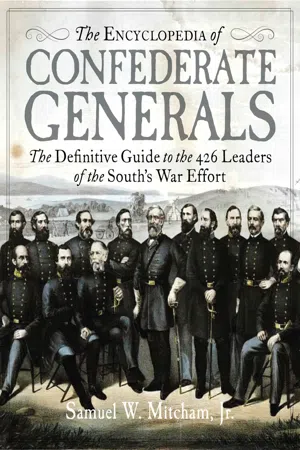
A renown military historian and frequent television commenter brings to life the generalship of the South during the Civil War in sparkling, information-filled vignettes. For both the Civil War completist and the general reader! Anyone acquainted with the American Civil War will readily recognize the names of the Confederacy's most prominent generals. Robert E. Lee. Stonewall Jackson. James Longstreet. These men have long been lionized as fearless commanders and genius tacticians. Yet few have heard of the hundreds of generals who led under and alongside them. Men whose battlefield resolve spurred the Confederacy through four years of the bloodiest combat Americans have ever faced. In The Encyclopedia of Confederate Generals, veteran Civil War historian, Samuel W. Mitcham, documents the lives of every Confederate general from birth to death, highlighting their unique contributions to the battlefield and bringing their personal triumphs and tragedies to life. Packed with photos and historical briefings, The Encyclopedia of Confederate Generals belongs on the shelf of every Civil War historian, and preserves in words the legacies once carved in stone.
Frequently asked questions

Yes, you can cancel anytime from the Subscription tab in your account settings on the Perlego website. Your subscription will stay active until the end of your current billing period. Learn how to cancel your subscription.
No, books cannot be downloaded as external files, such as PDFs, for use outside of Perlego. However, you can download books within the Perlego app for offline reading on mobile or tablet. Learn more here.
Perlego offers two plans: Essential and Complete
  • Essential is ideal for learners and professionals who enjoy exploring a wide range of subjects. Access the Essential Library with 800,000+ trusted titles and best-sellers across business, personal growth, and the humanities. Includes unlimited reading time and Standard Read Aloud voice.
  • Complete: Perfect for advanced learners and researchers needing full, unrestricted access. Unlock 1.4M+ books across hundreds of subjects, including academic and specialized titles. The Complete Plan also includes advanced features like Premium Read Aloud and Research Assistant.
Both plans are available with monthly, semester, or annual billing cycles.
We are an online textbook subscription service, where you can get access to an entire online library for less than the price of a single book per month. With over 1 million books across 1000+ topics, we’ve got you covered! Learn more here.
Look out for the read-aloud symbol on your next book to see if you can listen to it. The read-aloud tool reads text aloud for you, highlighting the text as it is being read. You can pause it, speed it up and slow it down. Learn more here.
Yes! You can use the Perlego app on both iOS or Android devices to read anytime, anywhere — even offline. Perfect for commutes or when you’re on the go.
Please note we cannot support devices running on iOS 13 and Android 7 or earlier. Learn more about using the app.
Yes, you can access The Encyclopedia of Confederate Generals by Samuel W. Mitcham in PDF and/or ePUB format, as well as other popular books in Histoire & Biographies militaires. We have over one million books available in our catalogue for you to explore.

Information

Image
Image
ISAAC MUNROE ST. JOHN was born in Augusta, Georgia, on November 19, 1827. His parents moved to New York City when he was a child, and he was educated at the Poughkeepsie Collegiate School and Yale University, from which he graduated in 1845. He became a lawyer, a newspaper editor, and a civil engineer with the Baltimore and Ohio (B&O) Railroad from 1848 to 1855. He relocated to South Carolina and from 1855 to 1861 and was chief construction engineer for the Blue Ridge Railroad Company.
When the war began, St. John cast his lot with the South. He enlisted in the Fort Hill Guards of South Carolina in April 1861. By October, he was an engineer in General John B. Magruder’s Army of the Peninsula. He was Magruder’s chief engineer during the Siege of Yorktown (1862) until April 18, when he was named chief of the Nitre Bureau (later the Nitre and Mining Corps). Nitre (or niter) is the mineral form of potassium nitrate, also known as saltpeter, and is a critical ingredient in the manufacture of gunpowder. St. John proved to be highly efficient at producing this vital substance, as well as other metals and supplies necessary to the Southern war effort. As the Union blockade tightened, St. John discovered that the limestone caves in the southern Appalachian Mountains contained saltpeter. It could thus be said that he outflanked the Northern blockade. Naturally, this led to promotions: to major of artillery (September 26, 1862), lieutenant colonel (May 26, 1863), and colonel (June 15, 1864).
On February 15, 1865, the Confederate House of Representatives officially called for the removal of Lucius Northrop from his post as commissary general for subsistence, and President Davis finally accepted his resignation. The next day, by a special vote, Congress gave the post to St. John, along with a promotion to brigadier general, to date from February 14, 1865. Lucius Northrop had done a miserable job, but Isaac St. John’s appointment came too late to make any difference for the survival of the Confederacy. He surrendered in Thomasville, Georgia, on or about June 1, 1865.
After the war, he worked as a civil engineer, mainly for railroads. Brigadier General Isaac M. St. John, a brilliant engineer and staff officer, died on April 7, 1880, at White Sulphur Springs, West Virginia. He was fifty-two. He is buried in Hollywood Cemetery, Richmond.
Image
JOHN CALDWELL CALHOUN SANDERS (his name is occasionally misspelled as “Saunders”) was born in Tuscaloosa, Alabama, on April 4, 1840, and grew up in Clinton, Alabama. In early 1861, after Alabama seceded, he left the University of Alabama, where he had been a student, to join the Confederate Guards, which later became Company E of the 11th Alabama Infantry Regiment. Sanders was elected captain of the company on June 11, 1861.
The 11th Alabama fought in the Battle of Seven Pines and the Seven Days Battles, including at Frayser’s Farm (June 30), where Captain Sanders was wounded in the leg by a shell fragment. When he returned to duty on August 11, he was the senior surviving officer. He assumed command of the regiment and led it at the Battle of Second Manassas. He was promoted to colonel on September 11, 1862.
Sanders fought at the Siege of Harpers Ferry and the battles of Sharpsburg, Fredericksburg, Chancellorsville, and Gettysburg, where he was wounded in the knee by a minié ball. After he recovered, he served as acting commander of Abner Perrin’s brigade in the Bristoe and Mine Run campaigns and then resumed his role as commander of the 11th Alabama in the spring of 1864.
Sanders led his regiment during the Overland Campaign of 1864 until General Perrin was killed at Spotsylvania on May 12. Sanders again assumed command of the brigade. He was promoted to brigadier general (temporary rank) on May 31. A competent brigade commander, he performed satisfactorily at the Battle of Cold Harbor and the Siege of Petersburg.
On August 21, while leading an attack along during the Battle of Globe Tavern, a minié ball ripped through his thighs, severing both femoral arteries. He calmly ordered his adjutant to take him to the rear. He bled to death within a few minutes. John C. C. Sanders was twenty-four years old.
The Alabamians were saddened by his loss. “He was stern but kind,” one of them recalled, “and always looked after the comfort and safety of his men, and as the war progressed he grew continually in their estimation.” He was also known to have a sterling moral character.
Sanders’s body was initially interred in a vault in Hollywood Cemetery, Richmond, Virginia. Eventually his family took him back to Alabama and buried him in Greenwood Cemetery, Montgomery. The exact location of his body has been lost, although a granite marker to his memory was erected in the cemetery in 1971.
Image
ALFRED MOORE SCALES was born on November 26, 1827, in Reidsville, North Carolina, the son of a medical doctor. He was educated at a boys’ preparatory school and the University of North Carolina at Chapel Hill, where he studied law. He was admitted to the bar in 1852 and in the 1850s was twice elected to the North Carolina House of Representatives and once to the U.S. Congress. He then worked as clerk of the court of equity of Rockingham County and was a presidential elector for John C. Breckinridge in 1860.
Five days after President Abraham Lincoln called for seventy-five thousand troops to suppress the “rebellion,” Scales enlisted in the Rockingham Guards as a private. The Guards became Company H of the 13th North Carolina Troops on April 30, and they elected Scales their captain. North Carolina seceded on May 20, 1861, and the regiment was soon on its way to Virginia. He became a colonel and commander of the regiment on November 14, 1861. The 13th North Carolina fought on the Virginia Peninsula and in the Seven Days Battles. Scales demonstrated great courage, and on the last day of the Seven Days Battles, he collapsed from exhaustion and almost died. It took him months to recover.
Colonel Scales returned to his regiment in November 1862 and fought at the battles of Fredericksburg and Chancellorsville, where the regiment formed part of Stonewall Jackson’s famous flanking attack and suffered 216 casualties out of about 500 engaged. One of them was Scales, who was shot through the thigh but kept on advancing until he collapsed from a loss of blood.
On June 13, 1863, while still home on medical leave, Alfred Scales was promoted to brigadier general. At Gettysburg, he led William Dorsey Pender’s former brigade (Pender having been promoted to division command) and on July 1 was severely wounded on Seminary Ridge by a shell fragment. He was evacuated to Virginia in the same ambulance that carried the wounded Dorsey Pender.
After Scales recovered from his latest wound, he rejoined the Army of Northern Virginia and fought in the Overland Campaign and the Siege of Petersburg. One of his old wounds acted up in 1865, and he took a leave of absence to let it heal. He was at home in North Carolina when Lee surrendered. He apparently was never paroled, but he did apply for amnesty on June 22, 1865, and was pardoned on June 18, 1866.
Scales returned to his law practice and was very successful. In 1874, he was elected to Congress and was reelected four times, serving from March 4, 1875, to December 30, 1884, when he resigned because he was elected governor of North Carolina.
Scales was governor from 1885 to 1889. His term was rather uneventful. His health was not good after his term expired. He spent his remaining years living in Greensboro, where he was president of Piedmont Bank. He also served as an elder in the First Presbyterian Church of Greensboro.
General Alfred M. Scales died in Greensboro, North Carolina, on February 8, 1892, at age sixty-four. He was buried in Green Hill Cemetery, Greensboro.
Image
THOMAS MOORE SCOTT was born in Athens, Georgia, in 1829. Little is known of his early life and education, except that he lived in both Georgia and Louisiana.
In the late 1850s, Scott was a farmer in Claiborne Parish, North Louisiana, near Homer. He joined the Claiborne Rangers in 1861 and was elected captain. The company left Homer on July 1, 1861, and underwent training at Camp Moore, Louisiana. The Rangers became part of the 12th Louisiana Infantry Regiment. Thomas Scott was elected colonel on August 13.
Initially, the 12th Louisiana was assigned to the defense of the Mississippi River. It first saw action at Island Number 10 near New Madrid, Missouri, during the bombardment of March 1862. It was then transferred to Fort Pillow. After operating against Grant in northern Mississippi, Scott and his men were transferred to Port Hudson in late 1862. They were assigned to William Loring’s division during the campaigns against Vicksburg and were cut off from the main army during the Battle of Champion Hill. Most of the regiment thus avoided being trapped in Vicksburg, although it lost its wagons during the escape. The 12th Louisiana was part of Joseph E. Johnston’s Army of Relief during the Siege of Vicksburg and at the Second Battle of Jackson.
During the fall and winter of 1863–64, Scott and his men remained in Mississippi. They were at Meridian in early 1864 and later retreated to Demopolis and Montevallo, Alabama. In the spring of 1864, Scott was ordered to Georgia, along with Leonidas Polk’s corps, for the Atlanta Campaign. Shortly after the start of Sherman’s drive on the city, Scott was promoted to brigade commander. His unit consisted of five Alabama regiments and his own 12th Louisiana, which suggests someone in authority (probably Joe Johnston) thought highly of him. He was promoted to brigadier general on May 10, 1864.
General Scott fought in the battles of Resaca, Marietta, Kennesaw Mountain, Lost Mountain, Bethel Church, and Atlanta. Casualties were high. After Atlanta fell on September 2, Scott accompanied General John Bell Hood into Tennessee. At Franklin, on November 30, 1864, he was one of seven seriously wounded Confederate generals; six others were killed.
Thomas M. Scott disappears from the record at this point. Apparently, he did not recover in time to see further action, and no record of his parole or pardon was found. After the war, he returned to Louisiana and became a sugar planter.
Scott’s wife died in New Orleans in 1866. After that, he took to drinking heavily and essentially drank himself to death. He died in Sample Coffee Shop in New Orleans on April 21, 1876.
General Thomas M. Scott was buried in Greenwood Cemetery, New Orleans. As of 2007, his tombstone (if there was one) was gone, and his burial site was just a pile of small rocks. He now (as of 2020, that is) has a Confederate headstone.
Image
WILLIAM READ “DIRTY NECK BILL” SCURRY was born in Gallatin, Sumner County, Tennessee, on February 10, 1821. He moved to Texas in 1839 and received a land grant in the San Augustine area. He was admitted to the bar in 1840 and became a district attorney the following year. He represented Red River County in the Congress of the Republic of Texas (1844–45), where he advocated Texas’s joining the Union.
In 1846, when the Mexican War broke out, he enlisted as a private in the 2nd Texas Mounted Rifle Regiment. Promoted to major on July 4, 1846, he distinguished himself in the Battle of Monterrey. After the war, he practiced law in Clinton, Texas, and was co-owner and editor of the Austin State Gazette, which he sold in 1854.
Scurry became a wealthy planter in the 1850s and owned dozens of slaves, but he came to view slavery as wrong. One night, he had an attack of conscience. He stayed up all night, pacing and debating with himself. The next morning, he freed his slaves—a tremendous material sacrifice for him, because they were worth more than a million dollars in today’s money.
Though now opposed to slavery, Scurry had become a pro-secession Democrat. That made him a political opponent of Sam Houston, who saddled Scurry with the nickname “Dirty Neck (or Dirty Shirt) Bill.” Bill Scurry was a member of the Texas Secession Convention and voted in favor of leaving the Union. In July 1861, he joined the Confederate Army as lieutenant colonel in the 4th Texas Cavalry. He distinguished himself in the New Mexico Campaign of 1861–62 and was de facto commander of the Confederate Army of New Mexico during the Battle of Glorieta Pass, where he was wounded but refused to leave the field. Scurry was promoted to full colonel effective March 28, 1862 and to brigadier general on September 12, 1862. He was sent to southeast Texas, where on January 1, 1863, he played a key role in helping General John B. Magruder recapture Galveston.
In October 1863, Scurry was named commander of the 3rd Brigade of John George Walker’s Texas Division, the Greyhounds. Captain E. P. Petty said of Scurry, “I am well pleased with him. He is a fighter and those who follow him will go to the Cannon’s mouth.”
General Scurry took part in the Red River Campaign and fought in the decisive victory at Mansfield, as well as at Pleasant Hill. After this, the Texas Division was sent north to deal with the U.S. VII Corps. On April 30, 1864, Confederate General Edmund Kirby Smith launched an ill-advised attack at Jenkins’ Ferry. General Scurry was wounded in the leg but refused to leave the field. Had he done so, surgeons might have been able to save his life, but Scurry was afraid that his absence would have a deleterious effect on the morale of his men. By the time he was taken to the rear, it was too late, and he died from a loss of blood. He was forty-three years old.
Scurry’s body was taken back to Texas and buried on Republic Hill in Texas State Cemetery, Austin, Texas, where the Lone Star State inters its heroes. Scurry County, Texas, is named in his honor.
Image
CLAUDIUS WISTAR SEARS was born in Peru, Massachusetts, on November 8, 1817. His father was a doctor. Claudius attended the U.S. Military Academy and graduated in 1841. Sears was assigned to the 8th U.S. Infantry and fought against the Seminoles in Florida but resigned after one year of service. He took a teaching position at an Episcopal military school in Mississippi and became a mathematics instructor at St. Thomas’s Hall i...

Table of contents

  1. Cover
  2. Title Page
  3. Introduction
  4. A: Adams – Ashby
  5. B: Baker – Butler
  6. C: Cabell – Cumming
  7. D: Daniel – Dunovant
  8. E: Early – Ewell
  9. F: Fagan – Fry
  10. G: Gano – Grimes
  11. H: Hagood – Hunton
  12. I: Imboden – Iverson
  13. J: Jackson – Jordan
  14. K: Kelly – Kirkland
  15. L: Lane – Lyon
  16. M: Mackall – Mouton
  17. N: Nelson – Northrop
  18. O: O’Neal
  19. P: Page – Pryor
  20. Q: Quarles
  21. R: Rains – Rust
  22. S: St. John – Stuart
  23. T: Taliaferro – Tyler
  24. V: Vance – Villepigue
  25. W: Walker – Wright
  26. Y: York – Young
  27. Z: Zollicoffer
  28. Appendix I
  29. Appendix II
  30. Epilogue
  31. About the Author
  32. Bibliography
  33. Copyright