Spanning cultures across the 20th century, this volume explores how marriage, especially in the West, was disestablished as the primary institution organizing social life. In the developing world, the economic, social, and legal foundations of traditional marriage are stronger but also weakening. Marriage changed because an industrial wage economy reduced familial patriarchal control of youth and women and spurred demands and possibilities for greater autonomy and choice in love. After the Second World War, when more married women pursued education and employment, and gays and lesbians gained visibility, feminism and gay liberation also challenged patriarchal and restrictive gender roles and helped to reshape marriage. In 1920 most people married for life; in the twenty-first century fewer marry, and serial monogamy prevails. Marriage is more diverse and flexible in form but also more fragile and optional than it once was.
Over the century control of courtship shifted from parents to youth, and friends, as opposed to kin, became more important in sustaining marriages. Dual-wage-earner families replaced the male breadwinner. Social and political liberalism assailed conservative laws and religious regimes, expanding access to divorce and birth control. Although norms of masculinity and femininity retain huge power in most cultures, visions of more egalitarian and romantic love as the basis of marriage have gained traction-made appealing by the global spread of capitalist social relations and also broadcast by culture industries in the developed world. The legalization of same-sex marriage-in over twenty-five nations by 2020-epitomizes a century of change toward a less gender-defined ideal that includes a continued desire for social recognition and permanence.
A Cultural History of Marriage in the Modern Age presents an overview of the period with essays on Courtship and Ritual; Religion, State and Law; Kinship and Social Networks; the Family Economy; Love and Sex; the Breaking of Vows; and Representations of Marriage.
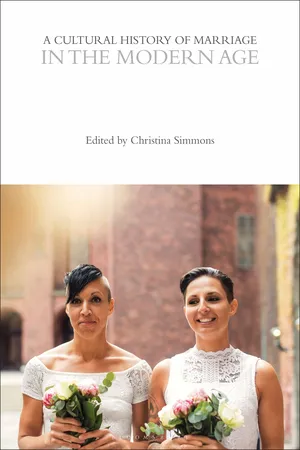
- 232 pages
- English
- ePUB (mobile friendly)
- Available on iOS & Android
eBook - ePub
A Cultural History of Marriage in the Modern Age
About this book
Trusted by 375,005 students
Access to over 1 million titles for a fair monthly price.
Study more efficiently using our study tools.
Information
CHAPTER ONE
Courtship and Ritual
American Dating from Dance Halls to the Internet
CHRISTINA SIMMONS
Around 1940 in Muhlenburg County, Kentucky, 16-year-old African American Maggie Dulin was being courted. The boy who loved her brought her nuts and candy at school and wanted to marry her when they got old enough. His parents loved her, and her parents loved him, but she refused to marry him because, although she hated to hurt him, she “just didn’t have special feelings for him.” After a stint working in a war factory in Chattanooga, Tennessee, Maggie returned home to care for her ailing mother, and Buckey, another boy who had always teased her, asked to call on her. On the front porch, he was “meek” when her very protective father asked what he was doing there; Buckey was allowed to keep visiting. After a year they were married, and in an oral interview in the 1990s Maggie recalled their very happy life together.1
Maggie’s story points to some of the ways that courtship changed over the twentieth century—in the United States but also, though later, in Britain. Like many American parents in the first half of the twentieth century, hers, who also happened to be serious Christians, limited her relationships with boys. Because they trusted the first boyfriend, they allowed him to take her to movies. However, they would not allow her to go to the larger town nearby, where “black people ran places where they would drink and dance and have fun … We knew about them! And we wanted to [go].” But she was afraid to disobey her parents.2 However, her parents did not control her ultimate choice of spouse. Despite family approval for the first boyfriend, Maggie refused to marry him and waited until she fell in love—something long practiced by native-born Americans. Young Americans had exercised substantial autonomy in courtship throughout the nineteenth century, but after 1900, parents increasingly lost what control of courtship they had previously had. British parents maintained more powerful influence into the mid-twentieth century. In both cases claims of love were deployed against parents’ economic or pragmatic rationales.3
Maggie’s attraction to dancing clubs indicates another change—in venues for acquaintance and courtship. As mandated school-leaving ages rose, kids met at school and older students at college; young wage-earners met in the workplace and city streets. As the system of dating developed, couples also met in, or went out to, new commercial amusements—movie theaters, skating rinks, dance halls, cabarets, and juke joints. (Movies additionally provided cultural scripts about love to compete with inherited familial rationales for marriage.) By the 1920s automobiles provided privacy and mobility for better-off couples to court. For gay men and lesbians in urban areas, bars that catered to them formed an essential meeting place for many before the greater openness that came with gay liberation in the 1960s and 1970s, though private homes and social groups were also important and provided greater protection from legal and social discrimination. All of these places were beyond the immediate oversight of parents.4
Dating affected gender and sexual dynamics as well as the generational balance of power. Because a man held more cultural and economic power, when his “calling” at the young woman’s home was replaced by taking her out to a public venue and away from parental scrutiny, the man gained more control over the interaction. Maggie’s parents sought to prevent that situation, especially in the juke joints associated with illicit sexual behavior. As long as a young couple acceded to the rules of chivalry and sexual restraint, and especially when group outings rather than dating in individual pairs prevailed, girls could enjoy this greater freedom from parental restrictions. But when couples did test the sexual limits, the double standard—whereby girls were always more subject to moral judgment than boys—and the threat of pregnancy made girls more vulnerable. Over the century, however, young women’s growing independence, especially those in the labor force, as well as the leverage men got when they paid for dates, led to more open sexuality. Parents with higher-class status and more money and those with stricter religious commitments could control their children more successfully, but youth of all social groups increased their premarital sexual expression.5
These patterns—loss of parental control in favor of “love,” new venues, and shifting gender and sexual dynamics—indicate the primary direction of change in twentieth-century courtship, but they appeared, if at all, at very different times in various ethnic and class groups. Older, family-driven processes such as arranged marriage continued and continue today, particularly among new immigrant groups, and mail-order marriage has revived in new forms. Meanwhile, the sexual revolution of the 1960s, as well as gay and lesbian liberation, greatly altered the system of dating; later, internet dating sites came to play a powerful role in enabling couples, gay and straight, to meet one another.
However the process of meeting takes place, wedding rites then move couples from (usually) youthful single status to the full adult status of marriage. The nature and timing of these rituals have changed significantly over the past century; now it is often a question of whether a couple will hold a formal marriage ceremony at all. Despite the huge diversification in how, when, or whether people marry, however, weddings themselves have become more extravagant, a major source of expense but also very important public symbols for many couples, including, now, some gay couples.
This chapter first gives a brief overview of parentally controlled courtship. Secondly, it addresses the movement toward youth-controlled courtship in the United States, with comparisons to Britain, from the 1920s to the 1960s, and then after the 1960s. Thirdly, it examines the shifting character of wedding rites, especially the promotion of big “white weddings” after the Second World War.
PARENTALLY CONTROLLED COURTSHIP
Marriage, for most of its history, was an alliance of families, not just two individuals; in many places it still is. Hence, parental involvement has been pervasive. Ancient and modern monarchs married off their children for political purposes. Aristocratic and propertied families guided their offspring into marriages offering economic benefits to both sides. Love marriage emerged in Europe in the eighteenth century, but parents’ active efforts to find marriage partners for their children, and certainly their approval if the children made choices, remained significant well into the twentieth century. Depending on these circumstances, courtship might be quite ritualized and circumscribed.6
In China, India, central Asia, the Middle East, and parts of southern and eastern Europe marriages arranged by the young couples’ families were customary until the twentieth century and often continue in modified form today. Arranged marriage is a logical corollary of the traditional concept of marriage as an economic and/or political alliance between families. It also obviates the free association of young men and women and their ability to make their own relationships—something unacceptable in patriarchal cultures—and allows for marriage of girls at a very young age, since it is their reproductive potential, not their maturity as individuals, that is at stake.
The marriage of Egyptian Huda Shaarawi—later a noted feminist—in 1892 illustrates how an arranged marriage served family interests and not individual feelings. Shaarawi was the daughter of a wealthy upper-class man and one of his concubines. Her father died in 1884. Soon after she reached menarche she was kept in the secluded female part of the house; then her father’s wife and Huda’s mother arranged Huda’s marriage to her much older first cousin Ali to protect her from another unwanted proposal. The household began the vast preparations for a marriage but lied to Huda about who was getting married. Her memoir (written in the 1940s) reports that she was devastated when she learned she was to be the bride, but the male relatives serving as intermediaries dissuaded her from rebelling by citing the potential disgrace to her parents. Huda was married at age 13 while Ali was nearly 50. Huda’s mother tried to protect her by demanding that Ali renounce relations with his concubine, but he did not. In about a year, when the family learned that the concubine was pregnant, they took Huda home, where she stayed for seven years. In 1900, however, when her brother said he would not marry until she returned to her husband, she did so. Courtship here was carried out almost exclusively by other family members, and the marriage was based on the social and economic needs of the family.7
When parents did not directly organize marriages, they often used a variant form with other intermediaries. Communist China’s 1950 marriage reform law banned arranged marriages, which still formed 73 percent of marriages in the 1950s in one northeastern village. After that, “match-by-introduction,” by friends, relatives, or professional matchmakers, increased and into the 1990s remained more common than free-choice matches, according to one anthropological study.8 Eastern European Jews through many centuries also commonly used matchmakers, as immortalized in the 1964 musical Fiddler on the Roof. These intermediaries developed expertise in locating potential spouses beyond the direct ties that a family might have. When European Jewish people immigrated to North America, these practices continued, though sometimes allowing the young man and woman to meet first and agree before proceeding. Those who became acquainted on their own sometimes brought in a matchmaker to negotiate the details, a practice also used in China after the 1950 reform and still used.9
Another form of arranged marriage in the early twentieth century for Japanese immigrants was the practice of marrying “picture brides.” Japan’s international power enabled it to avoid the total exclusion from the United States and Canada that the Chinese faced at this time. Instead, according to the Gentlemen’s Agreements with both countries, further Japanese male emigration was limited, but wives and children of Japanese men who had already immigrated were admitted. Until 1924 in the United States and 1928 in Canada, when immigration restriction ended this possibility, unmarried men got wives from Japan through the mediation of friends and relatives who organized the exchange of photographs by mail. The “picture brides” were married by proxy in Japan, then traveled to North America to meet their husbands (Figure 1.1).10
In the early twentieth century, even as notions of personal freedom and romantic love influenced many youth in the United States, economically pressed families attempted to control their children’s courting. Poor rural African Americans in the South, who often relied greatly on children’s labor, disapproved of romantic love and favored marriage at older ages. Children who did marry early were often expected to move in with their parents to help. British working-class families also needed their children’s wages, and engagements could extend for several years before parents assented to the wedding. In addition, adults in close-knit working-class neighborhoods—friends and neighbors as well as parents—kept close tabs on young people’s movements and prevented illicit premarital encounters—something also common in African American communities. Italian and Jewish families in Europe and after immigration to the United States faced substantial financial pressures as capitalist development altered traditional family economies; they too needed the income from children’s wage labor and children’s support in old age.11
In many places around the world today, parents and other kin retain at least strong influence and sometimes legal power over their children’s marriages. In Iran, for example, as late as 2009, the law required daughters to get permission from their fathers to marry.12 Current immigrants to North America from cultures still practicing arranged marriage often continue it in some form. In the first decade of the twenty-first century, for example, a female student from a Pakistani immigrant family in Windsor, Ontario, agreed to allow her parents to arrange a marriage for her (once she met and approved of the man).13 This practice remains useful particularly in societies where the family continues to be the central unit organizing economic life and social security, and children require their parents’ approval and support to enter into marriages that meet the family’s needs. Young women especially, in patriarchal societies such as Egypt, need the status and honor, as well as economic help and protection against husbands’ potential abuse, that parents can give them.14 Despite this widespread ongoing involvement of parents and other kin with courtship and marriage, however, the major trajectory of historical change is different.

FIGURE 1.1 Japanese Picture Brides at Immigration, 1920, Bettmann. Getty Imag...
Table of contents
- Cover
- Title Page
- Contents
- List of Figures
- Contributors
- General Editor’s Preface
- Introduction
- 1 Courtship and Ritual: American Dating from Dance Halls to the Internet
- 2 Religion: Polygamy, Divorce, and Sexuality in the Global Anglican Communion
- 3 State and Law: A Cultural History of American Marriage Law
- 4 The Ties That Bind: Marriage and Social Networks in the Modern Age (1920–Present)
- 5 The Family Economy: Supply and Demand in Marriage Markets
- 6 Love, Sex, and Sexuality: Touching Hands: Lovescapes and Marriage in the Middle East
- 7 Breaking Vows: Divorce in Latin America
- 8 Representation: The Marriage Thriller, or the Uncertainties of a Modern Institution
- Notes
- Bibliography
- Index
- eCopyright
Frequently asked questions
Yes, you can cancel anytime from the Subscription tab in your account settings on the Perlego website. Your subscription will stay active until the end of your current billing period. Learn how to cancel your subscription
No, books cannot be downloaded as external files, such as PDFs, for use outside of Perlego. However, you can download books within the Perlego app for offline reading on mobile or tablet. Learn how to download books offline
Perlego offers two plans: Essential and Complete
- Essential is ideal for learners and professionals who enjoy exploring a wide range of subjects. Access the Essential Library with 800,000+ trusted titles and best-sellers across business, personal growth, and the humanities. Includes unlimited reading time and Standard Read Aloud voice.
- Complete: Perfect for advanced learners and researchers needing full, unrestricted access. Unlock 1.4M+ books across hundreds of subjects, including academic and specialized titles. The Complete Plan also includes advanced features like Premium Read Aloud and Research Assistant.
We are an online textbook subscription service, where you can get access to an entire online library for less than the price of a single book per month. With over 1 million books across 990+ topics, we’ve got you covered! Learn about our mission
Look out for the read-aloud symbol on your next book to see if you can listen to it. The read-aloud tool reads text aloud for you, highlighting the text as it is being read. You can pause it, speed it up and slow it down. Learn more about Read Aloud
Yes! You can use the Perlego app on both iOS and Android devices to read anytime, anywhere — even offline. Perfect for commutes or when you’re on the go.
Please note we cannot support devices running on iOS 13 and Android 7 or earlier. Learn more about using the app
Please note we cannot support devices running on iOS 13 and Android 7 or earlier. Learn more about using the app
Yes, you can access A Cultural History of Marriage in the Modern Age by Christina Simmons in PDF and/or ePUB format, as well as other popular books in Storia & Storia del XX secolo. We have over one million books available in our catalogue for you to explore.