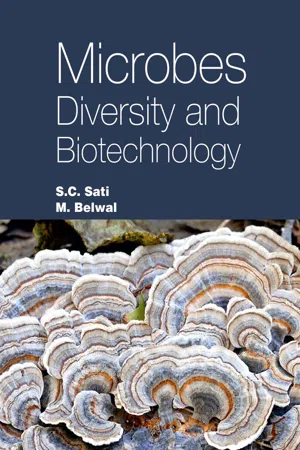
Microbes including fungi constitute an important component of biodiversity. They are our closest neighbour and comprise one of the biggest kingdom in the living world. There are more than 1 lac species of fungi known which grow and multiply in all divers habitats in nature. Due to indiscriminate exploitation and habitat destruction a substantial part of the world biodiversity is being concomitantly regularly lost. Who know many of microbes could be extinct well before we are ready to recognize them? Unfortunately a little attention has been paid towards this direction. Their management and exploitation for the betterment of mankind is must. The utilization and application of fungi by mankind has a long and varied history. Uses of fungi for mankind has broadened and grown considerably in the last 100 years. A well known example of this includes the discovery and production of antibiotics and wider utilization of fungi in the food industry, where they are used in the production of compounds and enzymes for food processing. The association of many fungi with plants has resulted in their use in agriculture as both biological control agents against plant pests and disease and as plant growth stimulants such as Mycorrhizal inoculants. Though there are many national and international Journals that bring out information about fungi and microbes but the recent knowledge is almost in scattered state. It could be kept in a book/ monograph at one place to provide up-to-date information about mycological research especially being done in different corner of India. It is an excellent collection of 30 original research/ review articles of eminent mycologists personalities from different corners of India including Nepal. It is doubtless to say that this monograph would be very useful to all scientists, teachers, students and readers whosoever is interested on mycology and mycological literatures.
- 727 pages
- English
- PDF
- Available on iOS & Android
eBook - PDF
About this book
Information
Topic
MedicineSubtopic
Biotechnology in MedicineTable of contents
- Preface
- List of Contributors
- 1. The Black Mildews
- 2. Distribution of Endophytic Fungi in Different Parts of Rudraksh (Elaeocarpus sphaericus) Plants
- 3. Aspect and Prospect of Endophytic Fungi
- 4. Phosphate Solubilizing Fungi and their Role in Improving Phosphorus Nutrition of Plants
- 5. Botanicals in Control of Microbial Spoilage of Food Commodities
- 6. Biological Control of Fungal Phytopathogens by Trichoderma sp.: Mechanisms of Action
- 7. Arbuscular Mycorrhizal Fungi as Symbiotic Bioengineers
- 8. Studies on Micro Fungal Diversity under Variable Habitats in Arunachal Pradesh
- 9. Culture of Cordyceps sinensis (Berk) Sacc.: A High Value Rare Medicinal Fungus of High Altitude Himalayan Region
- 10. Mass multiplication and Development of Formulations of the Biocontrol Agent: Trichoderma sp.
- 11. Diversity of Arbuscular Mycorrhizal Fungi in Wheat Agro-climatic Regions of India
- 12. Saprolegniasis in Fishes of Kolleru Lake in Andhra Pradesh
- 13. Arbuscular Mycorrhizal (AM) Fungi Associated with Wild Medicinal Plants Exhibit Variation in Phosphorus Concentration during Growth Developmental Stages
- 14. Isolation and Mass Multiplication of Vesicular Arbuscular Mycorrhizal Inoculum Using Monocot Hosts
- 15. Seed Mycoflora of Some Oil Yielding Plants from Dharwad
- 16. Studies on the Fungal Flora in Rhizosphere of Pea Plant in Subtropical Region
- 17. Dynamics of Leaf Surface Mycoflora of Ginkgo biloba and Taxus baccata in Kumaun Himalaya
- 18. The Aquatic Hyphomycetes: Aspects and Prospects
- 19. Studies on Antifungal Activity of the Plant Zanthoxylem armatum (Rutaceae)
- 20. Antifungal Potential of Gymnosperms: A Review
- 21. Microorganisms: A Source of Bio-pharmaceuticals
- 22. Use of AM Fungi Inoculated Plants in Alleviation of Stress Effects Existing in Mine Wastes
- 23. Aspergillus spp. Association with Major Crops and its Pathogenic Effects
- 24. Deep Mycoses in Fish Caused by Water-moulds and Stress Hypothesis: A Review
- 25. Effect of Temperature, pH and Light on the Growth of Some Aquatic Hyphomycetes
- 26. Endophytic Aquatic Hyphomycetes from Medicinal Plant Geranium nepalense Sweet.
- 27. Quantitative Estimation of Conidial Production of Water-borne Conidial Fungi on Defined Submerged Substrate
- 28. Arbuscular Mycorrhiza: Progression from Womb to World
- 29. Isolation and Control of Seed Mycoflora of Onion (Allium cepa L.) in Nepal
- 30. Antimicrobial Potentiality of Bryophytes
Trusted by 375,005 students
Access to over 1.5 million titles for a fair monthly price.
Study more efficiently using our study tools.
Frequently asked questions
Yes, you can cancel anytime from the Subscription tab in your account settings on the Perlego website. Your subscription will stay active until the end of your current billing period. Learn how to cancel your subscription
No, books cannot be downloaded as external files, such as PDFs, for use outside of Perlego. However, you can download books within the Perlego app for offline reading on mobile or tablet. Learn how to download books offline
Perlego offers two plans: Essential and Complete
- Essential is ideal for learners and professionals who enjoy exploring a wide range of subjects. Access the Essential Library with 800,000+ trusted titles and best-sellers across business, personal growth, and the humanities. Includes unlimited reading time and Standard Read Aloud voice.
- Complete: Perfect for advanced learners and researchers needing full, unrestricted access. Unlock 1.5M+ books across hundreds of subjects, including academic and specialized titles. The Complete Plan also includes advanced features like Premium Read Aloud and Research Assistant.
We are an online textbook subscription service, where you can get access to an entire online library for less than the price of a single book per month. With over 1.5 million books across 990+ topics, we’ve got you covered! Learn about our mission
Look out for the read-aloud symbol on your next book to see if you can listen to it. The read-aloud tool reads text aloud for you, highlighting the text as it is being read. You can pause it, speed it up and slow it down. Learn more about Read Aloud
Yes! You can use the Perlego app on both iOS and Android devices to read anytime, anywhere — even offline. Perfect for commutes or when you’re on the go.
Please note we cannot support devices running on iOS 13 and Android 7 or earlier. Learn more about using the app
Please note we cannot support devices running on iOS 13 and Android 7 or earlier. Learn more about using the app
Yes, you can access Microbes Diversity and Biotechnology by Sati, S C in PDF and/or ePUB format, as well as other popular books in Medicine & Biotechnology in Medicine. We have over 1.5 million books available in our catalogue for you to explore.