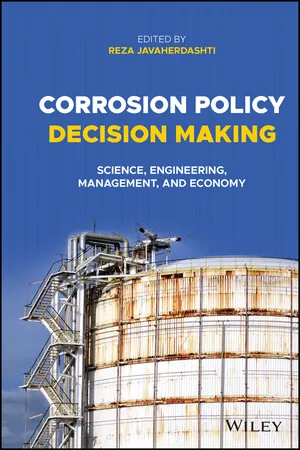
Explore the science, management, economy, ecology, and engineering of corrosion management and prevention
In Corrosion Policy Decision Making, distinguished consultant and corrosion expert Dr. Reza Javaherdashti delivers an insightful overview of the fundamental principles of corrosion with a strong focus on the applicability of corrosion theory to industrial practice. The authors demonstrate various aspects of smart corrosion management and persuasively make the case that there is a real difference between corrosion management and corrosion knowledge management.
The book contains seven chapters that each focuses on one important aspect of corrosion and corrosion management.
Corrosion management is an issue that is not just corrosion science or corrosion engineering but rather a combination of both elements. To cover this paradoxical aspect of corrosion management, chapter 2 deals with some basic, introductory concepts and principles of corrosion and coating/painting (an important corrosion protection method) while chapter 3 explains the elements of smart corrosion management in detail. Another important principle of smart corrosion management is to be able to study the cost of corrosion, chapter 4 introduces important points in the economics involved in a smart corrosion management. As indicated earlier, corrosion engineering is also an integral part of corrosion management and thus chapter 5 looks at the engineering side of corrosion by detailing the example of Process Additives (EMPA). Chapter 6 for the first time looks at the possibility of using TRIZ (algorithm of invention) in corrosion management. Finally, chapter 7 presents the necessary elements for building a model that would explore the mutual interaction between corrosion and environment mainly by exploring the difference between environmental impact and environmental effect. Chapter 7 is also very important because the four models so far applied to estimate the cost of corrosion (Uhlig Method, Hoar Method, I/O method and LCC method) are not capable of suggesting any clear model or a sensible way of exploring the elements necessary to explain the impact of indirect costs of corrosion the most important of which being environmental damages imposed by corrosion.
This book is ideal for engineers, students, and managers working or studying corrosion, Corrosion Policy Decision Making is also an indispensable resource for professionals in the fields of upstream and downstream, on-shore/off-shore oil and gas, transportation, mining, power generation as well as major sectors of other strategic industries.
Trusted by 375,005 students
Access to over 1.5 million titles for a fair monthly price.
General Manager, Eninco Engineering B.V., The Netherlands
This book is a first‐hand answer to two questions:
What corrosion management (CM) really means;
What to expect from CM.
Let us be more specific in describing what we mean by the above. For those of you who have been too engaged with your integrity management tasks that cannot find time to watch movies and particularly horror movies, I do recommend to watch the movie “Final Destination; Part 5,” and watch it with the eyes of a corrosion/integrity management specialist. In this movie (and its previous parts) what is shown is that something of little importance goes wrong, and in a series of unpredictable, sad events, one (or sometimes more) of the actors are killed in a very dramatic, graphic way. As said, the main lesson learned from this movie is that one problem can lead to another and in the end, a catastrophic result occurs. The same is also true with neglecting corrosion in an integrity management plan; something that one would think is not that important will lead to another, and if it is in its “pseudo‐FFS1” (Fit‐For‐Service State) stage, the result at its best could be arriving at a “Zugzwang effect” [1] stage, or simply said, failure.
In classical academic literature related to Management and its principles, perhaps one of the best definitions have been given by Henry Fayol as “To manage is to forecast and to plan, to organize, to command, to co‐ordinate and to control [1].” On the other hand, corrosion has also a clear definition that can be simplified as the chemical reaction between an electron donor (anode) and electron receiver (cathode) via a medium that allows exchange of ions and a metallic path that allows electron transfer.2 However, what is CM? In fact, when it comes to corrosion science, we know that we are talking about laboratories, white‐collar researchers, academic environments, and the search for understanding fundamentals and mechanisms of corrosion processes. In this context, innovation and how innovative research must be carried out is of fundamental significance. When we talk about corrosion engineering, it is the way the accumulated science and knowledge about corrosion and corrosion processes will become applicable in the field. For instance, the use of cathodic protection to let structures survive longer, or use of corrosion inhibitors and biocides to chemically control corrosion. Figure 1.1 can serve to show the essential elements of corrosion engineering and how corrosion engineering and other engineering disciplines are interconnected with each other. We see that when talking about corrosion engineering, we are actually talking about a multidimensional topic that in its wholeness is more complex than other engineering disciplines not in based on the subject of focus, but on the methodologies that apply to address corrosion and its various aspects such as monitoring and treatment:
Figure 1.1 Corrosion engineering and its relation to other engineering disciplines (right), essential features and components of corrosion engineering (left) (Used by permission from Eng. Riky Bernardo – Qatar).
All of these applications have their own codes and standards. When we talk about corrosion treatment, we know that we are talking about five strategies to deal with corrosion (physical measures, chemical measures, electrical measures, mechanical measures, and design/material selection measures). Corrosion monitoring is to address methods and technologies by which severity of corrosion within its course of action is studied by codes and measures pertaining to corrosion monitoring. All of the above bring to mind certain codes, working environments and specialties, and expertise. However, what is CM? It obviously has a part dealing with corrosion and a part dealing with management. The confusion arises from here; how can management which is seeming a non‐technical issue, be matched with corrosion which is a highly technical issue?
All the materials written to date on the management of corrosion are just looking at the science/engineering, and to some extent economy of corrosion, without detailing with the actual requirements (for example, about the economic nomenclature that is needed to understand cost of corrosion). Some of the publications about CM do suffer from the defects mentioned above. Some examples of CM literature are:
A. Morshed, “An Introduction to Corrosion Management in Industry,” NACE, USA, 2017.
A. Morshed, “An Introduction to Asset Corrosion Management in the Oil and Gas Industry, 2nd edition,” NACE, USA, 2016.
A.S. Groysman, “Corrosion Problems and Solutions in Oil Refining and Petrochemical Industry,” Springer, 2017.
“My Manual: Practical Corrosion Management,” a manual published by IDC Technologies, 2009, Perth, Australia.
Even IMPACT report by ex‐NACE (now AMPP) that was published in 2016 had some sections on management and economy without any focus on engineering and science aspect of corrosion.
No economist, environmental sciences specialist, or a non‐technical manager is likely to read those books (and similar ones) or attend CM seminars and webinars. The reason is simple; corrosion has not been defined for these non‐corrosionist professionals. Perhaps, the importance of corrosion has sometimes been flagged by some politicians,3 as well as passing bills to allow the establishment of certain corrosion related entities, say, within the army, but apart from those individual sparks, no overall, systematic understanding about corrosion and its various aspects exists yet.
Our iconoclast approach toward CM is what we call “Smart Management of Corrosion” in the sense that (i) it is smart because this system can adapt itself with any industry and, contrary to the existing assumption that CM is to be discussed within the context of a certain industry (oil and gas), smart management of corrosion is not industry‐specific; and (ii) it focuses of the management side rather+ than the corrosion side. Our understanding is that current CM systems mainly deali with the risk of corrosion, however it is essential to also deal with the cost of corrosion, whether economic cost or ecological cost. Management of corrosion is a term that acts as an umbrella to both CM (risk of corrosion) and corrosion knowledge management (CKM) (cost of corrosion) simultaneously and being as such, Management of Corrosion is a more general term than CM alone.
There are three very important features about corrosion:
Corrosion and Failure: Corrosion is inevitable and manageable; failure is inevitable and non‐manageable. Being non‐manageable does not mean that it cannot be prevented, it simply means that when failure happens, it happens! This distinguishment between these two terms if of vital importance; the prejudice of many who deal with corrosion issues is that they are entitled to find a way to prevent or control corrosion.4 Corrosion occurs anyway due to the thermodynamic nature of it, it is our duty, though, to prevent failures. It is through failures and leaks that not only economic costs are imposed (from shut down costs to maintenance and replacement), but also environmental effects also occur. Study of corrosion processes ending in leak and failure is the task of a corrosion specialist, post‐mortem forensic investigation of the failure is what a forensic investigator does to help build a root cause analysis report, but who is to measure the seriousness of the environmental effects thus produced? Who is going to estimate the economic loss (direct cost and indirect cost)?
Risk and Likelihood: If the likelihood of getting a certain type of corrosion‐related failure is low, it does not necessarily mean that is risk is also low and vice versa. The confusion between risk and likelihood is with no doubt one of the most important sources of problems that can even reach to the level of disasters. It is the mindset that can be observed in industry quite frequently and it has the potential of being lethal.
Corrosion and Aging: Aging implies that a structure has been in service for quite a long time, whereas corrosion can actually occur in structures right after being put into service. Therefore, corrosion‐related failures could happen in structures after a relatively ...
Table of contents
Cover
Table of Contents
Title Page
Copyright Page
Dedication Page
Preface
Authors and Contributors
1 Introduction
2 A Short Review of Some Important Aspects of the Science of Corrosion
3 Smart Corrosion Management Elements
4 Economics and Corrosion
5 Effective Management of Process Additives (EMPA)
6 Application of TRIZ for Corrosion Management
7 Environmental Impacts of Corrosion and Assessment Strategies
Index
End User License Agreement
Frequently asked questions
Yes, you can cancel anytime from the Subscription tab in your account settings on the Perlego website. Your subscription will stay active until the end of your current billing period. Learn how to cancel your subscription
No, books cannot be downloaded as external files, such as PDFs, for use outside of Perlego. However, you can download books within the Perlego app for offline reading on mobile or tablet. Learn how to download books offline
Perlego offers two plans: Essential and Complete
Essential is ideal for learners and professionals who enjoy exploring a wide range of subjects. Access the Essential Library with 800,000+ trusted titles and best-sellers across business, personal growth, and the humanities. Includes unlimited reading time and Standard Read Aloud voice.
Complete: Perfect for advanced learners and researchers needing full, unrestricted access. Unlock 1.5M+ books across hundreds of subjects, including academic and specialized titles. The Complete Plan also includes advanced features like Premium Read Aloud and Research Assistant.
Both plans are available with monthly, semester, or annual billing cycles.
We are an online textbook subscription service, where you can get access to an entire online library for less than the price of a single book per month. With over 1.5 million books across 990+ topics, we’ve got you covered! Learn about our mission
Look out for the read-aloud symbol on your next book to see if you can listen to it. The read-aloud tool reads text aloud for you, highlighting the text as it is being read. You can pause it, speed it up and slow it down. Learn more about Read Aloud
Yes! You can use the Perlego app on both iOS and Android devices to read anytime, anywhere — even offline. Perfect for commutes or when you’re on the go. Please note we cannot support devices running on iOS 13 and Android 7 or earlier. Learn more about using the app
Yes, you can access Corrosion Policy Decision Making by Reza Javaherdashti in PDF and/or ePUB format, as well as other popular books in Tecnología e ingeniería & Ciencias de los materiales. We have over 1.5 million books available in our catalogue for you to explore.