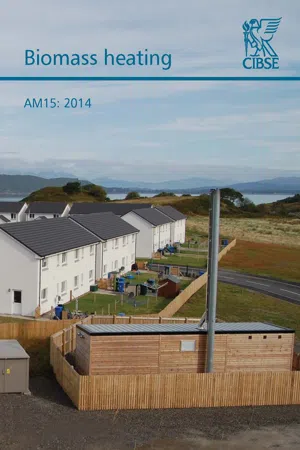
This Applications Manual concentrates on biomass systems with biomass boiler outputs in the range of 50 kW to 5 MW burning woodchips or wood pellets. The major application areas for biomass boilers will be for heating systems for existing buildings, and those with substantial heating and hot water loads throughout the year. Batch-fed boilers are briefly mentioned but it does not cover hot-air heaters, biomass gasifiers or biomass chp systems.The design of biomass boiler systems is considerably more complex than that of oil and gas boiler, heat pump and chp systems, and requires an informed design approach. Integrating biomass boilers with oil and gas boilers with load circuits to form efficient and controllable hydronic systems requires a detailed understanding of the dynamics and subtleties of biomass boilers. Hence, this Applications Manual is designed to help readers understand biomass boiler systems to a level where they can make knowledgeable decisions on system design. With the exception of specific hydronic arrangements for integrating biomass boiler systems with oil or gas boilers in Chapter 7 and specific advice on health and safety requirements, this manual does not provide prescriptive solutions nor does it attempt to cover every eventuality. The primary readership of this manual is intended to be professional building services engineers in the UK.Low-carbon related legislation and regulations are changing rapidly, and also vary significantly country by country. Reference is made throughout this manual to the UK's Renewable Heat Incentive (rhi) scheme and guidance is provided on measures which may be required to secure accreditation under the non-domestic RHI. Those installing boilers to provide heat to domestic properties, and seeking support under the domestic rhi, should refer to the appropriate guidance available on the Ofgem rhi website.Readers must ensure that they are aware of, and conform with all legislation and regulatory requirements applicable to their project.
eBook - PDF
Biomass heating (AM15)
- 120 pages
- English
- PDF
- Available on iOS & Android
eBook - PDF
Biomass heating (AM15)
About this book
Information
Year
2014eBook ISBN
9781906846510
Table of contents
- AM15 Biomass heating OFC
- Foreword
- Acknowledgements
- Contents
- 1 Introduction and scope
- 2 Biomass fuels, combustion and emissions
- 3 Fuel delivery, storage and extraction
- 4 Biomass boiler types and characteristics
- 5 Designing with buffer vessels and thermal stores
- 6 Sizing a biomass boiler and suitability of biomass
- 7 Connecting biomass boilers in parallel or series
- 8 Controls, pressurisation and headers
- 9 Heat metering
- 10 Flues
- 11 Summary of key considerations for biomass boilerhouse design
- References
- Glossary
- Key to symbols used in hydraulic diagrams
- Index
Trusted by 375,005 students
Access to over 1.5 million titles for a fair monthly price.
Study more efficiently using our study tools.
Frequently asked questions
Yes, you can cancel anytime from the Subscription tab in your account settings on the Perlego website. Your subscription will stay active until the end of your current billing period. Learn how to cancel your subscription
No, books cannot be downloaded as external files, such as PDFs, for use outside of Perlego. However, you can download books within the Perlego app for offline reading on mobile or tablet. Learn how to download books offline
Perlego offers two plans: Essential and Complete
- Essential is ideal for learners and professionals who enjoy exploring a wide range of subjects. Access the Essential Library with 800,000+ trusted titles and best-sellers across business, personal growth, and the humanities. Includes unlimited reading time and Standard Read Aloud voice.
- Complete: Perfect for advanced learners and researchers needing full, unrestricted access. Unlock 1.5M+ books across hundreds of subjects, including academic and specialized titles. The Complete Plan also includes advanced features like Premium Read Aloud and Research Assistant.
We are an online textbook subscription service, where you can get access to an entire online library for less than the price of a single book per month. With over 1.5 million books across 990+ topics, we’ve got you covered! Learn about our mission
Look out for the read-aloud symbol on your next book to see if you can listen to it. The read-aloud tool reads text aloud for you, highlighting the text as it is being read. You can pause it, speed it up and slow it down. Learn more about Read Aloud
Yes! You can use the Perlego app on both iOS and Android devices to read anytime, anywhere — even offline. Perfect for commutes or when you’re on the go.
Please note we cannot support devices running on iOS 13 and Android 7 or earlier. Learn more about using the app
Please note we cannot support devices running on iOS 13 and Android 7 or earlier. Learn more about using the app
Yes, you can access Biomass heating (AM15) by David Palmer Contributing Authors: Colin Ashford, Jim Kinnibrugh, Graham Smith in PDF and/or ePUB format, as well as other popular books in Technology & Engineering & Construction & Architectural Engineering. We have over 1.5 million books available in our catalogue for you to explore.