This book tells the fascinating, and sometimes frustrating, story of the journey from the iconic Jaguar E-type to its successor, the F-type. With nearly 300 photographs, it documents the evolution of the F-type from the Pininfarina XJ Spider through Jaguar's own XJ41/42, XX and XK180. It reviews the whole range of F-type convertible and coupe models and discusses the wild Project 7 and the latest turbo-charged four-cylinder cars. The special vehicles produced for Team Sky and Bloodhound SSC are included along with a useful chapter on buying an F-type. Finally, the book considers the F-type's future in a changing automotive world.
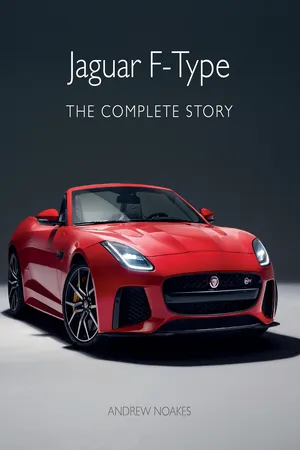
- 192 pages
- English
- ePUB (mobile friendly)
- Available on iOS & Android
eBook - ePub
About this book
Trusted by 375,005 students
Access to over 1.5 million titles for a fair monthly price.
Study more efficiently using our study tools.
Information
CHAPTER ONE
FORERUNNERS: BEFORE THE F-TYPE
The road to the Jaguar F-type was full of twists and turns, and they started right at the beginning of the story. This was because the company that became Jaguar started out building something other than cars, and the man who was the driving force behind it originally had a passion not for motor cars, but for motorbikes.
William Lyons was born in Blackpool, on the north-west coast of England, in 1901. His father, also William, was an Irish immigrant who ran a music shop. William junior was not much of a scholar, but was encouraged by his father to join Crossley Motors in Manchester at the age of sixteen as an engineering apprentice. Crossley built fine cars, and during World War I, its chassis formed the basis for military trucks and ambulances.

William Lyons in the 1920s astride a Harley-Davidson 11-F motorcycle. The bike appears to be prepared for speed, with no headlamp or speedo, and lowered handlebars. JAGUAR
But Lyons was not happy at Crossley, and in 1919 he joined Brown and Mallalieu, a motor car dealer at the Metropole Garage in Josiah Street, Blackpool, as a junior salesman. He had an aptitude for the work, and it allowed him to indulge on the side in his passion for motorcycles. Lyons was already trading in two-wheelers, and by the time he was twenty he had owned examples of many different marques, including Sunbeam, Indian, Norton and Harley-Davidson.
It was good fortune, then, that in 1921 William Walmsley moved into King Edward Avenue, close to where Lyons lived, and began rebuilding army surplus motorcycles for civilian use. He also designed a sidecar with octagonal bodywork in polished aluminium, which he offered for sale at £28. In an era when a sidecar body was either a large wicker basket or something with an alarming resemblance to a tin bath, Walmsley’s streamlined aluminium model was new and exciting. Lyons bought one, and spotted its potential straight away.
EARLY DEVELOPMENTS
Lyons and Walmsley were soon working together. Lyons envisaged production on a much grander scale than Walmsley’s rate of one a week, and this necessitated moving into larger premises. With a £1,000 bank loan guaranteed by their respective fathers, Lyons and Walmsley set up at Bloomfield Road in Blackpool. Lyons was still twenty and too young to enter into a legal business agreement, but shortly after his twenty-first birthday he formed an official partnership with Walmsley and the Swallow Sidecar Company was born.
The Swallow Sidecar Company
Lyons had already demonstrated the aptitude for salesmanship and business acumen that were to be notable throughout his career, and now he showed another trait that would serve him well down the years – as a showman. When Swallow went to the Motorcycle Show in London in November 1922 to display its sidecars, Lyons and Walmsley rode bikes to London with the sidecars attached. But these were not just any bikes – they were Brough Superiors, the finest British motorcycles of the day.

Swallow Model 4 Super Sports sidecar from 1928, fitted to a 1925 Brough Superior SS80. William Walmsley’s sidecars were very modern for their time and sold well. AUTHOR
Swallow’s sidecars sold well, and the company expanded into larger premises in Cocker Street, Blackpool, to cope with demand. It was there that Swallow branched out to build special bodywork for cars, initially the popular Austin Seven. At £175 the Austin Seven Swallow was a stylish and individual small car at a bargain price, and it was a huge success.
As the company continued to grow it became obvious that a location closer to the manufacturing centre of the British motor industry in the Midlands would be advantageous. Shortening the lines of communication with suppliers and the journeys between their factories and the Swallow works would cut costs and improve production flexibility. So in 1928 what was by then the Swallow Coachbuilding Company moved 130 miles south from Blackpool to the city of Coventry, already regarded as the centre of the British motor industry. They took up residence in a former munitions factory off Holbrook Lane in Foleshill, a couple of miles north of the city centre.
SS Cars
Swallow became a proper car maker thanks to the support of another Coventry-based automotive company: Standard. The Standard Motor Company supplied Lyons and Walmsley with engines, transmissions and chassis for the SS1, the first car that was a genuine Swallow product, rather than a bespoke body for a car made by someone else. The SS1 was announced at the London motor show in 1931 and had attractive, rakish lines – but it was not a performance car. Rather, Lyons had spotted a gap in the market for a car offering fine styling and value for money, and it proved to be another success for the fledgling firm. By now Walmsley was happy with what Swallow had achieved and had no real ambitions to do more, but Lyons wanted to go further. He created a new company, SS Cars, and bought out Walmsley’s share to become sole managing director.

An SS1 saloon at the 2014 Salon Privé event. The SS1 was the first complete car built by SS.
In 1935 SS introduced its first proper sports car, the two-seat SS90, but like previous SS models, it was still more about styling than performance. To address this William Heynes was brought in from Hillman to be chief engineer, and engine expert Harry Weslake was engaged to redesign the Standard engine. Weslake produced an overhead valve layout with a crossflow cylinder head, and in this form the engine developed 102bhp, a massive leap from the Standard’s 70bhp. The revised engine went into a new saloon car called the SS Jaguar, and then into the sports car to produce the SS Jaguar 100. In 3½-litre form this car was capable of 100mph (160km/h) – quite something for the 1930s. Finally Lyons had built a car with genuinely impressive performance to match the stunning styling that had always been an SS hallmark.
But the SS sports cars were not in production for long. With the onset of war in 1939 private car production was stopped, and SS turned its manufacturing facilities over to the production of aircraft components, including centre fuselage sections for the new Gloster Meteor, the first British jet fighter. But the war years were not entirely devoid of car-making activity – in fact two key decisions were taken by Lyons during this period which would have far-reaching effects for the company after the war.
The first came when John Black told Lyons in 1942 that Standard would be making a new range of engines after the war and would no longer supply SS with the existing units. Spotting the chance to become self-sufficient, Lyons immediately offered to buy all the tooling and equipment necessary to manufacture the existing engines. As soon as the deal was struck he had trucks and workmen at Standard’s Canley factory ready to remove all the equipment and take it to Foleshill before Black, a famously moody and capricious operator, could change his mind.

The SS100 established Lyons’ reputation for stunning looks and high performance at a good price.
As it turned out Black did indeed think twice, realizing too late that he had seriously curtailed the range of engines that Standard could now build for itself. ‘It wasn’t long before Black proposed that we should revert to the previous arrangement, and return the plant to Standard,’ said Lyons in a paper he presented to the Institute of the Motor Industry in 1969. ‘He pressed me very hard, even to the extent of suggesting that we should form a separate company together.’ When Black suggested Lyons return the engine tooling to Standard, Lyons is said to have replied: ‘No thank you, John, I have got the ball now, and I would rather kick it myself.’
The XK Engine
But while Lyons took the opportunity to secure the supply of engines for the short term, he was also lo...
Table of contents
- Cover
- Title
- Copyright
- Contents
- Timeline
- Introduction
- Chapter 1 Forerunners: Before the F-Type
- Chapter 2 First Thoughts: The XJ41/42, XX and X100
- Chapter 3 Further Forward: The XK180 and F-Type Concepts
- Chapter 4 First Look: The F-Type is Launched
- Chapter 5 Further Developments: The Coupé and Awd
- Chapter 6 Faster Still: Project 7, SVR and Modified F-Types
- Chapter 7 Facelifts and Four Cylinders
- Chapter 8 Future of the F-Type
- Chapter 9 F-Type Owning and Driving
- Appendix Jaguar Project Codes 1975–2019
- Index
Frequently asked questions
Yes, you can cancel anytime from the Subscription tab in your account settings on the Perlego website. Your subscription will stay active until the end of your current billing period. Learn how to cancel your subscription
No, books cannot be downloaded as external files, such as PDFs, for use outside of Perlego. However, you can download books within the Perlego app for offline reading on mobile or tablet. Learn how to download books offline
Perlego offers two plans: Essential and Complete
- Essential is ideal for learners and professionals who enjoy exploring a wide range of subjects. Access the Essential Library with 800,000+ trusted titles and best-sellers across business, personal growth, and the humanities. Includes unlimited reading time and Standard Read Aloud voice.
- Complete: Perfect for advanced learners and researchers needing full, unrestricted access. Unlock 1.5M+ books across hundreds of subjects, including academic and specialized titles. The Complete Plan also includes advanced features like Premium Read Aloud and Research Assistant.
We are an online textbook subscription service, where you can get access to an entire online library for less than the price of a single book per month. With over 1.5 million books across 990+ topics, we’ve got you covered! Learn about our mission
Look out for the read-aloud symbol on your next book to see if you can listen to it. The read-aloud tool reads text aloud for you, highlighting the text as it is being read. You can pause it, speed it up and slow it down. Learn more about Read Aloud
Yes! You can use the Perlego app on both iOS and Android devices to read anytime, anywhere — even offline. Perfect for commutes or when you’re on the go.
Please note we cannot support devices running on iOS 13 and Android 7 or earlier. Learn more about using the app
Please note we cannot support devices running on iOS 13 and Android 7 or earlier. Learn more about using the app
Yes, you can access Jaguar F-Type by Andrew Noakes in PDF and/or ePUB format, as well as other popular books in Technology & Engineering & Automotive Transportation & Engineering. We have over 1.5 million books available in our catalogue for you to explore.