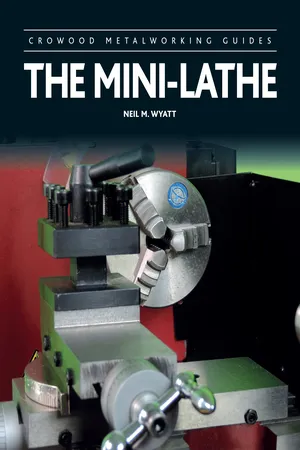
The mini-lathe is a useful tool in the model engineer's workshop. With more choice than ever of more compact machines, a mini-lathe is able to accommodate a wide range of engineering requirements, projects and techniques, as well as being suitable for the novice engineer and for those with limited workshop space. Author and model engineer Neil Wyatt provides a practical guide to purchasing and using a mini-lathe, as well as examining more advanced techniques. The book includes a projects section to show the application of mini-lathe techniques. Topics covered include: choosing a mini-lathe; workshop safety and setting up the lathe; basic through to more advanced machining skills; modifications, additions and tuning of the mini-lathe. This essential reference source is aimed at the novice engineer, home metalworkers and for those with limited workshop space. Fully illustrated with 304 colour photographs.
eBook - ePub
Mini-Lathe
About this book
Trusted by 375,005 students
Access to over 1 million titles for a fair monthly price.
Study more efficiently using our study tools.
Information
1 Why a Mini-Lathe?
Ask a dozen model engineers ‘what is the best lathe for me?’ and you will get two dozen answers! One of the finest writers on the hobby, Edgar Westbury (E.T.W.), said: ‘The so-called “ideal lathe” is in practice a romantic myth.’ He had the perception to realize we all have different needs and the best lathe for each of us will always be a compromise. Mini-lathes provide capacity, capability and many useful features at an affordable price. They may not be ‘ideal’ for everyone but they have proven the best route into hobby engineering for tens or hundreds of thousands.
Most modern books on small lathes have been written by authors more familiar with larger machines or ‘classic’ older lathes. Inevitably, their experience with larger machines colours their approach to these machines.
My own lathe, in regular use for the past sixteen years, is a Clarke CL300M mini-lathe (Fig. 1.1). This is one of the main machines featured in this book. In using the machine I have been pleasantly surprised – while some aspects of the lathe are made to keep costs down, it is rigid, accurate and reliable.

Fig. 1.1 The author’s Clarke CL300M mini-lathe in more or less original condition.
This book deals with what I have discovered during those sixteen years of use, from choosing a lathe, basic safety and setting it up properly, through a range of basic turning skills, to tackling some more challenging machining operations and making useful accessories. I can’t guarantee every single point I cover will apply to every variant of mini-lathe but, by the same token, many of the general principles will apply to any lathe of similar size.
I have made numerous modifications and additions to my machine; some of these are ‘standard’ upgrades, others are of my own devising. Be assured that none of them are essential to using a mini-lathe but also recognize the basic machine has plenty of scope for modification and tuning if you are, like me, a ‘tweaker’.
This book gives most dimensions in metric and imperial units. These are not intended to be exact equivalents, especially where a dimension is given as a guide. For example, a thousandth of an inch is exactly 0.0254mm but I may well write something such as ‘about 0.02mm (0.001in)’.
I would like to thank the many fellow mini-lathe users who both knowingly and unwittingly have helped me over the years with advice, ideas and guidance. In particular, the writings and ideas of Alastair Sinclair and Mike Cox have been a source of ideas and inspiration. They say there are no new ideas in engineering and I apologize if I have unintentionally copied anyone without giving due credit.
I would like to thank Arc Euro Trade, Axminster Tools & Machinery, Chester Machine Tools, Eccentric Engineering, Machine Mart and Warco for permission to use photographs of their machines, as well as SIEG for permission to use extracts from its user manual.
Finally, for a book like this I also needed access to an unmodified machine and various accessories to demonstrate certain points. I would like to thank Ketan Swali of Arc Euro Trade for the opportunity to use its studio to photograph a new, unmodified SIEG mini-lathe and also for his advice on the various subtleties and technical aspects of these worthy machines.
2 Safety
Some readers will groan at this point but, unless one has seen the aftermath of an industrial accident, is easy to be blasé about the risks associated with machine tools.
Lathes are one of the slower and quieter tools so it is easy to get complacent about the risks they pose. However, complacency is a cause of accidents. Even a mini-lathe is capable of causing serious injury from sharp tools, flying swarf (debris) and collisions or entanglement with moving parts. Don’t panic, though. Lathe safety mostly means using your common sense and keeping the working area clean and tidy. Here are some pointers towards the safe use of any workshop lathe but, remember, safety is your responsibility and if you are not sure – ask!
Emergency Stop
Make sure you are familiar with the emergency stop button. It does no harm to use this to stop the lathe in day-to-day operations and the more familiar you are with using it, the faster you will be able to hit it in an emergency (Fig. 2.1).

Fig. 2.1 If things start to go wrong, hit the emergency stop.
Protective Equipment
Unlike many machine tools, lathes do not demand a lot in the way of personal protective equipment. The HSE recommends eye protection is worn when using a lathe and if cutting something such as brass, which can send a vertical shower of small chips into the air, full eye protection is essential (Fig. 2.2). For most turning, many people find a pair of safety spectacles are sufficient but bear in mind that flying swarf is not the only risk – it is possible for loose work pieces to fly out of the chuck at high speed.

Fig. 2.2 A pair of safety googles is an excellent investment.
Electricity
As with any electrical equipment, take the usual care with leads and around the electrical parts of the machine, bearing in mind lathes move and wires can be drawn into machinery. Ensure the plug is wired correctly and any fuses that blow are replaced with the same type and value. If you have an electrical problem or fuses blow repeatedly, consult an electrician. Do not attempt to dismantle or repair any electrical elements of the machine unless you are competent to do so. If you use cutting fluid of any kind, take great care to make sure it goes nowhere near the motor, control box or wiring harness. Finally, some mini-lathes do not have a seal around the leadscrew. This allows swarf to potentially worm its way into the control box, with disastrous results. I have first-hand experience of this happening.
Guards
Older mini-lathes are equipped with tiny guards that serve little practical purpose as they rarely offer real protection in the actual working area and in some cases limit the usability of the machine (Fig. 2.3). A guard that interferes in this way gets left open or removed and is therefore pointless. The better and more recent models of minilathe have better designed, curved guards that are wired to an interlock switch (Fig. 2.4).

Fig. 2.3 The guards on early mini-lathes left something to be desired.

Fig. 2.4 Newer machines have more effective guards.
I have found the easiest and most effective guard is a sheet of polycarbonate about 200–250mm (8–10in) square mounted on an arm fixed to a weighted or magnetic base. This can be cleaned easily and placed so it protects the operator without interfering with the use of the machine.
Cutting Fluids
It may be a surprise to many but the HSE has found health problems, such as dermatitis, asthma and lung damage, from cutting fluid are one of the biggest hazards associated with lathe use. Most mini-lathe owners are unlikely to use floods of coolant and may do most of their work dry or just use small amounts of neat cutting oil applied with a brush or dribbled on to the work. This is less hazardous but it can still get thrown around or give off unpleasant fumes when the work gets hot. Take care to make sure you don’t breathe in fumes or overspray, and consider using barrier cream and/or a facemask.
Gloves and Loose Clothing
Do not wear gloves when working with a machine such as a lathe. If pulled into a moving machine they can lead to terrible injuries. I don’t suppose these days many of us would consider wearing a tie in the workshop but beware loose clothing and keep long hair tied back. A more modern hazard is the drawstrings found on hoodies – they can dangle right over the work as you lean forward for a closer look. The best workshop clothing is an overall with a Velcro fastening. Similarly, don’t use rags near moving work – kitchen roll is much better as, if caught, it will rip.
Lighting
It’s always important to ensure the lathe and work area is well lit. Ideally, use low voltage lighting or ensure any luminaires are proofed against the entry of swarf or liquids. Avoid old-fashioned fluorescent lights that can give the impression the lathe is not rotating if the machine speed synchronizes with the mains frequency. Twelve-volt, LED-based, lights are becoming increasingly popular with machinists.
Noise
Unlike many machines, a lathe is generally relatively quiet and if it is noisy it is probably trying to tell you things aren’t right. For example, a cut may be too heavy, causing shrieking chatter, or an interrupted cut is being taken too quickly or aggressively. There may be times, however, when you can’t stop a loud or unpleasant sound from a particular tool due to some resonance or other. You can keep a pair of ear protectors handy but a pack of earplugs are cheaper and equally effective (Fig. 2.5). Do take care though – it’s easy to be caught unaware by someone entering the workshop when you are wearing earplugs.

Fig. 2.5 Ear protectors are more c...
Table of contents
- Cover
- Title Page
- Copyright
- Contents
- 1 Why a Mini-Lathe?
- 2 Safety
- 3 What is a Mini-Lathe?
- 4 Choosing a Mini-Lathe
- 5 Getting to Know the Lathe
- 6 Setting up the Lathe
- 7 Work Holding
- 8 Lathe Tools
- 9 Basic Turning
- 10 More Advanced Lathework
- 11 Making Holes
- 12 Screwcutting
- 13 Milling in the Lathe
- 14 Modifications and Accessories for your Mini-Lathe
- 15 Projects
- 16 Where Next?
- Further Information
- Index
Frequently asked questions
Yes, you can cancel anytime from the Subscription tab in your account settings on the Perlego website. Your subscription will stay active until the end of your current billing period. Learn how to cancel your subscription
No, books cannot be downloaded as external files, such as PDFs, for use outside of Perlego. However, you can download books within the Perlego app for offline reading on mobile or tablet. Learn how to download books offline
Perlego offers two plans: Essential and Complete
- Essential is ideal for learners and professionals who enjoy exploring a wide range of subjects. Access the Essential Library with 800,000+ trusted titles and best-sellers across business, personal growth, and the humanities. Includes unlimited reading time and Standard Read Aloud voice.
- Complete: Perfect for advanced learners and researchers needing full, unrestricted access. Unlock 1.4M+ books across hundreds of subjects, including academic and specialized titles. The Complete Plan also includes advanced features like Premium Read Aloud and Research Assistant.
We are an online textbook subscription service, where you can get access to an entire online library for less than the price of a single book per month. With over 1 million books across 990+ topics, we’ve got you covered! Learn about our mission
Look out for the read-aloud symbol on your next book to see if you can listen to it. The read-aloud tool reads text aloud for you, highlighting the text as it is being read. You can pause it, speed it up and slow it down. Learn more about Read Aloud
Yes! You can use the Perlego app on both iOS and Android devices to read anytime, anywhere — even offline. Perfect for commutes or when you’re on the go.
Please note we cannot support devices running on iOS 13 and Android 7 or earlier. Learn more about using the app
Please note we cannot support devices running on iOS 13 and Android 7 or earlier. Learn more about using the app
Yes, you can access Mini-Lathe by Neil M Wyatt in PDF and/or ePUB format, as well as other popular books in Technology & Engineering & Technical & Manufacturing Trades. We have over one million books available in our catalogue for you to explore.