![]()
Chapter 1
DEVELOPMENT OF THE FACTORY
EARLY FACTORIES OR WORKS WERE OFTEN no more than small, utilitarian shed-like additions to or conversions of homes and mills, but when greater power became available towards the end of the eighteenth century, along with larger machinery, purpose-built structures were a necessity. For clarity, we should first define factories – buildings where goods are manufactured or assembled – and works, where industrial processing is carried out, involving construction or repair. These terms are often used interchangeably, but in general works are more likely to house engineering-based activities and be based around an erecting shop; this book covers both factories and works. Industrial architecture originated as an efficient, functional solution to the problem of accommodating machinery that was powered first by water and then by steam. The spatial relationship between machines and power source, together with the need for light within the building, resulted in rectangular, multi-storey blocks with long ranges of windows allowing good light penetration. By the 1780s this basic factory form, which could withstand the forces generated by machinery in use, had been developed by engineers and manufacturers.1
The Georgian Factory
Although many of the early water-powered mills were visually rather bleak, their spectacular setting besides rivers and streams in often beautiful countryside, for instance the Cotswolds, Tayside or the Derbyshire Dales, gave them an intrinsic beauty. The lack of smoking chimneys and soot-blackened buildings undoubtedly reinforced the impression that they were ornaments in the landscape, just as Georgian mansions were in their estates. As factories spread across the country, some industrialists began to give greater consideration to the appearance of their new buildings, the better to impress their peers, clients and workforce. The prevailing architectural style of the Georgian period was classical, more particularly Palladian, and this treatment could easily be applied to the factory facade.
Fig. 3 The main facade of Titus Salt’s massive Italianate alpaca wool mill (1851–53) at the heart of Saltaire, near Shipley in Yorkshire. It was designed by the Bradford architects Lockwood & Mawson, advised by the millwright and engineer William Fairbairn. Now known as Salt’s Mill, its huge floor space is devoted to cultural and retail uses.
Fig. 4 An early twentieth century postcard view of Samuel Fox & Co.’s steelworks at Stocksbridge near Sheffield. The site was first a silk mill, in the mid-eighteenth century, then a cotton mill before Fox took over in 1842. The works, which initially specialized in wire and umbrella frames, was expanded greatly during the 1860s. The little office building (1868), topped with a clock, was by architects Paull & Robinson of Manchester.
Fig. 5 Looking along the mill race to Gayle Mill (1784–85) near Hawes in Wensleydale, which was built as a water-powered cotton mill but converted to a mechanized sawmill in 1879. The waterwheel was replaced by a turbine driving line shafting; much of the original state-of-the-art woodworking machinery is extant.
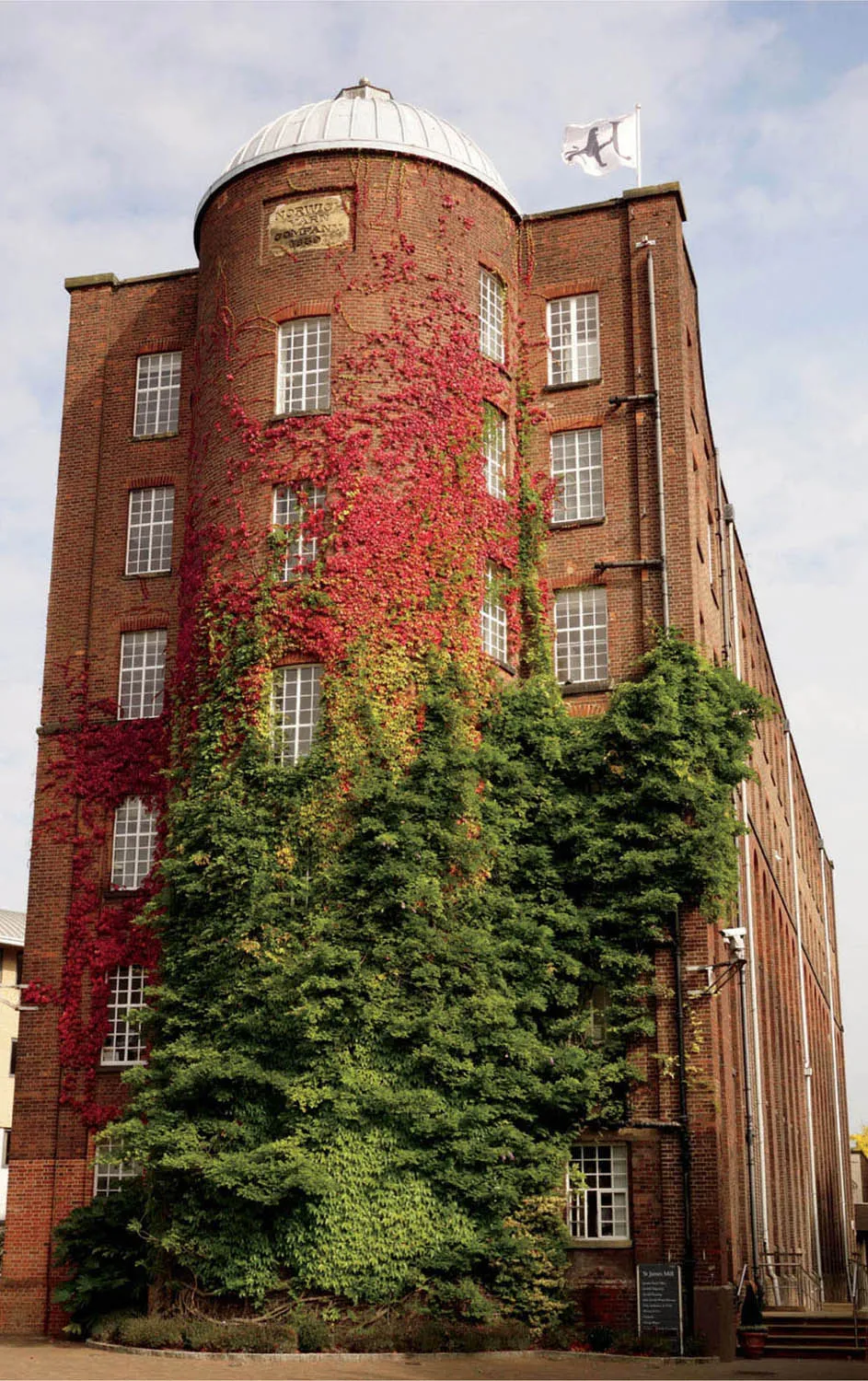
Fig. 6 The elegant, steam-powered St James’s Mill (1839) was the third mill to be built on this site beside the river Wensum in Norwich in an attempt to revive the city’s textile trade. The architect may have been the diocesan and county surveyor John Brown (1805–76), who designed the second mill (1836–39); this was demolished around 1912, along with its 1834 predecessor.
One of the earliest examples was the Soho Manufactory (1762–66) in then-rural Handsworth, just north of Birmingham. It was put up for the metal goods manufacturer Matthew Boulton (1728–1809) and designed by William Wyatt (1734–83) from the Lichfield family of architects and builders founded by Benjamin Wyatt. From a distance the Manufactory looked every inch the country house, with its end pavilions and central raised pediment. To the rear, though, stood more mundane forges and furnaces, with an enormous water wheel to provide power. Similarly, at Slane Mill in County Meath, a flour mill was built for engineer David Jebb in 1763–66, with a three-bay, pedimented central block projecting from the main frontage. The mill was the largest in Europe at the time of construction.2
In London, the immense Albion Mill (1783–86), a flour mill designed in classical style by Samuel Wyatt, briefly became a tourist attraction before it burnt down in 1791. The classical style also worked well with smaller industrial buildings, for instance the Liverpool Porter Brewery, which functioned around 1790–1815; although still recognizably a brewery, its facade included Palladian elements such as a Venetian window and a cupola.3 Gothic also had its adherents; Enoch Wood’s pottery (1789) at Burslem, Stoke-on-Trent, (the classical portion of which is still extant) featured a heavily battlemented gateway, while Irish mills of the late eighteenth century were typically tricked out with battlements and other Gothic motifs. As architects gradually took on more industrial work during the early nineteenth century, the buildings became more elaborate, but there was also a contrasting trend: less wealthy entrepreneurs tended to commission strictly utilitarian, cheaper structures.
Georgian Industrial Architects
Architects generally became involved with entrepreneurs when designing their houses. Indeed, many would not have wished to lower themselves by taking on factory or mill commissions, which in any case often comprised only the main facade; the owner and engineer or millwright decided on the building’s basic design and dimensions. The Nottingham builder and architect Samuel Stretton (1731–1811) was an exception, converting Richard Arkwright’s Nottingham works into an innovatory horse-powered cotton spinning mill in 1769. In partnership with his son William Stretton (1755–1828), their later designs included several buildings for the local textile industry, put up during the 1790s. By the early nineteenth century there were a few architects, often young men at the start of their careers, who were prepared to dabble in the industrial sector, and even specialize in works and factories. The young Decimus Burton (1800–81), who began practice in 1823, was the probable designer of the Abersychan Ironworks near Pontypool, where construction for the British Iron Company started in 1826; its classical office pavilion survives.
The first architect to build a career around designing for industry was Francis Edwards (1784–1857) of London, who studied in John Soane’s office and eventually went into practice on his own account in 1823. His long-term industrial clients were Goding’s Brewery and the Imperial Gas, Light and Coke Company, while he also took commissions from Robert Burnett’s distillery in Vauxhall (it made both gin and vinegar) and piano manufacturers Broadwood’s. Another early industrial architect was Richard Tattersall (1802–44) of Manchester, who combined his commercial work with many ecclesiastical commissions. Tattersall built at least two mills, Shaddon Mill (1835–36) in Carlisle and Samuel Brewis’s nineteen-bay cotton mill (1839) at Golborne, Lancashire. He also designed the chimney (1842) at Blinkhorn’s chemical works in Bolton, which was the tallest shaft in England until surpassed in 1909.
Fig. 7 Many mills and factories were drawn to Dartford because of its position on the river Darent. In 1888 Burroughs Wellcome & Co. bought the old Phoenix Paper Mill, which dated from the early 1850s; it was converted to a pharmaceutical plant, opened in 1889 and much extended thereafter. Here we see the site around 1905; the new building on the right bears the word ‘Tabloids’, the firm’s brand name for medicinal pills. (Courtesy of the Library of Congress, Photochrom Collection, LC-DIG-ppmsc-08610)
Distribution of Victorian Factories
Between 1700 and 1870 the location of the majority of industrial jobs changed from rural to urban, and the share of the population living in settlements of 10,000 people or more increased from twelve to forty-two per cent.4 Much of the growth was in the industrial areas of the North and Midlands, where coal was readily available: together, the West Riding of Yorkshire, Lancashire, Cheshire, Staffordshire and Warwickshire accounted for almost one-third of the total population by 1871.5 Historically, industries tend to cluster geographically; by 1881, for instance, male textile employment was almost completely concentrated in Yorkshire and Lancashire.6 At this point, the UK...