This comprehensive book, written by an acknowledged expert, is packed with useful information and is an invaluable reference work that covers all aspects of protected horticulture. It discusses the appropriate siting for a greenhouse enterprise, and covers greenhouse design principles and commercial glasshouses. It also considers cladding materials, the development and use of polythene-clad tunnel structures, and greenhouse energy sources. The greenhouse environment, growing rooms, irrigation, composts and other growing media are examined as well as plant nutrients, fertilizers, pest and disease control, nursery hygiene and much more. This is essential reading for keen amateur gardeners with an interest in growing plants under glass, and an invaluable reference work for undergraduate and post-graduate horticultural students, consultants, commercial horticultural growers and for all those involved in the protected horticultural sector. Fully illustrated with 86 colour photographs, graphs and drawings.
eBook - ePub
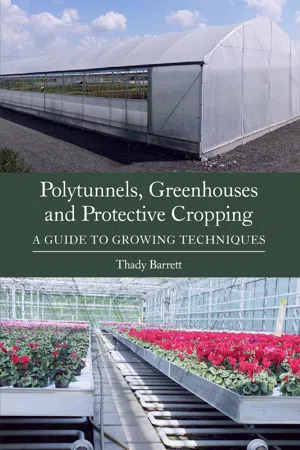
Polytunnels, Greenhouses and Protective Cropping
A Guide to Growing Techniques
- 300 pages
- English
- ePUB (mobile friendly)
- Available on iOS & Android
eBook - ePub
About this book
Trusted by 375,005 students
Access to over 1.5 million titles for a fair monthly price.
Study more efficiently using our study tools.
Information
1
Greenhouse Design Principles
In North America and in Europe there are standards set out for greenhouse designers, defined by codes to follow that consider the geographical and topographical siting and the proposed use of the project at the design stage. For example, in response to heavy storms and consequent damage in Holland in the 1980s, the ability to adequately insure glasshouses became tested. In response, the industry had to quickly come up with, and adopt, what is now the European standard (EN12021-1) to design, calculate and build in the correct glasshouse structural strength.
Greenhouse designs revolve around calculating loads that are placed on the proposed structure, but will also ensure that the structure has adequate stiffness to limit both vertical and transverse deflections. Lateral forces that consider the wind load on a structure will also cover seismic requirements. Readers wishing to know more can follow the American standards, for example via the National Greenhouse Manufacturers Association (http://www.ngma.com).
IDENTIFYING LOADS PLACED ON STRUCTURES
There is a range of ‘loads’ associated with greenhouse design; these include the following:
- Dead loads: refer to structural weight with cladding
- Live loads: refer to the roof
- Collateral loads: refer to the weight of mechanical equipment, for example such as circulations fans, permanently mounted heaters and irrigation equipment, and will also include, for example, gulleys suspended or attached to the structure for crop culture
- Plant live load: includes the weight of hanging plants at full productivity
External factors to consider include wind, snow and seismic events, which also provide a load on the proposed structure:

Single widespan greenhouse with structural components.
- Wind load: takes into consideration basic wind speed, wind exposure, prevailing wind direction, and the internal and external pressures placed on the components
- Snow load: encompasses the likelihood of snow level accumulating on the roof, mounted against the sides, and set against both the internal use and any heat requirements that can mitigate against snow load. However, in the event that the greenhouse is unoccupied for a number of weeks between crops in the winter months, the loading is now increased temporarily over the same area when the crop is being heated to 18–21°C. It may also be that temporary reduction in normal crop temperatures may be made in the worst case scenario to conserve heat where there is a possibility of an interrupted fuel supply.
Snow can be light and fluffy with a water equivalent of 12in equal to 1in of rain, or at the other extreme where 3in of wet snow equates to 1in of rain
There are generally different requirements for greenhouses that are used totally for production, and those that invite the public in (retail units), where health and safety is more stringent in response to an increased risk of injury or damage. In the latter case, building regulations governing the energy conservation aspect of the project can ultimately impact on being able to have a roof with sufficient light transmission for adequate plant growth.
GENERAL OVERVIEW
In a general overview there are features that are typical of most greenhouse designs; these are described under the following headings:
Primary roof system: Typically a truss, rigid frame, arch or something similar.
Secondary structural system: Bracing and support components, for example purlins, glazing bars, ridge beam and gutters. End-wall framing may have other roles such as supporting glazing, as well as bracing a structure and axial load.
Foundations: These may be spread footings, continuous concrete footings, or flagpole-type foundations placed directly on the earthen floor.
Cladding: This includes glass, polycarbonate, fibreglass or polythene, and other materials that have light transmission properties. For retail areas, various composite materials may be recommended to meet building regulations where a case cannot be made for ‘growing area’. These materials may also be incorporated in part of a new structure where an area is dedicated for crop preparation, or grading, packing and distribution requirements, and which is separated from the growing space.
Mobile or static structures: Early designs of mobile greenhouse were popular on market garden enterprises to extend continuity of cropping so as to extend the season. For example, early crops were established under cover, and then the entire structure was moved down to the next position for the next planting, leaving the original crop to continue growing and maturing in the open air. Crops might have been overwintered, or in the case of brassica production, young plants were sown and reared in pots ready for planting outside at the earliest opportunity in the spring. Cut flower enterprises also liked them. Early bedding plant production meant that the structure could be moved off to allow plants to harden off before marketing. The closest modern version of this is to use Spanish tunnels with their temporary covers – these are much easier to manage and cheaper to construct, but are less stable in high winds.

These mobile structures are based on galvanized frames and gutters; however, using wooden glazing bars they were designed to be moved in their entirety along ‘dollies’. The gable ends could be hinged up, the side skirts of rubber sheeting lifted, and then with the aid of a winch and a tractor, the whole structure would move down the site.
HEIGHT OF STRUCTURE
There continues to be an interest in building higher and higher greenhouses. The apprehension about increasing fuel costs pro rata does not appear to be founded on experiences that growers have from investing in higher gutter heights.
The current increase in heights reflects the following requirements:
- To accommodate equipment such as up to two separate horizontal screens
- To have suspended gutters for hydroponic crop cultivation or multi-tier baskets
- To allow for the height of vines for improved crop management and ease of picking at fruiting level
- To improve air movement generally, with the associated decrease in fungal problems
- To encourage fewer energy spikes: the greater the air volume, the slower the temperature changes, resulting in less fluctuation
- In the summer months there is a greater ‘pull’ through the higher roof vents, which creates more efficient cooling
LIGHT INTERCEPTION
During the winter months at northerly latitudes, the interception of as much light as possible determines early yield in salad crops, which commands the highest prices. Consequently much focus has been on improving light levels within greenhouses. However, in economic terms the balance has to be made between the levels of light intercepted and the heat-retaining properties of the cladding as energy costs continue to rise.
The reduction in light levels during short days at northerly latitudes is linked to the angle of the sun striking the corresponding angles used in the greenhouse structure. When light strikes the covering of a greenhouse, some of it is transmitted to benefit the plants inside, part of it is absorbed by the material itself and some is reflected. The least amount of reflection occurs at 90 degrees to sunlight, and the lower the angle the greater the reflection. Maximizing the amount of light transmitted is a matter of choice between cladding material, greenhouse design and the orientation of the greenhouse walls.
The cladding material needs to be assessed and compared for its light transmission and absorption properties, whilst reflection is a matter of angle to directional sunlight.
Glass manufacturing has advanced in leaps and bounds, with even an option now of having anti-reflective (AR) coatings built in at the manufacturing stage. AR coatings improve the transmission of diffuse light on a cloudy day. ETFE (ethylene tetrafluoroethylene copolymer) film, as used in the Eden Project in Cornwall UK, has the lowest refraction index and hence the highest transmission of light.

Traditional Dutch light greenhouse showing the sloping sides utilized to improve light interception in the winter months.
When it comes to light levels, the location and positioning of structural and ancillary support metalwork plays an important part. In mono-culture greenhouses with salad crops, growers will look at everything in order to reduce shade from greenhouse components and to maximize the diffusion of the light that enters the structure, even to putting white reflective polythene on the floor.
The orientation of crops to reduce the shadow effect requires them to run north/south, and this, along with structure design to support crop gutter systems, will decide the orientation of the greenhouse. Ironically for greenhouse operators in many northerly latitudes, the lowest light transmission rates occur when the operators need it most – that is, in winter and spring – and the highest rates occur when the operators need it least!
REFERENCE LINK
http://www.ngma.com
2
Commercial Glasshouses
A-FRAME GLASSHOUSES
Most glasshouse designs are based on the A frame as it is symmetrical and easily prefabricated before erection. However, in some climates growers may prefer a saw-tooth arrangement, and occasionally a lean-to, though the latter requires a back wall such as may be found in a traditional walled garden setting.
Whilst the following information is related to commercial horticultural enterprises raising crops, the needs of plant breeders and other research institutes are increasingly being recognized as having much higher standards of fittings and environmental control, often multi-compartmented with positive pressure atmospheres to keep out pests and diseases. Many greenhouse construction companies have experienced intense competition in the commercial greenhouse sector, so that tendering for specialist facilities such as for research, plant breeding, vertical farms projects, botanic gardens and garden centre buildings has become the norm. Also a wider view is taken, that the structure can be clad with anything...
Table of contents
- Cover Page
- Title Page
- Copyright Page
- Dedication
- Contents
- Preface
- Acknowledgements
- 1 – Greenhouse Design Principles
- 2 – Commercial Glasshouses
- 3 – Cladding Materials: Overview
- 4 – The Development and Use of Polythene-Clad Tunnel Structures
- 5 – Greenhouse Energy Sources
- 6 – The Greenhouse Environment
- 7 – Growing Rooms
- 8 – Irrigation
- 9 – Composts and other Growing Media
- 10 – Hydroponics
- 11 – Fertilizers for Greenhouse Crops
- 12 – Pest and Disease Control
- 13 – Nursery Hygiene
- Further Reading List
- Index
Frequently asked questions
Yes, you can cancel anytime from the Subscription tab in your account settings on the Perlego website. Your subscription will stay active until the end of your current billing period. Learn how to cancel your subscription
No, books cannot be downloaded as external files, such as PDFs, for use outside of Perlego. However, you can download books within the Perlego app for offline reading on mobile or tablet. Learn how to download books offline
Perlego offers two plans: Essential and Complete
- Essential is ideal for learners and professionals who enjoy exploring a wide range of subjects. Access the Essential Library with 800,000+ trusted titles and best-sellers across business, personal growth, and the humanities. Includes unlimited reading time and Standard Read Aloud voice.
- Complete: Perfect for advanced learners and researchers needing full, unrestricted access. Unlock 1.5M+ books across hundreds of subjects, including academic and specialized titles. The Complete Plan also includes advanced features like Premium Read Aloud and Research Assistant.
We are an online textbook subscription service, where you can get access to an entire online library for less than the price of a single book per month. With over 1.5 million books across 990+ topics, we’ve got you covered! Learn about our mission
Look out for the read-aloud symbol on your next book to see if you can listen to it. The read-aloud tool reads text aloud for you, highlighting the text as it is being read. You can pause it, speed it up and slow it down. Learn more about Read Aloud
Yes! You can use the Perlego app on both iOS and Android devices to read anytime, anywhere — even offline. Perfect for commutes or when you’re on the go.
Please note we cannot support devices running on iOS 13 and Android 7 or earlier. Learn more about using the app
Please note we cannot support devices running on iOS 13 and Android 7 or earlier. Learn more about using the app
Yes, you can access Polytunnels, Greenhouses and Protective Cropping by Thady Barrett in PDF and/or ePUB format, as well as other popular books in Biological Sciences & Agronomy. We have over 1.5 million books available in our catalogue for you to explore.