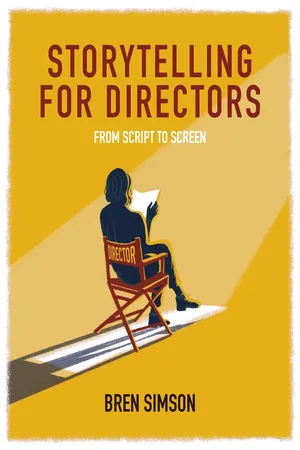
Storytelling for Directors will develop the communicative power of your storytelling, whether for the big or small screen, in long or short form. Without being prescriptive, the chapters explore the creative potential in every aspect of the filmmaking process, giving directors the skills to put their ideas into practice. Coverage includes: analysing the script to find the character action; building the story world; deciding each element within the frame; shaping the actors' performances; telling the story with the camera; casting; working the schedule, budget and rehearsals, and finally, shaping the film in the edit.
- 144 pages
- English
- ePUB (mobile friendly)
- Available on iOS & Android
eBook - ePub
About this book
Trusted by 375,005 students
Access to over 1.5 million titles for a fair monthly price.
Study more efficiently using our study tools.
Information
Subtopic
Film Direction & Production1
WHAT IS THE STORY?
ANALYSING THE SCREENPLAY
A screenplay is a visual story in written form. The job of a director is to transform the words on the page into a series of moving images. The first steps in this process of transformation take place as the director starts to interpret and re-imagine the screenplay as a visual narrative.
Storytelling in a visual medium relies, above all, on action and movement, rather than dialogue; which is not to say words are not important, but it is the emotion that lies behind them that counts. A screenplay uses minimal dialogue, relying instead on the dramatic event, the physical movement of the characters, together with their unspoken emotions, to convey the story’s meaning.
THE FIRST READ
The first task is to read the screenplay. The emotional impression the story makes on this first reading is an important guide to the film you will make and the responses you want to inspire in the audience. Even if you are the screenwriter, it is important, when starting a production, to try to read the script afresh, re-imagining it as a visual story.
The first reading is when you allow yourself to experience the story unfiltered by anything other than curiosity. Letting it wash over you, leaving an overall impression of the story. Remembering your initial response to the story will come in useful in the coming weeks, as you start to break down the screenplay into its component parts.
After the first reading comes the second, the third and so on, until you feel comfortable with the task ahead. This process of engaging intensively with the material is all about deciding how the story will work dramatically. For the writer director, it is about finding the most compelling way of turning your original idea into drama.
STORY AS DRAMATIC ACTION
This is not so much about asking, ‘What is the story about?’ this comes later, instead, it’s ‘What happens in the story?’.
For the visual storyteller, story is action, a series of events, which are time-related. How one event follows another is key to how the story or the plot moves forward, seizing the imagination of the audience so that it wants to know what happens next.
Trey Parker and Matt Stone, the writers of South Park (1997–), in a talk they gave to students at Columbia University, New York, came up with a basic rule to express this relationship between events.1 They explained that between each event you must be able to say the word ‘therefore’. This happens therefore this happens and so on. If, on the other hand, you find yourself saying this happens and then this happens, you will have a very boring story. To add more interest, you will need a complication, which is expressed as ‘but’. So, this happens therefore this happens but then this happens, a complication. The Trey Parker and Matt Stone rule is a wonderfully simple way of explaining how a story is made up of dramatic events or actions, which are all related to one another.
STORY EVENTS
In a film, each scene is a unit of action, an event or a happening, which moves the story forward within a certain timespan.
What is meant by an event? It could be a birthday party, a wedding or a funeral. The screenwriter will have chosen a particular happening because it has a special significance, often life-changing for the characters in the story. Other scenes might be lower-key – a domestic event, an encounter, an appointment with a psychiatrist. Whatever the event, something happens, an action, which will determine what happens next in the story.
As the Hollywood director Raoul Walsh opined, the only way to direct a scene is so that the audience understands what happens next. This happens therefore this happens. It is important to know the therefore not just so you understand why one scene follows another, but to understand the emotional significance of what is happening within the scene itself and whether it works for the storytelling.
The wedding in Francis Ford Copoola’s The Godfather (1972) unfolds as a predicable Italian Mafia wedding on an extravagant, no-expensespared scale, appropriate to the status of its leading character, played by Marlon Brando. However, its dramatic purpose is to bring all the main characters, all members of the same family, including three brothers and a sister, whose wedding it is, together in one place, at the beginning of the film.
During the wedding, the struggle as to who might inherit the family business, one of the central themes of the movie, is brought into sharp focus in a series of incidents in which each member of the family reveals their essential character, destined to have a profound effect on how the story plays out. The fact that each incident follows logically and purposefully, one after another, is not what the audience will remember about the wedding, but the sequence of events is essential to engaging the audience’s interest in what happens.
Analysing the dramatic purpose of each scene in a screenplay, or in the script of a small-screen episode, is essential to understanding its importance for the storytelling structure of the film. How it fits into the plot.
THE DRAMATIC STRUCTURE
Theorists of dramatic structure point out that drama is the art of preparing crises. A series of interesting incidents or events may indeed be as entertaining as a complete narrative. But real drama is created by the continuous and very real involvement of the audience as its emotions are engaged both in advance of the crisis and then in the repercussions of what they have just witnessed.
Alexander Mackendrick, On Film-Making3
SCENE STRUCTURE
Every scene or event has a beginning, a middle and an end. The main story might employ a more sophisticated three-act structure. The five-act structure is not unusual, although more recently there has been a trend towards a one-act structure, most often found in short films.
The structure of a scene can be broken down still further into beats. A beat is when there is a significant change in the intentions of the main character as they react to the other character or characters in the scene. The change can come on a line of dialogue or in a gap or pause between the lines. These changes to the main character’s emotions and intentions come out of the conflict or tension generated by the obstacles placed in the way of their wants by the other character – the antagonist. These changes to the character’s thinking will move the story on to the next action or event.
There can be no drama without tension or conflict between characters. As Alexander Mackendrick points out, action without tension is merely activity.2 Writing a letter is an activity but receiving a letter, which remains unread and unopened, can be a moment of dramatic tension.
Conflict creates drama by building the tension and the audience’s feelings of anticipation about what will happen next.
CONFLICT
Robert Benton’s Kramer vs. Kramer (1979) was a ground-breaking film in its day. Dustin Hoffman plays a father, Ted Kramer, left to bring up his young son when his wife leaves him. The wife, Joanna, played by Meryl Streep, feels stifled by the marriage and wants to find herself by leaving and starting a new life.

Joanna ‘It’s me, it’s my fault’. Dustin Hoffman and Meryl Streep in Kramer vs. Kramer (1979), directed by Richard Benton. Columbia. TCD/PROD.DB/ALAMY STOCK PHOTO
At the time, the Women’s Liberation Movement in America and the UK was raising issues around women’s exploitation inside and outside marriage. One of the key demands of the movement was wages for housework. Women began to form conscious-raising groups to explore their problems and find a voice.
At the start of the film, in a sequence designed to build the audience’s anticipation of an impending crisis, we see Ted, an advertising executive, being given a promotion. He celebrates with his boss, which makes him late home. We see Joanna, his wife, saying goodnight to her son, followed by packing a suitcase. She is waiting for Ted, with her packed suitcase by the door, when he finally knocks on the door of their New York apartment. He has forgotten his keys. This is the start of the crisis scene, an inciting incident, so called because it sets off the chain of events that make up the story.
In the scene, the conflict develops as Joanna tells Ted she is leaving him and proceeds to hand over her credit cards and her keys. Ted tries to stop her. His pleading reveals how inadequate his understanding of her feelings is, while Joanna’s responses show her desperation to leave. She explains that she feels inadequate as a mother and a woman, making it clear that, in her mind, she has no alternative but to go.

Floor plan of ‘Joanna leaving Ted without taking Billy’. Kramer vs Krammer. MAXIMILLIAN MENA

Joanna makes her escape. Kramer vs. Krammer. MAXIMILLIAN MENA
Meryl Streep’s highly charged performance as Joanna reveals her internal...
Table of contents
- Cover
- Title
- Copyright
- Contents
- Acknowledgements
- Introduction
- 1 What is the Story?
- 2 Finding the Theme
- 3 Character and Performance as the Engine of Story
- 4 The Producer, The Director and the Budget
- 5 Designing the Story World
- 6 The Moving Image
- 7 Working With Actors
- 8 From Script to Screen
- 9 The Edit
- Endnotes
- Index
Frequently asked questions
Yes, you can cancel anytime from the Subscription tab in your account settings on the Perlego website. Your subscription will stay active until the end of your current billing period. Learn how to cancel your subscription
No, books cannot be downloaded as external files, such as PDFs, for use outside of Perlego. However, you can download books within the Perlego app for offline reading on mobile or tablet. Learn how to download books offline
Perlego offers two plans: Essential and Complete
- Essential is ideal for learners and professionals who enjoy exploring a wide range of subjects. Access the Essential Library with 800,000+ trusted titles and best-sellers across business, personal growth, and the humanities. Includes unlimited reading time and Standard Read Aloud voice.
- Complete: Perfect for advanced learners and researchers needing full, unrestricted access. Unlock 1.5M+ books across hundreds of subjects, including academic and specialized titles. The Complete Plan also includes advanced features like Premium Read Aloud and Research Assistant.
We are an online textbook subscription service, where you can get access to an entire online library for less than the price of a single book per month. With over 1.5 million books across 990+ topics, we’ve got you covered! Learn about our mission
Look out for the read-aloud symbol on your next book to see if you can listen to it. The read-aloud tool reads text aloud for you, highlighting the text as it is being read. You can pause it, speed it up and slow it down. Learn more about Read Aloud
Yes! You can use the Perlego app on both iOS and Android devices to read anytime, anywhere — even offline. Perfect for commutes or when you’re on the go.
Please note we cannot support devices running on iOS 13 and Android 7 or earlier. Learn more about using the app
Please note we cannot support devices running on iOS 13 and Android 7 or earlier. Learn more about using the app
Yes, you can access Storytelling for Directors by Bren Simson in PDF and/or ePUB format, as well as other popular books in Media & Performing Arts & Film Direction & Production. We have over 1.5 million books available in our catalogue for you to explore.