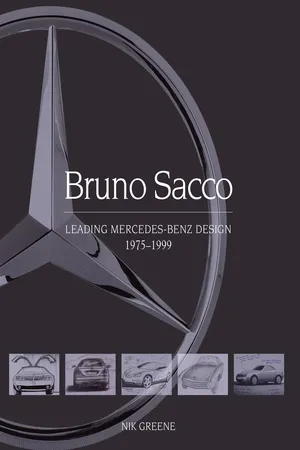
When Bruno Sacco walked through the doors on his first day at Mercedes-Benz on 13 January 1958 it is highly unlikely that his Daimler-Benz colleagues could ever imagine that this nervous young man would not only revolutionize design but would change the way design and innovation connected with brand tradition forever. Bruno Sacco is one of the most influential automotive designers of the late twentieth century; many models launched during his era now characterize the Mercedes-Benz brand. When Nik Greene asked Bruno Sacco to assist with this book, he replied humbly 'No-one designs a car alone, and more to the point, I never, for one minute, wanted to. From the moment I became Head of Design, I put down my pens and became a manager of minds.' With over 330 photographs and illustrations, this book includes an overview of the early days of functional vehicle design; the influence of safety on design evolution; protagonists of Daimler-Benz design from Hermann Ahrens to Paul Bracq; design philosophy and innovation under Bruno Sacco; the Sacco-designed cars and, finally, the Bruno Sacco legacy.
- 192 pages
- English
- ePUB (mobile friendly)
- Available on iOS & Android
eBook - ePub
About this book
Trusted by 375,005 students
Access to over 1 million titles for a fair monthly price.
Study more efficiently using our study tools.
Information
CHAPTER ONE
THE EARLY DAYS OF AUTOMOBILE DESIGN
FROM THE CARRIAGE TO THE FIRST PROPER CAR
In the mid- to late nineteenth century, as industrialization gradually took hold in Europe and north America, huge leaps forward in technology began to spill over into public and domestic life. Engineers, scientists, inventors and mathematicians were changing the face of society and, with the development of steam-powered engines, the world was opening up as never before.
Although vast stretches of railway were being built in earnest across the western world, many people (at least, those who could afford it) still travelled by carriage, pulled by horses or oxen on roads that were both made and unmade, many following ancient paths. It is hardly surprising that, in the early days of the automobile, many of the first ‘cars’ were built in the tradition of the horse-drawn carriage. It was the only design there was, after all.
For their first car, in 1886, Gottlieb Daimler and his chief designer Wilhelm Maybach mounted an engine into a modified carriage. The standing power unit protruded through the floor of the vehicle in front of the rear seats. A couple of years later, Carl Benz took a different design approach for his first automobile; his three-wheeler was more heavily influenced by the bicycle, with a horizontal single-cylinder engine mounted at the rear.
Daimler and Maybach quickly followed Benz in finding their own design style. In 1889, they presented their elegant two-cylinder wire-wheeled car with tubular frame, which also unmistakably borrowed design elements from bicycle manufacture.
Although Benz and Daimler had undoubtedly taken the first significant steps into the world of automobile design, their stylistic ambitions met with limited enthusiasm initially. With most radical design innovation, it takes some time to convince enough potential customers of its attributes. For the first time, the developers of the automobile were realizing that it does not matter how innovative a design is; it is the opinion of the customer that keeps a company buoyant.

Artisan-built G. Tibert 1892 17 HP.
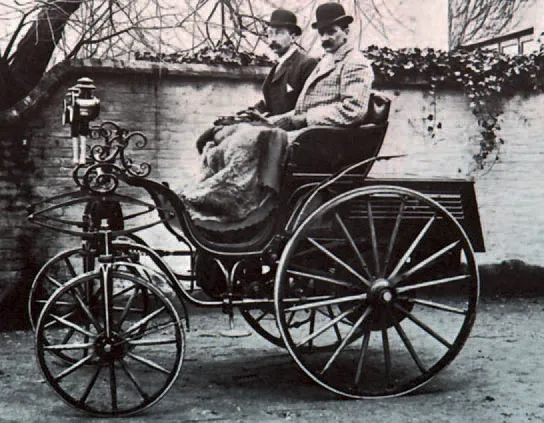
Lutzmann-built ‘horseless carriage’ (1895).

An unknown chain-driven carriage from 1896.

Gottlieb Daimler in the back of his first ‘motor carriage’, driven by his son Adolf.

Carl Benz two-cylinder motor car, with wire wheels, showing the innovative tubular frame.

Carl Benz patent, 2 November 1886.
In simple terms, customers in the late nineteenth century were accustomed to modes of transport looking like a carriage and this is what they expected of the new automobile. At first, both Benz and Daimler were forced to respond to the conservative thinking and returned once again to carriage design. Progress and design had to be paired with conformist thinking.
Perhaps this was no bad thing. A company chronicle produced by Benz in 1910 cited a publication on the subject that dated from the early days of the automobile:
Motor cars can follow the designs of the various customary forms of carriage. When observing the vehicle from the exterior, one notices only the absence of a drawbar and the extension of the carriage body to the rear. This lengthened carriage body serves to accommodate the driving force, the engine, whereas the drawbar is replaced by a steering stick located in front of the driver’s seat.
In order to ensure that the new motor car would appeal to potential customers, Daimler-Motoren-Gesellschaft (Daimler Motors Company, or DMG) – the engineering company that had been founded in 1890 by Daimler and Maybach – needed to convince the public that every horse-drawn carriage could be converted to an automobile by the installation of a motorized mechanism. It was no wonder, then, that carriage design in all its diversity remained the benchmark during the early period.
On 8 March 1886, Gottlieb Daimler ordered a carriage in the ‘Americaine’ version from coachbuilder Wilhelm Wimpff & Sohn, ostensibly as a present for his wife Emma’s forthcoming birthday. It became the first commercial ‘motor carriage’, and it was exactly that – a motorized carriage. It was not until 1889 that Daimler and Maybach were able to move slightly away from conventional carriage technology, by introducing the wire wheel, a two-cylinder engine and a manual gear transmission. It was another small but significant step forward in motor vehicle design.

Daimler introduced wire wheels in 1889.

1895 belt-driven two-cylinder.
Even as late as 1897, Daimler’s belt-driven cars had remained heavily influenced by carriage design. Handcrafting still dominated and, as such, the early automobiles had no individualistic design styling. The only area where design was a factor at this stage concerned the location of the drive system, and the quest for a sensible solution to this issue would change everything. Most designers were convinced that it was preferable to install the motor behind and below the passenger area. However, when Panhard et Levassor decided to introduce a front-engined car in the early 1890s, the first design challenge (both in terms of concept and construction) arose.
Émile Levassor and René Panhard were great friends of Gottlieb Daimler, and the three engineers often shared information about updates to their vehicles. The Panhard et Levassor concept was adopted by Daimler in 1897; four years later, Carl Benz introduced his first front-engined car.
Despite this important step in functional design, the first front-engined vehicles were still closely modelled on the form of a carriage, with very high ground clearance and a stout appearance. DMG still had to learn that design needed to be more than simply led by function. It took a prototype designed by Paul Daimler (see below), the eldest son of the company founder, as well as a magazine article, to convince them. The article appeared in the Scientific American periodical in 1899 and described the Daimler ‘Phoenix’ as ‘a queer-looking thing’, with a ‘picturesque ugliness’. According to the journalist, it was to be hoped that ‘some gifted genius may soon arrive … and whip it into shape and make it a damned sight more presentable!’
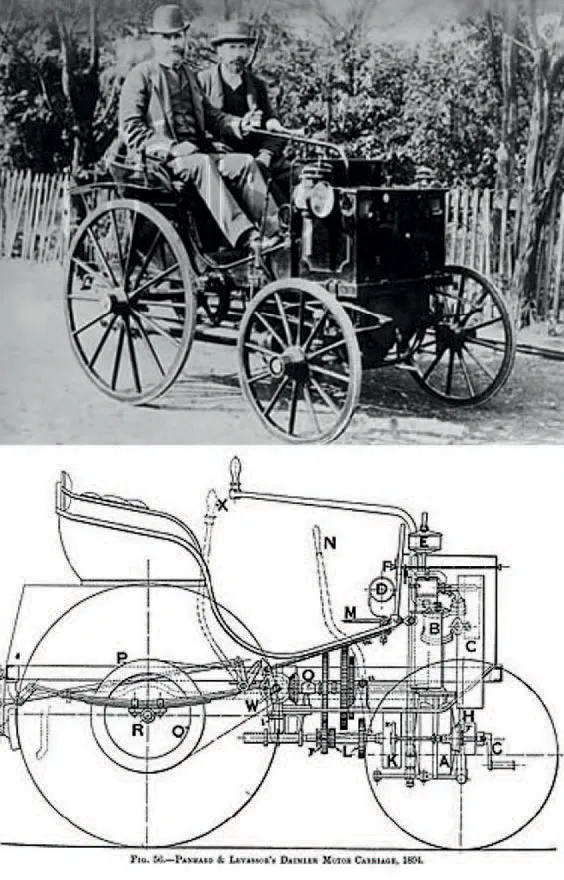
1894 Panhard-Levassor front-engined motor car using a Daimler engine.

1897 ‘horseless carriage’ with optional roof covering.

1897 Daimler Vis à Vis, with a Phoenix engine in the front for the first time.

Daimler Phoenix car, 1898 –1902, with the engine at the front and a four-speed gearbox.
THE PAUL DAIMLER CAR
Paul Daimler, the eldest son of the company founder, worked in the design office of DMG from 1897 onwards. The young Daimler often considered Wilhelm Maybach’s design concepts to be in competition with their own, and was no...
Table of contents
- Cover
- Title
- Copyright
- Contents
- Preface & Acknowledgements
- Milestones of Mercedes-Benz Design
- CHAPTER 1 THE EARLY DAYS OF AUTOMOBILE DESIGN
- CHAPTER 2 DESIGNING THROUGH SAFETY AND ACCIDENT RESEARCH
- CHAPTER 3 THE PROTAGONISTS
- CHAPTER 4 SHAPING THE BRAND THE SACCO WAY
- CHAPTER 5 THE MODELS
- CHAPTER 6 SACCO'S LEGACY
- Index
Frequently asked questions
Yes, you can cancel anytime from the Subscription tab in your account settings on the Perlego website. Your subscription will stay active until the end of your current billing period. Learn how to cancel your subscription
No, books cannot be downloaded as external files, such as PDFs, for use outside of Perlego. However, you can download books within the Perlego app for offline reading on mobile or tablet. Learn how to download books offline
Perlego offers two plans: Essential and Complete
- Essential is ideal for learners and professionals who enjoy exploring a wide range of subjects. Access the Essential Library with 800,000+ trusted titles and best-sellers across business, personal growth, and the humanities. Includes unlimited reading time and Standard Read Aloud voice.
- Complete: Perfect for advanced learners and researchers needing full, unrestricted access. Unlock 1.4M+ books across hundreds of subjects, including academic and specialized titles. The Complete Plan also includes advanced features like Premium Read Aloud and Research Assistant.
We are an online textbook subscription service, where you can get access to an entire online library for less than the price of a single book per month. With over 1 million books across 990+ topics, we’ve got you covered! Learn about our mission
Look out for the read-aloud symbol on your next book to see if you can listen to it. The read-aloud tool reads text aloud for you, highlighting the text as it is being read. You can pause it, speed it up and slow it down. Learn more about Read Aloud
Yes! You can use the Perlego app on both iOS and Android devices to read anytime, anywhere — even offline. Perfect for commutes or when you’re on the go.
Please note we cannot support devices running on iOS 13 and Android 7 or earlier. Learn more about using the app
Please note we cannot support devices running on iOS 13 and Android 7 or earlier. Learn more about using the app
Yes, you can access Bruno Sacco by Nik Greene in PDF and/or ePUB format, as well as other popular books in Technology & Engineering & Automotive Transportation & Engineering. We have over one million books available in our catalogue for you to explore.