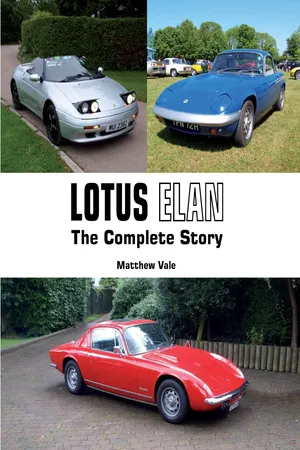
The Lotus Elan was Lotus's definitive roadster. It replaced the elegant but expensive Lotus Elite and was the first car to employ the innovative Lotus steel backbone chassis. The original Elan was produced as a two-seat, open-top sportscar and hardtop coupe from 1962 to 1973. The range was extended by the addition of the 2+2-seater Plus 2 from 1967 to 1974. Lotus introduced an all-new front wheel drive Elan in 1989, the M100, which was produced until 1995. Lotus Elan studies the history and development of all the Elans and describes each model in detail. It gives technical details for all models, examines unusual conversions, and includes driving experiences from Elan owners. A complete and readable resource for all Lotus Elan owners and motoring enthusiasts who aspire to own one of these iconic British sports cars. Superbly illustrated with 250 colour photographs.Matthew Vale is a motoring author and passionate Lotus Elan enthusiast.
- 176 pages
- English
- ePUB (mobile friendly)
- Available on iOS & Android
eBook - ePub
About this book
Trusted by 375,005 students
Access to over 1 million titles for a fair monthly price.
Study more efficiently using our study tools.
Information
CHAPTER ONE
THE LOTUS ELAN IN CONTEXT
Introduction
Elan is an evocative name for Lotus, as it was the name given to the company’s first truly commercially successful road car. Following the sophisticated but racing-oriented Elite, the original Elan of the 1960s was the right car at the right time, a sophisticated road car based on race-winning technology, powered by Lotus’s own Ford-based engine, which gave the customer superb performance, handling and roadholding combined with acceptable levels of refinement and comfort.
The car outperformed and out-handled the British-built opposition, was much cheaper than foreign exotica and enabled Lotus to become a successful and profitable volume car manufacturer in its own right. Lotus introduced a larger four-seater Elan, the Plus 2, in 1967 to capitalize on the growing market for larger sports cars and produced it alongside the original Elan.
Lotus then moved away from the small sports-car market in the 1970s and 1980s with the larger, upmarket wedge-shaped four-seater Elite (not to be confused with original 1950s Lotus Elite), the Coupé-styled Eclat and Excel and the mid-engine Esprit ranges, which, while they were outstanding cars in the Lotus tradition, had only limited commercial success. So in the late 1980s and early 1990s Lotus tried to emulate the original Elan’s success with a new small sports car, also called the Elan. This front-wheel-drive car was aimed squarely at the small sports-car market, just as the original Elan had been, and also had class-leading performance, handling and roadholding. However, while it was critically acclaimed by the motoring press and has a strong following today, it did not sell in the numbers needed to recoup its costs and so was dropped by 1995.

The last incarnation of the Elan was the Sprint. With its excellent performance, the Elan was the epitome of the British sports car.

The Elan Plus 2 was introduced in 1967 as a larger 2+2 version of the original Elan. To some eyes it was better proportioned than the original and was an excellent GT car.

The M100 Elan was introduced in 1991 and, in true Lotus fashion, was an excellent performer.
Lotus Company History Pre-Elan
The founder of Lotus, Anthony Colin Bruce Chapman, was born on 19 May 1928, in Richmond, Surrey, and was bought up in North London by his parents, Stanley and Molly Chapman, who ran a successful catering business and the Railway Hotel in Tottenham Lane, Hornsey. In October 1945, Colin Chapman started studying for a degree in civil engineering at University College, London, from which he graduated in 1948. While he was at university he dealt in second-hand cars, but the withdrawal of the basic petrol ration in October 1947 meant that the bottom fell out of the second-hand market, and Chapman ended up having to sell his current stock at a loss, thus wiping out all his profits from the enterprise. One car could not be shifted, a 1930 Austin Seven saloon, so Chapman had to keep it. He was busily converting this into a touring car when he came across a car trial in Aldershot, and was so inspired by the spectacle that he changed direction and converted the Seven into what would become the first Lotus – a trials special.
When it was completed, the car had to be re-registered (with the registration number ‘OX 9292’) and as Chapman did not want it to be called an ‘Austin Special’ on the registration logbook, he decided to call it the Lotus Mark 1. The origins of why Chapman chose the ‘Lotus’ name remain obscure to this day. The Lotus Mark 1 was built by Chapman with lots of help from his girlfriend and wife-to-be Hazel Williams while working out of a lock-up garage owned by Hazel’s father. The car featured a body that was made from aluminium sheet attached to plywood and, following Chapman’s study of aircraft design and construction, the body was designed to be rigid, light and strong enough to brace the flexible Austin chassis. The Lotus Mark 1 was put to good use in the following year, 1948, with Chapman and Hazel competing in numerous trials around the country.
While Chapman was at university, he had gained his private pilot’s licence through membership of the University Air Squadron and on graduation in 1948 he took up a short service commission in the RAF, mainly, it was rumoured, to cont...
Table of contents
- LOTUS ELAN
- CONTENTS
- ACKNOWLEDGEMENTS
- PREFACE
- CHAPTER ONE THE LOTUS ELAN IN CONTEXT
- CHAPTER TWO THE HEART OF THE MATTER – THE LOTUS TWIN CAM ENGINE
- CHAPTER THREE THE ORIGINAL ELAN
- CHAPTER FOUR THE PLUS 2
- CHAPTER FIVE THE ELAN 26R AND COMPETITION
- CHAPTER SIX ELAN M100 – 1989 TO 1999
- CHAPTER SEVEN OWNING, RUNNING AND MODIFYING
- RESOURCES FOR THE ELAN OWNER
- INDEX
- RELATED TITLES FROM CROWOOD
Frequently asked questions
Yes, you can cancel anytime from the Subscription tab in your account settings on the Perlego website. Your subscription will stay active until the end of your current billing period. Learn how to cancel your subscription
No, books cannot be downloaded as external files, such as PDFs, for use outside of Perlego. However, you can download books within the Perlego app for offline reading on mobile or tablet. Learn how to download books offline
Perlego offers two plans: Essential and Complete
- Essential is ideal for learners and professionals who enjoy exploring a wide range of subjects. Access the Essential Library with 800,000+ trusted titles and best-sellers across business, personal growth, and the humanities. Includes unlimited reading time and Standard Read Aloud voice.
- Complete: Perfect for advanced learners and researchers needing full, unrestricted access. Unlock 1.4M+ books across hundreds of subjects, including academic and specialized titles. The Complete Plan also includes advanced features like Premium Read Aloud and Research Assistant.
We are an online textbook subscription service, where you can get access to an entire online library for less than the price of a single book per month. With over 1 million books across 990+ topics, we’ve got you covered! Learn about our mission
Look out for the read-aloud symbol on your next book to see if you can listen to it. The read-aloud tool reads text aloud for you, highlighting the text as it is being read. You can pause it, speed it up and slow it down. Learn more about Read Aloud
Yes! You can use the Perlego app on both iOS and Android devices to read anytime, anywhere — even offline. Perfect for commutes or when you’re on the go.
Please note we cannot support devices running on iOS 13 and Android 7 or earlier. Learn more about using the app
Please note we cannot support devices running on iOS 13 and Android 7 or earlier. Learn more about using the app
Yes, you can access Lotus Elan by Matthew Vale in PDF and/or ePUB format, as well as other popular books in Technology & Engineering & Automotive Transportation & Engineering. We have over one million books available in our catalogue for you to explore.