![]()
CHAPTER ONE
PEUGEOT BEFORE THE 205
The lion was a key factor in Peugeot’s branding from early in its history.
The Peugeot family can trace its businesses back as far as the nineteenth century, but it was the arrival of the industrial revolution in France that set the family on its path to automotive manufacture. Two brothers, Jean-Pierre and Jean-Frédérick, set up a steel mill near Montbéliard in eastern France. At just nineteen, Jean-Frédérick developed a technique that saw the company mass-produce tools such as saws that were both high in quality and low in price. By the 1850s the company was producing everything from animal hair clippers to women’s underwear. It was the production of lingerie that ultimately led to the company’s move into vehicle production.
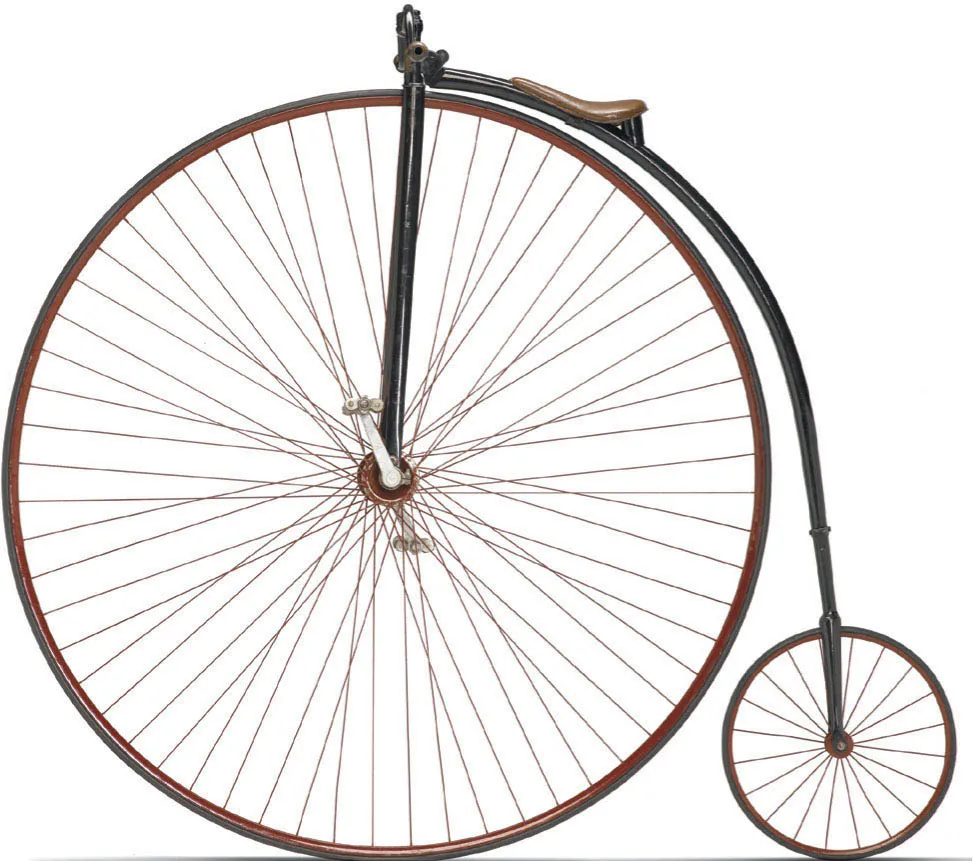
Traditionally whalebone had been used in the production of corsets, making them the preserve of only the wealthiest people in the country. Peugeot changed all that by using steel instead of bone, allowing corsets to be made much cheaper. As bicycles became more popular, Peugeot repurposed their machinery to produce spokes for bicycle wheels. Within five years the company was selling its own bicycles and became one of the country’s top manufacturers.
Tool manufacturing formed the basis of Peugeot’s early business. The tools were highly regarded for their quality and affordability.
FROM TWO WHEELS TO FOUR
With bicycle production now in full swing, the great-grandson of Peugeot’s founder, Armand Peugeot, felt the company’s future lay in more than just bicycles. He had spent some time in Britain studying production methods. At his behest, the company built its first vehicle, the Type 1, a steam-driven, three-wheeled car.
Armand drove the car from Paris to Lyon, and though it was plagued with reliability issues, it was well received by the visitors to the 1889 Paris Exposition, where Emile Levassor was impressed with the car – though not the engine that powered it. Levassor had just acquired production rights for Daimler’s petrol engine. Soon enough Levassor and Peugeot joined forces. In 1890 the company produced its first four-wheeled petrol-driven vehicle and by 1896 Peugeot was producing its own petrol engines. After four years the company had produced seventy-five cars and Peugeot had begun to export the car.
Armand Peugeot – the father of Peugeot’s motor cars.
Peugeot’s move into transportation began with bicycles.
The other members of the Peugeot family did not share Armand’s confidence in the motor car and insisted he set up his own plant. He did, and saw the new company’s fortunes grow and grow. By the dawn of the twentieth century the company offered fifteen different models.
The rest of the Peugeot family saw the error of their ways and produced their first car in 1905, in direct competition with Armand. In 1911 the two companies joined forces and built a new factory in Sochaux, close to the border with Switzerland, where its operational headquarters remain to this day. Before the outbreak of the First World War Peugeot was producing almost 10,000 cars annually across four factories with a range of eighteen models. During the war the company became involved in the war effort, producing trucks, armaments and aeroplane engines.
While still in its formative years the company enjoyed motor-sport success, winning the French Grand Prix in 1912 and 1913 as well as the Indianapolis 500 in 1913, 1916 and 1919.
The Type 5 (1893–96) was one of Peugeot’s early ‘horseless carriages’ – it was also the first Peugeot to enter competition.
The Quadrilette arrived after the First World War and proved popular thanks to its low cost and impressive reliability.
After the war Peugeot began production of a small car, the Quadrilette. The little 667cc car gained a strong reputation for its impressive fuel economy, and before long it was offered with a larger 720cc engine. Almost 100,000 Quadrilettes were sold between 1920 and 1929.
As the company grew in size, so did the number of employees. The Peugeot family was keen to provide its staff with an activity for their leisure time. Football was becoming increasingly popular across Europe and Jean-Pierre Peugeot, head of the company, set about creating a team for his staff to support. Thanks to the company’s success, he had the funding to do it and in 1928 FC Sochaux-Montbéliard was formed.
The club began playing in the lowest tier of the league but quickly gained notoriety when Jean-Pierre admitted to paying his players, something that was strictly forbidden at the time. FC Sochaux became strong advocates for professionalism within the game and were the first club to become professional in 1929, in the process becoming founder members of the French football league. The club went further, too, organizing a competition, La Coupe Peugeot, featuring the best clubs in France. Close links have been maintained with the football club to this day, with Peugeot being principal shirt sponsors of the team and retaining ownership of the club itself.
TWO IS THE MAGIC NUMBER
In 1929 Peugeot introduced the 201, the cheapest four-seater in France, which in 1931 became the world’s first mass-produced car with independent front suspension. The car’s name came from the fact that it was Peugeot’s 201st design. (Thereafter all Peugeot models would feature a zero in the middle of the name – see box.) Unlike any other car in Peugeot’s history, the 2-series range is the only one to have a continuous sequence of models, right up to today’s 208.
The 201 was launched in 1929 and began the legendary 2 series.
WHAT’S IN A NAME?
Until the late 1920s each distinct model was given a ‘Type’ designation by Peugeot, even if it was known to the public by another name. This changed in 1929 when the 201 replaced the Type 190 and a new three-digit naming convention was established. It is simple to decipher: the first digit represents the model size, the middle is always a zero and the final figure(s) represents that particular generation of model. So although the 201 was the 201st Peugeot design, it was also the first generation of the 2 series, hence 201. During the 1930s, some Peugeots were named according to the amount of power they produced, hence the 5CV and 10CV. Peugeot acted to secure every variant of their new naming system, to prevent other manufacturers from interrupting the sequence. This most noticeably forced Porsche to rename its 901 concept the 911, though Peugeot chose not to take action against Ferrari when the Ferrari 308 was unveiled. The naming system was modified in 2012, with the brand-identifying ‘0’ (or ‘00’) remaining in the middle and the end digit becoming ‘1’ or ‘8’ to determine whether the car was intended for established markets, ‘8’ for markets such as Western Europe and ‘1’ for emerging markets.
Peugeot’s numbering system survived until the launch of the 208 in 2012.
Improvements in production techniques lifted Peugeot’s annual production capacity to 43,000 units and over 140,000 vehicles were built during the 201’s lifetime. The more aerodynamic 301 appeared in 1933, followed in 1934 by a convertible model sporting a revolutionary folding roof operated by compressed air, which also opened the boot in order to stow the hood away.
Production of the 202 was interrupted by the outbreak of the Second World War.
The 202 succeeded the 201 in 1938. Featuring an 1133cc, water-cooled engine it demonstrated once again Peugeot’s ability to develop a wide range of vehicles from a single model. It was offered as a four-door saloon, a two-door convertible, a pick-up truck an...