The tomato is a popular and versatile choice in the garden. It is vibrant, nutritious and delicious. It can be grown from hanging baskets with herbs, can yield prolific crops, and can cheer up a summer salad with its red, yellow, orange or green hues.This practical book explores all aspects of growing tomatoes from cultivar selection and plant raising, through outdoor and protected crop production, to plant care and training. It also advises on what to do if things start to go wrong. Topics covered include: tomato history; guide to choosing cultivars; ideas for growing tomatoes; advice on greenhouses; instruction on pests and diseases. Written by a specialist, it will ensure that every gardener enjoys their tomatoes to the full. Superbly illustrated with 135 colour photographs.
- 128 pages
- English
- ePUB (mobile friendly)
- Available on iOS & Android
eBook - ePub
About this book
Trusted by 375,005 students
Access to over 1.5 million titles for a fair monthly price.
Study more efficiently using our study tools.
Information
Topic
Scienze biologicheSubtopic
Orticoltura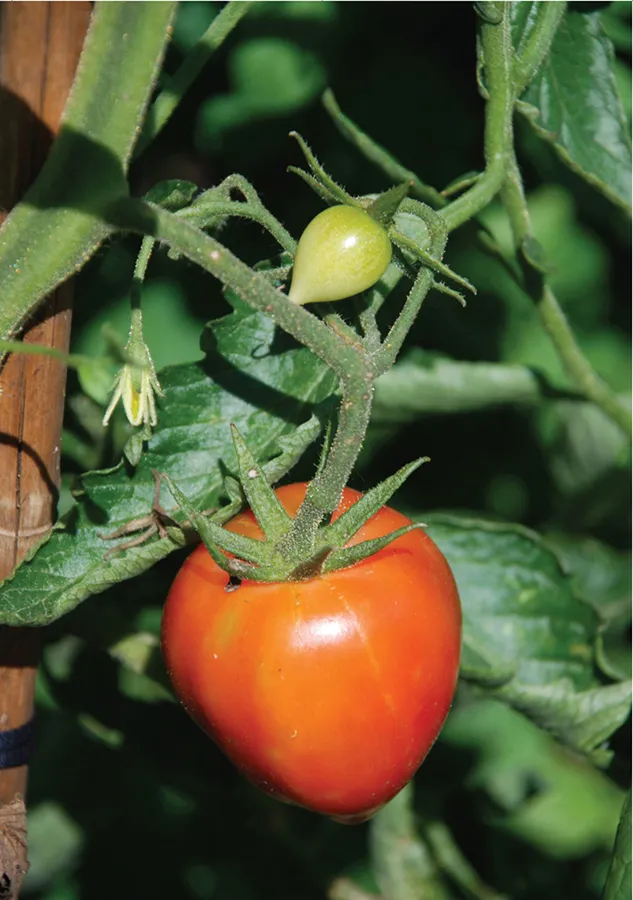
Nutritious and delicious, the tomato is a favourite crop for the gardener.
1 TOMATO HISTORY
The original wild tomatoes come from South America, and can still be found in Peru, Bolivia, Ecuador, Chile and Colombia. Rather oddly there is no word for the plant in early South American Indian languages, and certainly no record of its cultivation, so it seems unlikely that any of the early local inhabitants found a use for it. Of the thirteen wild species considered as ‘tomatoes’, no single one of these is recognized as being the direct ancestor of the modern cultivated tomato, though genetically the closest relative is the tiny fruited Lycopersicon pimpinellifolium, or redcurrant tomato.
The first cultivation of the tomato appears to have been by the Aztecs in what is now Mexico, some 2,000 miles distant from its native region. When the Spanish conquistadors arrived they found an advanced agricultural system, and yellow-fruited tomatoes being grown. How the Aztecs got their hands on the original plants from 2,000 miles away is something of a mystery, though a believable theory is that over time, seeds of the plants would have had found their way into the area courtesy of migrating birds. Tomato seeds are well known for their ability to pass through the digestive tract, as the stories of bumper crops of tomato plants found at sewage treatment works will support.
The tomato made its way into Europe, and also into Spanish colonies in North America and the Caribbean, in the very early 1500s, although some attribute its introduction into Europe to Columbus as early as 1498. As the first tomatoes to appear in Europe were the yellow-fruited form, they gained the name pomo d’oro’ or ‘golden apple’, which remains the same in Italian to this day. The tomato gets a mention in several of the early herbals from the mid-1500s and 1600s. Writing in 1550, Pier Andrea Mattioli used the Italian name ‘pomodoro’ – but he also mentioned that there was a red form of the fruit.
Initially no one seemed particularly impressed by the fruit; though edible it was identified as a close cousin of the deadly nightshade, so became regarded as slightly suspicious, if not quite as dangerous as its relative.
The date of the introduction of the tomato to England is usually given as 1596, but was almost certainly earlier as the first description of the fruit in the English language came courtesy of John Gerard in his Herball of 1597. Gerard was also fairly unimpressed, writing: ‘In Spaine and those hot regions they used to eate the apples prepared and boil’d with pepper, salt and oyle, but they yeeld very little nourishment to the bodie.’
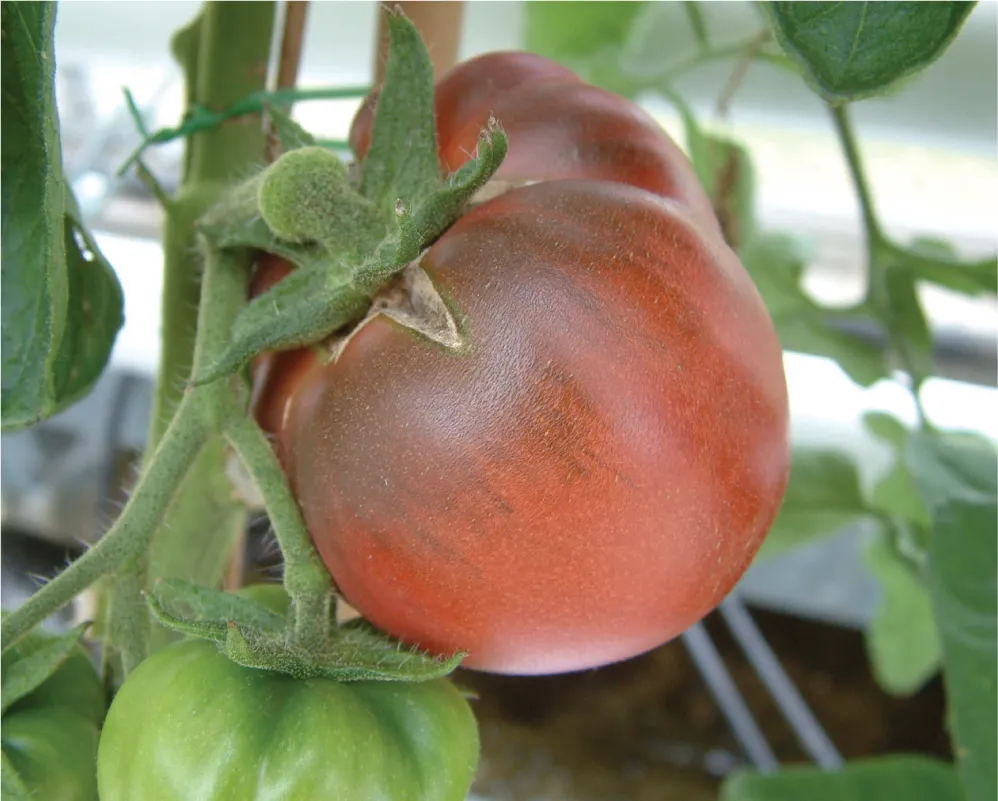
‘Black Russian’, an interesting old heritage cultivar.
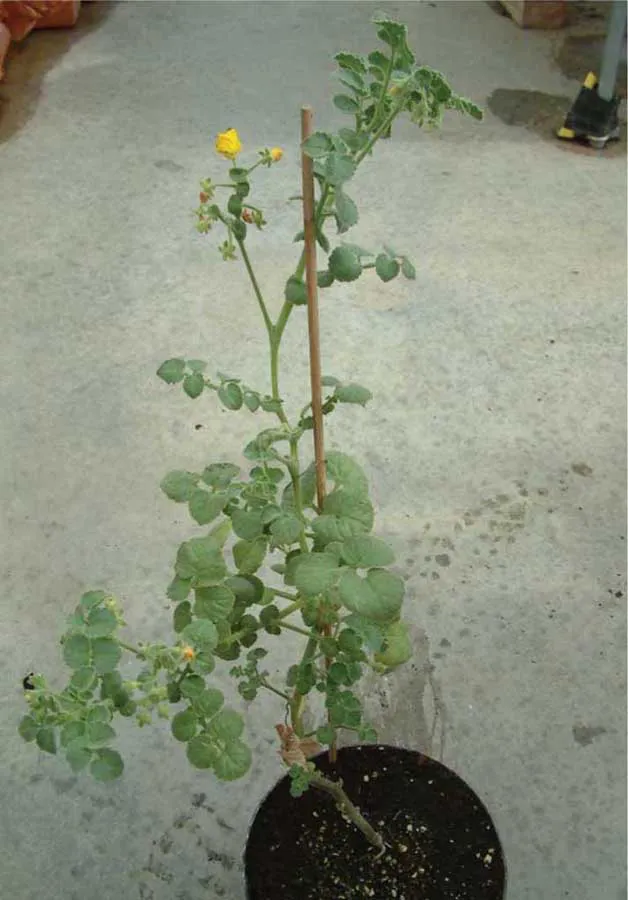
Lycopersicon penellii – a ‘wild’ tomato.
By the end of the sixteenth century the redfruited form had become more commonplace, and in England had picked up the common name ‘love apple’; the reason for this is lost in history, possible theories ranging from the associations with the red colour of the fruit, to a misinterpretation of the name ‘pomodoro’ as ‘pomi de moro’ (‘apple of the Moors’, or ‘Spanish’) and then to the French ‘pomme d’amour’. Whatever the origin, a reputation for aphrodisiac qualities stuck by association, and consequently the English were a bit nervous about eating the fruit, growing the plant principally as a botanical curiosity and for its ornamental value. (Interestingly the potato once commanded high prices in parts of Europe due to its reputation as an aphrodisiac, though this is more likely to have been a cunning bit of marketing than something connected with the Solanaceae in general.)
There does not appear to be a particular point at which the tomato made the transition from ornamental to edible; it is most likely that it caught on gradually. Hannah Glasse’s cookbook The Art of Cookery of 1758 lists a tomato recipe.
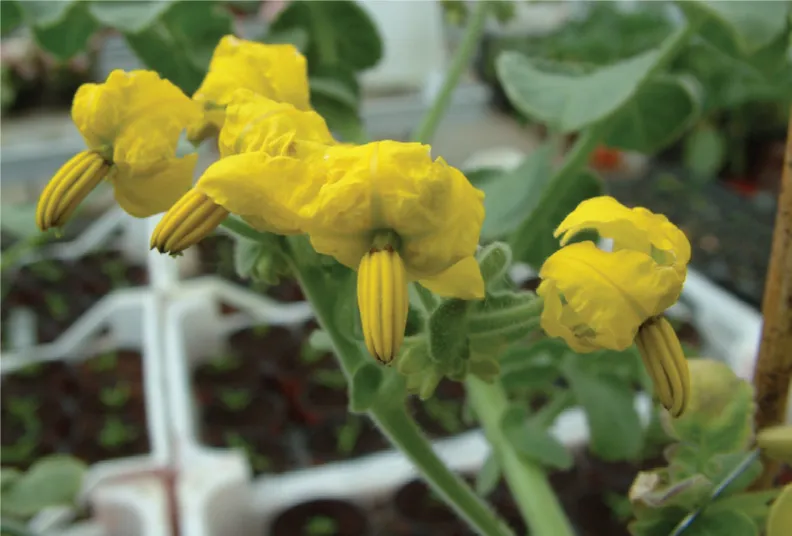
Flowers of Lycopersicon penellii.
It took until 1822 for the first specific instructions for the cultivation of the tomato to appear, by which time they were already being produced for sale in the south of England, though their popularity was not great. In William Cobbett’s The English Gardener of 1829 the whole subject of the production of ‘tomatum’ is disposed of in half a page, whereas the other salad staple, the cucumber, is indulged for a full nine pages. Cobbett appears fairly disinterested in the tomato, writing: ‘The fruit is used for various purposes, and sold at a pretty high price.’
AGREEING ON A NAME
In the novel Lark Rise to Candleford (set in the late 1800s) Flora Thompson describes the first appearance of red and yellow tomatoes on the local peddler’s cart, saying that they had ‘Not long been introduced into the country, and were slowly making their way into favour’. Struck by the colours, the girl Laura asks what they are, and is told: ‘Love apples, me dear, love apples, they be; though some hignorant folk be calling them tommy-toes.’ The name ‘tomato’ appears to have come by a rather roundabout route from the Aztec Xitomatl or Tomatl, via the seventeenth-century Spanish tomate, by way of tomata in England and America in the 1800s (Dickens uses the word ‘tomata’ in The Pickwick Papers) to the tomato’ of today.
Latin Origins: the Edible Wolf Peach
The Latin name given to the tomato is Lycopersicon esculentum, which translates as the ‘edible wolf peach’. The origin of the name Lycopersicon is attributed to the Greek naturalist Galen (129–207AD), but whatever plant Galen was describing it certainly wasn’t a tomato, as they didn’t appear in the Mediterranean area for another 1,400 years. How the tomato took the name Lycopersicon appears to stem from its similarity (particularly in the appearance of the fruit) to another famous member of the Solanaceae family, the belladonna or deadly nightshade. In Germany it was believed that witches used belladonna to conjure werewolves, so Germans considered the name wolf peach quite appropriate.
Linnaeus (1753) classified the tomato as Solanum lycopersicon, but Tournefort (1694) had already considered the tomato to be a distinct and separate genus, Lycopersicon. Consequently the name Solanum lycopersicum is still occasionally found, but Lycopersicon esculentum is the accepted botanical name. The actual taxonomy or botanical classification of tomato is still far from clear, particularly concerning the ‘wild’ types of tomato. The classification developed by C. H. Muller in his ‘A revision of the genus Lycopersicon’ of 1940 is still commonly used. Muller divides the genus into two sub-genera Eulycopersicon and Eriopersicon, putting L. esculentum into the first sub-genus, as shown below:

Young deadly nightshade plant Atropa belladonna.
Genus: Lycopersicon
Sub-genus: Eulycopersicon
Sub-genus: Eulycopersicon
Lycopersicon esculentum
Lycopersicon esculentum Pyriforme – pear-shaped tomato
Lycopersicon esculentum Cerasiforme – cherry tomato
Lycopersicon pimpinellifolium – redcurrant tomato
Whatever the taxonomists eventually end up agreeing on, it is very convenient that all the ‘wild’ types of tomato are capable of being crossbred with the cultivated types (though sometimes this is difficult to achieve), representing a great genetic base for continued crop improvement.
FROM HUMBLE BEGINNINGS TO THE TOMATO OF TODAY
The slow acceptance of the fruit in England – even after the reputation for being a slightly poisonous aphrodisiac had worn off – can be put down to a number of reasons, principally availability. Obviously production was seasonal: in the open ground or walled garden the fruit would only be available in quantity for three months of the year, and production in glasshouses did not start on a commercial scale until the very late 1800s. The first records of tomato crops from the emerging glasshouse industry in the Lea valley (just north of London) date from 1887.

Ripe deadly nightshade berries.
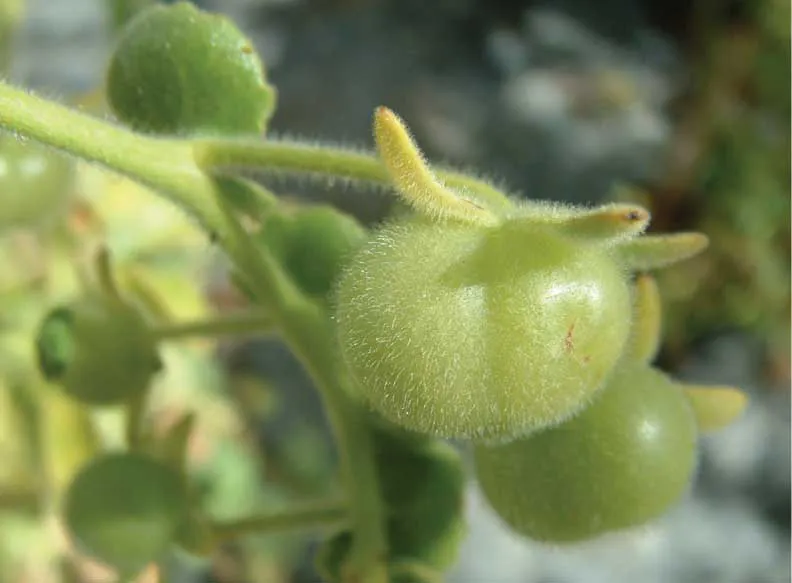
The fruit of lycopersicon penellii – hairy fruit is typical of the Eriopersicon types, or wild tomatoes.
Initially tomatoes would have been more available to city dwellers, as market gardens with greenhouses developed on the fringes of large urban conurbations. The expansion of the railways, increased supplies from the Channel Islands, and the developing greenhouse industry on the south coast of England steadily widened availability. In America, where the tomato had become very popular from the mid-1800s, the growers had a lucky break: in 1893, flying in the face of botanical facts, the US supreme court classed the tomato as a vegetable rather than a fruit, and as all imported vegetables were taxed at the time (whereas fruits were not), supplies from Cuba and Mexico dried up, leaving the way clear for domestic growers to fill the supply gap.
The emerging greenhouse industry took to the tomato as a useful summer crop, grown ...
Table of contents
- Cover
- Title
- Copyright
- Contents
- 1 Tomato History
- 2 The tomato plant: Physiology and Varieties
- 3 The history and development of tomato production
- 4 Plant Raising
- 5 Housing your tomatoes
- 6 Cropping indoors and out
- 7 Plant training and routine operations
- 8 Irrigation and Fertilization
- 9 Pests, Diseases and Disorders
- 10 Tomato Miscellany
- Further Information
- Index
Frequently asked questions
Yes, you can cancel anytime from the Subscription tab in your account settings on the Perlego website. Your subscription will stay active until the end of your current billing period. Learn how to cancel your subscription
No, books cannot be downloaded as external files, such as PDFs, for use outside of Perlego. However, you can download books within the Perlego app for offline reading on mobile or tablet. Learn how to download books offline
Perlego offers two plans: Essential and Complete
- Essential is ideal for learners and professionals who enjoy exploring a wide range of subjects. Access the Essential Library with 800,000+ trusted titles and best-sellers across business, personal growth, and the humanities. Includes unlimited reading time and Standard Read Aloud voice.
- Complete: Perfect for advanced learners and researchers needing full, unrestricted access. Unlock 1.5M+ books across hundreds of subjects, including academic and specialized titles. The Complete Plan also includes advanced features like Premium Read Aloud and Research Assistant.
We are an online textbook subscription service, where you can get access to an entire online library for less than the price of a single book per month. With over 1.5 million books across 990+ topics, we’ve got you covered! Learn about our mission
Look out for the read-aloud symbol on your next book to see if you can listen to it. The read-aloud tool reads text aloud for you, highlighting the text as it is being read. You can pause it, speed it up and slow it down. Learn more about Read Aloud
Yes! You can use the Perlego app on both iOS and Android devices to read anytime, anywhere — even offline. Perfect for commutes or when you’re on the go.
Please note we cannot support devices running on iOS 13 and Android 7 or earlier. Learn more about using the app
Please note we cannot support devices running on iOS 13 and Android 7 or earlier. Learn more about using the app
Yes, you can access Tomatoes by Simon Hart in PDF and/or ePUB format, as well as other popular books in Scienze biologiche & Orticoltura. We have over 1.5 million books available in our catalogue for you to explore.