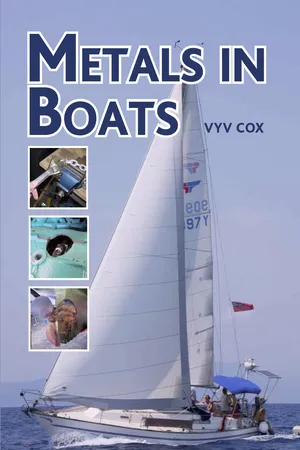
Metals have been used in boats for thousands of years, as components of the vessel's construction, as load-bearing parts of the rigging and steering systems, and for a wide variety of domestic and service duties. Due to misunderstandings of the properties of the metals used, and in some cases to questionable design and manufacture, there have been spectacular and sometimes tragic failures of boats' metalworking. These continue even today. This new book explains in layman's terms how a wide variety of metal alloys may best be selected, formed and manufactured to give optimum performance in the typical conditions of a sailing or powered vessel. Subjects as wide-ranging as anodes, batteries, hulls, skin fittings and rigging components are described in detail, enabling the boat owner to select the preferred material for his vessel. This practical and instructional book will be of great interest to sailors, boat owners and those involved in boat maintenance, and is fully illustrated with 90 colour photographs and 20 diagrams.
eBook - ePub
Metals in Boats
About this book
Trusted by 375,005 students
Access to over 1.5 million titles for a fair monthly price.
Study more efficiently using our study tools.
Information
Subtopic
AviazioneCHAPTER 1
Metal Facts and Properties
Modern boats depend heavily upon a wide range of metals for specialist fittings such as masts and spars, cleats and fairleads, nuts and bolts, in addition to the more mundane items such as engines, chain and anchors. Even in these parts the range of metals can be astonishing, with more specialism appearing annually. Selection of the correct metal for each task is rendered difficult because it not only has to give optimum performance in the application but also offer resistance to that ever-present corrosive medium, seawater. Even when it has been selected to satisfy these criteria it may perform poorly when attached to another metal due to the possibility of galvanic corrosion. Given the wide range not only of alloy compositions but also their manufacturing method, heat treatment and control of grain size, a good understanding is needed before specifying any metallic part.
In attempting to steer the user through the most common metals and alloys in service, this book will cover many terms with which the non-metallurgist is unfamiliar. Many specialist terms have entered general usage incorrectly, perhaps the word ‘alloy’ being one of the worst examples. To the vast majority ‘alloy’ means aluminium wheels on a car, or is used even by people who should know better, for example yachting journalists, just as a synonym for aluminium. The truth is very different. So without going into detailed metallurgy I will start with an explanation of some of the terms that will be used throughout the book.
ALLOY
When two molten metals are mixed together and allowed to solidify, one of two things may happen. They will either be immiscible and solidify separately, or they will form an alloy. Sometimes the alloy will be a simple solid solution, in which a single phase of the same composition is formed, or in others a far more complex alloy is produced comprising several phases. Phases in metal alloys have differing compositions formed from the elements in the alloy. They are typically named according to the Greek alphabet, α, β, γ and so on, but of course the α phase in one alloy has a different composition from an α phase in another. Phases are commonly altered by heat treatment, affecting the properties of the alloy.
Variations in the proportions of the two component metals will affect the phase structure of the final alloy, for example when 70 parts of copper and 30 parts of zinc are mixed to form a 70/30 brass the result is a single α phase, whereas a 60/40 brass has a duplex α + β two phase structure and a 40/60 brass also has a duplex structure but of β + γ composition. The properties of the alloy depend upon the phases present, in the case of brass the α phase being more ductile but the β phase being stronger.
There are other possibilities, such as the formation of intermetallics, which will be touched upon briefly when galvanizing is discussed. In all cases a commercial alloy offers superior properties to the elements from which it has been made. Some of these properties will be discussed later.
GRAIN STRUCTURE
The internal structure of almost all metals is granular, that is made up of grains. As a molten metal cools solid crystals begin to form and grow, dependent upon the cooling rate. The final shape, or morphology, of the grains dictates the properties of the metal. Metals with a grain morphology that is rounded have good tensile and compressive properties in all directions, whereas elongated grains may cause the metal to be strong in one direction but weak at right angles to it. The ideal microstructure for most applications is equiaxed, that is grains with similar dimensions in all directions.
STRESS AND STRAIN
Although these terms are widely, and incorrectly, used in everyday life they have very specific meanings when discussing the properties of metals and materials. The definition of stress is load divided by crosssectional area, thus in a simple example a piece of metal 1cm square subjected to a load of 1 tonne will be more highly stressed than a piece of the same metal 1m square subjected to the same load. The strength of a metal is the stress that it can sustain before fracturing.
Strain is a measurement of the deformation of a metal as the result of stress. In a tensile test it is expressed as the change in length divided by the original length of the test specimen.
HARDNESS AND STRENGTH
There is a direct relationship between these two – an increase in h...
Table of contents
- Cover Page
- Title Page
- Copyright Page
- Contents
- Foreword
- Introduction
- 1 Metal Facts and Properties
- 2 Iron and Steel
- 3 Stainless Steels
- 4 Copper and its Alloys
- 5 Aluminium and its Alloys
- 6 Zinc
- 7 Lead
- 8 Fracture
- 9 Joining Metals
- 10 Corrosion
- 11 Fatigue
- 12 Combinations of Failure Modes
- 13 Inspection
- Index
Frequently asked questions
Yes, you can cancel anytime from the Subscription tab in your account settings on the Perlego website. Your subscription will stay active until the end of your current billing period. Learn how to cancel your subscription
No, books cannot be downloaded as external files, such as PDFs, for use outside of Perlego. However, you can download books within the Perlego app for offline reading on mobile or tablet. Learn how to download books offline
Perlego offers two plans: Essential and Complete
- Essential is ideal for learners and professionals who enjoy exploring a wide range of subjects. Access the Essential Library with 800,000+ trusted titles and best-sellers across business, personal growth, and the humanities. Includes unlimited reading time and Standard Read Aloud voice.
- Complete: Perfect for advanced learners and researchers needing full, unrestricted access. Unlock 1.5M+ books across hundreds of subjects, including academic and specialized titles. The Complete Plan also includes advanced features like Premium Read Aloud and Research Assistant.
We are an online textbook subscription service, where you can get access to an entire online library for less than the price of a single book per month. With over 1.5 million books across 990+ topics, we’ve got you covered! Learn about our mission
Look out for the read-aloud symbol on your next book to see if you can listen to it. The read-aloud tool reads text aloud for you, highlighting the text as it is being read. You can pause it, speed it up and slow it down. Learn more about Read Aloud
Yes! You can use the Perlego app on both iOS and Android devices to read anytime, anywhere — even offline. Perfect for commutes or when you’re on the go.
Please note we cannot support devices running on iOS 13 and Android 7 or earlier. Learn more about using the app
Please note we cannot support devices running on iOS 13 and Android 7 or earlier. Learn more about using the app
Yes, you can access Metals in Boats by Vyv Cox in PDF and/or ePUB format, as well as other popular books in Tecnologia e ingegneria & Aviazione. We have over 1.5 million books available in our catalogue for you to explore.