Based on real-life experiences and written by expert authors, the books in the Maintenance and Upgrades series from Crowood will help owners develop the workshop skills needed for the maintenance and repair of their cars, and give guidance on possibilities for improvements and upgrades to performance. With step-by-step instructions and safety information throughout, this book is a valuable technical resource for owners of the Land Rover Discovery, Series 1 and 2. Illustrated with over 300 photographs, the book covers sourcing parts and tools; common problems and solutions, covering all engine types, including Rover V8 and diesel engines; service and repair; improvements for wheels and tyres and detailed specifications. This valuable technical guide for owners of the Land Rover Discovery, Series 1 and 2 will be of particular interest to home and professional mechanics and Land Rover enthusiasts, specialists and owners' clubs. Illustrated with over 300 colour photographs.
- 160 pages
- English
- ePUB (mobile friendly)
- Available on iOS & Android
eBook - ePub
Land Rover Discovery Maintenance and Upgrades Manual, Series 1 and 2
About this book
Trusted by 375,005 students
Access to over 1.5 million titles for a fair monthly price.
Study more efficiently using our study tools.
Information

The Discovery’s proportions were very carefully engineered to make it look smaller than it was, note how much the rear door slopes forward at the top.
1 |
introduction |
The Land Rover Discovery is a fantastic go-anywhere vehicle, unless it’s broken down on your driveway. If that happens then chances are it is because of poor maintenance. The Discovery 1 is based on the Range Rover Classic, which first went on sale in 1970, so some parts are from an age where extensive maintenance was simply routine, and whilst the Discovery 2 didn’t need its distributor cap replacing every year, its added complexity brings with it a few more jobs to do.
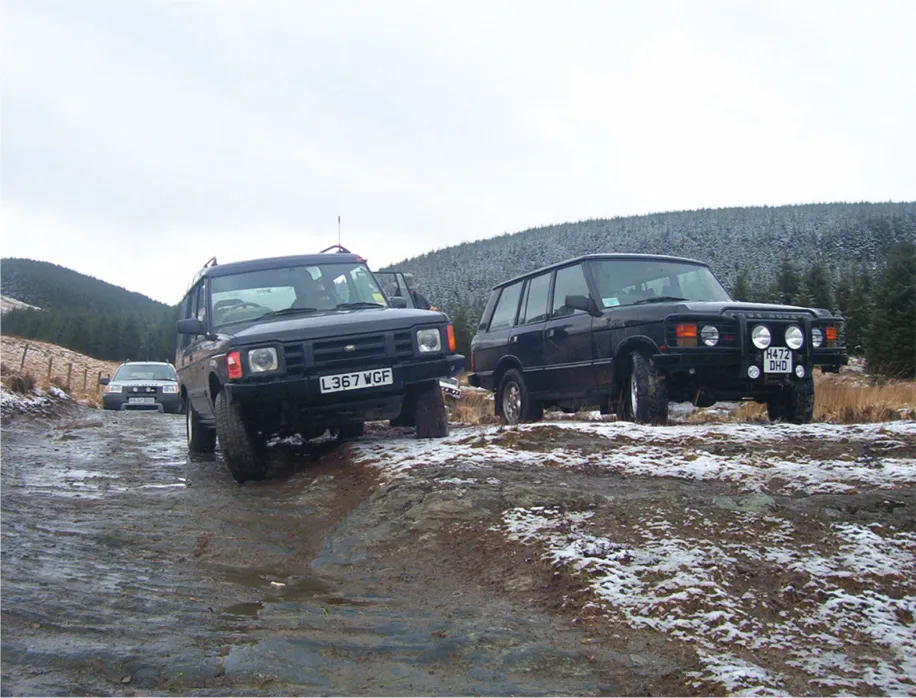
A Discovery and the Range Rover that inspired it, undaunted by rough roads and poor conditions.
Good maintenance makes these superb vehicles a joy to own; poor maintenance makes them a nightmare. Knowing what to look for is the key to keeping your car working, but sadly the usual workshop guides miss a few things out. This book is written largely from personal experience and some lessons I learned the hard way so hopefully you don’t have to.
I have been enjoying these cars since they first appeared, having owned four Series 1 and two Series 2 Discoverys and worked on a great many more. I’ve used them for everyday commuting, the school run, moving building materials (750kg pallet of bricks does just fit in the back of a 200 with the back seat out!), towing my race cars all over the country and off-roading trips through mountainous valleys, rivers, deep mud and glaciers. My Discoverys have rescued people from floods, shipped families to weddings, carried furniture home and also been used for pure entertainment at ‘pay and play’ off-road days. And that’s why I think they are brilliant.
I have always done all the maintenance, and a few modifications too, myself. That way I know the job was done the way I wanted it, plus when working on my own car I learn more about its condition, which sometimes helps to stop problems developing. One such problem is the scourge of fake parts, which can make a mockery of home maintenance and lead to dire consequences. So please read the section at the end of this book about where to buy parts and tools from to avoid any nasty surprises.

That’s me, your author, clearly pleased with my day’s ‘work’ with my ’94 Discovery 1 V8.
I have also included a glossary at then end of the book, which hopefully should explain any technical jargon that’s crept into the book.
With the right knowledge, tools and quality parts, maintaining these great cars is very rewarding. Being able to fix things yourself is very liberating, plus it saves a ton of money on labour costs.
WARNING
However, before you read on I must give you a word of warning: working on your own car can be dangerous. Many parts are sharp or heavy and could very easily injure you, but also if you make a mistake then you could turn the car into a death trap. Making mistakes on things like suspension or brakes could lead to loss of control and a potentially fatal accident.
So please ensure you have the right skills to do the job before you start. If in doubt, get professional help. You can also learn the necessary skills at one of the great classes run by local colleges, with the added advantage that you will meet other like-minded enthusiasts who might just be persuaded to come round and help with the tricky bits.
Even if you have prior knowledge it is often worth retraining and expanding your skills. I am a professional automotive engineer with decades of experience, and I still constantly study and undergo training. Never stop learning.
I have made every effort to ensure everything in this book is correct, but no one is perfect. If you spot an error then let me know. Please do not take this book to be superior to the official workshop manuals.
Where I show a technique that worked on my car there is no guarantee that it will work so well on your car. Land Rover changed detail specifications on a regular basis and made some variants that were poorly documented, particularly those for some specific foreign markets, and of course anything made by the Specialist Vehicle division.
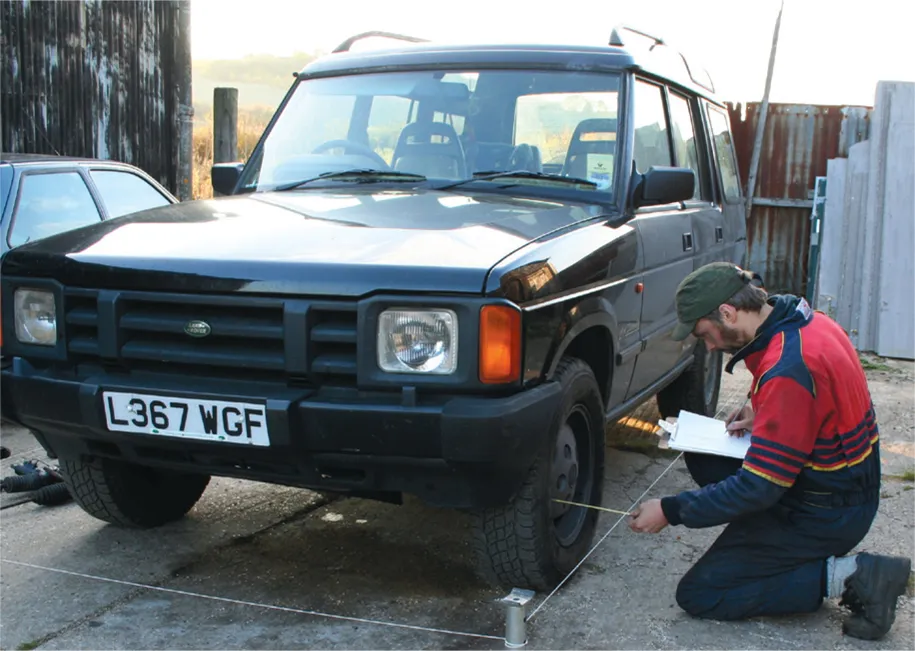
It is amazing just how much can be done by the home mechanic. Here I’m checking and setting suspension geometry.
2 | history |
It is remarkable to think that the Discovery was launched way back in 1989, designed with real purpose in mind: to bring active families to the scene of their adventure. Capability was the key, being equally as good as a family estate car as it was an off-road work horse. The interior was brilliantly appointed by Conran Design and the exterior was styled to make it look smaller than its big brother, the Range Rover, even though it was built on a near identical chassis. In fact, not only is the chassis borrowed from the Range Rover Classic (RRC), a design first launched in 1970, but the front bulkhead, windscreen, door frames and the complete engine and transmission system was too. Other parts came from the Rover parts bin, including Sherpa headlights, Metro indicator stalks and Montego van rear lights, which all helped to bring production costs down.
The visual trick of making it look smaller was done by making the back door stop short of the rear bumper and sloping it forwards. It’s not obvious but it actually slopes quite a lot. All this was done to combat the effect of the higher rear roof, designed to make it easy to get bicycles and other ‘adventure’ equipment in. It is also quite useful as a work horse: with the rear seats out I have been able to forklift a full-size industrial pallet into the back carrying three-quarters of a ton of bricks. Safety was important in the new design: the body shell had a welded-on steel roof and big rear pillars, giving much better rollover protection than either the Range Rover or Defender, and a welded-in steel rear floor pan, which all adds up to a much stronger shell. The downside is that all that extra steel, about 200kg of it, adds weight when compared to a Range Rover of that era and most of it is quite high up. For that reason early Discos tend to roll more in corners, which soon lead to the introduction of anti-roll bars.
On arrival the Discovery had the 200Tdi diesel and 3.5 V8 petrol engine (initially with twin SU carburettors, then subsequently Lucas fuel injection), the LT77 five-speed manual gearbox and LT230 transfer box and the two-door body. The four-door version was launched in 1990 and subsequent years saw the specification gradually improve to include things like electric windows, central locking/alarm/immobiliser, ABS and the ZF4HP22 four-speed automatic. I think those very first cars had a beautiful simplicity to them, but they are getting very rare now and becoming quite collectable.

The Sherpa headlights have a slightly unfair reputation. If kept in good condition and with quality modern bulbs they are perfectly adequate.

Some enthusiasts were concerned that the introduction of anti-roll bars would limit axle articulation. Here my long suffering ’94 model suggests there is nothing to worry about.

The face-lifted Discovery Series 1 became known as the 300, after the 300Tdi engine that was introduced at the same time.
In 1993 Land Rover introduced the 4-cylinder petrol 2.0Mpi engine because some countries such as Italy had severe taxes on vehicles over 2 litres. Also the Discovery Commercial was introduced that year – a very useful two-door car with no rear side windows and a slightly different floor pan at the back with more usable space.
The V8 was enlarged to 3.9 litres in 1994 and had anti-roll bars fitted front and rear, which reduced roll in corners very noticeably. Some earlier cars had the anti-roll bar mountings on the chassis but no bars were fitted, so these cars can be upgraded fairly easily.
In 1994 the 300 Series facelift arrived and the diesel engine was revised for better refinement. Named 300Tdi, it was now attached to a new, stronger R380 manual gearbox. The rear indicators, side and brake lights were moved to the bumpers to comply with new regulations that required the lights to be visible when the rear door was open, but the original side and brake lights were retained in the clusters too, giving double the number of lights. The headlights were enlarged from the original Sherpa units and were significantly brighter.
The interior was revised, the dashboard became clearer, and the heater became a dual-zone unit with rotary controls that were easier to use and more reliable.
Camel Trophy special editions were made from 1990 to 1997. All were used in the competition and have had a hard life, but all were refurbished before being sold on and have a strong fol...
Table of contents
- Cover Page
- Title Page
- Copyright Page
- Acknowledgements
- Contents
- 1 Introduction
- 2 History
- 3 Using the Discovery
- 4 Common Problems and Solutions
- 5 Servicing – Simple Jobs
- 6 Servicing – Big Jobs
- 7 Non-Standard Techniques
- 8 Repair
- 9 Improvements
- 10 Where To Buy Parts and Tools
- 11 Specifications
- 12 Contacts
- 13 Appendix I: Discovery 1 Technical Service Bulletins (TSB)
- 14 Appendix II: Discovery 2 Technical Service Bulletins (TSB)
- Glossary
- Index
Frequently asked questions
Yes, you can cancel anytime from the Subscription tab in your account settings on the Perlego website. Your subscription will stay active until the end of your current billing period. Learn how to cancel your subscription
No, books cannot be downloaded as external files, such as PDFs, for use outside of Perlego. However, you can download books within the Perlego app for offline reading on mobile or tablet. Learn how to download books offline
Perlego offers two plans: Essential and Complete
- Essential is ideal for learners and professionals who enjoy exploring a wide range of subjects. Access the Essential Library with 800,000+ trusted titles and best-sellers across business, personal growth, and the humanities. Includes unlimited reading time and Standard Read Aloud voice.
- Complete: Perfect for advanced learners and researchers needing full, unrestricted access. Unlock 1.5M+ books across hundreds of subjects, including academic and specialized titles. The Complete Plan also includes advanced features like Premium Read Aloud and Research Assistant.
We are an online textbook subscription service, where you can get access to an entire online library for less than the price of a single book per month. With over 1.5 million books across 990+ topics, we’ve got you covered! Learn about our mission
Look out for the read-aloud symbol on your next book to see if you can listen to it. The read-aloud tool reads text aloud for you, highlighting the text as it is being read. You can pause it, speed it up and slow it down. Learn more about Read Aloud
Yes! You can use the Perlego app on both iOS and Android devices to read anytime, anywhere — even offline. Perfect for commutes or when you’re on the go.
Please note we cannot support devices running on iOS 13 and Android 7 or earlier. Learn more about using the app
Please note we cannot support devices running on iOS 13 and Android 7 or earlier. Learn more about using the app
Yes, you can access Land Rover Discovery Maintenance and Upgrades Manual, Series 1 and 2 by Ralph Hosier in PDF and/or ePUB format, as well as other popular books in Technology & Engineering & Automotive Transportation & Engineering. We have over 1.5 million books available in our catalogue for you to explore.