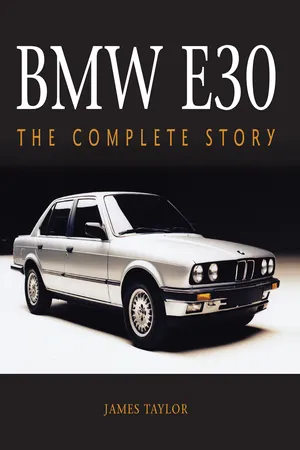
The E30 3 Series was the car that defined BMW more than any other during the 1980s, and it has gone on to become a much-loved modern classic. This book tells the full story of the cars from the time in 1976 when work first began on the successor to the original E21 3 Series. This new book features the story of how and why BMW designed their new compact E30 saloon for the 1980s; the styling, engineering and specification changes introduced over the lifetime of the model. There are full technical specifications, including paint and interior trim choices given along with a chapter on the special US variants. Details of the M3 and the cars produced by the leading German tuners and finally, there is a chapter on buying and owning a BMW E30.
- 176 pages
- English
- ePUB (mobile friendly)
- Available on iOS & Android
eBook - ePub
About this book
Trusted by 375,005 students
Access to over 1.5 million titles for a fair monthly price.
Study more efficiently using our study tools.
Information
CHAPTER ONE
THE E30 RANGE IN CONTEXT
The BMW product strategy that came together during the 1970s has since become a model for the rest of the car industry. It was beautifully simple and at its heart was a philosophy that aimed to foster lifelong marque loyalty. The three-tier product range – which has since been considerably expanded to tackle ‘niche’ sectors of the market – consisted of basic designs with three clear and easily understood names. These names were 3 Series, 5 Series and 7 Series (a 6 Series was added later), and within each series there would be a range of models, so organized that the top ones merged almost seamlessly with the next series up in the hierarchy.

The first of the 3 Series ranges was the E21 – this 316 model was the entry-level type for most of its production run. The E21 was a very neat design that had a strong influence on the E30.
The strategy was deliberately and strongly hierarchical. The 3 Series cars were compact saloons designed primarily to appeal to younger buyers, but within that range there were also models that would appeal to older buyers who wanted to downsize their cars without sacrificing too much comfort or performance. Next up was the 5 Series, a range of medium-sized family saloons that were aimed at an older group of buyers, whose requirements of a car were rather different from those of the 3 Series buyers. Then at the top of the tree, and aimed at top managers and company directors, were the large and luxurious 7 Series saloons. All these ranges were distinctly BMW in character and all of them were designed with a family resemblance so that there could be no mistaking them for any other maker’s products.
By the time BMW started work on the E30 3 Series models in the mid-1970s, that core range of three hierarchical ‘series’ was firmly established. BMW had gone through some lean times between 1945 and 1960, but with a new product philosophy for the new decade it gradually established itself as a major player among the German car makers. The 1960s range grew up piecemeal, beginning with a medium-sized four-door saloon and gradually developing to include a cut-down two-door version of it, a big saloon and a closely related big coupé. But the rationalization that occurred as these cars fell due for renewal in the following decade was hugely impressive.

Next in the BMW hierarchy was the 5 Series medium-sized family saloon. This one is a first-generation E12 model, with the original specification that was introduced in 1972.

The top of the BMW saloon range was the 7 Series. This one is an E32 model; despite the deliberate big-car look, it shares many design cues with the 3 Series and 5 Series saloons of its time.
The first model to embody the new philosophy was the replacement for the medium-sized saloon, launched in 1972 as the 5 Series range. Three years later, the two-door models were replaced by a new 3 Series range. Two years after that, the 7 Series was announced as the top range of luxury saloons. In the meantime, BMW had also found the resources to replace its big coupés with a 6 Series range in 1976. So it was into this well-structured world of strong-selling cars, all with the vital ingredient of sporting appeal that was a BMW hallmark, that the new E30 3 Series range was born in 1982.
With hindsight, it is easy to see that the E30 3 Series was pivotal in establishing the BMW company of today. It sold very strongly all around the world, setting a standard for compact saloons to which other makers aspired. It was not always the best car in its class; its premium pricing often raised questions about the value it offered for the money, yet it was always in demand. Bolstered by a very strong image, the E30 3 Series always seemed to offer something that rivals did not, with even Mercedes-Benz coming off second best when it introduced a rival range in 1982.
Sometimes, the image associated with the E30 range was not entirely positive. The cars were carefully designed and specified to appeal to an emerging group of consumers that became known as ‘Yuppies’ – the name was an abbreviation of Young and Upwardly-mobile – and in some quarters that consumer group’s attitudes were strongly disliked. Being a Yuppie involved being pushy, successful and following the latest fashion trends, and there was a strong suspicion that many E30s were sold to such buyers simply because they were the latest fashion trend. Perhaps that was true, but BMW laughed all the way to the bank.
Most importantly, the E30 range actually had the credentials to support its popularity. The cars were very well built by the standards of the time. They were also supported by an excellent warranty and by a very high level of dealer service. Dealer support was expensive, but buyers generally accepted the cost because they knew that they were getting what they paid for; there were several other car makers whose dealers did not enjoy such a good reputation. On the whole, the E30s were very reliable, too – and reliability is the one criterion that appeals to every buyer of a new car.
BMW’s aim with the E30 range was obviously to establish a strong following from customers who would later move on to buy a 5 Series, and so on. So right from the start, the company knew that it had to make this series of cars quite literally the foundation of its range. The wider the appeal, the more customers who would potentially become BMW owners for life, with the result that the E30 3 Series was broadened far beyond the scope of the 3 Series that had preceded it in the 1970s. That range had consisted of two-door saloons (and approved ‘targa-top’ conversions). The new range certainly started with two-door saloons and similar conversions, but it expanded over the years to include four-door saloons, convertibles and estate cars as well. Its range of engines may have started with a small 4-cylinder petrol type, but it soon expanded to include 6-cylinder petrols and 6-cylinder diesels as well.

US regulations required extended bumpers before the E30 models were introduced and BMW wanted to avoid the over-bumpered look that this 1980 US-model E21 presented.
A very important element right from the start was for the E30 range to give BMW a secure footing in the USA. By the end of the 1970s, American buyers recognized the sporting appeal of BMW models, but the company was still something of a niche player in the market. The E30 had the job of changing perceptions of its manufacturer so that the BMW name became part of the automotive mainstream in the USA. It simply had to meet not only the unique legal requirements about exhaust emissions and safety in the USA, but also the aspirations of a largely (but not exclusively)Yuppie target audience in a country where wealth generally seemed to be on the increase.
So BMW put an enormous amount of effort into keeping the E30 abreast of US requirements and, despite the performance-sapping effects of some of the relevant legislation, its efforts were amply rewarded. Total sales of 350,000 E30 models across the Atlantic were a cause for jubilation as production of the cars ended in the 1990s – but they were just a stepping stone to the greater things expected of its replacement.
BMW AND NUMBERS
There are multiple numbers associated with the BMW marque and seasoned enthusiasts reel them off without a second thought. For anybody new to the marque, however, they can initially be very confusing. So, for the benefit of readers new to the world of BMW, here is a brief explanation of some of the key number codes.
Model Codes (Badges)
In the early 1970s, BMW established a model naming system that was the height of clarity and which has been the envy of most other car manufacturers ever since. The company used codes that were based on a hierarchy of different ranges: the smallest models were the 3 Series; the mediu...
Table of contents
- Cover
- Halftitle
- Title
- Copyright
- Contents
- Introduction and Acknowledgements
- Timeline
- CHAPTER 1 THE E30 RANGE IN CONTEXT
- CHAPTER 2 MDESIGN AND DEVELOPMENT
- CHAPTER 3 TWO-DOOR DAYS, 1982–3
- CHAPTER 4 MAKING A STATEMENT, 1983–7
- CHAPTER 5 THE SECOND PHASE, 1987–94
- CHAPTER 6 ALTERNATIVE FUELS: DIESEL AND ELECTRIC E30 MODELS
- CHAPTER 7 THE M3
- CHAPTER 8 THE E30 IN THE USA
- CHAPTER 9 THE SPECIAL E30 MODELS
- CHAPTER 10 THE E30 AFTERMARKET
- CHAPTER 11 BUYING AN E30 AS A CLASSIC CAR
- APPENDIX PRODUCTION TOTALS
- Index
Frequently asked questions
Yes, you can cancel anytime from the Subscription tab in your account settings on the Perlego website. Your subscription will stay active until the end of your current billing period. Learn how to cancel your subscription
No, books cannot be downloaded as external files, such as PDFs, for use outside of Perlego. However, you can download books within the Perlego app for offline reading on mobile or tablet. Learn how to download books offline
Perlego offers two plans: Essential and Complete
- Essential is ideal for learners and professionals who enjoy exploring a wide range of subjects. Access the Essential Library with 800,000+ trusted titles and best-sellers across business, personal growth, and the humanities. Includes unlimited reading time and Standard Read Aloud voice.
- Complete: Perfect for advanced learners and researchers needing full, unrestricted access. Unlock 1.5M+ books across hundreds of subjects, including academic and specialized titles. The Complete Plan also includes advanced features like Premium Read Aloud and Research Assistant.
We are an online textbook subscription service, where you can get access to an entire online library for less than the price of a single book per month. With over 1.5 million books across 990+ topics, we’ve got you covered! Learn about our mission
Look out for the read-aloud symbol on your next book to see if you can listen to it. The read-aloud tool reads text aloud for you, highlighting the text as it is being read. You can pause it, speed it up and slow it down. Learn more about Read Aloud
Yes! You can use the Perlego app on both iOS and Android devices to read anytime, anywhere — even offline. Perfect for commutes or when you’re on the go.
Please note we cannot support devices running on iOS 13 and Android 7 or earlier. Learn more about using the app
Please note we cannot support devices running on iOS 13 and Android 7 or earlier. Learn more about using the app
Yes, you can access BMW E30 by James Taylor in PDF and/or ePUB format, as well as other popular books in Technology & Engineering & Automotive Transportation & Engineering. We have over 1.5 million books available in our catalogue for you to explore.