The story of Jensen favouring American V8 power began during the 1930s, with the building of their first prototype car. Although this pre-war period was short-lived, this would be the start of what was to eventually become one of the company's main trademarks - the V8 engine. This new book examines the C-V8, Interceptor and FF models as well as Jensen's use of Chrysler, Ford and General Motors engines. The history, design, development and production of these cars is covered and the book is illustrated with 300 colour photographs.
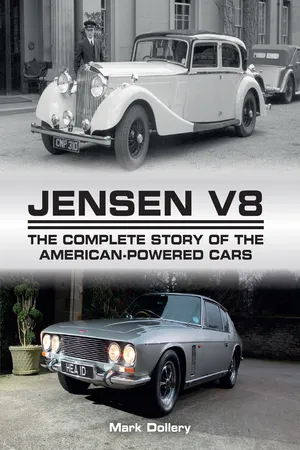
- 304 pages
- English
- ePUB (mobile friendly)
- Available on iOS & Android
eBook - ePub
About this book
Trusted by 375,005 students
Access to over 1.5 million titles for a fair monthly price.
Study more efficiently using our study tools.
Information
CHAPTER ONE

TWO INNOVATORS, ONE DREAM
The origins of Jensen Motors go back to the nineteenth century, when a second-generation Danish family decided to make a new life for themselves by emigrating to Britain. One of the sons decided to embark on his own shipbroking business, moving later into provisions importing. He was to be the father of two sons who would rise through the ranks to become highly respected captains of the British motor industry. Frank ‘Alan’ and Richard Arthur Jensen were born in Moseley, Birmingham, in 1906 and 1909, respectively. During their educational years they showed very little enthusiasm for schoolwork, with Alan regularly being at the bottom of the class, mainly due to a poor memory, and Richard spending most of the time sketching, the theme usually being motor cars! Right from the start, though, both brothers showed an interest in innovation, with Alan being involved with amateur radio and Richard being fanatical about maintaining and repairing his bicycle.
(Incidentally, the name ‘Jensen’ originates from the countries of Denmark, Norway and North Friesland. It means literally ‘son of Jens’, and is the most common Danish surname and ninth most common Norwegian. ‘Jens’ is the most common Danish and Frisian version of the biblical name Ioanne (John in English). There are three alternative spellings: in Danish and Frisian it is spelt like the car, ‘Jensen’; in Norwegian, ‘Jenssen’; and in English, ‘Jenson’. Perhaps the most famous English Jenson is Formula One racing driver and 2009 World Champion, Jenson Button.)
THE FIRST ‘JENSEN SPECIAL’
On leaving school, the brothers both started apprenticeships in their home town of Moseley. Alan was first assigned to the machine shop at Serck Radiators and gradually worked his way up to the drawing office. Richard, the keener motoring enthusiast, working on the more practical side of things at Wolseley Motors. The idea of the brothers building their own motor car came to Alan Jensen one spring evening in 1927, during a game of tennis at their local club, a pastime regularly enjoyed by both of them. Cecil West, a close friend of the brothers, turned up in a rather Heath-Robinson-looking affair that he had built himself. It was hand-painted patriotically in red, white and blue and fitted with a beaten-up old radiator from a Morris Cowley. Less than impressed with West’s creation, Alan none the less accepted a lift home from the tennis club and discovered that the car handled and performed much as it looked – it was dreadful, to say the least. When they arrived at the Jensen home in Bloomfield Road, engulfed in clouds of exhaust smoke, Richard came dashing out of the house to see what on earth was going on. After quickly casting his eye over the car, he came to much the same conclusion as his brother. On Cecil West’s smoke-filled departure, Alan is said to have turned to Richard to say, ‘If we couldn’t build a better car than that, then we ought to die in the attempt.’
Mr Jensen Senior strongly disapproved of the boys owning motorcycles, so, when they showed enthusiasm for owning a motor car instead, he very quickly offered to put down the money to make it possible. The car in question was a 1923 Austin Seven Chummy, registered OL 437, bought from a small local garage in town for £65. This was to be the platform for the Jensens’ first attempt at building a car of their own. It was collected one Saturday morning and driven straight back to Bloomfield Road, where it was put into a purpose-built workshop that had been erected at the side of the house. The first job was to remove the Austin body from its chassis, and by the end of that Saturday evening it had already been stripped down, ready to be re-clothed. After many hours of work, often burning the midnight oil, their creation was completed. Within a few months, using only very basic tools, the brothers had built an aluminium-bodied, two-seater sports model. The little car featured motorcycle-styled mudguard wings, full-width split windscreen, louvred side bonnets that were formed to fit against a 3-litre Sunbeam radiator and a boat-tail styled rear section, not dissimilar to that of the Type 35 Bugatti. Mechanically, the only modification carried out was the fitting of twin SU carburettors to the small 747cc fourcylinder engine, for more power. It was painted in green and retained the Austin’s original Birmingham registration number.
The first outing for the ‘Jensen Special’ was a memorable one for the brothers, for two reasons. Armed with just a basic tool kit in the back, they set off to a spectate at the well-known hill-climb at Shelsley Walsh. On the way there, one of the mudguard brackets broke, and the guard itself actually fell off into the road. Once the guard had been retrieved and the repair completed, they continued their journey to the hill-climb, only to be directed on arrival to the competitors’ parking area, rather than the spectators’! The organizers evidently thought that the brothers’ creation looked sporty enough to compete with the rest of the cars.
Before long, the ‘Jensen Special’ had received its first modification, in the form of restyled mudguard wings, which now flowed at an angle towards the middle of the car, incorporating short running boards. This was followed by an overhaul of the front suspension.

Jensen Special Number 1.
THE STANDARD PROJECT
One Saturday in mid-1928, whilst road testing OL 437 after its front-suspension overhaul, Alan Jensen had an encounter with Alfred Wilde, at that time the Chief Engineer at the Standard Motor Company in Coventry. It was to change the brothers’ lives for ever. Wilde had seen the little home-built car many times before but this time, impressed again by the sight of it, he hastily U-turned his Standard saloon and gave chase, beeping his horn and flashing his headlights until Alan pulled over. Wilde explained that he had been Chief Engineer at Standard since 1927 and that he had already designed the company’s successful new 9-horsepower saloon. He was looking for an opportunity to produce a sports variant based on a Standard chassis. Would the brothers be interested in designing a similar-looking body for a new sports model? He invited both of them to visit the Standard factory to discuss the project. When Alan returned home and told Richard of the chance meeting, it was quickly agreed that they could not turn down such a fantastic opportunity.
The brothers turned up for the appointment at Standard in their ‘Jensen Special’. Wilde and his engineers took a closer look at how the body was constructed and, once they had declared themselves satisfied with the quality of the work, the brothers were invited to select a running chassis for their build. The Standard 9 chassis was delivered to their garage in Bloomfield Road in July 1928, for work to begin at once on the new design. Because the Standard 9 chassis had a larger frame than that of the Austin, the brothers had an opportunity to build a more powerful-looking car, while still retaining the styling characteristics of the original ‘Special’.
Alan Jensen was still working at Serck Radiators, and was well placed to design and construct a unique and very striking-looking radiator for the new sports model. It was similar in design to the current offering from Standard, but was V-fronted in shape instead of being flat. Alan spent a considerable amount of the firm’s time, including overtime, developing it. This did not go unnoticed by his foreman, who eventually informed the management about young Jensen’s activities, resulting in an invoice to Alan for the sum of £21, to cover the cost of the materials that he had used to build the radiator. He was then summoned to see managing director Sydney Purchase in order to explain himself. Alan told him that he could not possibly afford to pay that amount of money and the story goes that Purchase looked him in the eye and said, ‘How will a nominal pound do, Jensen?’ Greatly relieved, Alan fled from the office.
‘Jensen Special No. 2’ (the first special was now referred to as ‘No. 1’) was first registered by Richard Jensen on 4 December 1928 as VP 4117. It was finally completed in February 1929 and painted in pale blue. The body panels were hand-formed in lead-coated steel over a wooden ash frame and power came from Standard’s 1153cc four-cylinder engine, with a three-speed manual gearbox.
Standard were very pleased with the brothers’ effort and, by August 1929, plans were drawn up for the prototype to enter production. It was not long before the car started receiving very encouraging magazine reviews, including one from Eric Findon of Light Car and Cycle Car and another from the then Midlands editor of The Autocar, Monty Tombs. Later photographic evidence shows that VP 4117 was modified into a two-/four-seater variant, featuring a reworked flat tail section with a flat windscreen and known as the ‘Jensen Special No. 3’.
Alfred Wilde was also in charge of the car’s production process and he soon decided that the construction of the bodies was to be contracted out to the nearby Warwickbased New Avon Motor Body Company. The reasoning behind this was quite simple: New Avon at that time was run by John Maudslay, who just happened to be the son of the Standard Motor Company’s founder and chairman, Reginald Maudslay.

Jensen Special Number 3, clearly showing the revised mudguard arrangement, flat windscreen and tail design.
STANDARD REGISTER
For production purposes, the ‘Jensen Special No. 2’ underwent some minor changes regarding mechanical specification, including raising the compression ratio of the 1153cc engine, the fitting of an SU carburettor, a lower axle ratio and rear springs, a modified radiator and exhaust system, along with revised instrumentation and altered steering column rake. Designated as the Avon Standard Special Sports, the first models were ready for dispatch by October 1929. By this time, Alan Jensen had left Serck Radiators and joined New Avon in a supervisory role to oversee the build process of the bodies. Richard had moved on from Wolseley Motors to work for Lucas, the manufacturer of automotive electrical components.
Production continued throughout 1930, with Alan constantly working with Standard’s own designers and even Wilde himself, making improvements to various styling features. They even designed a similar body to fit on to Standard’s larger, nine-point-nine horsepower chassis, which used a bored-out version of the 1153cc engine. Now 1287cc, it was also used in their new ‘big’ Nine, which was introduced in August 1930. Unfortunately though, the end of 1930 brought tragic circumstances for the Standard Motor Company, with the death of Alfred Wilde on Christmas Day, the cause being a heart attack due to a combination of malignant flu and overwork.
Back in late 1929, Standard had introduced their much larger Sixteen model, powered by a 2054cc six-cylinder engine. But it was not until a year later that the Sixteen chassis would be clothed with coachwork designed by Alan Jensen, which featured Swan coupé and open-tourer bodies. These designs were improved upon for 1931 – on the Swan coupé, this included shortening the bonnet area, making the interior more spacious to allow for the fitting of an occasional rear seat. The idea was that the seat could also be folded forward in order to increase the size of the boot compartment; tough rubber matting covered the rear of the backrest to allow for this. Wind-down windows with safety glass were also fitted, along with a sliding sunshine-roof, electric windscreen wipers and an improved ‘twin-top’ four-speed gearbox, which replaced the previous ‘crash’ unit with synchromesh in third and fourth gears. Also in 1931, Standard introduced a model called the ‘little’ Nine – a baby version of the ‘big’ Nine, with power coming from a much smaller, 1005cc four-cylinder engine. In the meantime, having been out of the limelight for a while, Richard Jensen was desperately craving the opportunity to design and build another car with his brother. It was his friend Arthur Clackett who would be responsible for bringing the two of them back together again.
AVON MOTOR BODY COMPANY
Founded in 1919 by Mr Tilt and Captain Phillips as the Avon Motor Body Company, for the first ten years the business concentrated solely on building specialist bodywork for the motor manufacturer Lea-Francis. In 1922, it was renamed as the New Avon Motor Body Company and, in 1929, also started building bodies for the Austin Motor Company, while at the same time developing a contract with Standard that would last for the next ten years. In 1938, New Avon was renamed Avon Motor Bodies Ltd and became part of the Maudslay Motor Group, which had been founded by Reginald Maudslay’s father, Walter H. Maudslay. It also moved to larger premises at Ladbroke House, Millers Road, Warwick, where it would remain for the next fifty years or so. After the war, John Maudslay retired, to be replaced by one of the company’s directors, a Mr Watson, who steered away from the coachbuilding side of the business and started focusing more on undertaking body repairs of standard-built vehicles, which continued well into the 1970s.
In 1973, the company was sold to Graham Hudson, who wanted to expand by combining New Avon with his own already thriving Volvo agency and body repair business. Already well aware of New Avon’s coachbuilding past, he planned to revert to producing specialist bodywork for other motor manufacturers and, by 1978, Ladbroke Avon Ltd incorporating Avon Special Products was formed. Initially, the new company produced a series of converted Land Rovers and Range Rovers, but their most memorable conversion was, without doubt, the beautiful Avon-Stevens Jaguar/Daimler XJC convertible, named after its designer Anthony Stevens. It was basically a standard-specification Series 2 two-door XJ-coupé with the roof removed and replaced by a manually operated vinyl hood, lined inside using ‘West of England’ cloth.
In 1980, the convertible was joined by an estate version, again designed by Anthony Stevens, which was based on Jaguar’s Series 3 of the time. The design was not particularly graceful, to say the least, but it was very practical, offering 35cu ft of luggage space with the rear seat in place and more than 58cu ft when it was folded down. The estate’s tailgate was also very cleverly devised and this was achieved by grafting a Renault 5’s rear hatch frame on to the vertical boot panel of the XJ, with rear ventilation grilles being sourced from the Renault as well. When launched at the 1980 Motor Show in Birmingham, the XJ-estate won Avon the gold award in the international coachwork competition – praise indeed. The XJ-estate conversions continued through to 1981, but by then, Graham Hudson had decided to move towards the less luxurious end of the market by offering high-specification versions of the newly launched Triumph Acclaim.
PATRICK-JENSEN MOTORS
In 1930, Arthur Clackett introduced Richard to a certain Joe Patrick, who at that time was running a firm called Edgbaston Garages Ltd, based on the Bristol Road in Selly Oak, Birmingham. The business was actually owned by Joe’s father Albert, who had recently purchased the garages for Joe to take on the day-to-day running. Like the Jensen brothers, Joe was a very keen motoring enthusiast and had been following their work, in particular Alan’s more recent designs that he had been creating at New Avon. The outcome of the meeting was that Joe Patrick offered Alan and Richard a position with the firm, so they could once again combine their creative ability in producing coach-built bodies.
They both accepted the offer and, once Alan had left New Avon and Richard had left Lucas, work started immediately on reorganizing the garage. A coachbuilding department was set up, along with a service centre that was open in the evenings, and on Sundays too. It was not...
Table of contents
- Cover Page
- Title Page
- Copyright Page
- Contents
- Acknowledgements
- Introduction
- Chapter 1 Two Innovators, One Dream
- Chapter 2 The Pre-War V8, Straight-Eight and V12-Cylinder Models 1934–1941
- Chapter 3 The Post-War Straight-Eight and Six-Cylinder Models, Including V8 Prototypes 1946–1963
- Chapter 4 Sub-Contracting Work 1948–1967
- Chapter 5 Jensen C-V8 Mk. 1, 2 and 3 Models 1962–1966
- Chapter 6 The P-66, 1964–1966 – Filling the Gap
- Chapter 7 Jensen Interceptor Mk. 1, 2 and 3 Models 1966–1976
- Chapter 8 Jensen FF Mk. 1, 2 and 3 Models 1966–1971
- Chapter 9 Jensen Interceptor S4 Models 1983–1992
- Chapter 10 Jensens in the Twenty-First Century
- Index
Frequently asked questions
Yes, you can cancel anytime from the Subscription tab in your account settings on the Perlego website. Your subscription will stay active until the end of your current billing period. Learn how to cancel your subscription
No, books cannot be downloaded as external files, such as PDFs, for use outside of Perlego. However, you can download books within the Perlego app for offline reading on mobile or tablet. Learn how to download books offline
Perlego offers two plans: Essential and Complete
- Essential is ideal for learners and professionals who enjoy exploring a wide range of subjects. Access the Essential Library with 800,000+ trusted titles and best-sellers across business, personal growth, and the humanities. Includes unlimited reading time and Standard Read Aloud voice.
- Complete: Perfect for advanced learners and researchers needing full, unrestricted access. Unlock 1.5M+ books across hundreds of subjects, including academic and specialized titles. The Complete Plan also includes advanced features like Premium Read Aloud and Research Assistant.
We are an online textbook subscription service, where you can get access to an entire online library for less than the price of a single book per month. With over 1.5 million books across 990+ topics, we’ve got you covered! Learn about our mission
Look out for the read-aloud symbol on your next book to see if you can listen to it. The read-aloud tool reads text aloud for you, highlighting the text as it is being read. You can pause it, speed it up and slow it down. Learn more about Read Aloud
Yes! You can use the Perlego app on both iOS and Android devices to read anytime, anywhere — even offline. Perfect for commutes or when you’re on the go.
Please note we cannot support devices running on iOS 13 and Android 7 or earlier. Learn more about using the app
Please note we cannot support devices running on iOS 13 and Android 7 or earlier. Learn more about using the app
Yes, you can access Jensen V8 by Mark Dollery in PDF and/or ePUB format, as well as other popular books in Tecnologia e ingegneria & Trasporti e ingegneria automobilistica. We have over 1.5 million books available in our catalogue for you to explore.