Vauxhalls held a special place in the British motoring scene of the mid-twentieth century. Solid, reliable and respectable, they were carefully designed to meet the expectations of buyers and also to meet the global ambitions of General Motors in America, the company that owned the Vauxhall marque. The book covers just over two decades of Vauxhall history, between the late 1950s and the late 1970s, that saw Vauxhall producing a succession of fondly remembered models, including some genuine classics. This new book features the styling, engineering and specification changes introduced over the lifetime of the Victor, Cresta and Viva ranges, and their offshoots. It gives full technical specifications of each model and includes a special examination of engine development in this period. Finally, there is advice about buying each of these models.
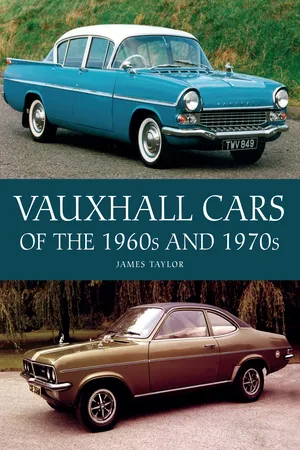
- 176 pages
- English
- ePUB (mobile friendly)
- Available on iOS & Android
eBook - ePub
Vauxhall Cars of the 1960s and 1970s
About this book
Trusted by 375,005 students
Access to over 1.5 million titles for a fair monthly price.
Study more efficiently using our study tools.
Information
CHAPTER ONE
A CLASSIC ERA, 1957 TO 1979
At the start of the period covered by this book,Vauxhall was a highly respected name among British motor manufacturers. Vauxhalls had a reputation as family cars that were reliable, easy to drive, straightforward to maintain, and provided good value for money. They were not glamorous or prestigious, but they did stand for solid, middle-class values, and they usually incorporated some ultra-modern features that distinguished them from their competitors.
By the end of the period, the Vauxhall name had been dragged through the mud along with those of many other British marques, and the company had been relegated by its American owners to second-best behind Opel in Germany. For the Vauxhall company, it had been a roller-coaster period of just over two decades, but it had produced some memorable cars that have belatedly become acknowledged as classics.
TWO MEMORABLE DECADES
1957 was a watershed year for Vauxhall. Ever since car production had restarted at the end of World War II, the company had been obliged to base all its models on a single bodyshell because its Luton factory did not have enough space to build two model ranges at once. But in 1957, new assembly buildings were completed, allowing the company to build clearly differentiated models for the 4-cylinder 1.5-litre class, and the over 2-litre 6-cylinder class.

The F-series Victor introduced in 1957 was a clear witness to the fact that Vauxhall’s owners, General Motors, believed that American styling led the world.
VAUXHALL HERITAGE
VAUXHALL HERITAGE

When American styling themes were applied to the larger 6-cylinder cars later in 1957, the result was nevertheless a classic shape. This is a 1959 PA-series Velox.
VAUXHALL HERITAGE
VAUXHALL HERITAGE
The first of the new models to enter production was the 4-cylinder Victor, which brought a new model name to the Vauxhall catalogue. It was followed just a few months later by the 6-cylinder Velox and Cresta, two variants of the same model that used established model names. From that point on, Vauxhall was able to develop the two ranges separately, tailoring each more closely to the tastes of its intended buyers and so increasing their appeal and, most importantly, their sales.
Six years later, car ownership in Britain was on the rise, and a larger market had opened up for smaller and more affordable family saloons.Vauxhall determined to get a share of this as well, and developed a completely new entry-level saloon that it called the Viva. To build it, the company built a new factory at Ellesmere Port, in Cheshire.
It is those three ranges – Viva, Victor and Cresta – and their offshoots that are the story of this book. They saw the company through one of the most interesting times in its history – although these were not always happy times. Vauxhall models had developed a well-deserved reputation for early rusting by the end of the 1950s, and despite their equally well-deserved reputation for reliability and simplicity, this harmed the company’s image and its sales right through the 1960s and into the 1970s.That same problem has limited the number of survivors, so a marque that was once very common in Britain is now quite poorly represented on the classic car scene.
Vauxhall’s sales were by no means confined to its home market of Britain. By 1960, about half of all Vauxhalls built since 1946 had been sold overseas, and Vauxhall was always encouraged to think globally by its American owners. The company was not narrowly focused on Britain, or even on Europe, and in the period covered by this book a key export market was Canada, for which country several special variants of the mainstream ranges were designed and built. Vauxhalls were mostly built in Britain, but there were also many overseas assembly operations that built cars from CKD (‘Completely Knocked Down’) kits shipped out from the UK.
VAUXHALL AND GENERAL MOTORS
Although many people perceived Vauxhall as a completely British company in the post-1945 era, that perception was a long way from the truth.The company was certainly British in origin, and its headquarters and primary manufacturing plants were in Britain, but since November 1925 it had actually belonged to General Motors (GM) in America.When Vauxhall failed to respond to changes in the car market after the end of the Great War in 1918, its sales had dwindled, and when some long-term loans became due for payment, the directors of the company were obliged to seek an alliance that might keep the company afloat. GM seized its opportunity, seeing ownership of Vauxhall as a bridgehead into British sales.

Toned down in its second incarnation as the FB-series, the Victor was promoted here as a fine design.

Export sales were important to Vauxhall, and the company drew up special variants, notably for Canada. The FB-series was sold there with Envoy badges.
Vauxhall was not GM’s only outpost in Europe. In 1929, the American company also took ownership of the Opel marque in Germany. Elsewhere it gradually acquired or established a series of other subsidiaries around the world that gave it a huge empire, and after 1945 the managers of that empire began to look for ways of rationalizing their holdings. Although the concept of a ‘world car’ – a design that could be sold in any country in the world, albeit with minor changes to suit local requirements – did not become reality until the 1970s, GM exercised an increasingly tight control over the products of its subsidiaries.

The PB-series cars were similarly toned down from the American lines of their PA forebears. Australia was another strong market for Vauxhall, and this advertisement bears witness to the links with the local GM subsidiary, GMH (GM-Holden).

Vauxhall were proud of the lugging power of the 3.3-litre 6-cylinder engine in later variants of the PB-series, so they pictured this 1965 Cresta on a steep hill.
VAUXHALL HERITAGE
VAUXHALL HERITAGE
In the 1940s and 1950s, a primary GM concern was that those subsidiaries should all turn out products that were recognizably GM in origin. From the early 1960s, the company began to encourage closer international co-operation, and Vauxhall and Opel were encouraged to share elements of some new models. The GM product philosophy of introducing new features every year to stimulate sales also put Vauxhall on a merry-go-round of new product launches in the early and middle 1960s; some new ranges lasted no more than three years before they were completely replaced, and this put a huge strain on the company’s design and engineering resources. By the 1970s, the ‘world car’ was about to become reality, and by the end of that decade GM saw no real need for separate product design departments in Britain and Germany; Vauxhall therefore ceased to design its own cars and simply added badges and minor details to cars that originated with Opel in Germany.That era, though, is beyond the one covered by this book.

Expansion of the model range came in 1963, when the new Viva, in HA-series form, took Vauxhall into the emerging market for small family cars.
VAUXHALL HERITAGE
VAUXHALL HERITAGE

The Victor FC-series arrived in 1964, and this VX4/90 version from 1966 is witness to the fact that Vauxhall were now offering ‘performance’ versions of their family saloons.
VAUXHALL HERITAGE
VAUXHALL HERITAGE
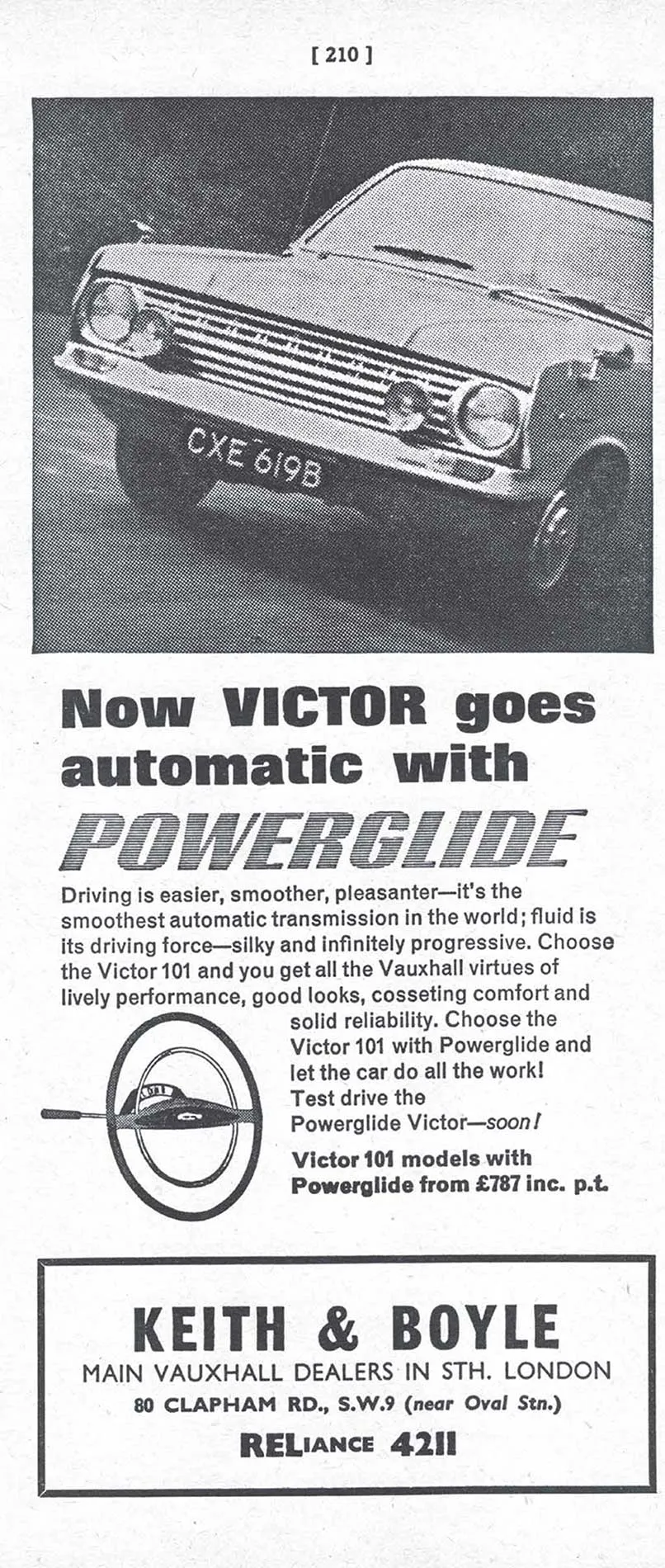
American influence still prevailed in the mid-1960s, and the FC-series was made available with GM’s two-speed Powerglide automatic, which worked well with big American V8s but not with the 1.6-litre 4-cylinder in the FC.
The extent to which GM controlled what went on at Vauxhall depended very much on who was in charge of the company in Detroit. Theoretically, Vauxhall reported to a division called GMOO (GM Overseas Operations), but the ultimate approval for new products rested with GM’s top management, who regularly kept in touch with progress on new designs. In the 1950s, Harlow Curtice proved to be a very hands-on and demanding president of GM, and insisted that Vauxhall should toe the corporate line. He encouraged GM styling chief Harley Earl to impose US-style design on the company’s European subsidiaries, and the results were not always pleasing. John Gordon took over from him in 1958; he took a more relaxed stance, and his new styling chief, Bill Mitchell, wanted to eliminate the fins and chrome of the Earl era in favour of designs that were more readily compatible with European tastes.
Bill Mitchell remained in charge of GM Styling until 1977, and his successor arrived too late to have any significant influence over the Vauxhalls covered in this book. At top management level, James Roche took over in 1965, the year when Ralph Nader targeted the design of the GM-built Chevrolet Corvair in his book Unsafe at Any Speed, and he had too much firefighting to do to worry much about Vauxhall. Ed Cole, who took over in 1971, and Elliott (Pete) Estes who replaced him in 1974 also had far too much corporate trouble to deal with to get involved in micro-managing Vauxhall.
GMOO nevertheless continued to keep a close eye on Vauxhall product design, evaluating prototypes in Detroit and on several occasions putting forward styling ideas that were so out of touch with European norms that they must have infuriated the styling team at Luton. Nevertheless, there were benefits to the link with GM, and advances such as the automatic choke, collapsible steering column, and gradual reduction in maintenance requirements originated in Detroit and gave Vauxhall a valuable lead in engineering. GM also appointed Vauxhall’s managing directors, and their choices did not always turn out to be good ones, but when they parachuted their own men into Luton to help out in specific product development areas, the benefits were often great. Among those who made a positive impact on Vauxhall products were Leo Pruneau and Wayne Cherry in...
Table of contents
- Cover
- Halftitle
- Title
- Copyright
- Contents
- Introduction and Acknowledgements
- Timeline
- Chapter 1 A Classic Era, 1957 to 1979
- Chapter 2 The Victor Range
- Chapter 3 Velox, Cresta and Viscount 6-Cylinders
- Chapter 4 The Viva Range
- Chapter 5 The Firenza and Magnum Ranges
- Appendix: The Engines
- Index
Frequently asked questions
Yes, you can cancel anytime from the Subscription tab in your account settings on the Perlego website. Your subscription will stay active until the end of your current billing period. Learn how to cancel your subscription
No, books cannot be downloaded as external files, such as PDFs, for use outside of Perlego. However, you can download books within the Perlego app for offline reading on mobile or tablet. Learn how to download books offline
Perlego offers two plans: Essential and Complete
- Essential is ideal for learners and professionals who enjoy exploring a wide range of subjects. Access the Essential Library with 800,000+ trusted titles and best-sellers across business, personal growth, and the humanities. Includes unlimited reading time and Standard Read Aloud voice.
- Complete: Perfect for advanced learners and researchers needing full, unrestricted access. Unlock 1.5M+ books across hundreds of subjects, including academic and specialized titles. The Complete Plan also includes advanced features like Premium Read Aloud and Research Assistant.
We are an online textbook subscription service, where you can get access to an entire online library for less than the price of a single book per month. With over 1.5 million books across 990+ topics, we’ve got you covered! Learn about our mission
Look out for the read-aloud symbol on your next book to see if you can listen to it. The read-aloud tool reads text aloud for you, highlighting the text as it is being read. You can pause it, speed it up and slow it down. Learn more about Read Aloud
Yes! You can use the Perlego app on both iOS and Android devices to read anytime, anywhere — even offline. Perfect for commutes or when you’re on the go.
Please note we cannot support devices running on iOS 13 and Android 7 or earlier. Learn more about using the app
Please note we cannot support devices running on iOS 13 and Android 7 or earlier. Learn more about using the app
Yes, you can access Vauxhall Cars of the 1960s and 1970s by James Taylor in PDF and/or ePUB format, as well as other popular books in Technology & Engineering & Automotive Transportation & Engineering. We have over 1.5 million books available in our catalogue for you to explore.