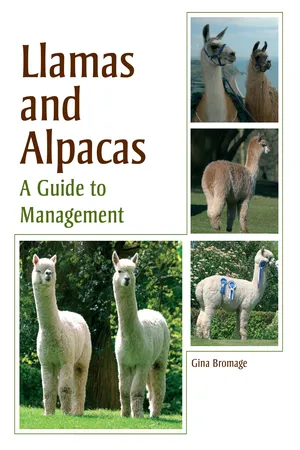
Llamas and Alpacas
eBook - ePub

Llamas and Alpacas

A Guide to Management

  1. 208 pages
  2. English
  3. ePUB (mobile friendly)
  4. Available on iOS & Android
eBook - ePub

Llamas and Alpacas

A Guide to Management

About this book

As well as being adorable animals with a thick, warm fleece, llamas and alpacas are also intelligent, discerning, curious and sociable. In addition they are docile, gentle and easily trained. Natural grazers and browsers, they keep down hedges and pastures, they rarely challenge even the most pathetic fencing unless they are frightened, or in love. They require very little supplementary feed, live outside all year round, are generally hardy, healthy and happy. Llamas and Alpacas - A Guide to Management contains all the basic information required in order to keep these animals successfully and provides an invaluable insight into what keeping llamas and alapacas involves in terms of resources, housing, equipment and skills. It assumes no prior knowledge of llamas and alpacas, nor the husbandry of other domesticated species, and is ideal for the uninitiated as well as being a comprehensive reference source for the established camelid keeper. The book contains chapters that deal with land and housing, nutrition, husbandry and welfare, fleece evaluation, fleece marketing, animal assessment and showing, breeding, birth, the care of the newborn and common health problems.Designed to be a husbandry handbook, it aims to cover the basic knowledge required to keep llamas and alpacas successfully. It assumes no prior knowledge of llamas and alpacas, nor the husbandry of other domesticated species, and is ideal for the completely uninitiated, as well as being a useful source of first reference for the established camelid keeper. Superbly illustrated with 183 colour photographs and 23 diagrams and drawings. Gina Bromage is an experienced veterinary surgeon who keeps alpacas.

Frequently asked questions

Yes, you can cancel anytime from the Subscription tab in your account settings on the Perlego website. Your subscription will stay active until the end of your current billing period. Learn how to cancel your subscription.
No, books cannot be downloaded as external files, such as PDFs, for use outside of Perlego. However, you can download books within the Perlego app for offline reading on mobile or tablet. Learn more here.
Perlego offers two plans: Essential and Complete
  • Essential is ideal for learners and professionals who enjoy exploring a wide range of subjects. Access the Essential Library with 800,000+ trusted titles and best-sellers across business, personal growth, and the humanities. Includes unlimited reading time and Standard Read Aloud voice.
  • Complete: Perfect for advanced learners and researchers needing full, unrestricted access. Unlock 1.4M+ books across hundreds of subjects, including academic and specialized titles. The Complete Plan also includes advanced features like Premium Read Aloud and Research Assistant.
Both plans are available with monthly, semester, or annual billing cycles.
We are an online textbook subscription service, where you can get access to an entire online library for less than the price of a single book per month. With over 1 million books across 1000+ topics, we’ve got you covered! Learn more here.
Look out for the read-aloud symbol on your next book to see if you can listen to it. The read-aloud tool reads text aloud for you, highlighting the text as it is being read. You can pause it, speed it up and slow it down. Learn more here.
Yes! You can use the Perlego app on both iOS or Android devices to read anytime, anywhere — even offline. Perfect for commutes or when you’re on the go.
Please note we cannot support devices running on iOS 13 and Android 7 or earlier. Learn more about using the app.
Yes, you can access Llamas and Alpacas by Gina Bromage in PDF and/or ePUB format, as well as other popular books in Technology & Engineering & Animal Husbandry. We have over one million books available in our catalogue for you to explore.
CHAPTER 1

Introducing Llamas and Alpacas

This chapter will briefly describe the origins of the domesticated South American camelids (i.e. llamas and alpacas) and the purposes of their domestication, and indicate some important differences between them and other domesticated animals in the UK.
Llamas and alpacas belong to a group of animals known as the South American camelids, which are descended from an ancient camel-like ancestor that migrated to the Americas millions of years ago. (The term camelid derives from their scientific family name, Camilidae.) Other camelids include the dromedary and bactrian camels. The American camelids subsequently died out in the northern part of the continent, but in the south they were domesticated by the Incas, and they formed the basis of the Inca economy. They were used for meat, fleece, hides, leather, tools and fuel, and as pack animals. The harsh environment of the Andes makes each of these resources truly a matter of life and death, and an animal that could thrive there was essential to human survival. When the Spaniards conquered the Inca, they seemed to make a particular campaign of attempting to exterminate llamas and alpacas. This has given rise to the idea that the Spanish may have seen such a strategy as a way of fatally weakening the much more numerous Inca.
A llama, the largest of the four South American camelids. (Photo: Chris Eke, UK Llamas)
An alpaca, the luxury fibre factory of the South American camelids. (Photo: John Gaye, Alpacas of Wessex)
A guanaco, the wild progenitor of the llama, is still found extensively in South America. (Photo: Chris Eke, UK Llamas)
A vicuna, the shy, rare, endangered progenitor of alpacas. It is found on limited ranges, mainly in the altiplano. (Photo: John Gaye, Alpacas of Wessex)
A tampuli llama. Notice the fibre on the neck and upper legs – much thicker and longer than in other llamas. (Photo: Chris Eke, UK Llamas)
A ccara llama. Notice the light fibre cover on the head, neck and legs. (Photo: Chris Eke, UK Llamas)
Tampuli llama. Notice the fringing on the head and ears. (Photo: Chris Eke, UK Llamas)
A selection of products that can be made from llama fibre.
It is generally accepted that llamas (Lama glama) were domesticated from the larger of the two wild camelids, the guanaco (Lama guanicoe), and that alpacas (Vicugna pacos) derived from the smaller, shyer, rarer vicuna (Vicugna vicugna). However, genetic studies have indicated that there has been crossbreeding in the past (possibly as a result of the disruption caused by the Spanish conquest) and all four species are capable of interbreeding and producing fertile crosses. There are no wild llamas or alpacas: they exist only as domesticated animals. There is in South America a large number of llama/alpaca-cross individuals, which are called huarizos or mistis. There are also wild populations of guanaco and vicuna. The guanaco is found extensively in South America, but the vicuna is endangered and protected. It lives in limited ranges in harsh conditions at high altitude.

LLAMAS

These are the largest of the four South American camelids, and can weigh from 110–250kg (250–550lb) and stand 102–119cm (40–47in) at the shoulder. They can be many different colours, and also a mixture of colours. There are several physical types, but their characteristics can overlap, so in a sense they are not true ‘breeds’. In South America they are distinguished by whether the neck and head is woolly or fairly bare, and on the length and cover of the rest of their fibre. The woolly necked types are collectively known as tampuli, and can be further subdivided into lanuda and tapada. The lanuda is woolly on the ears and head, and further down the legs. The barer-necked ones are the short-coated ccara (or ‘classic’, although these are actually numerically rarer in South America) and curaca, with a medium coat. The barer-necked llamas tend to moult to a close-cropped level of fleece. The reason for these different forms is that there is a number of different jobs for the animal to do. Pack animals will cope better with exertion if their coats are not too heavy and thick, but because the Incas made everything from ropes and bags to upholstery and clothing from fibre, some heavily fibred animals with a range of fibre types were also needed. In addition, there is considerable variation of climate, and different fleece types allow the animals to cope best with their local weather conditions.

ALPACAS

These are much smaller than llamas, weighing in at between 55 and 90kg (121 and 200lb) and reaching only 76–96cm (30–38in) at the shoulder. Twenty-two different shades of solid colour are recognized, allowing a wide range of fabric colours to be produced from the undyed fleece. There are two basic breeds, classified by fleece character: the huacaya, which has a sheep-like woolliness, and the suri, whose fleece hangs in long spiral locks. This is a true-breeding genetic difference, with the suri gene being dominant: a first cross should look like a suri, but, if crossed again with a huacaya, the result will be a 50:50 mixture of suri-looking offspring and huacaya offspring
Alpacas are the major fibre-producer. Note that it’s ‘not done’ to call it wool. This is not merely snobbery, since the microscopic structure of the fibre is indeed different, with the...

Table of contents

  1. Cover
  2. Title Page
  3. Copyright
  4. Contents
  5. Acknowledgements
  6. Preface
  7. CHAPTER 1: Introducing Llamas and Alpacas
  8. CHAPTER 2: Why Llamas or Alpacas?
  9. CHAPTER 3: Land and Housing
  10. CHAPTER 4: Feeding and Nutrition
  11. CHAPTER 5: Husbandry
  12. CHAPTER 6: Behaviour, Handling and Training
  13. CHAPTER 7: Fleece Evaluation
  14. CHAPTER 8: Fleece Marketing
  15. CHAPTER 9: Assessment and Showing
  16. CHAPTER 10: Breeding
  17. CHAPTER 11: Birth
  18. CHAPTER 12: Care of the Newborn
  19. CHAPTER 13: Common Health Problems
  20. Glossary
  21. Further Reading and References
  22. Useful Addresses
  23. Index