The Mercedes-Benz W123 was launched in 1976 and sales quickly surpassed those of its predecessor, the W114. The W123 went on to become the most successful Mercedes, selling 2.7 million cars. Mercedes-Benz W123 - The Complete Story explores the life of this highly regarded executive car from its initial evolution, development and production to the creation of new models and its success in motorsport. The book features the styling, engineering and technical advances introduced over the lifetime of the three series; full technical specifications together with customer options, equipment and interior trim for each model; production numbers and vehicle number sequences and finally there is a section on the little-known details of the manufacture of the car in China.It is superbly illustrated with 240 colour and black & white photographs. James Taylor is a professional motoring writer with over thirty years' experience and Mercedes-Benz is one of his favourite car manufacturers.
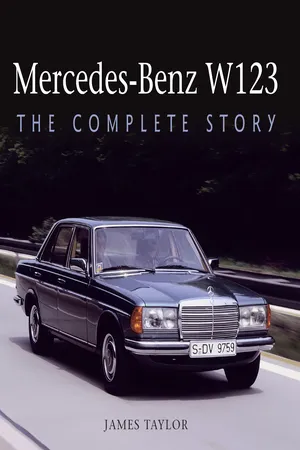
- 176 pages
- English
- ePUB (mobile friendly)
- Available on iOS & Android
eBook - ePub
About this book
Trusted by 375,005 students
Access to over 1.5 million titles for a fair monthly price.
Study more efficiently using our study tools.
Information
CHAPTER ONE
DESIGN AND DEVELOPMENT
In 1968, just a year after the M114 six-cylinder and M115 four-cylinder models had been introduced to the showrooms, Mercedes-Benz designers at the company’s Stuttgart headquarters began thinking about the medium-sized saloon that would replace them. This was not in any sense considered to be premature. There are always ideas left over from the design of a new car that are worth retaining for its successor, and in any case an early start to the design of such an important model – the medium-sized saloons were Mercedes’ strongest sellers – was no bad thing.

Responsibility for the engineering of the 123-series cars fell to Hans Scherenberg, Mercedes’ long-serving technical chief.
At that stage, the key figures in the Mercedes-Benz passenger car division were the engineering director Hans Scherenberg and the chief designer Friedrich Geiger. Between them, these two were to be responsible for the design of the next generation of medium-sized saloons. One early decision they took was to develop the new cars with a common design that would suit both four-cylinder and six-cylinder variants. Instead of two different but related projects, as there had been for the W114 and W115 models, there would be a single project. It would be coded W123.

Friedrich Geiger was in charge of the Mercedes styling department in the late 1960s and early 1970s, and oversaw the development of the 123-series shape.
To the uninitiated, W123 sounds like a random alphanumeric group, but, as with all Mercedes-Benz matters at the time, it was underpinned by logic. The initial ‘W’ stood for Wagen (German for ‘car’) and ‘123’ was part of a numeric sequence. That sequence had begun in the 1930s and by the late 1960s had gone way past 100 (the number allocated to the big Mercedes 600 limousine announced in 1963). Numbers 114 and 115 had been allocated to the New Generation saloons released in 1968, and 116 represented the forthcoming new flagship model that would be released in 1972 as the S Class. Although none of the numbers between 117 and 122 was associated with a production model, they were probably all used at Stuttgart; indeed, details of abortive projects numbered 118, 119 and 122 have leaked out over the years, so there were undoubtedly others along the way.
As work began on the new W123 models, a new look for Mercedes-Benz cars was already in preparation within Friedrich Geiger’s styling department. It would not become public knowledge until 1971, when the new R107 SL sports cars (the ‘R’ standing for ‘roadster’) were announced. Crucial to the new look were simple, elegant lines that helped make the cars look low and purposeful, while at the front a shallower version of the traditional Mercedes-Benz grille was flanked by horizontal headlamp assemblies. These features represented a radical departure from the vertically stacked light units that had characterized the cars of the 1960s, and they were to be matched at the rear by large, horizontal light units with distinctive ribbed lenses. The design was meant to reduce any build-up of road dirt that might obscure the light. Unsurprisingly, the intention was for the new W123 cars to follow this new design direction too.

The assembly lines at Sindelfingen in the late 1960s, with examples of the 114 and 115 saloons alongside the 113 ‘Pagoda’ two-seaters and, under shrouds on the extreme left, the big W108 coupés.

A new Mercedes family style was emerging as the 1970s opened; the R107 roadster that replaced the W113 pagoda-roof cars was the first model with it.
Meanwhile, the guidance given to Hans Scherenberg’s engineers was also very much forward-looking. The new W123 models were to be safer than their predecessors, not least because they would have to satisfy and stay ahead of new legislation affecting motor vehicles that was being introduced all round the world by the late 1960s. They were to incorporate whatever technical advances would be ready in time for their launch, which at this stage was tentatively proposed for 1974, and there were also to be general improvements in refinement. Another element of the engineers’ brief was that the W123s should be easier to repair and service than their predecessors. This was a particularly interesting idea that arose from a clear appreciation that modern cars were becoming more and more complex – and that a new Mercedes-Benz still had to be simple enough to be maintained and repaired by mechanics in what were then called Third World countries.
Above all, these were to be very rational cars, in the way that was characteristic of Mercedes-Benz at the time. Every little detail was to be thought through carefully, and engineering would take precedence over appearance in every case – although appearance was by no means low down on the list of design priorities. Nor would the engineers allow themselves to be rushed by sales teams anxious to get the new car into the showrooms: throughout the design and development stages of the 123 series, it seems to have been understood that this car would be released when it was ready, and not a moment earlier.
ACHIEVING A STYLE
These days, car designers prefer not to use the word ‘style’ to describe what they do, arguing that it diminishes the value of their contribution to the completed car. Nevertheless, the word was current to describe the visual design of cars in the 1960s, and Friedrich Geiger’s team would have seen themselves as ‘stylists’.
They started in the traditional way, sketching out proposals on paper. The most promising of these were then turned into three-dimensional scale models, and then a further selection was made, with the preferred designs being created as full-size models, using clay on a wooden armature. Friedrich Geiger would no doubt have been encouraging the younger men in his team as they worked towards successful solutions; it was his job, too, to maintain a continuity with existing Mercedes styling traditions so that the new cars were recognizably products of the Stuttgart manufacturer. It looks as if he may have deliberately provoked them with some radical ideas as well: for some years he had been keen on extended rooflines that finished in a cowl over a reverse-rake rear window. Some designs with this quite un-Mercedes-like feature persisted in the mix until quite late in the styling process.
Some of the full-size clays that existed by summer 1970 were clearly identifiable as ancestors of the production car, although the final details of such features as lights had not been settled by this stage. In profile, the new W123 saloon was surprisingly similar to the W114 and W115 models it was to replace, but more rounded, softer lines and modern details such as single-piece front-door glasses without a quarter-light disguised the similarities very effectively. The bonnet shape was simpler, too, with flatter sides that met the wings in a gentle curve, whereas the older cars had a raised section to blend with their vertical light stacks. Less visibly, an extra 45mm (just over 1¾in) in the wheelbase gave more room in the passenger compartment. Inevitably, some themes were carried over from the 107 roadster models and the 116 S Class; not only had such themes proved themselves to be successful, but they would also give the family resemblance that was traditional to the Mercedes-Benz passenger car range.

The second new model with the new Mercedes style was the W116 S Class saloon, which arrived in 1972. It was inevitable that the styling solutions chosen for these cars would have an impact on the new W123 models.

The W123 design did not immediately take on the latest styling elements. This early full-size mock-up, dated January 1971, is really a cautious progression from the existing 114 and 115 style, with more rounding in the body and an interesting take on headlight design.

Styling development progressed through 1/5th scale models like the one seen here with a cutaway scale model designed to show the volumes devoted to each element of the car. The scale model shows a dipped waistline that did not make it into production. It also has US-style impact bumpers with a design that was not adopted.
In August 1971, the Mercedes-Benz Board of Management visited the styling studios for an update on progress. Geiger’s team arranged for the three most promising full-size clay models to be viewed amid a selection of older Mercedes models and rival saloons in the same market sector. The board selected its preferred option: a scaled-down and lighter-looking derivative of the 116 S Class design, with a more pronounced rake from front to rear. That was then worked up in more detail, with the final design being signed off in summer 1973.

Bruno Sacco took over from Friedrich Geiger when the latter retired in 1973, but the shape of the 123 series had already been signed off for production.
The final stages of W123 styling development were overseen by Bruno Sacco, who took over as head of Mercedes-Benz passenger car styling when Freidrich Geiger retired in December 1973. However, he made no attempt to alter the design language of the cars, which had been entirely created by Geiger. Sacco’s take on Mercedes-Benz styling would not become apparent until the introduction of the W126 S Class saloons in 1979, and would steer the company’s cars in a distinctively different direction.
Multiple considerations affected the final styling that was signed off for production. Among them was the need to sell the cars in the USA, where the requirement for side marker lights had led to some rather ugly solutions on the 114 and 115 models. For the 123 series, Geiger’s team fell back on the wraparound front lights they had designed for the 107 and 116 cars, which made the turn signals more easily visible from the side and could also be used to house marker lights when these were needed. It was an elegant solution that also simplified manufacturing by using a single lens design to cover all requirements. The rear light units wrapped around the sides of the car for the same reason, and of course the lenses of both front turn signals and rear light units had the same ribbed design as on the 107 roadsters and the 116 S Class: Mercedes insisted that this prevented the entire lens from becoming obscured by dirt.
However, the 123s could not be made to look too much like the more expensive S Class cars, for fear of upsetting the owners of these top-model Mercedes. As a result, although both cars were made to look longer and lower by horizontal lines running along their flanks, the rubbing-strip on the 123s was mounted much higher up than its equivalent on the 116, and was matched by a discreet styling crease at bumper height. The radiator grille was much lower on the 123 than on the 114 and 115 models and very similar in overall appearance to that on the 116 type. Where the grille of the S Class had plastic vanes in a cheese-cutter design, the 123 had simpler horizontal slats...
Table of contents
- Cover
- Title
- Copyright
- Contents
- Introduction
- Acknowledgements
- Timeline
- Chapter 1 Design And Development
- Chapter 2 First-Series Saloons, 1976–1979
- Chapter 3 The Later Saloons, 1979–1985
- Chapter 4 The Coupés, 1977–1985
- Chapter 5 The T-Series Estates, 1978–1985
- Chapter 6 LWB Saloons and ‘Platforms’
- Chapter 7 The 123 Series in North America
- Chapter 8 The 123 Series in Motorsport
- Chapter 9 The Aftermarket
- Chapter 10 Buying and Owning a 123-Series Mercedes
- Appendix I Production Statistics
- Appendix II Vehicle Number Sequences
- Appendix III The Mercedes 123 in China
- Index
Frequently asked questions
Yes, you can cancel anytime from the Subscription tab in your account settings on the Perlego website. Your subscription will stay active until the end of your current billing period. Learn how to cancel your subscription
No, books cannot be downloaded as external files, such as PDFs, for use outside of Perlego. However, you can download books within the Perlego app for offline reading on mobile or tablet. Learn how to download books offline
Perlego offers two plans: Essential and Complete
- Essential is ideal for learners and professionals who enjoy exploring a wide range of subjects. Access the Essential Library with 800,000+ trusted titles and best-sellers across business, personal growth, and the humanities. Includes unlimited reading time and Standard Read Aloud voice.
- Complete: Perfect for advanced learners and researchers needing full, unrestricted access. Unlock 1.5M+ books across hundreds of subjects, including academic and specialized titles. The Complete Plan also includes advanced features like Premium Read Aloud and Research Assistant.
We are an online textbook subscription service, where you can get access to an entire online library for less than the price of a single book per month. With over 1.5 million books across 990+ topics, we’ve got you covered! Learn about our mission
Look out for the read-aloud symbol on your next book to see if you can listen to it. The read-aloud tool reads text aloud for you, highlighting the text as it is being read. You can pause it, speed it up and slow it down. Learn more about Read Aloud
Yes! You can use the Perlego app on both iOS and Android devices to read anytime, anywhere — even offline. Perfect for commutes or when you’re on the go.
Please note we cannot support devices running on iOS 13 and Android 7 or earlier. Learn more about using the app
Please note we cannot support devices running on iOS 13 and Android 7 or earlier. Learn more about using the app
Yes, you can access Mercedes-Benz W123 by James Taylor in PDF and/or ePUB format, as well as other popular books in Technology & Engineering & Automotive Transportation & Engineering. We have over 1.5 million books available in our catalogue for you to explore.