eBook - ePub
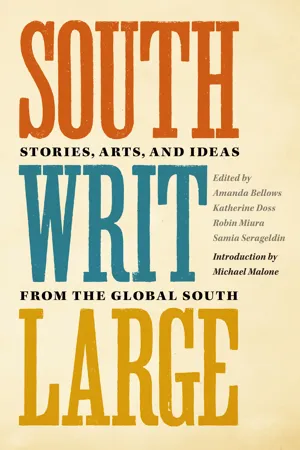
South Writ Large
Stories from the Global South
- 156 pages
- English
- ePUB (mobile friendly)
- Available on iOS & Android
eBook - ePub
South Writ Large
Stories from the Global South
About this book
South Writ Large: Stories from the Global South is an anthology of personal essays, articles, poetry, and artwork that explores the culture of the U.S. South and its extensive connections to other regions of the world. The collection is composed of articles published over the past ten years in the online magazine South Writ Large, which examines the changing South in its symbolic and psychological complexity to stimulate conversation about the culture of the South at home and abroad. The anthology's accomplished contributors work in broad-ranging fields: novelist Jill McCorkle; poet Jaki Shelton Green; historians Clay Risen and Malinda Maynor Lowery; journalist and politician W. Hodding Carter III; author and chef Bill Smith; and artists Bo Bartlett and Welmon Sharlhome. The introduction is by novelist Michael Malone and the afterword is by anthropologist Jim Peacock, whose Global South concept inspired South Writ Large Magazine and this anthology.
Trusted by 375,005 students
Access to over 1.5 million titles for a fair monthly price.
Study more efficiently using our study tools.
Information
CULTURAL CARTOGRAPHIES
Half-Drawn Hispaniola
IN FEBRUARY, I found myself in Nashville with a few hours to kill before my reading at Parnassus Books. It was terribly cold, and weird pellets of slush were pinging off my windshield; I asked the audience that night about the phenomenon, and they told me it was sleet. I felt a renewed gratitude for my New Orleans home. In the midst of this frigid, wet assault, seeking shelter, I made my way to the Frist Center for the Visual Arts, a museum encased in an art deco former post office that’s marbled with glamour. The exhibition on display didn’t matter—I just wanted to thaw my toes—but it ended up being quite beautiful, pulling together a private Spanish collection that included works by Goya, Rubens, and Titian. This noble family also owned a folder of Columbiana, documents from those initial expeditions to the Americas in the 1490s: a ship manifest, a decree from Ferdinand and Isabella, and a travel diary from the winter of 1492–93 with a sketch of the northern coastline of Hispaniola.
I hovered over this map for a few moments then continued around the gallery, gawking at Goya’s Duchess of Alba in White with its hilariously stoic lapdog. But a few minutes later I was standing again at the glass case, peering in. Just a simple sketch. Probably, though not certainly, by Columbus. Probably, though not certainly, the first map of the Americas drawn by a European. I was impressed, against my better judgment. (Where was the first map of Europe drawn by an indigenous American?) The image was captivating because it represented one of those flash points in history after which everything was irrevocably changed. That line in ink, drawn by a single man on a single ship sailing slowly past a coast, was also a line through the heart of the continent. Not a sketch but a garrote.
The map is small, but it takes up two pages of Columbus’s travel diary, as if he misjudged the proportions when he began and ran over the crease in the binding with some chagrin. I can’t help thinking he could have turned the diary ninety degrees and used his white space more efficiently. He may have thought the same. But this was more a placeholder than a piece of art. The line starts around the present-day town of Gaspar Hernández in the Dominican Republic, then snakes around the bumps in coastline (more prominent here than in actuality) until it rounds the western corner of Haiti and fizzles out near the present-day town of Gonaïves. Columbus is taken with the islands: Île de la Tortue is here (“Tortuga”), but also a cluster of three small islands near Cap-Haitien and a veritable archipelago near the peak of “Monte Cristi”: a larger bean-shaped island and four whimsical satellites, each drawn counterclockwise. He deems the western cape “San Nicolas” and marks a single mainland town: “Natividad,” or Villa de la Navidad, the fort his men built after the Santa María floundered on the reef. He was stuck there three weeks before finally escaping on the Niña. (When he returned a year later, the thirty-nine men he’d left had vanished, the settlement burned to the ground. Archaeologists are still poking around the Haitian coast searching for the ruins, the Hispanic Roanoke.) In and among the lines representing actual features are eight brown inkblots that exist in a cartographic twilight zone between island and bloodstain. They’re precise enough for the former, and brown and clotty enough to shiver anyone who knows what Columbus brought to the Caribbean. From one of the stains a small cross grows: a sign of faith? A compass rose?
I didn’t know what else was in the diary, and I wasn’t particularly interested; Columbus’s actual notes didn’t hold any fascination for me. It’s the map that was magnetic. It marked a story that had just begun; the continent’s fate was being outlined—messily, hesitatingly. The fact that the map was unfinished drew the viewer in like a morbid counterfactual. Could things have gone differently? He’s only half there. He’s only so far in. No one knows what comes next.
This map only pops up in a few places when you search online. One is Yale University, on a webpage nestled in their Genocide Studies Program. Another is Southern Methodist University, where it advertises an exhibition on campus “celebrating Columbus Day weekend.” It occurred to me that Columbus is kind of a southern story, if we embrace our Caribbean neighbors in a shared past. And what do southerners do if not remember things problematically?
What do we think we’re celebrating on Columbus Day? That half-drawn line? The unknown that lures any explorer? The darkness that needs our own enlightened gaze? It’s the impulse behind Manifest Destiny, colonialism, the Apollo missions: white people be conquerin’! Columbus’s partial map is a drawing that invites our participation not only in the thrill of discovery but in the horror of what was to come. On the island of Hispaniola alone, 80 to 90 percent of the Taíno population died within a generation after Columbus’s ships arrived. Some estimates put that at three million souls. As the great navigator bent over the desk in his cabin, tracing out the contours of a foreign land, his men were twisting through the forests, carrying guns and swords and viruses and Christianity and racism. For the Taíno, this was a story of genocide, not celebration. Yale got it right.
But the South, for all its memory problems, has a wealth of stories to draw from; Europeans weren’t the only ones telling us what the world is shaped like. What about early American Indian maps? What do they look like? Circles upon circles upon circles, each linked by umbilical cords. Where Columbus drew a line and abandoned it, as far as his own knowledge reached, early maps from Catawbas and Chickasaws on the North American continent show the intricate relations between communities. There was no individual; there was no unknown territory. On a Catawba deerskin map from 1721, beyond the circles of towns, the English settlements to the north and south sit on the periphery, represented as squares. “This is our country,” the map implicitly says, “and you are over there.” (In addition to these sociopolitical maps, Native peoples created pictorial facsimiles of their physical environments as accurately as any European; Columbus himself encountered a Mayan man in 1502 who could chart sections of the coastline of Honduras.)1
West from Hispaniola, at about the same time Columbus was poking around the islands, the Aztecs were engaged in an interdisciplinary mapmaking venture of their own. The Codex Xolotl shows not just the mountains and rivers of the region but also its history: the arrival of the Chichimecs to Mexico, their exploratory jaunts through the terrain, and all the intricate dramas of a people in migration. There are speech bubbles, flipbooks of action, secondary plots. These maps are very much alive; the Aztecs had no interest in creating a static record of an unchanging natural world.
Maps reveal what a person, and the culture looming behind that person, thinks is important. Columbus wanted a precise rendering of Hispaniola’s coastline, as far as his pen could reach. Why? So he knew where to land, how to retrace settlements, what he could claim. The Catawbas wanted a holistic picture of the peoples of the South; they needed to know where their friends and enemies stood, along what lines resources could be shared or traded, what a Catawba identity meant in a region of many identities. The Aztecs recounted a conquering history in order to legitimize their enduring presence in Mexico, link the people with the land, and shape communal memory. The indigenous mapmaking of the Americas tended to prize stories over data, a sense of fullness and completeness rather than the line that trails off because the individual’s knowledge comes to an end.
And I, standing over a glass case in an old post office to escape the sleet of downtown Nashville—what did I need directions for?
I don’t travel as much as I’d like. As a writer, I tend to be fairly stationary. Maps to me are games for the imagination: alternate worlds, a different set of eyes, might-have-beens. I imagine myself a tiny ink person traveling along this wiggly ink coastline—at a certain point, I fall off, like people told Columbus he would. His line takes me to the Caribbean. A map that depicts a location. His messy inkblots carry me to the cabin of his ship. A map of a man’s body, the upset of his stomach, his shaky hands, a whispered “mierda!” His looped labels—Natividad, Monte Cristi—funnel me inside his brain: a map of the conqueror’s hubris, a last flashing attempt at civilization before the ignorance and cruelty of his own people eradicate an entire culture, all those alternate maps destroyed before they could even be drawn.
I left the glass case and retreated to the far side of the gallery, where I pretended to look at a portrait of a woman in flounces while I watched the other patrons glide past the Columbiana display. Most glanced in the case for a second, scanning. Some, uninterested in pieces of paper, walked on by. One man stared for quite a while, then gestured excitedly to his wife, “Honey! Come check this out!” Could I blame him? I, too, hadn’t been able to look away.
NOTE
1. Gregory A. Waselkov, “Indian Maps of the Colonial Southeast,” in Powhatan’s Mantle: Indians in the Colonial Southeast, rev. ed., ed. Gregory A. Waselkov, Peter H. Wood, M. Thomas Hatley (Lincoln: University of Nebraska, 2006), 435–502. See also Mary Eliza-beth Fitts, “Mapping Catawba Coalescence,” North Carolina Archaeology 55 (2006): 1–59.
Recognizing Lumbee History through Land
LUMBEE HISTORY begins with the stories we tell about family and land. Those stories cannot be told apart from one another, for each gives the other meaning. Even as these elements reinforce each other, our history is also infused with contradictions, opposing forces that we must hold together in a tender kind of tension. Lumbees have built our nation to withstand these contradictions; we have learned that trying to erase them only reinforces the power of some at the expense of others.
Actually, land is hardly the right term for the Lumbees’ home place—it is water and soil, two perfect opposites flowing together since ancient times. There are dense swamps where the water runs southwest, fingerlike, toward the river. But the river is not the wide Shenandoah or roaring Colorado; the Lumber River meanders slowly, twisting and turning an intricate design that changes periodically as her waters forge new paths.
In the Indian section of the county, seen from above, the Lumber River looks like a great snake, twisting and turning, swelling and breathing with the spring and summer rains. Snakes, in fact, have found a comfortable home there. Between the swamps there are wide, shallow basins that never dry out, called pocosins. European newcomers retained the word from our Algonquian ancestors; it translates to “swamp-on-a-hill.” Pocosins are home to the Venus flytrap, the carnivorous threat to unwitting insects and a precious specimen to mystified humans. An equally charming, sweet-smelling vine, the Carolina jessamine, also makes its home there, entwining human hearts in its scent. But don’t suck its nectar or eat its flower; you’ll lose control of your muscles, your speech, convulse, and stop breathing—essentially the same symptoms of a poisonous love. Yet in the hands of particularly skilled healers, the vine’s underground stem can cure the pains of love, especially migraines, fever, and menstrual problems.
Pocosin soil is peat, the vegetative material that becomes coal under proper conditions. Peat began forming 360 million years ago.1 Like Lumbee women who will cry as they laugh, peat itself can burn when it’s wet—burning peat is probably why one of our swamps is called Burnt Swamp. Our ancestors gazed at that peat fire, which burned indefinitely, beneath flowing water. Water would never put out that fire, so long as the peat was there to fuel it.
What spirits inhabit land where fire and water coexist, neither extinguishing the other? No wonder they dubbed one of these places a burning swamp; the name is a contradiction, and contradictions are reminders of how our history affects us. The land and its spirits have history too. We used to place our cemeteries at the edge of pocosins, perhaps because of the spiritual power we recognized there. We also planted a cedar tree, as cedar is the herb that heals—death, and its partner, eternal life, ultimately heal the body’s frailties.
Centuries ago, our pine trees became partners with the swamps. Although the longleaf pine is mostly gone from our landscape today, we can remember a time in which it dominated. In 1524, Italian explorer Giovanni da Verrazzano described “immense forests of trees, more or less dense, too various in colors … too delightful and charming in appearance to be described.”2 The sandy well-drained soil in which longleaf pine grows best accompanied our rich peat: perfect opposites. The longleaf is an evergreen, like the cedar, and from a distance its needles look furry, soft, touchable. They are long and naturally curled, like a child’s eyelashes; many Lumbee men retain those long, curly eyelashes into adulthood, making women mad for them and madly jealous at the same time.
All was forest and swamp, except for footpaths used to navigate through the dry places. The Lowry Road, also called the Mulatto Road, was one of the first of these paths to appear on English maps.3 Local Indians and Natives from other places carved the Lowry Road. It runs from the Cape Fear River in Cumberland County into South Carolina. In the 1600s, Seneca hunters from Upstate New York may have traveled the Lowry Road as part of their search for beaver and their warfare against Catawbas and other communities in Piedmont Virginia, North Carolina, and South Carolina.4 While the road became a place for migrants to travel, it was also a place for us to protect as a boundary that connected our family settlements and kept them hidden from view.
Like so many parts of Lumbee life, the road’s contradictions made our power invisible and at the same time secured it. Just as our Lumbee and American history is a group of stories that we tell, it’s also a collection of silences that we hide behind. The name Mulatto Road is but one example of such concealment. “Mulatto” is how outsiders described us, and it’s a label that speaks to racial ancestry (Indian, Black, and white). But that label is not necessarily how we described ourselves because it does not represent kinship. “Lowry” represents people and relationships, not race, and so that is the name we have upheld, just as we uphold family.
Knowledge of family networks is another way we know who we are, encapsulated in the simple question a Lumbee will often ask when meeting another Lumbee, both at home and when the two have traveled to a far-off place: “Who’s your people?” Southerners of all backgrounds use that phrase to narrow the distance between two people, but in the non-Lumbee world, it is often a test of social class, as if to say, “Is your family the same status as mine?” In other words, how powerful is your family compared to mine? Economics and politics are invested in that question. For Lumbees, the phrase tests a different kind of knowledge—an understanding of history. Often, we might find common ancestors three or four generations past, and then we usually ask another question: “Where do you stay at?” Often the answer is a community like Deep Branch or Union Chapel, one of the communities that has been central to our nation’s structure since before the formation of the United States. This information yields another layer of knowledge, which informs relationships among people but also between people and places. Lumbees are a people because of our attachments to places, and our power is in our history.
The main roads, like the Lowry Road, took our ancestors in and out of our present-day homeland of southeastern North Carolina, and some of them were not from this particular place. Instead, many of our ancestors came from places all the way north to the James River in Virginia and south to the Santee River in South Carolina, east to the Atlantic Ocean and west to the Great Pee Dee and Catawba Rivers, an area of about seven thousand square miles. That territory is not ours today, but we are products of it nonetheless.
Our ancestors were not members of one nation, but from dozens that lived in this territory. The names of these diverse communities varied depending on where they lived and what Europeans wrote down about them. For example, the present-day Waccamaw Siouan people in North Carolina’s Columbus County may have been called Woccon on British maps before relocating to their present homeland. Some of our Cheraw—also called Saura and Xuala—ancestors lived in and traveled through the present-day Lumbee homeland prior to the eighteenth century. Other Indians who moved to our present-day homeland were most likely refugees from as many as twenty different Indian communities, each with different names. All of these people spoke different languages and practiced different traditions from what scholars later called Algonquian, Iroquoian, and Siouan culture groups.5
The ethnic diversity of this area is hard to comprehend when US history teaches you that Indians are a “race” of people. We understand race today to mean that members of the racial group share a common culture and that the only differences might be in customs and attitudes, as in northerners are different from southerners. But before the settlers came, Indians in North and South Carolina and Virginia were enormously different from each other.
During the first two centuries of European exploration and settlement, those differences probably diminished according to the enormous destruction wrought quickly by disease. Lumbee ancestors probably began to die of diseases contracted from their Native trading partners before any of them ever saw any Europeans. The oldest members of the community, who kept our histories, died first, and the youngest members, who represent our futures, died second. The rapid and unexpected deaths of our elders and our children meant near instantaneous loss of cultural knowledge that had been accumulated for thousands of years, followed by the more gradual collapse of governments, languages, and every other commonality that keeps a nation together. Imagine what happens when an infectious disease kills 95 percent of your town, and you see why the intent may not have been genocidal, but the result certainly was. Yet there were survivors, and we are them.
NOTES
1. Thomas E. Ross, One Land, Three Peoples: An Atlas of Robeson County, North Carolina (privately printed, 1992), 34.
2. Giovanni da Verrazzano to King of France, published in 1841 by the New York Historical Society, with a translation by Dr. J. G. Cogswell, at “Giovanni da Verrazzano (Verrazzani),” Son of the South, http://www.sonofthesouth.net/revolutionary-war/explorers/giovanni-verrazzano.htm.
3. See, for example, Map of Robeson County, North Carolina, 1797, John Gray Blount Papers, North Carolina State Archives, North Carolina Maps http://dc.lib.unc.edu/cdm4/item_viewer.php?CISOROOT=/ncmaps&CISOPTR=3026&CISOBOX=1&REC=4.
4. For Seneca travels in North Car...
Table of contents
- Front Cover
- Title Page
- Copyright Page
- Dedication
- Contents
- Introduction
- Cultural Cartographies
- Antebellum Legacies
- Homelands
- Visual Cultures
- Culinary Kinships
- Southern Afterlives
- Afterword
- Contributors
- Back Cover
Frequently asked questions
Yes, you can cancel anytime from the Subscription tab in your account settings on the Perlego website. Your subscription will stay active until the end of your current billing period. Learn how to cancel your subscription
No, books cannot be downloaded as external files, such as PDFs, for use outside of Perlego. However, you can download books within the Perlego app for offline reading on mobile or tablet. Learn how to download books offline
Perlego offers two plans: Essential and Complete
- Essential is ideal for learners and professionals who enjoy exploring a wide range of subjects. Access the Essential Library with 800,000+ trusted titles and best-sellers across business, personal growth, and the humanities. Includes unlimited reading time and Standard Read Aloud voice.
- Complete: Perfect for advanced learners and researchers needing full, unrestricted access. Unlock 1.5M+ books across hundreds of subjects, including academic and specialized titles. The Complete Plan also includes advanced features like Premium Read Aloud and Research Assistant.
We are an online textbook subscription service, where you can get access to an entire online library for less than the price of a single book per month. With over 1.5 million books across 990+ topics, we’ve got you covered! Learn about our mission
Look out for the read-aloud symbol on your next book to see if you can listen to it. The read-aloud tool reads text aloud for you, highlighting the text as it is being read. You can pause it, speed it up and slow it down. Learn more about Read Aloud
Yes! You can use the Perlego app on both iOS and Android devices to read anytime, anywhere — even offline. Perfect for commutes or when you’re on the go.
Please note we cannot support devices running on iOS 13 and Android 7 or earlier. Learn more about using the app
Please note we cannot support devices running on iOS 13 and Android 7 or earlier. Learn more about using the app
Yes, you can access South Writ Large by Amanda B. Bellows, Katherine Doss, Robin Miura, Samia Serageldin, Amanda B. Bellows,Katherine Doss,Robin Miura,Samia Serageldin in PDF and/or ePUB format, as well as other popular books in History & North American History. We have over 1.5 million books available in our catalogue for you to explore.