eBook - ePub
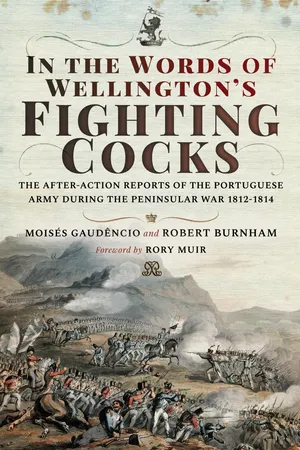
In the Words of Wellington's Fighting Cocks
The After-action Reports of the Portuguese Army during the Peninsular War 1812–1814
- 352 pages
- English
- ePUB (mobile friendly)
- Available on iOS & Android
eBook - ePub
In the Words of Wellington's Fighting Cocks
The After-action Reports of the Portuguese Army during the Peninsular War 1812–1814
About this book
The literature of the Peninsular War is rich with vivid source material – letters, diaries, memoirs, and dispatches – but most of it was written by British soldiers or by the French and their allies. As a result the history and experience of the Portuguese forces – which by 1812 composed close to half of Wellington's Army – have been seriously under-represented. That is why this pioneering book, which publishes for the first time in English the after-action reports written by the commanders of Portuguese battalions, regiments and brigades, is so important. For these detailed, graphic firsthand accounts give us a fascinating insight into the vital contribution the Portuguese made to the allied army and shed new light on the struggle against the French in the Iberian Peninsula. The authors provide an introduction tracing the history of the Portuguese Army prior to the Salamanca campaign of 1812, while tracking its organizational changes and assignment of commanders from 1808 to 1814. They include detailed notes on the after-action reports which set them in the context of each stage of the conflict.
Trusted by 375,005 students
Access to over 1.5 million titles for a fair monthly price.
Study more efficiently using our study tools.
Information
Subtopic
Military BiographiesIndex
HistoryChapter 1
The Portuguese Army from 1793 to 1812
It would be almost impossible to understand the Portuguese Army in the latter years of the Napoleonic Wars without some historical background on how it became such an integral part of Wellington’s Army. This chapter briefly examines Portugal’s involvement in the Wars of the French Revolution, the Peninsular War, and the Civil War that divided Portugal in the 1820s and 1830s. We then continue with an overview of the Portuguese military system at the time of the Peninsular War. There is not room to explain in detail the changes, reforms, and reorganizations that the army underwent in this period for that is a book in itself, but we will provide enough information to help the reader’s understanding of the events referred to in the reports and biographies.
Years of Turmoil
Despite being isolated from the upheaval of the early years of the French Revolution, Portugal, at the request of Spain, and supported by Britain, joined the 1st Coalition’s war against the French Republic in 1792. In 1793 a Portuguese fleet of eighteen ships carried a Portuguese division to Catalonia. This division, of 5,500 men and 22 artillery pieces, was under the command of General John Skelater. It took part in the campaign in Rossillon, southern France, and in the eastern Pyrenees, and Catalonia, and remained there until peace was declared in 1795.
From that date on, France and Spain, now allies, put continuous pressure on Portugal to quit its traditional alliance with Britain. Portugal resisted both diplomatic pressure and military threats until 1801, when it was forced to defend itself against a Spanish invasion, supported by France, the so-called War of the Oranges. Between February and June it engaged in a disastrous campaign and was forced to sign the Treaty of Badajoz on 6 June 1801. In accordance with the treaty, among other harsh conditions, Portugal agreed to close its ports to British shipping and to hand over the town of Olivença to Spain.
Taking advantage of the Peace of Amiens, the Franco-Spanish defeat at Trafalgar, and Napoleon’s engagements in central Europe, Portugal delayed complying with the treaty on the closing of its ports to the British for fear of British reprisals against its overseas possessions. Napoleon’s Berlin Decree of 21 November 1806 establishing the continental blockade left Portugal in a difficult position, being one of the last European countries open to British commerce. The evasive behaviour of the Portuguese government was no longer to be tolerated, and Napoleon ordered the occupation of Portugal.
In November 1807 a French army under General Andoche Junot, supported by several Spanish divisions, invaded Portugal. The Portuguese Queen Maria and her court fled to Rio de Janeiro, Brazil. Prior to leaving, João, the Prince Regent, ordered that no resistance to the French was to be made. The Prince also appointed a government council in Lisbon to rule the kingdom and deal with the French. In February 1808 Napoleon declared that the Portuguese royal house of Bragança was no longer the legitimate rulers of Portugal. The government council was deposed, the Portuguese military system dismantled, and a corps of Portuguese troops was sent to France. They were organized there as the Legion Portugaise.
In the spring of 1808 Spain revolted against the French, who had begun to occupy the country. In June an insurrection against French rule erupted in the northernmost and southernmost provinces of Portugal. Local juntas were formed to organize the rebellion. The following month the French sent forces into Beira and Alentejo provinces to suppress the insurrection but had little success. About this time the Junta Suprema at Oporto took political control of the northern provinces. In August the British sent a small army under Wellington to assist the Portuguese. A small force hastily raised in the northern provinces by the Oporto Junta marched south to join Wellington and their combined army defeated the French at Roliça and Vimeiro. Another small force raised in the southern provinces also marched on Lisbon. The defeat of the French Army resulted in the Convention of Cintra, where it was agreed that the French would evacuate Portugal. The British reinstated the Portuguese government council, known as the Regency, which started regaining political control of the kingdom and organizing an army.
The Regency realized that they needed to modernize their army and looked for an outsider to do it. They asked the British government for an officer to take command of the new army. In March 1809 Lieutenant General William Beresford was appointed commander-in-chief of the Portuguese Army with the rank of marshal. With the support of a group of British officers who were commissioned into the Portuguese Army, he began to organize the Portuguese Army in accordance with British standards. Later that month Wellington, who had been recalled to Britain in October to testify at an inquiry about the Convention of Cintra, arrived back in Portugal to take command of the British Army in Portugal. He also took command of the Portuguese Army with the rank of marshal general. Over the next five years he led the combined Anglo-Portuguese Army in the Peninsular War.
After the war ended in April 1814 Wellington’s Army was disbanded and the Portuguese troops marched back to Portugal. The royal court, which had been in Brazil since 1807, decided not to return to Portugal. In 1815 the Prince Regent ordered the raising of the Divisão dos Voluntários Reais do Príncipe13 from the Portuguese Army, under the command of General Carlos Frederico Lecor. The division was shipped to southern Brazil with the objective of invading the Banda Oriental, part of the Spanish territories of La Plata, which would become modern Uruguay. From July 1816 to 1820 the division’s Peninsular veterans and Brazilian forces fought and defeated the Uruguayan resistance. In the year following Banda Oriental was annexed with the name of Cisplatina province, whose capital was the city of Montevideo.
In August 1820 a liberal rebellion broke out in Portugal and by September it had brought down the Regency in Lisbon. It installed a parliament known as the Cortes, which wrote and implemented a written constitution for the country. The following year the former Prince Regent, now King João VI, returned to Lisbon and assumed his new role as a constitutional king.
In 1822 Brazil declared its independence from Portugal. Prince Pedro, King João’s eldest son, was named Emperor of Brazil. Several army garrisons remained loyal to Portugal, namely those at Bahia, Montevideo, and Maranhão. Fighting broke out, but the Brazilians prevailed and the last Portuguese troops in South America left Montevideo in 1824.
In 1823 Prince Miguel, the king’s youngest son, with the support of the army, led a coup-d’état against the Cortes that ended the liberal experience. Portugal returned to an absolutist regime and Prince Miguel was appointed commander-in-chief of the army.
In the next eleven years Portugal was torn apart by the conflict between two parties with irreconcilable visions for the future of the country. The conservative Absolutist Party headed by Prince Miguel fought the liberal Constitutional Party, supporting Princess Maria’s claim to the throne, and led by her father, the former Emperor of Brazil, Prince Pedro, leading to an all-out civil war that lasted from 1828 to 1834. The Portuguese Civil War – also known as the Liberal Wars, the Miguelite War, and the War of the Two Brothers – ended with a liberal victory and the establishment of a constitutional monarchy in Portugal.
The Portuguese Military System
The Role of the Sovereign
From 1777 the sovereign of Portugal was Queen Maria but due to her mental illness her son, Prince João, governed in her name from 1792. In 1799 he took the title of Prince Regent and became King João VI in 1816 when his mother died. The sovereign ruled through his ministers and several councils. These ministers were called secretaries of state and they formed the government. Since the seventeenth century the most important ruling body in the army’s chain of command was the Conselho de Guerra or War Council, which managed the daily administration of the army, the appointment of its officers, and reviewed sentences of courts-martial. Another council, the Junta dos Três Estados, was responsible for the finances and supply of the army. The post of Secretary of State for Foreign Affairs and War was created in 1736 to increase the king’s control over military matters and to coordinate the action of the different administrative bodies of the army. Over time, the modernization of the military led to an increase in the influence of the secretary at the expense of the War Council. Beginning in 1801 several departments were set up as part of the Real Erário14 to mana...
Table of contents
- Cover
- Title
- Copyright
- Contents
- Foreword
- Acknowledgements
- Introduction
- List of Abbreviations
- Chapter 1 The Portuguese Army from 1793 to 1812
- Chapter 2 British Officers in the Portuguese Army, 1808-1826
- Chapter 3 An Overview of the Campaign of 1812
- Chapter 4 The Battle of Salamanca
- Chapter 5 The Siege of Burgos Castle
- Chapter 6 The Retreat to Portugal, October-November
- Chapter 7 An Overview of the Campaigns of 1813
- Chapter 8 The Battle of Vitoria, 21 June 1813
- Chapter 9 Tolosa, 25 June 1813
- Chapter 10 Combat in the Bastan Valley, 5-8 July 1813
- Chapter 11 The Siege of San Sebastian
- Chapter 12 Battles in the Pyrenees, 23-31 July 1813
- Chapter 13 The Combats of 31 August 1813
- Chapter 14 The October Battles: Banca and the Crossing of the Bidassoa River
- Chapter 15 The Battle of Nivelle, 10 November 1813
- Chapter 16 The Battle of the Nive, 9-13 December 1813
- Chapter 17 An Overview of the Campaign of 1814
- Chapter 18 The Actions of 3-6 January 1814
- Chapter 19 The Battles of February 1814
- Chapter 20 The Combats of March 1814
- Chapter 21 The Battle of Toulouse, 10 April 1814
- Chapter 22 The Siege of Bayonne, February-April 1814
- Appendix A: Portuguese Officers’ Biographies
- Appendix B: British and Foreign Officers’ Biographies
- Notes
- Bibliography
- Plate section
Frequently asked questions
Yes, you can cancel anytime from the Subscription tab in your account settings on the Perlego website. Your subscription will stay active until the end of your current billing period. Learn how to cancel your subscription
No, books cannot be downloaded as external files, such as PDFs, for use outside of Perlego. However, you can download books within the Perlego app for offline reading on mobile or tablet. Learn how to download books offline
Perlego offers two plans: Essential and Complete
- Essential is ideal for learners and professionals who enjoy exploring a wide range of subjects. Access the Essential Library with 800,000+ trusted titles and best-sellers across business, personal growth, and the humanities. Includes unlimited reading time and Standard Read Aloud voice.
- Complete: Perfect for advanced learners and researchers needing full, unrestricted access. Unlock 1.5M+ books across hundreds of subjects, including academic and specialized titles. The Complete Plan also includes advanced features like Premium Read Aloud and Research Assistant.
We are an online textbook subscription service, where you can get access to an entire online library for less than the price of a single book per month. With over 1.5 million books across 990+ topics, we’ve got you covered! Learn about our mission
Look out for the read-aloud symbol on your next book to see if you can listen to it. The read-aloud tool reads text aloud for you, highlighting the text as it is being read. You can pause it, speed it up and slow it down. Learn more about Read Aloud
Yes! You can use the Perlego app on both iOS and Android devices to read anytime, anywhere — even offline. Perfect for commutes or when you’re on the go.
Please note we cannot support devices running on iOS 13 and Android 7 or earlier. Learn more about using the app
Please note we cannot support devices running on iOS 13 and Android 7 or earlier. Learn more about using the app
Yes, you can access In the Words of Wellington's Fighting Cocks by Moisés Gaudêncio in PDF and/or ePUB format, as well as other popular books in History & Military Biographies. We have over 1.5 million books available in our catalogue for you to explore.