Alexei Vangenheim
‘Pass on my enthusiasm to her’
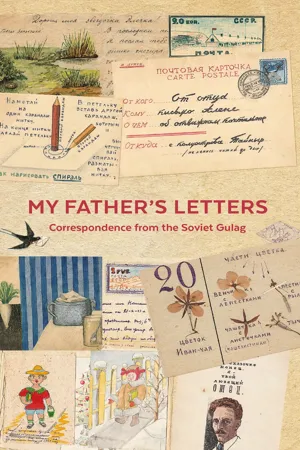
Alexei Vangenheim wrote his letters home to Moscow from the Solovki labour camp (on the Solovetsky Islands), where he had been sent following his arrest in January 1934. He remained there until 1937, when he was shot upon the orders of a Troika of NKVD. His letters were addressed to his wife and young daughter, Eleonora, who was only three years old at the time of his arrest. Alexei’s wife, Varvara Kurguzova, was headmistress at School Number 40, described at the time as an establishment for ‘late starters’.
Vangenheim penned a remarkable total of 168 letters from Solovki, of which 141 still survive today, thanks to the efforts of his wife and daughter. These letters allow us a glimpse into the thoughts, fears and hopes of a highly intelligent and remarkable man.
‘I voluntarily rejected all the advantages of the social class into which I was born.’ (An extract from a letter written 20 February 1934)
Alexei Vangenheim’s life could have taken him down an altogether different path. He was born into a family of landowners in 1881 – a report written by the Troika of NKVD condemning him to death (dated 9 October 1937) describes him as ‘the son of a nobleman and major landowner’. His father, Feodosi Vangenheim, had been a father of eight, a village intellectual and a member of the local land council, who managed to construct a meteorological observation station and testing field on his farmstead. The origins of the family name are disputed, but it is likely that they had Dutch or German ancestry.
Alexei was the second eldest son, and his education got off to a good start at home, where he learned to read and speak in both German and French. He attended the local grammar school – Oryol Gymnasium – before moving to Moscow to study at Moscow State University and the Moscow Agricultural Institute.
During the First World War, Vangenheim was appointed manager of the Eighth Army Weather Service and later, on the south-western front, he was promoted to the rank of colonel. His role in the organisation of a gas attack on the Austrian army earned him a ceremonial golden weapon. He was in such a position of favour that had he wished to follow the example of his brother Nikolai and emigrate to France after October 1917, he could easily have done so. Instead, he inadvertently chose a very different fate.
By the time he took up his studies at the Faculty of Physics and Mathematics in Moscow, Vangenheim was already a devotee of socialism, and as such he was an active participant in student unrest. After the October Revolution, he became involved in organising the ‘revolutionary education’ of the population of Dmitriyev, directing the education and activism of the peasant farmers of Kursk Province.
In June 1919 Vangenheim founded the museum in Dmitriyev that is now named after him. In July 1921, he was appointed the district’s chief agronomist and took part in the launch of a weather bureau in Kursk Province. Far from being just an amateur hobbyist, the dedicated young scientist elected to continue his studies at the Moscow Agricultural Institute while working for the Snug weather bureau, which had been named by his father.
It was in the 1920s that meteorology became the most important part of young Vangenheim’s life. Having arrived in Petrograd in 1923, he began work as a weather forecaster in the Department of Long-Range Weather Forecasting in the Central Physics Observatory (CPO), under the direction of the future academic and famous meteorologist Professor Boris Multanovsky. By 1925 he was a member of the CPO’s management team and contributing to the publication of two journals: Climate and Weather and the Geophysics and Meteorology Journal. He also delivered lectures at sessions of the Russian Geographical Society’s Meteorological Committee.
Vangenheim returned to Moscow in 1926 to take up the post of deputy director of the Science Institute of the Central People’s Commissariat for Education for the RSFSR (Russian Soviet Federative Socialist Republic). Two years later he was appointed a professor at Moscow University, officially joined the Bolshevik Party (though he had been a member of the Russian Social Democratic Labour Party even before the Revolution), and became a general committee member for the State Council of Science. He had a pass enabling him to come and go freely from the Kremlin and associated with the likes of Anatoly Lunacharsky, Lenin’s wife Nadezhda Krupskaya, and various people’s commissars. Both Maxim Gorky and Otto Schmidt visited his apartment, along with numerous foreign scientists on visits to the USSR. And when, on 28 August 1929, members of government voted to implement one of his initiatives – creating a united hydro-meteorological service (the Hydro-Meteorological Committee of the USSR) – Alexei Vangenheim was nominated as its president.
In time, he settled into family life, marrying Varvara Kurguzova, whom he had met in Dmitriyev several years earlier. A much-adored daughter, Eleonora, was born shortly afterwards and her father nicknamed her ‘Zvezdochka’. The future seemed bright and the former nobleman believed that he finally had it all: his work, his family and his country.
Vangenheim was arrested on 8 January 1934. He and his wife had tickets to go to the opera that evening, but Varvara waited in vain on the steps of the Bolshoi Theatre for her husband to arrive.
Following a short investigation into the standard accusations of spying and sabotage, his sentence was announced: ten years in a corrective labour camp.
In his letters from the Solovki camp, Vangenheim often remembered his efforts to educate the peasants in Dmitriyev, as well as his later work as president of the USSR’s Hydro-Meteorological Committee. On 24 August 1935 he wrote: ‘In spite of everything, I have no doubt that my prediction regarding the unification of the global meteorological services will prove correct.’ These memories were painful. Pride in his achievements was closely intertwined with extreme hurt and resentment.
An alarm rings involuntarily in my soul, warning that the truth is redundant. (14.07.1934)
When I remember … my work at the Hydro-Meteorological Committee and my brainchild, the Hydro-Meteorological Service, which I nurtured and cherished out of pride for the USSR, my thoughts take on a terrible, painful quality that makes me want to scream out loud. (09.11.1934)
I remember the many tens of lectures I gave in towns and villages between 1918 and 1922; at that time I never undertook a single journey without giving a lecture of some sort. At first, I would talk about the fundamentals of socialism and the tasks facing the Soviet leaders, often using homemade projection slides to accompany my lectures. I brought the idea of the dictatorship of the proletariat and the uncompromising war on religion to the peasants with such firm belief in my mission. How many agricultural lectures I gave and organised for people across all those districts, not to mention for the youths on the pre-conscription military training programmes! All of this is now of course forgotten, since somebody considered it necessary to slander me in this absolutely absurd manner. (17.04.1936)
Despite the pain, he continued to revisit his memories. In a letter to his wife he mused:
Time will pass, and everything will be forgotten. All that I accomplished in my working life will be forgotten. And so I have decided to summarise a little of what I achieved, so that you and my daughter may know that I did not idle my life away in vain.
Vangenheim had evidently already lost all hope of seeing his family again. He hurried to recollect and express all that he had managed to achieve, and all that which he had hoped to accomplish but had been unable to realise.
In a recent journal I read an article about the use of wind power in the construction of a socialist state […] This energy, if used judiciously, could provide us with tens of thousands of Dneprostrois (Dnieper Hydroelectric Station) and would enable us to fight drought, especially in deserts where heat and winds are at their most extreme and to where it is exceptionally difficult to deliver fuel for machinery. Wind could turn these deserts into oases. The prospects are dazzling, even before we consider that in the north, the wind is not only able to provide energy for heating and lighting, but also for cooking and transportation. […] I recall that I was the first person not only to raise this idea, but also to set it in motion, having included the ‘Wind Cadastre’ into the plan […] By 1934 I was due to have completed the first atlas of wind energy distribution patterns in the USSR. Of course, it will still be published, just without me. The same goes for the so-called ‘Solar Cadastre’, also my brainchild, designed to record solar energy in the USSR. […] The future rests on solar and wind energy, since it is inexhaustible and colossal in the scope of its power, and yet it seems to me that my departure will ...