A study of how the film industry came to flourish in Detroit in the early years as locals were lured into the new picture theaters.
Motor City Movie Culture, 1916–1925 is a broad textured look at Hollywood coming of age in a city with a burgeoning population and complex demographics. Richard Abel investigates the role of local Detroit organizations in producing, distributing, exhibiting, and publicizing films in an effort to make moviegoing part of everyday life.
Tapping a wealth of primary source material—from newspapers, spatiotemporal maps, and city directories to rare trade journals, theater programs, and local newsreels—Abel shows how entrepreneurs worked to lure moviegoers from Detroit's diverse ethnic neighborhoods into the theaters. Covering topics such as distribution, programming practices, nonfiction film, and movie coverage in local newspapers, with entr'actes that dive deeper into the roles of key individuals and organizations, this book examines how efforts in regional metropolitan cities like Detroit worked alongside California studios and New York head offices to bolster a mass culture of moviegoing in the United States.
- 308 pages
- English
- ePUB (mobile friendly)
- Available on iOS & Android
eBook - ePub
Motor City Movie Culture, 1916–1925
About this book
Trusted by 375,005 students
Access to over 1 million titles for a fair monthly price.
Study more efficiently using our study tools.
Information
ENTR’ACTE 1
The Michigan Film Review
THE MICHIGAN FILM REVIEW, ONE OF PERHAPS FEWER than ten regional trade journals in the country during the silent cinema period, first appeared in early November 1916 and ran at least through the 1920s. Fortunately, nearly all of the second volume, dated from November 6, 1917, to October 22, 1918, survives in the Bentley Historical Library at the University of Michigan. The Review’s publisher and editor was Jacob Smith,1 who also contributed a few articles on the city to Moving Picture World at the time, and his initial office was located in the Free Press Building, suggesting the trade paper may have had links with that newspaper. “Published Weekly in the Interests of the Moving Picture Exhibitors and Exchanges of Michigan” (as the official organ of the American Exhibitors’ Association in the state),2 the Review’s sixteen pages offered not only a wealth of publicity but also a forum for exchanging information between the region’s rental exchanges and its exhibitors as well as among exhibitors in this metropolis of nearly one million people.3
The Michigan Film Review advertised occasionally in Variety in the early 1920s,4 and it celebrated its tenth anniversary in 1926 with a large ad in Film Daily, claiming that weekly issues were “mailed to 100 per cent of the exhibitors in Michigan.”5 A year later, it became one of seven regional trade journals that the publisher of The Reel Journal integrated into a single group, with an overall circulation of nine thousand, through Associated Publications in Kansas City.6 In the 1930s, the seven combined journals became the basis for Box Office Magazine.
Notes
1. In 1929, Jacob Smith died at the young age of 45—“Illness Fatal to Publisher,” DFP (September 23, 1929): 11.
2. Founded in July 1917, the American Exhibitors’ Association (AEA) initially sought, without success, to become a member of the National Association of the Motion Picture Industry (NAMPI), which had been founded a year earlier, Within a month of gaining NAMPI membership, the AEA had hundreds of members in thirty-six states. By December 1917, it had 2,786 members in forty-six states and briefly coordinated its legislative activity with the NAMPI; negotiations between the two trade organizations broke down the following year, and the AEA aligned with the older Motion Picture Exhibitors’ League of America (MPELA). See Kia Afra, The Hollywood Trust: Trade Associations and the Rise of the Studio System (Lanham, MD: Rowan & Littlefield, 2016), 53, 90–91, 95–96, 113.
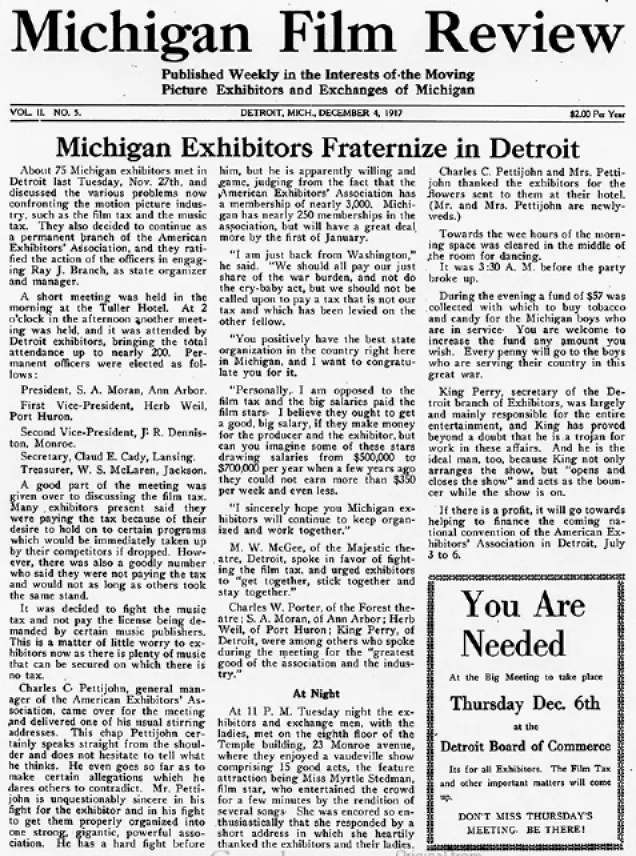
Fig. EA1.1. Michigan Film Review (December 4, 1917): 1.
3. “The Michigan Film Review is now the official trade paper of the Michigan and Detroit branches of the A.E.A.,” MFR (December 11, 1917): 11.
4. Michigan Film Review ads, V (March 4, 1921): 54, and (September 3, 1924): 25.
5. Michigan Film Review ad, FD (1926): 790.
6. “Seven Midwestern Regional Papers Welded Together,” MPN (August 26, 1927): 580; and “Regional Papers Combine: Gross Circulation, 9,000,” V (August 31, 1927): 9.
1
MAPPING CIRCULATION IN DETROIT’S MOVIE MARKET
September Is Go-To-Theatre Month, with the Leading Motion Picture Theatres
Detroit Sunday Free Press (September 3, 1922)
Neighborhood theatres in Detroit have become almost as numerous as neighborhood groceries. People must have recreation and amusement just as they require food and drink.
Detroit Free Press (December 22, 1918)
IMAGINE YOU ARE THE MANAGER OF A NEW picture theater, such as the Farnum in Hamtramck, seeking reliable information about booking films in 1917. One source to consult, besides the industry trade press, personal contacts, and word of mouth, would have been the regional trade weekly, Michigan Film Review, which late that year began compiling a directory of downtown rental exchanges that distributed films throughout the city of Detroit and beyond.1 This directory listed eleven exchanges that operated across North America: Paramount-Artcraft, Blue Bird, Fox, General, Goldwyn, George Kleine, Mutual, Metro, Pathé, Triangle, Universal, Vitagraph, and World. Most had offices, with their own screening rooms, on adjacent floors of the New Film Building (or Joseph Mack Building), but Metro and Triangle shared space with John Kunsky’s Madison Film Exchange, while Universal and Paramount-Artcraft rented offices on the west edge and east edge of downtown, respectively. The other eleven local or regional exchanges, besides Madison Film, also were clustered downtown (many in the New Film Building as well), with some, like Strand Features and Standard Film Service, specializing in reissues or older short-reel comedies and cartoons. The downtown locations of this movie business hub allowed easy access to the main rail station, where film prints came in, were inspected, went out on trucks to picture theaters, returned in reverse order, and left for other cities and towns. The offices were close to major hotels that could house industry representatives promoting their products in the branch offices to managers like Farnum’s. To help those managers keep their theaters attractive and running smoothly, the directory also included two “supply houses” for projector parts (United Theatre Equipment and Michigan Motion Picture Supply, both in the New Film Building); but many other local firms advertised in the Michigan Film Review: for example, Premier Scenery Studios, General Theatre Display and Advertising, Theatrical Advertising, Sign & Poster, Simpson Cartage Service, and Exhibitors Film Delivery.
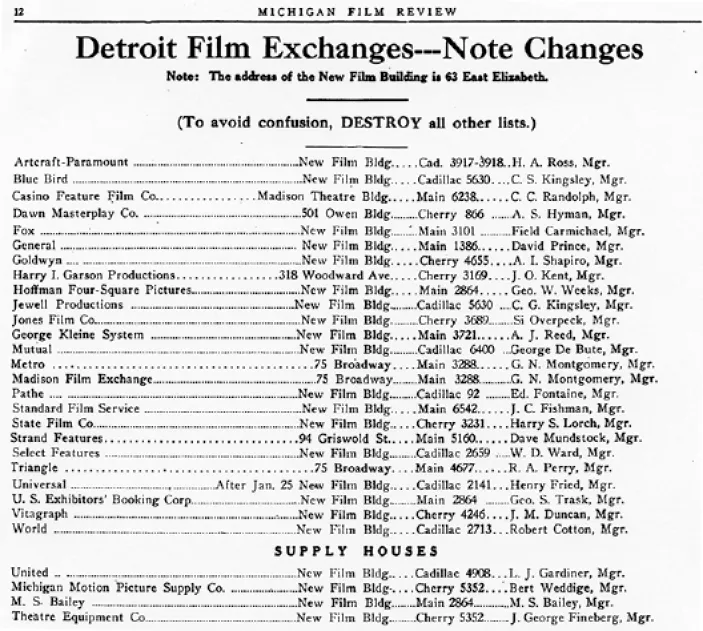
Fig. 1.1. Detroit Film Exchanges Directory, Michigan Film Review (January 22, 1918): 12.
Reciprocally, imagine you are an exchange man, that same year, mapping the territory of the city in order to circulate your company’s films efficiently and profitably. Your branch office would have an inventory of the area’s picture theaters and a record of past rentals—but those apparently no longer survive. That inventory probably paralleled the listings in the Detroit City Directories, which totaled 125–130 theaters by late 1917.2 Of those, fewer than ten advertised on a regular basis in the Sunday Free Press, and even fewer in the Sunday News-Tribune.

Fig. 1.2. 1917 Detroit map of major theaters.
But five major theaters would have been the prime venues for first-run bookings. Nearly all were owned by one of three entrepreneurs, were located either in the downtown center just below Grand Circus Park or to the north along Woodward Avenue, and had seating capacities of 1,000 or more: John Kunsky’s Washington (1,862 seats) and Madison (1,965 seats);3 Phil Gleichman’s Broadway Strand (1,488 seats); and C. H. Miles’s vaudeville houses, the Majestic (1,760 seats) and Regent (2,150–3,600 seats), in the New Center and North Woodward areas, respectively.4
The next tier of theaters included Kunsky’s downtown Liberty (720 seats), Garden (950 seats), and Alhambra (1,475 seats),5 plus the smaller Drury Lane (600 seats), Fine Arts (582 seats), and Forest (592 seats) also ranged north along Woodward; Kunsky’s Strand (1,384 seats) on Grand River, the Ferry Field (1,325 seats) on West Grand Boulevard, and the Stratford (1,025 seats) on Dix, to the northwest and west, respectively; and the Rialto (1,334 seats) on Gratiot, the Duplex (1,250 seats) on East Grand Boulevard, and the Del-The (1,076 seats) on Mack, to the east.
Among the third group of theaters, the Garden and the Forest (reportedly a “social center” for a Jewish community)6 alone seemed close to ethnic neighborhoods, and the only others with 900 to 1,000 seats were the Farnum and the Russell, both of which opened in or near Hamtramck in 19177—but neither of which initially advertised in newspapers.

Fig. 1.3. 1917 Detroit map of neighborhood theaters.
Exchange managers likely gave very low priority to the smaller ethnic neighborhood theaters, but these theaters do become visible when one compares city directories, maps of neighborhood locations, and later studies and directories.8 In Lower Poletown, for instance, the A...
Table of contents
- Cover
- Title Page
- Copyright
- Contents
- Acknowledgments
- List of Abbreviations
- Introduction
- Entr’Acte 1: The Michigan Film Review
- 1. Mapping Circulation in Detroit’s Movie Market
- Entr’Acte 2: Detroit Area Picture Theaters
- Entr’Acte 3: John H. Kunsky and George W. Trendle
- 2. Movies, Live Acts, and the Theatrical Experience: Programming Practices in the Motor City
- Entr’Acte 4: Detroit-Made Films
- Entr’Acte 5: The Metropolitan Film Company
- 3. “Detroit-Made” Newsreels and Other Short Nonfiction Films
- Entr’Acte 6: Star Gazing
- 4. Motor City Menus for Movie Fans
- Afterword
- Bibliography
- Index
- About the Author
Frequently asked questions
Yes, you can cancel anytime from the Subscription tab in your account settings on the Perlego website. Your subscription will stay active until the end of your current billing period. Learn how to cancel your subscription
No, books cannot be downloaded as external files, such as PDFs, for use outside of Perlego. However, you can download books within the Perlego app for offline reading on mobile or tablet. Learn how to download books offline
Perlego offers two plans: Essential and Complete
- Essential is ideal for learners and professionals who enjoy exploring a wide range of subjects. Access the Essential Library with 800,000+ trusted titles and best-sellers across business, personal growth, and the humanities. Includes unlimited reading time and Standard Read Aloud voice.
- Complete: Perfect for advanced learners and researchers needing full, unrestricted access. Unlock 1.4M+ books across hundreds of subjects, including academic and specialized titles. The Complete Plan also includes advanced features like Premium Read Aloud and Research Assistant.
We are an online textbook subscription service, where you can get access to an entire online library for less than the price of a single book per month. With over 1 million books across 990+ topics, we’ve got you covered! Learn about our mission
Look out for the read-aloud symbol on your next book to see if you can listen to it. The read-aloud tool reads text aloud for you, highlighting the text as it is being read. You can pause it, speed it up and slow it down. Learn more about Read Aloud
Yes! You can use the Perlego app on both iOS and Android devices to read anytime, anywhere — even offline. Perfect for commutes or when you’re on the go.
Please note we cannot support devices running on iOS 13 and Android 7 or earlier. Learn more about using the app
Please note we cannot support devices running on iOS 13 and Android 7 or earlier. Learn more about using the app
Yes, you can access Motor City Movie Culture, 1916–1925 by Richard Abel in PDF and/or ePUB format, as well as other popular books in Médias et arts de la scène & Histoire de l'Amérique du Nord. We have over one million books available in our catalogue for you to explore.