- 96 pages
- English
- ePUB (mobile friendly)
- Available on iOS & Android
eBook - ePub
About this book
The stunning follow-up volume to Natasha Trethewey's Pulitzer Prize–winning Native Guard, by the 19th Poet Laureate of the United States.
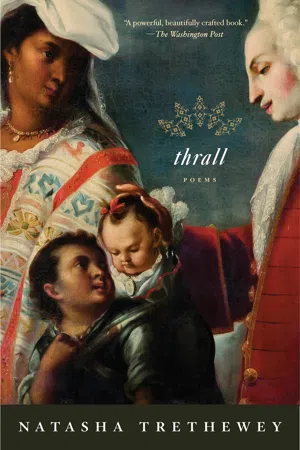
Natasha Trethewey's poems are at once deeply personal and historical—exploring her own interracial and complicated roots—and utterly American, connecting them to ours. The daughter of a black mother and white father, a student of history and of the Deep South, she is inspired by everything from colonial paintings of mulattos and mestizos to the stories of people forgotten by history.
Meditations on captivity, knowledge, and inheritance permeate Thrall, as she reflects on a series of small estrangements from her poet father and comes to an understanding of how, as father and daughter, they are part of the ongoing history of race in America.
Thrall confirms not only that Natasha Trethewey is one of our most gifted and necessary poets but that she is also one of our most brilliant and fearless.
Natasha Trethewey's poems are at once deeply personal and historical—exploring her own interracial and complicated roots—and utterly American, connecting them to ours. The daughter of a black mother and white father, a student of history and of the Deep South, she is inspired by everything from colonial paintings of mulattos and mestizos to the stories of people forgotten by history.
Meditations on captivity, knowledge, and inheritance permeate Thrall, as she reflects on a series of small estrangements from her poet father and comes to an understanding of how, as father and daughter, they are part of the ongoing history of race in America.
Thrall confirms not only that Natasha Trethewey is one of our most gifted and necessary poets but that she is also one of our most brilliant and fearless.
Tools to learn more effectively

Saving Books

Keyword Search

Annotating Text

Listen to it instead
Information

Elegy
For my father
I think by now the river must be thick
with salmon. Late August, I imagine it
as it was that morning: drizzle needling
the surface, mist at the banks like a net
settling around us—everything damp
and shining. That morning, awkward
and heavy in our hip waders, we stalked
into the current and found our places—
you upstream a few yards and out
far deeper. You must remember how
the river seeped in over your boots
and you grew heavier with that defeat.
All day I kept turning to watch you, how
first you mimed our guide’s casting
then cast your invisible line, slicing the sky
between us; and later, rod in hand, how
you tried—again and again—to find
that perfect arc, flight of an insect
skimming the river’s surface. Perhaps
you recall I cast my line and reeled in
two small trout we could not keep.
Because I had to release them, I confess,
I thought about the past—working
the hooks loose, the fish writhing
in my hands, each one slipping away
before I could let go. I can tell you now
that I tried to take it all in, record it
for an elegy I’d write—one day—
when the time came. Your daughter,
I was that ruthless. What does it matter
if I tell you I learned to be? You kept casting
your line, and when it did not come back
empty, it was tangled with mine. Some nights,
dreaming, I step again into the small boat
that carried us out and watch the bank receding—
my back to where I know we are headed.

Miracle of the Black Leg
Pictorial representations of the physician-saints Cosmas and Damian and the myth of the miracle transplant—black donor, white recipient—date back to the mid-fourteenth century, appearing much later than written versions of the story.
1.
Always, the dark body hewn asunder; always
one man is healed, his sick limb replaced,
placed in the other man’s grave: the white leg
buried beside the corpse or attached as if
it were always there. If not for the dark appendage
you might miss the story beneath this story—
what remains each time the myth changes: how,
in one version, the doctors harvest the leg
from a man, four days dead, in his tomb at the church
of a martyr, or—in another—desecrate a body
fresh in the graveyard at Saint Peter in Chains:
there was buried just today an Ethiopian.
Even now, it stays with us: when we mean to uncover
the truth, we dig, say unearth.
2.
Emblematic in paint, a signifier of the body’s lacuna,
the black leg is at once a grafted narrative,
a redacted line of text, and in this scene a dark stocking
pulled above the knee. Here the patient is sleeping,
his head at rest in his hand. Beatific, he looks as if
he’ll wake from a dream. On the floor
beside the bed, a dead Moor—hands crossed at the groin,
the swapped limb white and rotting, fused in place.
And in the ...
Table of contents
- Title Page
- Contents
- Copyright
- Dedication
- Epigraph
- Part I
- Elegy
- Part II
- Miracle of the Black Leg
- On Captivity
- Taxonomy
- Kitchen Maid with Supper at Emmaus; or, The Mulata
- Knowledge
- Part III
- The Americans
- Mano Prieta
- De Español y Negra; Mulata
- Mythology
- Geography
- Torna Atrás
- Bird in the House
- Artifact
- Fouled
- Rotation
- Part IV
- Thrall
- Calling
- Enlightenment
- How the Past Comes Back
- On Happiness
- Vespertina Cognitio
- Illumination
- Notes
- Acknowledgments
- Read More from Natasha Trethewey
- About the Author
- Connect with HMH
Frequently asked questions
Yes, you can cancel anytime from the Subscription tab in your account settings on the Perlego website. Your subscription will stay active until the end of your current billing period. Learn how to cancel your subscription
No, books cannot be downloaded as external files, such as PDFs, for use outside of Perlego. However, you can download books within the Perlego app for offline reading on mobile or tablet. Learn how to download books offline
Perlego offers two plans: Essential and Complete
- Essential is ideal for learners and professionals who enjoy exploring a wide range of subjects. Access the Essential Library with 800,000+ trusted titles and best-sellers across business, personal growth, and the humanities. Includes unlimited reading time and Standard Read Aloud voice.
- Complete: Perfect for advanced learners and researchers needing full, unrestricted access. Unlock 1.4M+ books across hundreds of subjects, including academic and specialized titles. The Complete Plan also includes advanced features like Premium Read Aloud and Research Assistant.
We are an online textbook subscription service, where you can get access to an entire online library for less than the price of a single book per month. With over 1 million books across 990+ topics, we’ve got you covered! Learn about our mission
Look out for the read-aloud symbol on your next book to see if you can listen to it. The read-aloud tool reads text aloud for you, highlighting the text as it is being read. You can pause it, speed it up and slow it down. Learn more about Read Aloud
Yes! You can use the Perlego app on both iOS and Android devices to read anytime, anywhere — even offline. Perfect for commutes or when you’re on the go.
Please note we cannot support devices running on iOS 13 and Android 7 or earlier. Learn more about using the app
Please note we cannot support devices running on iOS 13 and Android 7 or earlier. Learn more about using the app
Yes, you can access Thrall by Natasha Trethewey in PDF and/or ePUB format, as well as other popular books in Literature & American Poetry. We have over one million books available in our catalogue for you to explore.