Life and Death on the Eastern Front
eBook - ePub

Life and Death on the Eastern Front

Rare Colour Photographs From World War II

  1. 288 pages
  2. English
  3. ePUB (mobile friendly)
  4. Available on iOS & Android
eBook - ePub

Life and Death on the Eastern Front

Rare Colour Photographs From World War II

About this book

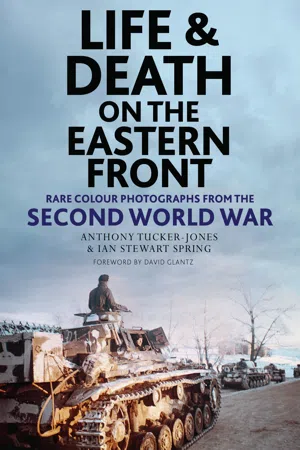
This incredible visual record of life and death along the Eastern Front features more than 250 images from the the PIXPAST Archive, a collection of more than 32, 000 original color photographs taken between 1936 and 1946. Collated into three parts and organised thematically, the book begins with images of the ground war, including Hitler’s invasion of the Soviet Union and the tanks, vehicles, weaponry and infantry on both sides. Moving into the war in the skies, the images depict aircraft in flight and on the ground, the bombers, fighters, Luftwaffe personnel and the destruction wrought from battle. And finally, the images take us behind the lines, to the prisoners of war, partisans, medics, the daily lives and leisure activities of soldiers and civilians along the front and the impact of the harsh Russian winter. Accompanied by text by renowned author and commentator Anthony Tucker-Jones, these images offer a rare, often surprising insight into the realities of the Second World War and people caught up in it, in vivid color detail.

Frequently asked questions

Yes, you can cancel anytime from the Subscription tab in your account settings on the Perlego website. Your subscription will stay active until the end of your current billing period. Learn how to cancel your subscription.
No, books cannot be downloaded as external files, such as PDFs, for use outside of Perlego. However, you can download books within the Perlego app for offline reading on mobile or tablet. Learn more here.
Perlego offers two plans: Essential and Complete
  • Essential is ideal for learners and professionals who enjoy exploring a wide range of subjects. Access the Essential Library with 800,000+ trusted titles and best-sellers across business, personal growth, and the humanities. Includes unlimited reading time and Standard Read Aloud voice.
  • Complete: Perfect for advanced learners and researchers needing full, unrestricted access. Unlock 1.4M+ books across hundreds of subjects, including academic and specialized titles. The Complete Plan also includes advanced features like Premium Read Aloud and Research Assistant.
Both plans are available with monthly, semester, or annual billing cycles.
We are an online textbook subscription service, where you can get access to an entire online library for less than the price of a single book per month. With over 1 million books across 1000+ topics, we’ve got you covered! Learn more here.
Look out for the read-aloud symbol on your next book to see if you can listen to it. The read-aloud tool reads text aloud for you, highlighting the text as it is being read. You can pause it, speed it up and slow it down. Learn more here.
Yes! You can use the Perlego app on both iOS or Android devices to read anytime, anywhere — even offline. Perfect for commutes or when you’re on the go.
Please note we cannot support devices running on iOS 13 and Android 7 or earlier. Learn more about using the app.
Yes, you can access Life and Death on the Eastern Front by Anthony Tucker-Jones,Ian Spring in PDF and/or ePUB format, as well as other popular books in History & Eastern European History. We have over one million books available in our catalogue for you to explore.

Information

Part One

Image

The Ground War

1 Day of the Panzer

Image
ON THE EVE OF Operation Barbarossa Hitler massed his panzer divisions ready for the invasion of the Soviet Union. Army Group North was poised in East Prussia, Army Group Centre in western Poland and Army Group South in Hungary and Romania. Their job would be to surround the Red Army and secure Russia’s major cities.
Image
The crew of this early model Panzer IV could not resist the temptation to photograph their tank on the streets of a Polish town. It belonged to the 29th Panzer Regiment, 12th Panzer Division, which came under the command of Generalmajor Josef Harpe. The dunkel grau or panzer grey looks almost dark olive green. The vertical object on the turret cupola is an MG34 machine gun on an anti-aircraft mount. The circular objects on the rear of the tank are spare road wheels. To give them added range, many panzers towed a twowheeled fuel trailer that carried two extra 44-gallon petrol drums. These were produced in the field by their engineers. Some crews also strapped jerrycans to their turrets to make them less reliant on the supply columns. The 12th Panzer was created from the 2nd Infantry Division (Motorised) in Stettin in October 1940. It fought in central Russia before taking part in the siege of Leningrad.
Image
A German armoured column belonging to the 3rd Panzer Division ready for the off. It includes Panzer IIIs and IVs. The main types of military motorcycle with sidecar were produced by BMW and Zündapp. The Einheits sidecar could carry a machine gun and mortar. In some cases, the role of the motorcycle with sidecar was replaced by the VW Kübelwagen. This BMW R12 is undergoing some maintenance while an officer (standing) watches on. The 3rd Panzer divisional symbol is clearly visible on the front of the sidecar. It was one of Germany’s original three panzer divisions formed in 1935, followed by five more in 1938-39. In this instance the panzer grey is almost black in appearance.
Image
Panzers roll! On 22 June 1941 the Wehrmacht stormed into the Soviet Union. This column of Panzer IVs is very dusty. For some reason the rear vehicle has one of its track guards in a raised position. The fascine, or bundles of logs, on the engine decks of these tanks were intended to help the tanks traverse ditches and anti-tank traps. The rear of the hull bears the distinctive German national insignia known as the Balkan cross (Balkenkreuz). This was a development of the solid white cross used in the invasion of Poland, which was found to be too conspicuous. The white outline cross was standard between 1940 and 1942, by which time the black Balkenkreuz with white edging had become more popular. The billowing smoke in the background is probably the result of dive-bomber attack. The drawback of dunkel grau was that it was intended to help vehicles blend in with the shadows cast by trees and buildings in western Europe. On the open steppe in Russia it simply made vehicles stand out as a solid object.
Image
Russian children look on as their homeland is invaded. Luckily for these Panzer IVs exposed on such an open landscape, the Luftwaffe swiftly destroyed the Red Air Force, both in the air and on the ground. The Panzertruppen are in their distinctive black uniforms, this consisted of a Feldjacke with pink Waffenfarbe on the collar and shoulder straps along with matching trousers and Feldmütze. The two men riding on the tank on the left are wearing denim fatigue overtrousers. These were normally dyed grey or black. Assault gun and self-propelled gun crews generally wore a field-grey version. As the war progressed, crews wore a combination of whatever was available. Interestingly, the panzer grey on the turret looks almost blue. The bluish and yellow tinge to the grass is a typical Agfacolor problem.
Image
Russian anti-tank ditches ultimately posed little problem for the panzers. German pioneers were able to breach such defences swiftly. When Hitler attacked, the Red Army was still in the process of establishing new frontier defences in Soviet-occupied eastern Poland, and they were far from ready. In the meantime, most of the old Soviet border defences had been dismantled and were being moved into Poland.
Image
A full house in terms of Hitler’s early panzers. Left to right are a Panzer IV, III and II, while in the foreground is Hitler’s very first tank, the Panzer I. The two earliest ones were little more than training vehicles that were poorly armed and armoured. The Panzer III was designed as a tank-to-tank weapon and the Panzer IV was intended initially as a support tank. Once again, these tanks look almost olive green; the culprit for this is presumably the Agfacolor. In the background can be seen a panzer crane, used for removing turrets and engine blocks.
Image
A despatch rider examines a burnt-out Panzer II Ausf. F. The rubber tyres on the central road wheels have...

Table of contents

  1. Cover
  2. Title
  3. Copyright
  4. Content
  5. Introduction: The Cameramen
  6. Eastern Front Chronology: Key Events
  7. Part One: The Ground War
  8. Part Two: War in the Skies
  9. Part Three: Behind the Lines
  10. Sources and Further Reading
  11. Plate section