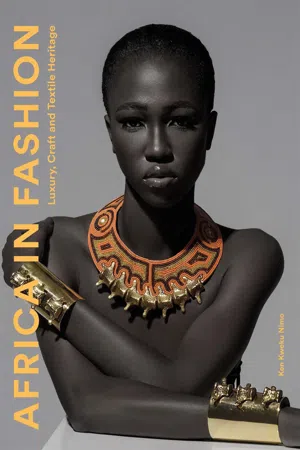
Africa Fashion explores the kaleidoscope of craft cultures that have shaped African fashion for centuries and captures the intriguing stories of contemporary and avant-garde African brands.
Part One looks at Africa's rich cultural heritage and place in the network of global fashion. The first chapter retells the history of African fashion, exploring Africa's textile traditions, artisanship and role as a global resource. The second chapter presents a New Africa and examines the promise and potential of Africa's markets, while challenging stereotypes and the concept of European hegemony particularly in the realm of luxury fashion. It also spotlights Africa's unique position as the global industry shifts towards a more sustainable future.
Part Two ushers the reader into the spectacular world of African fashion today. It showcases a carefully curated set of the continent's most dynamic brands and, through interviews with prominent and inspiring designers, offers rare insight into their ethos and design practice. Covering unisex fashion, menswear, womenswear, accessories and jewellery the brands are each purposefully selected to contribute uniquely to the mosaic of Africa evolving creative landscape.
- 400 pages
- English
- ePUB (mobile friendly)
- Available on iOS & Android
eBook - ePub
About this book
Trusted by 375,005 students
Access to over 1.5 million titles for a fair monthly price.
Study more efficiently using our study tools.
Information
Topic
DiseñoSubtopic
Diseño de moda
CHAPTER 1
African Fashion History
Fashion is a social phenomenon that has captivated people throughout the world throughout history. Defined loosely, it is the distinctive sartorial style and adornment of people from diverse cultures and social classes. Beyond this, it is at once constructive and subversive, the outcome of people striving for social capital and status in almost every society with a degree of stratification. However, because of a predominant misconception of fashion as solely an agent of western modernity, the dress practices of many cultures within Africa and its diaspora, have received little attention in conventional histories of global fashion.
Today, the narrative of an ‘unfashionable’ Africa is well contested and gradually being replaced by a compelling counter-narrative.
This chapter starts by exploring the history of the development of African fashion under the vectors of trade, culture, colonialism and globalization. This exploration culminates with a discussion of the ways in which Africa has influenced fashion ‘beyond Africa’ throughout the centuries. The chapter then moves on to take a closer look at the rich heritage of the continent in sub-chapters devoted more specifically to textiles and to accessories and embellishments.
A History Retold
Recent media attention and literature on African fashion has highlighted its potency as a medium of cultural expression, with a kaleidoscope of textiles, accessories and art forms constituting a truly dynamic sartorial discourse.1 The rich history of African fashion remains widely unacknowledged in the context of global fashion, however. Here, it is retold through the vectors of trade, culture, colonialism and globalization, and explored throughout the continent and beyond.
Trade
Before the arrival of the first European ships, inhabitants of many of Africa’s ancient empires including Ghana, Mali and Songhai traded across regional and territorial boundaries. The nexus of trade in precolonial Africa was remarkably complex, with routes traversing the west, central and northern regions of Africa and across the Mediterranean to Europe. Trading centres were connected by major highways with safety patrols and toll points dotting the seemingly trackless forest and vast desert terrains.
While the currency for trade varied across regions, ethnic groups and empires, it comprised primarily gold dust, brass, iron, copper, strips of cloth and ivory. In the ninth century, the caliphs of North Africa minted their own gold dinars to trade with merchants from Spain and other parts of Europe.
Between the fifth and late nineteenth centuries, trade fostered the rise of prosperous cities and major empires, with the extensive period of inter-cultural interactions impacting Africa’s material culture across the arts, architecture and fashion. Through the lenses of Africa’s two major trade histories, the trans-Saharan trade and the trans-Atlantic trade, it is possible to conceptualize the history of fashion in precolonial Africa.

Seventeenth-century engraving from Olfert Dapper’s Naukeurige beschrijvinge der Afrikaensche gewesten, showcasing a majestic procession at the court of the Kingdom of Benin (in present-day Nigeria).
Trans-Saharan trade
Trans-Saharan trade, which began as early as the fifth century, peaked between the eleventh and sixteenth centuries as a result of the Arab invasion of North Africa, and the patronage of adept Islamic merchants. The trans-Saharan trade networks, which originated in North Africa and penetrated the rainforest regions further south consisted of large caravans of mostly Berber and Andalusian Moor traders. The primary commodities of the outbound trade, gold and slaves – captured through tribal strife and wars – were essential to the northern kingdoms, which traded with distant civilizations including the Levant (western Asia) and Europe. To ensure the safe transit of goods and merchants, entrepôts along major routes provided security and refreshment while exacting tolls and levies. The port cities of Sijilmasa (in Morocco) and Oualata (in Mauritania) grew in wealth and experienced remarkable socio-cultural transformation.
Beside the primary commodities for exchange, the trade fostered the diffusion of an expansive array of luxury goods such as silk skeins, brocades, damask, Fezzan silks and apparel composed of fine linen and cotton from Europe and Egypt. The trade placed within the reach of local artisans new markets, improved technology, novel materials and, in some cases, skilled artisans, which greatly propelled indigenous textile industries. Kofar Mata in Kano, present-day northern Nigeria, for example, was the source of natural indigo-dye fabrics for the nomadic tribes of North Africa, including the Tuaregs and Fulani of Mali. Among the Zazzau (of present-day Kaduna State in Nigeria), an extensive textile and apparel value chain emerged, comprising cotton cultivation, spinning, weaving, dyeing, tailoring and embroidery. The Girken Zazzau and Yar Madaka, both voluminous and sumptuously embroidered gowns, which became popular exports throughout the Sokoto Caliphate and Sudan were the handiwork of master weavers and embroiderers in Kasar Zazzau.

The Sultan’s advisor in magnificent regalia made of shimmering indigo-dyed fabric.
Through trade, new socio-cultural, political and religious ideals filtered into African societies. Trade also guaranteed the prosperity of major indigenous empires and the concomitant development of prolific material cultures. Well into the eighteenth century, increased demand for indigenous cotton and textile products transformed large trading and production centres, such as Kano, into net exporters of textile products, a trade that proved more profitable than the budding slave trade. Some notable trading cities that thrived well into the eighteenth century include Djenne and Timbuktu in Mali, Goa in Songhai, Kaya among the Mossi, Salaga in Ghana, Dendi in northern Dahomey, Ife and Kano in Nigeria, many of which became highly stratified societies, characterized by the sumptuous and elitist lifestyles of distant cultures.
Trade caravans arriving from Europe and the Levant through the northern entrepôts bore not only commodities for exchange, but also precious gifts of lavishly embellished clothing, Persian silk and brocade, regal tunics, sumptuous jewellery and articles such as intricately engraved daggers. These items served as gifts from merchants, or the emissaries of kings, as goodwill gestures. Their quality and exoticism inspired and influenced the arts, fashions and craft of the indigenous societies. Fourteenth-century accounts of the majestic Musa I of Mali hint at a profusion of costly garments, some imported, others made locally. Regaled in silk and brocade, the extravagant Musa made a pilgrimage to Mecca in the company of over a thousand slaves and servants bearing precious gifts for rulers of the distant lands to which he travelled. Silk brocade, which refers to both the textile and the technique, is characterized by complex patterns of embossed floral elements interwoven in threads of gold and silver. This technique, and its spectacular products, although particular to the Persian region, had filtered into the royal courts of Africa through trade, where the Peul or Fulani of Mali developed local expertise.
In the detailed accounts of Islamic scholars, the Kings of Ghana, Kaw Kaw and Mali, as well as the nobility of these ancient Kingdoms adopted styles of dress from regions involved in the trans-Saharan trade, particularly Morocco. The evolution of kente (see here), which is rooted in the panolopy of West African strip-weaving cultures, benefited immensely from the flow of colorful silks through the tran-Saharan trade networks encompassing textile hubs in Arabia, Spain and the Fez (in present-day Algeria). Furthermore, trans-Saharan caravans ensured safe passage for itinerant weavers and craftsmen seeking their fortune in new lands where their skill was in high demand.
Trans-Atlantic trade
Trans-Saharan trade thrived well into the late sixteenth century. By the early eighteenth century, however, the trans-Atlantic trade had totally eclipsed the trade networks to the north. The primary objects of this trade were gold, ivory, exotic skins, gum Arabic, spices, and feathers – exchanged for textiles, glass beads, spirits, muskets, sewn garments and many items of luxury – but it differed remarkably from the trans-Saharan trade. Previously, the arduous caravan journeys had restricted the volume and variety of commodities that could be traded, but now the remarkable speed of the seafaring European traders guaranteed access to a greater variety of products, many of which were acquired at entrepôts closer to the West African coast. Again, while the trans-Saharan trade propelled indigenous craft industries, the trans-Atlantic trade undermined them by supplanting indigenous goods, such as local textiles and apparel with an array of imported subsitutes.
The trans-Atlantic trade impacted most profoundly on the socio-cultural and economic fabric of sub-Saharan Africa. Almost as quickly as it began, a vast discovery of European goods entered into the material culture of indigenous societies. However, it was the trade in slaves that ushered in the most unprecedented changes in the socio-economic fabric of sub-Saharan Africa. By the mid-eighteenth century, a surge in the demand for slaves in the Americas and the British West Indies fostered new structures in local trade networks, with intermediary African agents benefiting immensely. Along the ‘Slave Coast’, in cities such as Lagos, Ane´ho, Porto Novo, Anomabo, Cape Coast and Elmina, intermediary merchant princes also known as ‘caboceers’ (derived from the Portuguese caboceiro, meaning headman or official) wielded substantial influence and power as overlords of the coastal trade. They accumulated immense wealth not only as brokers but as landlords to whom European traders paid rental charges and accorded lavish gifts of clothing and luxury goods.
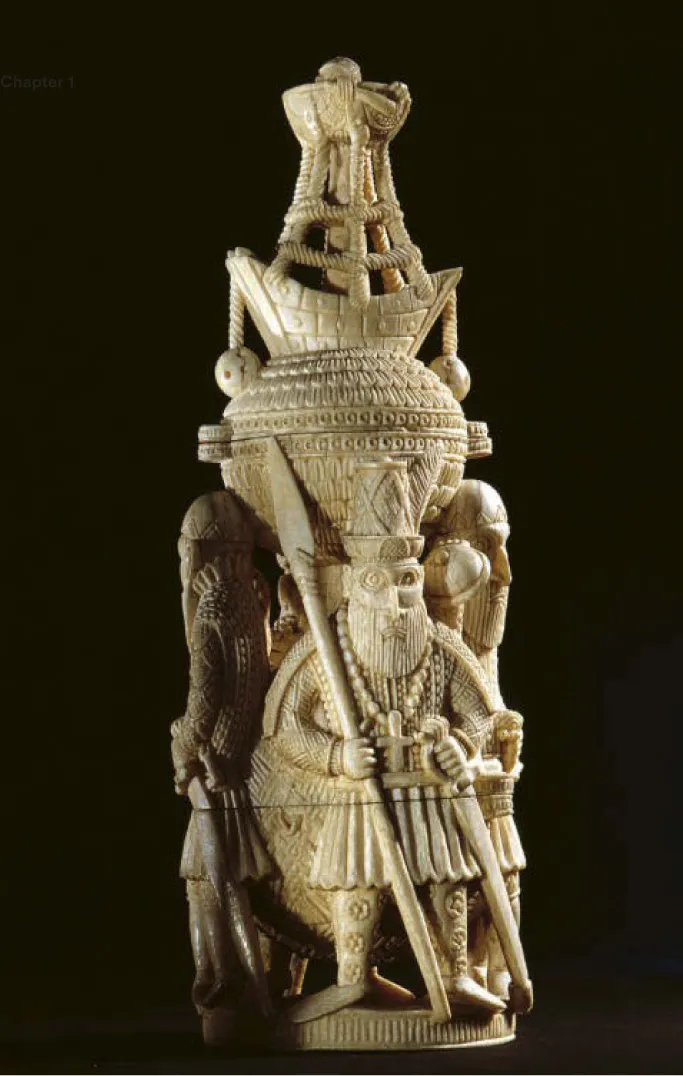
The salt cellar carved out of ivory by Benin master craftsmen. The cellar portrays Portuguese traders, illustrated with long hair, beards and prominent noses. Atop the sculpture is a Portuguese ship. From Benin, Nigeri...
Table of contents
- Cover
- Title
- Copyright
- Contents
- Foreword by Deola Sagoe
- Introduction
- Chapter 1: African Fashion History
- Chapter 2: The New Africa
- Chapter 3: New Wave of African Talent
- Glossary
- Endnotes
- Bibliography
- Index
- Credits
- Acknowledgements
Frequently asked questions
Yes, you can cancel anytime from the Subscription tab in your account settings on the Perlego website. Your subscription will stay active until the end of your current billing period. Learn how to cancel your subscription
No, books cannot be downloaded as external files, such as PDFs, for use outside of Perlego. However, you can download books within the Perlego app for offline reading on mobile or tablet. Learn how to download books offline
Perlego offers two plans: Essential and Complete
- Essential is ideal for learners and professionals who enjoy exploring a wide range of subjects. Access the Essential Library with 800,000+ trusted titles and best-sellers across business, personal growth, and the humanities. Includes unlimited reading time and Standard Read Aloud voice.
- Complete: Perfect for advanced learners and researchers needing full, unrestricted access. Unlock 1.5M+ books across hundreds of subjects, including academic and specialized titles. The Complete Plan also includes advanced features like Premium Read Aloud and Research Assistant.
We are an online textbook subscription service, where you can get access to an entire online library for less than the price of a single book per month. With over 1.5 million books across 990+ topics, we’ve got you covered! Learn about our mission
Look out for the read-aloud symbol on your next book to see if you can listen to it. The read-aloud tool reads text aloud for you, highlighting the text as it is being read. You can pause it, speed it up and slow it down. Learn more about Read Aloud
Yes! You can use the Perlego app on both iOS and Android devices to read anytime, anywhere — even offline. Perfect for commutes or when you’re on the go.
Please note we cannot support devices running on iOS 13 and Android 7 or earlier. Learn more about using the app
Please note we cannot support devices running on iOS 13 and Android 7 or earlier. Learn more about using the app
Yes, you can access Africa in Fashion by Ken Kweku Nimo in PDF and/or ePUB format, as well as other popular books in Diseño & Diseño de moda. We have over 1.5 million books available in our catalogue for you to explore.