- English
- ePUB (mobile friendly)
- Available on iOS & Android
eBook - ePub
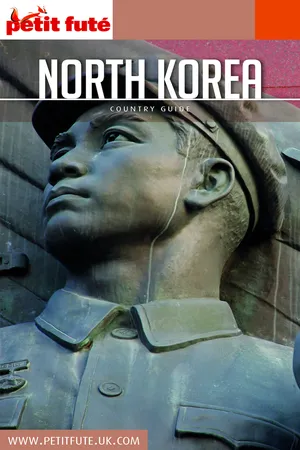
NORTH KOREA 2019/2020 Petit Futé
About this book
North Korea is constantly spoken of through its nuclear gesticulations and difficult relations with its neighbouring countries and the United States. But what do we really know of this country, if not its regime? North of the demilitarised zone, an impassable border that has separated it from South Korea for seven decades, North Korea is gradually opening up to tourism by offering, beyond clichés, a rich and specific culture that draws from its common roots with South Korea, while taking a different path to the point of asserting its own identity. In addition, one can admire the most beautiful landscapes of the peninsula, from the mountains to the coastal areas; the capital, Pyongyang, a true window on a country that has proclaimed itself autonomous and a place dedicated to the glory of the Kim dynasty; the historical heritage of the peninsula and its kingdoms; Chinese and Russian influence, the two northern neighbours... And then there are the people. Contrary to popular belief, North Koreans are welcoming, kind and open. On the one hand, there is the regime, and on the other, there is the territory and those who live there: this is what the traveller mainly remembers from his stay in North Korea.
Trusted by 375,005 students
Access to over 1.5 million titles for a fair monthly price.
Study more efficiently using our study tools.
Information
Topic
Personal DevelopmentSubtopic
TravelDISCOVERY

DISCOVERY - Bronze propaganda at the Great Mansudae Monument.
© Hugues de Zélicourt

North Korea in 20 keywords

PYONGYANG 평양 - Local vegetables (to be mixed with rice).
© Hugues de Zélicourt
Patriotic song
The patriotic song (애국가) is the North Korean national anthem. Adopted as early as 1947, a year before the official proclamation of the Democratic People's Republic of Korea, the North Koreans refer to the latter via the name of its first words "ach'im ŭn imŭn" or "let the morning shine".
Written by Pak se-Yong in 1946, on a music – of strong Soviet inspiration – composed by Kim Won-Gyun in 1945, he celebrates as much the love of the country, of the Korean people as the beauty of Korea as evidenced by its first verse: "country of the calm morning, full of sunshine, teeming with gold, silver, it is the beautiful homeland of three thousand li of our brave people honoured by its history five times millennia, the brilliance of its culture. May everyone to our dear Korea be devoted body and soul! »
The anthem of North Korea was recently discussed in 2018, due to the stun of an official in charge of music that has inadvertently interchanged the anthem of the two Koreas during the Asian under-19 football tournament in Malaysia.
Code of conduct
Imposed on all citizens of the People’s Republic of North Korea, the full name of this code is: ten principles for the establishment of a monolithic ideological system (노동당 유일사상 10 대 원칙). Composed of 10 principles as its name implies and 65 clauses, it was imposed by Kim Yong-ju, the younger brother of Kim Il-song and all the citizens of North Korea must learn it by heart. The objective of this code of conduct is to reinforce the unconditional love that every citizen has to bring to the ruling family. Thus, the code is the cornerstone of the politics of the cult of personality which is in force in the country.
Hermit (Kingdom)
This is one of the most common expressions used to talk about the Democratic People's Republic of Korea. It designates its international isolation and also, the aura of mystery that it creates. The expression "hermit kingdom" was democratized by Hillary Clinton when she was Secretary of State (the equivalent of the Foreign Minister in the United States).
Tests (nuclear)
It is undoubtedly the word that best describes North Korea for the people of the planet as well as the most problematic topic when one think about the Hermit Kingdom. In fact, North Korea conducts nuclear tests at more or less regular intervals – its sixth was held on 3 September 2017. This is equally so as to show to the world (and in particular to the United States) that it must be regarded as an important country in the world, but also, internally, to establish the legitimacy of the governing power and ruling dynasty.
Hanbok
Also called joseonot (조선옷) in North Korea, hanbok is the traditional garment of the Korean peninsula. Worn during traditional festivals and other important events, the promotion of this garment remains for the North Korean regime a way to display its anchor in the history of the peninsula.
Hangeul
Called Joseon ' gŭl (조선글) in the North, the Hangeul is the Korean alphabet. It is composed of 51 letters and was created in the fifteenth century. Until then, the previous official writing was based on Chinese characters and was mastered only by aristocratic elites. The primary objective of the creation of this alphabet was to reduce the illiteracy rate and allow greater access to education. Who create the Hangeul? The fourth King of the Yi dynasty: Sejong the great! Everything suggests that this phonetic specialist initially developed this alphabet in secret, surely for fear of opposition from the cultivated classes. The alphabet was published in 1446 in a document titled Hunmin Jeongeum, which means "the correct sounds for the education of the people". The term Hangeul was used as from 1912 and means "Korean writing". The Hangeul, before becoming the official writing, encountered a strong opposition from the elites. As a first step, the alphabet was used by women, who did not have access to Chinese studies and uneducated backgrounds. Following the multiple invasions of its history, the Hangeul has gradually become a symbol of Korean identity. Thus, in 1894, the alphabet was adopted in official documents and it governs life in the peninsula ever since.
Hanok
Hanok (한옥) are traditional Korean houses. Built of wood on stone structures, they do not have the slightest nail and their architecture rests on wooden pegs. As a result, they are removable and can be transported. If they have totally disappeared from the cities, the Korean War and the reconstruction of whole neighbourhoods from the 1950 years, they are still very present in the most remote countysides of North Korea.
Inminban
The inminban (인민반, "neighbourhood unit" or "popular unit") is a local social organization that structures homes in North Korea, like the neighbourhood committees (e.g. in China) or communes. In each inminban, there are 20 to 40 households, which meet regularly (usually once a week) to expose policies at the local level. At the head of the inminban is an official, most often a woman, whose official function is inminbanjang ("head of popular unit"). All North Korean citizens are attached to an inminban, both in the city and in the countryside. As such, the inminban, like inminbanjiang, plays an important role in supporting the North Korean political (and security) system as a whole.
Internet
The number 28 could sum up the not as tricky question of Internet access in North Korea. This figure makes headlines when it was released in the national and international press. It corresponds in fact to the number of sites officially identified on the Internet network of the country, which would therefore rather be comparable to an intranet answering the sweet name of Kwangmyong (광명), "shining star". Open since the beginning of the year 2000, this network to the 28 sites would be counted among others: a site called social network, a site dedicated to airline ticket booking and a site dedicated to cooking recipes. Beware, however, as according to several international media, there would be some 1 024 IP addresses throughout the country which therefore have access to the well named World Wide Web. It is impossible to know to whom these addresses are.
Jangmadang
Local agricultural markets are known as Jangmadang (공화국의 영원한 주석) in North Korea. Since the great famine of the 1990 years, they are a very important part of the country's economy since this is where basic foodstuffs, such as vegetables or rice, are traded. Since Kim Jong-UN's arrival in power, it seems that these markets are less regulated than in the past and that everyone is free (to some extent) to exchange food.
Joseon (Choson), the country of calm morning
Joseon is the name that Korea wore until 1945. It was the name of the country under the Yi dynasty, chosen by the founder Yi Seong-Gye on the advice of the Emperor of China. However, it was further rooted in history since it was the name given to the semi-legendary Kingdom founded by Dan-gun in 2333 B.C. (Gojoseon or Ancient Joseon) and guarded by his successor (Wiman-Joseon).
After the liberation, the two parts of the newly divided country hesitated for a moment on the choice of their name: the North kept the name of Joseon (Choson) which is rooted in a history several times millennia, while the South decided to adopt the name of Hanguk (Han country). This term Han, often supplemented with DAE, "large" (the full official name of the country is Daehanminguk), seems to endorse and historically justify the current North-South split. The word Joseon is generally translated as "the country of calm morning".
Juche
This word is the basis of the system that is ruling North Korea. But it has an older history since it relates to an old concept used in the nineteenth century by Korean nationalists. It refers to the idea of autonomy and self-sifficiency and means "the body, the master system (of oneself)". It became famous for its use in North Korea: it became the basic concept of the regime, formally theorised by Kim Il-Sung. Included in the Constitution of the country, it still governs all political and diplomatic decisions. According to the Juche, North Korea must settle its own problems according to its inner reality (i.e. without following the principles of Moscow or Beijing) based on political independence, economic self-sufficiency and defence. The North intends to achieve an independent socialist society. In this concept, there are the ghosts of the "Hermit Kingdom" (the ancient nickname of Korea) which undermined it and long explained its weakness.
It should be noted that on the occasion of the seventieth anniversary of President Kim Il-Sung in 1982, the Juche tower was erected in Pyongyang.
Kimchi
Kimchi refers to fermented vegetable dishes, which once allowed Koreans to store food during long winter months as a substitute for fresh vegetables. If there is a significant amount of kimchi (more than 160 varieties according to official figures), most of them are composed of spicy dishes, and cabbage is most often the basic vegetable. Nowadays, kimchi is still the most popular food in Korea, and accompanies meals in small cups positioned on the table. It is a must in North Korea (as well as in the South).
Kippumjo
Kippumjo (기쁨조) is one of those North Korean peculiarities which it is difficult to know whether it is a myth or reality. Generally translated as "fun group", "fun squad", "pleasure brigade", or "joy division", we would be struggling with a group of about 2 000 women and girls at the disposal of the North Korean leader in order to satisfy the sexual ardour and the desires ...
Table of contents
- Cover
- Table of contents
- INVITATION TO TRAVEL
- DISCOVERY
- PYONGYANG 평양 AND ITS SURROUNDINGS
- SOUTH KOREA 남부 부분
- ALONG THE SEA OF JAPAN 일본 해 해 안에
- NORTH OF PYONGYANG 평양 북부
- FUTE IDEAS
- Photos gallery
- Maps gallery
Frequently asked questions
Yes, you can cancel anytime from the Subscription tab in your account settings on the Perlego website. Your subscription will stay active until the end of your current billing period. Learn how to cancel your subscription
No, books cannot be downloaded as external files, such as PDFs, for use outside of Perlego. However, you can download books within the Perlego app for offline reading on mobile or tablet. Learn how to download books offline
Perlego offers two plans: Essential and Complete
- Essential is ideal for learners and professionals who enjoy exploring a wide range of subjects. Access the Essential Library with 800,000+ trusted titles and best-sellers across business, personal growth, and the humanities. Includes unlimited reading time and Standard Read Aloud voice.
- Complete: Perfect for advanced learners and researchers needing full, unrestricted access. Unlock 1.5M+ books across hundreds of subjects, including academic and specialized titles. The Complete Plan also includes advanced features like Premium Read Aloud and Research Assistant.
We are an online textbook subscription service, where you can get access to an entire online library for less than the price of a single book per month. With over 1.5 million books across 990+ topics, we’ve got you covered! Learn about our mission
Look out for the read-aloud symbol on your next book to see if you can listen to it. The read-aloud tool reads text aloud for you, highlighting the text as it is being read. You can pause it, speed it up and slow it down. Learn more about Read Aloud
Yes! You can use the Perlego app on both iOS and Android devices to read anytime, anywhere — even offline. Perfect for commutes or when you’re on the go.
Please note we cannot support devices running on iOS 13 and Android 7 or earlier. Learn more about using the app
Please note we cannot support devices running on iOS 13 and Android 7 or earlier. Learn more about using the app
Yes, you can access NORTH KOREA 2019/2020 Petit Futé by Dominique Auzias,Jean-Paul Labourdette in PDF and/or ePUB format, as well as other popular books in Personal Development & Travel. We have over 1.5 million books available in our catalogue for you to explore.