Encyclopedia on Blockchain for beginners and experts alike
Key Features ? Includes the basics of Blockchain ? Comparative study of public Blockchains (Ethereum, Hashgraph, Cardano, Algorand, Solana etc.) ? Comparison of interoperable Blockchains (Polkadot vs. Cosmos vs. Polygon). ? Comparison of private permissioned DLTs (Fabric vs. R3 Corda vs. Quorum). ? Comparison of R3 Corda opensource and Enterprise ? Comparison of Hyperledger Besu and GoQuorum ? Use Cases as Decentralized Identity, CBDC, NFT, Smart Cities etc.
Description Today, the Blockchain comes with many variations, including shared ledger, distributed ledger, mutable ledger, etc. In addition to that, there are adjoining technologies as the layer-2 setup and low code environments for smart contracts. Knowing them all and matching the individual's requirements is a must for the future IT industry. "Blockchain From Concept to Execution" is thoughtfully designed to match the need of the students and experts alike. Phase I covers the most widely adopted Blockchains of today. The first chapter starts with the very basic concepts of Blockchain that everyone should learn. The remaining chapters of this phase discuss some of the most popular Blockchains of today. Phase II further looks over the popular public inter-operable Blockchains in the market. It also explores the competitive study between the different public Blockchains and inter-operable Blockchains. Phase III illustrates the private permissioned DLTs that are adopted by the organizations. The final chapter in this phase also comes with a comparative study to help the reader choose one over the other. Phase IV describes some of the most popular industry use cases as of today. Phase V gives a guideline on how an industry can fast-track the Blockchain adoption and some research area of tomorrow.
What you will learn ? Freshers can learn different Blockchains and DLTs through 20 Chapters with 182 MCQs, 70 diagrams and, sample codes. ? Experts can explore the comparative study of Blockchains and DLTs ? Browse most popular use cases of "Decentralized Identity", "Tokenization, DeFi, NFT and CBDC" and "Smart Cities".
Who this book is for This book would be most suitable for business leaders, decision-makers, solution architects, business analysts, trainers, developers, and all Blockchain enthusiasts to understand the capabilities and application of different Blockchain and DLT frameworks and help them to choose the right one for their business needs.
Table of Contents 1. Introduction to Blockchain 2. Ethereum 3. Hedera Hashgraph 4. Tezos 5. Cardano 6. Algorand 7. Solana 8. Avalanche 9. Polygon 10. Polkadot 11. Cosmos 12. Comparison of Blockchains 13. Hyperledger Fabric 14. R3 Corda 15. Consensys Quorum 16. Comparison of Hyperledger Fabric, R3 Corda and Consensys Quorum 17. Decentralized Identity 18. Tokenization, DeFi, NFT and CBDC 19. Blockchain and 5G for IoT 20. Production and Beyond
Trusted by 375,005 students
Access to over 1.5 million titles for a fair monthly price.
Blockchain is one of the latest revolutions of the 21st century, many of whose fruits are yet to be harvested.
In this chapter, we will cover the introduction to Blockchain, the hype of Blockchain, and all the inherent and adjoining technologies that the decentralized architectures are dependent on. This knowledge would help us in the later chapters to understand the inherent mechanisms of different Blockchain protocols and choose the one that best suits our business needs.
1.1 The Blockchain Market
As per a 2020 report by Markets and Markets, “the global Blockchain market to be $3.0B in 2020 and is projected to reach $39.7B by 2025. The market growth can be attributed to the increasing number of venture funding and investments in the Blockchain technology and the increasing popularity of the Blockchain in retail and supply chain management.”
This report is seconded by another market analysis report by “Grand view research” that has the opinion that, “The global Blockchain technology market size was valued at USD 3.67 billion in 2020. It is expected to expand at a compound annual growth rate (CAGR) of 82.4% from 2021 to 2028.”
While North America has been the major investor that contributes to nearly 40% of the global revenue, we can find regional interest as well. And though the interest started with Banking and Fintech, today every business vertical seems to be looking for opportunities with the Blockchain technologies.
1.2 Evolution of Blockchain Technology and Hype
Blockchain is already a decade old, and hence, for the people who look for opportunities with this technology, it’s absolutely needed to understand the latest developments and the trends in this space.
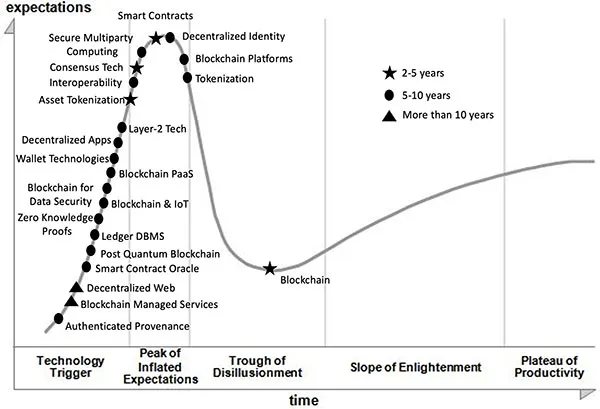
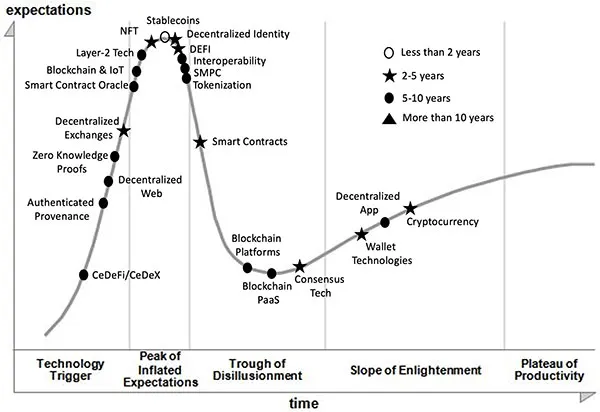
One of the best place to do so is to keep a close eye on the “Gartner Hype Cycle” that registers all the emerging technologies and religiously follows their developments. Any such technology as per Gartner would first go through five phases namely innovation trigger, followed by a peak of inflected expectation, trough of disillusionment, slope of enlightenment, and finally the plateau of productivity. Different technologies or use cases take different amount of time to travel from the innovation trigger till productivity. Figure 1.1 and Figure 1.2 shows the Gartner hype cycles for the past 2 years, where they have especially highlighted the Blockchain use cases and their estimated timelines for reaching productivity, as shown as follows:
Figure 1.1: Gartner Hype Cycle for Blockchain 2020 (Source: Gartner)
Figure 1.2: Gartner Hype Cycle for Blockchain 2021 (Source: Gartner)
Blockchain was introduced for the first time in Gartner Hype Cycle in 2016, and in just under five years, many of its use cases are in production. This signifies that in comparison to many others emerging technologies, the adoption of Blockchain is much faster. In the later chapters, we will read about many of the Blockchain use cases along with their supporting products and technologies that would help us understand the entire ecosystem with clarity.
1.3 Birth of Bitcoin
Unlike some of the other emerging technologies as Artificial Intelligence, IoT, Robotics etc., Blockchain is a relatively new technology that was introduced almost a decade ago through a cryptocurrency called “Bitcoin”. In 2008, someone named Satoshi Nakamoto published a whitepaper called “Bitcoin: A Peer-to-Peer Electronic Cash System”, that described the idea of Bitcoin cryptocurrency and Blockchain as the new technology to back such a currency. Within a year, Nakamoto released the first version of Bitcoin in the market that was also associated with the first implementation of the Blockchain so far. The first block called the “Genesis Block” was added to the Blockchain network on 3rd January 2009, and the first Bitcoin transaction happened on 12th January 2009. By year 2010, Satoshi vanished from the scene totally stopping his involvement in the associated activities. The price of the Bitcoin as well as the demand of the Blockchain as a technology, however, never looked back. In just over a decade, Bitcoin has observed exponential growth from zero to roughly $2+ trillion which is approximately 0.5% of the global wealth. The person behind the name, Satoshi Nakamoto, the father of Bitcoin, still remains a mystery. Was he a man, a woman, a group of people, an alien, or even a time traveller from the future, who gifted us this superior technology, and then simply vanished? The genius always prefers to stay away from the limelight, or does he?
1.4 Bitcoin vs. Previous Generation Electronic Money
Bitcoin is not the first digital money, nor will it be the last. Since the 1980s, many people have tried their hands on digital or electronic currencies but have failed due to technical or regulatory reasons. Organizations such as PayPal, eCash, WebMoney, Liberty Reserve, Payoneer, cashU etc., tried to achieve similar results but through centralized ecosystems which come with their own shortcomings such as the following:
Possibility of mass hacking
Single point of failure
High transaction fees
What made Bitcoin a shining star in the space of electronic funds transfer was its unique features. A few surprising benefits because of which Bitcoin became a milestone in payments are as follows:
Immunity to Fraud
No single point of failure
Low transaction fees
Universally acceptable
Instantaneous Settlements
Prevents Identity Theft
Today, there are more than 6000 cryptocurrencies being traded in the market and most of them use the concept of decentralization in one way or the other. All thanks goes to Satoshi and his concept of decentralized architecture in Blockchain, which is the essence behind the growth of cryptocurrencies.
1.5 Key Concepts
Unlike popular belief, Blockchain is not a new technology; rather it’s an amalgamation of many existing technologies along with a few new. Hence, let’s explore the basic elements and key concepts of Blockchain before diving deeper into the next chapters.
1.5.1 Cryptography, Encryption, and Decryption
Cryptography is the backbone of every Blockchain, and hence, it’s expected that we should have sound knowledge of its basic principles first.
Cryptography is the science of secure communication where two people can send and receive information openly using some sort of algorithm, so that the others cannot interpret the message even if they have access to it. The concept of Cryptography is nothing new. One of the earliest mention can be found as early as around 100 BC when the Roman general Julius Caesar used such techniques to send messages to his generals. Over the years, though many new cryptographic algorithms have been developed, but so have their hacking methodologies.
Every algorithm in Cryptography is divided into two different phases, which are as follows:
Encryption or transforming the original data to a cryptic or uninterpretable format.
Decryption or converting the encrypted data back to its original form.
In each cryptographic algorithm, we use two different types of cryptographic keys for the encryption and decryption of the data, which are as follows:
Symmetric cryptography
Asymmetric cryptography
1.5.1.1 Symmetric Cryptography
In symmetric cryptography, there is only one cryptographic key that is used for both encrypting as well as decrypting the data. This approach is easier and yet has limited functionalities and use cases.
1.5.1.2 Asymmetric Cryptography
Public-key cryptography, also known as asymmetric cryptography, uses a pair of keys, which are as follows:
Public key, that can be visible to others
Private key, that stays only with the owner
While one key can be used to lock the message, the other can unlock it. These two keys can be used in a variety of different ways; look at the following example:
Alice wishes to send a secret message to Bob. Alice would encrypt the transaction with Bob’s public key and only Bob can decrypt it using his own private key.
Alice signs a document using her private key, also known as “Digital Signature”. The others who know Alice’s public key can validate that the document is actually signed by Alice.
The following are the different types of asymmetric cryptography:
1.5.1.2.1 RSA
Introduced in 1977, Rivest–Shamir–Adleman or RSA is one among the first public-key Cryptography used for secure data transmission. This cryptography depends on solving a factoring problem with two large prime numbers. Though RSA is tough to breach, compared to DSA, it’s faster for its signature validation and slower in generation. Being there for a long time, RSA is most widely used and best supported.
1.5.1.2.2 DSA
Digital Signature Algorithm or DSA, a ...
Table of contents
Cover Page
Title Page
Copyright Page
Dedication Page
About the Author
Acknowledgements
Preface
Errata
Table of Contents
1. Introduction to Blockchain
PHASE I – PUBLIC BLOCKCHAINS
PHASE II – INTEROPERABLE BLOCKCHAINS
PHASE III – PRIVATE PERMISSIONED DLT
PHASE IV – USE CASES
PHASE V – Blockchain Adoption and Future
Glossary
Index
Frequently asked questions
Yes, you can cancel anytime from the Subscription tab in your account settings on the Perlego website. Your subscription will stay active until the end of your current billing period. Learn how to cancel your subscription
No, books cannot be downloaded as external files, such as PDFs, for use outside of Perlego. However, you can download books within the Perlego app for offline reading on mobile or tablet. Learn how to download books offline
Perlego offers two plans: Essential and Complete
Essential is ideal for learners and professionals who enjoy exploring a wide range of subjects. Access the Essential Library with 800,000+ trusted titles and best-sellers across business, personal growth, and the humanities. Includes unlimited reading time and Standard Read Aloud voice.
Complete: Perfect for advanced learners and researchers needing full, unrestricted access. Unlock 1.5M+ books across hundreds of subjects, including academic and specialized titles. The Complete Plan also includes advanced features like Premium Read Aloud and Research Assistant.
Both plans are available with monthly, semester, or annual billing cycles.
We are an online textbook subscription service, where you can get access to an entire online library for less than the price of a single book per month. With over 1.5 million books across 990+ topics, we’ve got you covered! Learn about our mission
Look out for the read-aloud symbol on your next book to see if you can listen to it. The read-aloud tool reads text aloud for you, highlighting the text as it is being read. You can pause it, speed it up and slow it down. Learn more about Read Aloud
Yes! You can use the Perlego app on both iOS and Android devices to read anytime, anywhere — even offline. Perfect for commutes or when you’re on the go. Please note we cannot support devices running on iOS 13 and Android 7 or earlier. Learn more about using the app
Yes, you can access Blockchain From Concept to Execution by Debajani Mohanty in PDF and/or ePUB format, as well as other popular books in Computer Science & Cryptography. We have over 1.5 million books available in our catalogue for you to explore.