"A deep, fascinating dive into a uniquely American brand of religious zealotry that poses a grave threat to our national parks, wilderness areas, wildlife sanctuaries, and other public lands. It also happens to be a delight to read."
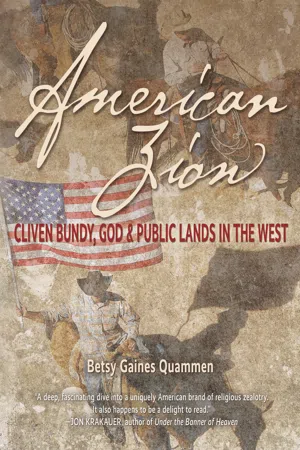
—JON KRAKAUER American Zion is the story of the Bundy family, famous for their armed conflicts in the West. With an antagonism that goes back to the very first Mormons who fled the Midwest for the Great Basin, they hold a sense of entitlement that confronts both law and democracy. Today their cowboy confrontations threaten public lands, wild species, and American heritage. BETSY GAINES QUAMMEN is a historian and conservationist. She received a doctorate in Environmental History from Montana State University in 2017, her dissertation focusing on Mormon settlement and public land conflicts. After college in Colorado, caretaking for a bed and breakfast in Mosier, Oregon, and serving breakfasts at a cafe in Kanab, Utah, Betsy has settled in Bozeman, Montana, where she now lives with her husband, writer David Quammen, three huge dogs, an overweight cat, and a pretty big python named Boots.
- English
- ePUB (mobile friendly)
- Available on iOS & Android
eBook - ePub
About this book
Trusted by 375,005 students
Access to over 1.5 million titles for a fair monthly price.
Study more efficiently using our study tools.
Information
Topic
Theology & ReligionSubtopic
North American HistoryPart 1:
THE COWBOY AND THE PROPHET
The Battle of Bunkerville
The fight for freedom is God’s fight.
—Ezra Taft Benson
On April 12, 2014, hundreds of protesters, including members of various militia groups, gathered near Bunkerville, Nevada, in the southeastern corner of the state, making their stand in solidarity with Cliven Bundy. They had gathered to shut down the court-ordered removal of the Bundys’ cattle from public lands. Many in the crowd carried guns and a few were positioned as snipers, their rifles aimed at federal agents and police. Agents aimed back. Men in cowboy hats rode on horseback with a crowd pushing along to face Las Vegas police and Bureau of Land Management (BLM) officers. Some of the protesters threatened and yelled obscenities. One guy in a Pittsburgh Steelers jersey asked a police officer if he was ready to die.
Cliven and Carol Bundy told me that even a backfire could have triggered another Waco. Of course, militia members and anti-government protesters say this all the time. Waco, Texas, is the town where, in 1993, federal agents, along with state lawenforcement officers and US military, led a siege of the compound in which a group, the Branch Davidians, had barricaded themselves. That siege ended in a final assault and a fire, resulting in the deaths of dozens of men, women, and children, an event that became a rallying cry in anti-government circles. Some allude to Waco as a cautionary tale, others with a kind of yearning, eager to have it out with a government they so despise.
During the Bundy standoff, Interstate 15 was shut down while north- and southbound traffic idled. On that spring day in Nevada, rifles aimed and ready, some of the protesters awaited a sign that would determine the outcome. Would the feds attack first, giving the protesters their chance to defend the Bundys? To protect them from the same evil forces responsible for the fate of the poor Branch Davidians of Waco? Or would the itchy fingers of an armed protester set off a volley of bullets? Perhaps divine intervention might take place, indicating God’s sympathy for this Mormon rancher and his family. In the minds of the protesters there that day, all scenarios were possible.
After a tense standoff, no bullets were exchanged. It was no Waco. In fact, the feds and the police relented and drove away. The retreat thrilled the protesters, but left the officers and agents shaken. Sergeant Tom Jenkins of the Las Vegas Metropolitan Police Department said, “We didn’t show any fear that day, but I can tell you, we all thought in the back of our minds, we all thought it was going to be our last day on earth.” Although the law officers weren’t interested in sacrificing their lives for cattle, many Bundy supporters evidently were.
Cliven’s son Ryan declared to the crowd, “The West has now been won.” Cliven Bundy, his family, and his followers reveled in the agents’ retreat. “If the standoff with the Bundys was wrong,” Cliven said later, “would the Lord have been with us? … Could those people that stood without fear and went through that spiritual experience … have done that without the Lord being there? No, they couldn’t.” To the Bundys, the day validated their position and demonstrated that God was on their side.
The Bundys and their public land battles initially sounded like a fringe cause—an isolated family caught up in a quixotic battle with the government over a bunch of cows. But in fact, in their crusade, they have inspired hundreds of thousands of supporters in the years following the Nevada standoff. The Bundys, as western “everymen,” have become the heroic face of anti-government agitators. Taking a passionate battle from Nevada to Oregon, where members of the family later led an armed occupation of a wildlife refuge, the Bundys staked their own claims on American public land and traditional Native land. They have gotten away with illegal grazing, takeovers, standoffs, and expensive property damage. To some, they have become champions. And as such, their amalgamation of Mormon beliefs, libertarianism, and a right-wing reading of the Constitution continues to inform and embolden anti-government activism.
Now members of this Mormon ranching family have launched a campaign, meeting with thousands of people, including reporters, supporters, and other ranchers, urging their followers to flout government regulations and join Cliven in his crusade to take back the West. In addition, Cliven’s reach online is incalculable. So, what is his message to these rapt audiences? Essentially this: We the people get to tell the federal government what they can and can’t do. And the government cannot own public lands. Therefore, federal regulations on lands do not exist. In fact, public land is just the wrong name. Really, it’s YOUR ranch. It’s all spelled out for you in the Constitution. And if you don’t trust me, just ask God. That’s what He’ll tell you.
Hardly the first member of his faith to break a federal law in favor of God’s higher authority, Cliven Bundy comes from a long line of Latter-day Saints, or Mormons, who talk to God and take His word over the law of the land. The line starts with Joseph Smith, the first Mormon prophet, seer, revelator, and founder of the Church of Jesus Christ of Latter-day Saints, who was arrested over forty times during his life of offenses that ranged from fraud and polygamy to conspiracy to commit murder. Smith’s loyal bodyguard, Orrin Porter Rockwell—nicknamed “the Destroying Angel of Mormondom,” because he brazenly went after enemies of the church, perceived or otherwise—killed many men in his lifetime and very probably tried to assassinate the governor of Missouri. Brigham Young, who succeeded Smith in 1844, spent decades ignoring federal laws as he established Mormon homeland in the Great Basin, while encouraging violence, fraud, and multiple deceptions.
And 172 years after Smith’s murder, and less than a year after the Battle of Bunkerville, the Heavenly Father would tell Cliven’s sons Ryan and Ammon Bundy to take up arms against an oppressive United States government. On January 2, 2016, the boys arrived with a small army of supporters, locked and loaded, to occupy the Malheur National Wildlife Refuge in Oregon until their arrest six weeks later. When Bundy family members heard the heavenly call toward the righteous direction, it was game on. Thy will be done.
The Bundy family is a product of a region where the corners of southern Utah and northern Arizona abut the state of Nevada; a place where Mormon communities today are scattered among the parks, monuments, and recreational areas. In the nineteenth century, their ancestors built settlements and livelihoods across the West, within what became a mosaic of federal and private holdings. Today, these places are visited, or at the very least driven past, by millions of tourists every year. It is a multilayered landscape, considered homeland to Latter-day Saints and sacred ground to the Southern Paiute people. Hikers, mountain bikers, and climbers in the thrall of writings by Terry Tempest Williams and Edward Abbey, find in these places both sanctuary and adventure. Ranchers look out and see lifestyle and legacy. It’s desert and it’s canyon country, a home to retired snowbirds, Park Service personnel, lodge managers, and outfitters who each see their own various cosmologies and values reflected in these rocks. Some see majesty. Some see money. Some see birthright. And some see God.
The Seeker
Know ye not that ye are in the hands of God?
—Book of Mormon, Mormon 5:23
Cliven Bundy will tell you that his land war is part of being Mormon, though many Saints would counter his presumption. The church has publicly condemned the family’s claim that their anti-government agitations are justified through Mormon scripture. And this is very important. The Bundy family’s position does not reflect teachings upheld in modern mainstream Mormonism. Yet some of his supporters, including prominent Mormon politicians, do embrace the same convictions that the Bundys espouse. In order to grasp these rationales, we need to go back to the beginnings of the church, this incredibly successful American religion that has a lot to say about proprietorship, rights, and sticking it to the man. We also need to trace how a culture of European and Yankee farmers became irascible cowboys. Then we can better understand Cliven Bundy.
When Cliven’s ancestors arrived in the Great Basin in the late 1840s, finally safe from religious oppression, they made their home in a land most other white settlers had overlooked. They helped build a homeland there, one promised to them by their prophet but which had eluded them before they found it on the flanks of the Wasatch Range. For the Bundy family, their birthrights to this land came with the arrival and the settlement of their forefathers. To make sense of Cliven Bundy and his insurgency is to understand the philosophies, assurances, and prophecies that came from early pioneers devoted to Joseph Smith.
The Bundy family story intrigued me. I’d spent the last decade working with religious leaders on conservation initiatives and I’d not yet had the opportunity to work with Mormons. The church had been slow to issue any formal statement on the environment, and the Bundy family seemed to be using their faith as an argument to deplete the land rather than steward it. I visited the family on March 5, 2015, and left their compound with my own signed Book of Mormon, courtesy of the family patriarch, vowing to Ryan and his father that I would read it. Because Cliven’s convictions were so tied to his religion, I thought this volume would shed light on the underpinnings of the Bundy war. Perhaps as someone raised outside the church, I missed a profundity and poetry that I’ve come to associate with other religious texts, though the Book of Mormon is informative when following Bundy’s motivations. But The Nay Book, a homemade manifesto filled with prophetic quotes by Mormon prophets and warnings about the precarious state of the US Constitution, is even more so. Ryan thumbed through his own copy, one bound in a vinyl binder, during the time I spent with the family. Named for the neighbor who compiled it, Keith Nay, it is often seen in the hands of Bundy’s inner circle at events and gatherings.
Three men came into view the day of my visit, each foundational to the Bundy family position and approach. Nephi Johnson, Cliven’s spiritual great-grandfather. Cleon Skousen, a Mormon right-wing agitator. And of course, Joseph Smith, who built a religion defined by promises of homeland and a personal relationship to God. The first Mormon prophet established a community of people with a history of despising the government, yet a belief in some duty to keep it in check, no matter what this entailed. The world is in its latter days, he warned, which meant time is almost up, coining a “truth” that created, and still creates, an urgency to action. If a stand must be taken, take it now, because there’s no time to lose. With this comes another implication, maybe also contributory to the uprising at Bunkerville, and later at the Malheur National Wildlife Refuge: an expectation that a standoff might have a domino effect, leading to larger events that fulfill prophesies outlined in the Book of Revelation, of the story of earth’s destruction and of Christ’s Second Coming.
So let’s begin with Joseph Smith, the first leader of the Latter-day Saints and first Mormon prophet. Many books have been written about Smith, and they range from fawning to condemning. Alex Beam, Fawn Brodie, Richard Lyman Bushman, and even Smith’s own mother, Lucy Mack Smith, told the story of this amazing human, a man who held many in his thrall while outraging and repulsing others. He was incontrovertibly impressive in what he achieved—his church now has over sixteen million members, among whom are the Bundys. And one would be hard-pressed to find a historical figure as curious and as striking as the founder of this ever-flourishing, influential, and inescapably American religion.
Before Joseph was a prophet, as a young man, he was a scryer, a trade that used magical tools in the search for hidden treasure. For his work, he used a device called a seer stone, a dark brown rock he used to seek riches rumored to be buried near his home on the New York frontier. This was a hobby not unusual to his time and place—one based on hearsay and wishful thinking. Stories about buried treasure abounded in upstate New York, where Joseph Smith’s family, for a time, made their home. Tales of pirate Captain Kidd’s gold bullion led hundreds to dig deep trenches in vain. Rumored Spanish and Indian silver called to the farmers in their stony fields, promising riches and escape from the grindingly difficult life of the frontier settler. It certainly called to young Joseph Smith.
In his lifetime, he would meet with unimaginable fame and infamy, leaving behind a legacy that swelled ever greater after his death. But he began his career by digging. The process went more or less like this: First, he would place the stone in the bottom of his hat, then plunge his face into the gloom. In order for the spell to work, all light needed to be occluded so that his stone could “see” treasure, and thereby ascertain its coordinates. But this was only the first of many fiddly steps. Once he determined the location, preparation for excavation began. Perhaps he drew concentric circles around the loot, a ritual his mother would years later write about in her memoir. Pressing circles into the dirt was said to foil supernatural guardians, the ghosts of murdered men charged for eternity to protect these mythic fortunes. Those in the treasure trade warned that phantoms pulled the valuables back deep into the earth if they sensed any threat. Coarse language or the garrulous talk of careless seekers, it was said, could tip the guardians off and cause them to spirit the treasure away.
Smith’s father, Joseph Smith Sr., also a scryer, emphasized the importance of night digs to his son. During the day, he explained, solar warmth coaxed hidden chests with piles of precious objects from the depths of the ground. Best to do most of the work after sunset, when the booty sat just below the earth’s surface. Night digs were thrilling (and booze-soaked) diversions for those living in this time and place, full of ceremony, ritual, and the delicious anticipation of instant wealth. It is easy to imagine that many of the stories of ghosts said to watch over the treasure sites were actually the invention of jumpy drunks startling themselves in the murk of the forest. Strong drink could make the mind rather credulous and prone to exaggeration. Blaming a ghost offered a good excuse for those coming home hammered and empty-handed.
Joseph was born in Vermont in 1805 to parents well-versed in the magic and the supernatural. His father claimed celestial visions and his mother talked regularly to God. This was quite common among folks of this region in nineteenth-century America, a time of great uncertainty and adversity. Having a personal relationship with God and the supernatural provided reassurance in a place where poverty, disease, and desperation abounded. As a boy, Joseph and his family moved from place to place, due to failed crops and burgeoning mortgages. Through difficult though necessary moves, the Smith family, following several failures and subsequent relocations, landed in an environment well-suited to their numinous hobbies. New York State’s “Burned-over District” marinated in a stew of wild revivalism, cults, and extremists preparing adherents for end-times. And it was there Joseph Smith spent his formative years.
In his youth, millennialism was rampant, as were utopian societies promoting everything from sexual libertinism (Oneidans) to abstinence (Shakers). Protestant branches proliferated, especially those offering rebellion against Calvinist notions of predeterminism. In other words, folks did not want to believe that they were fated to either heaven or hell even before they were born. If this were true, then why would one stay upright and honorable rather than spend the days drunk and feckless? If God had already made up His mind, then what was the point of being virtuous? Calvinism left many searching for a faith that would give them some agency, some skin in the game, and the opportunity to be judged for their actions, whether meritorious or sinful. Be it harps and halos or pitchforks and flames, they wanted to feel like they had some ability to determine where they spent their afterlife.
Growing up, Joseph picked through hot embers of the Second Great Awakening, pursuing both buried riches and new versions of Christianity. Although the tray of options was overflowing, he was not satisfied with what was offered. Untrained ministers, aspiring prophets, and self-proclaimed Second Comings roamed the countryside alongside the scryers, all searching to fill that emptiness found both in pockets and souls. Would they discover gold or God? Joseph came of age amid spiritual promiscuity, where, under the drape of a tent, silver-tongued preachers brought their audiences into flailing, juddering, and jerking fits, as if the hand of the Lord himself had reached out and shaken them. So eager were the people for religious novelty, the enthusiasms of upstate New York even brought believers into fits of glossolalia, speaking in tongues known only to God.
This birthplace for so many religious movements provided the incubator for Shakers, Seventh-day Adventists, and Oneidans—sects that encouraged perfectionism. And communalism. And various riffs on hanky-panky. A hundred years after the death of Joseph Smith Jr., writer Fawn Brodie, who grew up in a family with a deep regard for his teachings, described the Burned-over District of upstate New York as a cadre of “the Baptists split into Reformed Baptists, Hard Shell Baptists, Free Will Baptists, Seventh Day Baptists, Footwashers and other sects.” She mentioned Anna Lee, the founder of the Shaker sect who regarded herself as the reincarnation of Christ. And “Isaac Bullard, wearing nothing but a bearskin girdle and his beard, who gathered a following of pilgrims in 1817 in Woodstock, Vermont.” He was a “champion of free love and communism, he regarded washing as a sin and boasted he had not changed his clothes in seven years.” So many wanted to know God. Or to be God. These emerging religious leaders filled a great need, arising in response to a culture yearning for celestial reassurance. Further, if there was ever a place that might inspire someone to imagine his own version of a religion or fancy herself a mystic, the Bu...
Table of contents
- Cover
- Title Page
- Copyright
- Dedication
- Contents
- Introduction
- Part 1: The Cowboy and the Prophet
- Part 2: American Zion
- Part 3: We the People
- Acknowledgments
- Endnotes
- Selected Bibliography
- Index
- About the Author
- Torrey House Press
Frequently asked questions
Yes, you can cancel anytime from the Subscription tab in your account settings on the Perlego website. Your subscription will stay active until the end of your current billing period. Learn how to cancel your subscription
No, books cannot be downloaded as external files, such as PDFs, for use outside of Perlego. However, you can download books within the Perlego app for offline reading on mobile or tablet. Learn how to download books offline
Perlego offers two plans: Essential and Complete
- Essential is ideal for learners and professionals who enjoy exploring a wide range of subjects. Access the Essential Library with 800,000+ trusted titles and best-sellers across business, personal growth, and the humanities. Includes unlimited reading time and Standard Read Aloud voice.
- Complete: Perfect for advanced learners and researchers needing full, unrestricted access. Unlock 1.5M+ books across hundreds of subjects, including academic and specialized titles. The Complete Plan also includes advanced features like Premium Read Aloud and Research Assistant.
We are an online textbook subscription service, where you can get access to an entire online library for less than the price of a single book per month. With over 1.5 million books across 990+ topics, we’ve got you covered! Learn about our mission
Look out for the read-aloud symbol on your next book to see if you can listen to it. The read-aloud tool reads text aloud for you, highlighting the text as it is being read. You can pause it, speed it up and slow it down. Learn more about Read Aloud
Yes! You can use the Perlego app on both iOS and Android devices to read anytime, anywhere — even offline. Perfect for commutes or when you’re on the go.
Please note we cannot support devices running on iOS 13 and Android 7 or earlier. Learn more about using the app
Please note we cannot support devices running on iOS 13 and Android 7 or earlier. Learn more about using the app
Yes, you can access American Zion by Betsy Gaines Quammen in PDF and/or ePUB format, as well as other popular books in Theology & Religion & North American History. We have over 1.5 million books available in our catalogue for you to explore.