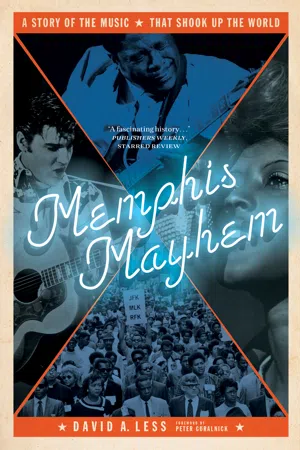
Memphis gave birth to music that changed the world — Memphis Mayhem is a fascinating history of how music and culture collided to change the state of music forever
"David Less has captured the essence of the Memphis music experience on these pages in no uncertain terms. There's truly no place like Memphis and this is the story of why that is. HAVE MERCY!" — Billy F Gibbons, ZZ Top
Memphis Mayhem weaves the tale of the racial collision that led to a cultural, sociological, and musical revolution. David Less constructs a fascinating narrative of the city that has produced a startling array of talent, including Elvis Presley, B.B. King, Al Green, Otis Redding, Sister Rosetta Tharpe, Justin Timberlake, and so many more.
Beginning with the 1870s yellow fever epidemics that created racial imbalance as wealthy whites fled the city, David Less moves from W.C. Handy's codification of blues in 1909 to the mid-century advent of interracial musical acts like Booker T. & the M.G.'s, the birth of punk, and finally to the growth of a music tourism industry.
Memphis Mayhem explores the city's entire musical ecosystem, which includes studios, high school band instructors, clubs, record companies, family bands, pressing plants, instrument factories, and retail record outlets. Lively and comprehensive, this is a provocative story of finding common ground through music and creating a sound that would change the world.
“And somebody said, ‘That’s John Lennon.’ So, I just laughed.”
—Ann Peebles, soul singer
A story circulated among Memphis musicians a few years ago about Blair Cunningham, a member of a legendary family of local drummers, who had moved to England to pursue his career. Cunningham’s older brother Carl was a member of the original Bar-Kays and was killed in the airplane crash that claimed most of his bandmates and soul singer Otis Redding.
According to the story, in the early 1990s, Blair was invited to try out for a new band being formed by Paul McCartney. He dutifully went to the former Beatle’s estate where he and Paul jammed alone together for a few hours, McCartney on guitar and Cunningham on drums.
At the end of the session, the young drummer from Memphis told the bassist of the most successful rock band in history that they might have a good band if they could find a good bass player.
Cunningham got the job and played with McCartney for a few years. The point of the story is not to disparage him for not knowing McCartney’s background. He came from a family of musicians and certainly knew The Beatles’ music. But musicians in Memphis were often enveloped in a cocoon of the region’s great music.
It was less important to those artists what other people were doing. What was being created in Memphis was what mattered . . .
Growing up in Memphis in the 1950s and 1960s, I was unaware of any national significance of local racial, musical, or political issues. We were such a provincial city that it seemed unlikely that anything occurring here impacted the conversation in larger markets. The country was facing major changes in light of newly passed civil rights laws. The onslaught of mass media was making the world seem smaller, even if the South tried to hold on to its distinct regional culture.
The expansion of national chains like McDonald’s, Kentucky Fried Chicken, and Memphis-born Holiday Inn promised to erase any semblance of local flair to their products. Patrons were assured the same experience at these establishments regardless of geography. And kids nationwide were all hearing and dancing to the same music thanks to Dick Clark’s American Bandstand. When Ed Sullivan first introduced Elvis Presley on September 9, 1956, and The Beatles on February 9, 1964, to prime-time TV, the entire country took notice.
Like many others, my family moved to the economically segregated suburbs when faced with the prospect of integrated neighborhoods. My childhood mirrored those of thousands of white kids across the country. The distinction was in the music that came from my hometown.
By the time I entered junior high school in September 1964, the question was not “Do you play an instrument?” but rather “What instrument do you play?” Certainly, part of this evolution of musicians was due to the influence of The Beatles. In fact, I began playing drums because of Ringo Starr.
But there is a long Memphis tradition of children learning an instrument that precedes the British Invasion. It’s part of the culture. And in our bands in the 1960s, we played what we knew, which included what we heard from other local bands and popular music from the radio. At our proms and dances, we heard legendary African American bandleaders like Willie Mitchell and Gene “Bowlegs” Miller. On the radio, we listened to Rufus Thomas on WDIA, the first all-black station in the United States.
As a teenager in Memphis, I assumed that there was an Elvis Presley living in every town. Or that some version of Charlie Rich or Ronnie Milsap played piano at local night spots. If you had a decent high school band like The Gentrys or The Box Tops, you could make a hit record at Chips Moman’s American Sound Studio. Stax Records was our record label, and its stars were seen around town at the grocery stores or the Poplar Tunes record shop. Booker T. & the M.G.s did a free show at the Overton Park Shell, where the Memphis Country Blues Festival was held annually and featured regional elder blues legends like Furry Lewis, Gus Cannon, Bukka White, and others.
Until I first moved away for college in 1970, I had no idea that there was anything different about Memphis.
It was 1967 and popular music was in transition. Successful British newcomers The Who and U.S. expatriate Jimi Hendrix were bridging the divide and bringing their music to the States. Established English performers The Beatles and The Rolling Stones were expanding musical boundaries with Sgt. Pepper’s Lonely Hearts Club Band and Their Satanic Majesties Request, respectively.
Meanwhile, the mainstays at Stax Records in Memphis really didn’t have a sense of how far their music was reaching outside of their hometown. Otis Redding had visited the United Kingdom for a short tour in 1966, but the label’s owner, Jim Stewart, was reluctant to have his house band, Booker T. & the M.G.s, out of the studio for too long. The quartet played on most of the records made at the tiny studio in Memphis, and Stewart didn’t want to shut down production for an extended period of time.
Stax vice president Al Bell felt there was an opportunity to increase overseas sales and favored the idea. Finally, Stewart planned a thirteen-show European tour beginning March 17 and running until April 9, 1967. The revue featured the label’s most popular acts anchored by Redding. The lineup also included Carla Thomas, The Mar-Keys, Sam & Dave, Eddie Floyd, and Arthur Conley. Booker T. & the M.G.s backed all the singers, and the horn section from The Mar-Keys joined them to form the house band. Most of the participants were in their twenties and completely unaware of the worldwide following for their music.
According to The Mar-Keys’ trumpeter Wayne Jackson, “We didn’t have any idea that we were making any impact except the songs were going up and down the charts.”1
“The Stax/Volt Tour of 1967 was the first time we got a chance to go overseas. The Big Stax Show on the Road,” said saxophonist Andrew Love. “When we landed in England, we had limos provided by The Beatles. That’s when we began to think, ‘Hey, maybe we’re somebody.’”2
Before the revue tour began, Carla Thomas played with Booker T. & the M.G.s at a small club in London called Bag O’Nails. Beatle Paul McCartney showed up. Years later, she reminisced, “It was to get the practice and it was a real intimate little place. Of course, that just made us feel really good that he came to see us. . . . And we all sat at the table and talked to him and he stayed the whole night, just until about the club closed. He was in awe. He was wonderful. It was just an exchange of mutual admiration.”3
“I love you!” yelled the man in the audience.
The diminutive soul singer with the big voice ignored the outburst. She was accustomed to rowdy admirers. After all, she had played in the clubs in Memphis. And this was the legendary Troubadour, one of the top showcase clubs in Los Angeles. She had dealt with hecklers before. What could go wrong?
“I love you!” shouted the obviously intoxicated man again.
This was Memphian Ann Peebles’s big showcase. The Troubadour was the hot club in town where stars and music aficionados gathered. Where careers could be launched and the elusive “buzz” could begin.
Decades later, she told me in an interview, “I looked out in the audience and somebody just kept screaming my name and screaming, ‘I love you. I love you.’ And I kept looking and I was saying, ‘Who is this?’ I kept looking out and I saw him, but he had a sanitary napkin taped to his forehead. And he kept screaming and screaming. I said, ‘Who is that?’ And somebody said, ‘That’s John Lennon.’ So, I just laughed.”4
It was 1974 and Lennon had moved to Los Angeles and begun an eighteen-month period of debauchery. He had gone to the Troubadour with friends to listen to Peebles. Her rendition of “I Can’t Stand the Rain” had been released a year earlier, and Lennon had declared itto be “the best song ever” in Billboard magazine. That evening, he was inebriated and had slipped into the ladies’ room, emerging with a sanitary napkin across his forehead. As the evening wore on, his declarations of admiration for the soul singer from Memphis grew more graphic. After the show, he came backstage and apologized to Peebles.
“He came backstage and we had a long talk. He’s a funny guy.”5
Rick Ivy
Ann Peebles at Royal Studios, Memphis
Twentieth-century music is a difficult art form to force into genres. Lines blur between blues, jazz, rock and roll, and R&B. Many of these terms are primarily marketing tools to help retailers and radio stations target consumers.
Congress designated Memphis the “Home of the Blues” on December 15, 1977, probably because of the sheet music and early recordings of band leader W.C. Handy, whose contributions cannot be discounted. Likewise, New Orleans lays claim to its place as the birthplace of jazz based on descriptions of the music played by early pioneer Buddy Bolden, whose renditions were not recorded. The reports of improvisation in his performances are a powerful harbinger of jazz.
Truthfully, both cities’ claims are probably not accurate as the instrumentation and repertoire seemed similar between Handy’s and Bolden’s bands. In fact, music can seldom point to a singular event as its genesis. Even Elvis Presley’s first rock recordings stemmed from his love of R&B.
Handy’s band read music and played a stricter, more formal style than Bolden’s, but musicians and the black audiences likely traveled frequently between the two cities. Both are on the Mississippi River and offered jobs, entertainment, and a population that included the first generation of African Americans born after slavery was abolished.
As American music developed, pockets of innovation existed in many U.S. cities, including clubs on Elm Street in Dallas and those on Decatur Street in Atlanta. But regional differences were often pronounced and led to distinct characteristics that shaped the progression of the music. Such was the case in Memphis.
What is it about this small Southern town that produced music that so enthralled the most famous musicians in the world? Why would both Paul McCartney and John Lennon, the most successful songwriters and musicians of that era, act like fawning fans of its artists?
It’s all part of the story of the music from Memphis.
Chapter Two: Race Relations
“Mrs. Moss, she went to jail,
Called on Judge Dubose,
Judge Dubose came out and said,
‘Get right on away from here.’”
—Local song from 1892
The city of Memphis never had an exclusive on racism, despite its history as a major slave-trading center. After all, enslaved people were sold and traded as property in many states in the South. But because of these historical atrocities committed by whites upon slaves, Southern whites and blacks have a different relationship than those who live elsewhere in the country.
Marvell Thomas, Memphis musical family scion, said that the major difference between racism in the South as opposed to the North is that racism here has always been overt. Everybody knew where everybody stood on the subject.
Historically, Southern whites and Southern blacks all grew up in an agrarian society. They knew each other because they worked in close contact with each other all the time. The kids grew up playing with each other on the farms and in the streets until they were teenagers. In the segregated North, there was less personal, social contact.
As a river port, Memphis imported diverse regional influences and exported its innovations. Coupled with the ratio of blacks unable to le...
Table of contents
Foreword by Peter Guralnick
Introduction
Chapter One: Mutual Admiration
Chapter Two: Race Relations
Chapter Three: Black Neighborhood Schools
Chapter Four: The Racial Bridge
Chapter Five: That Was Just Memphis
Chapter Six: The Memphis Beat
Chapter Seven: Ghosts Walked among Them
Chapter Eight: City Mice and Country Mice
Chapter Nine: Jazz — Teachers and Students
Chapter Ten: Booker and Doughbelly
Chapter Eleven: Saints and Sinners
Chapter Twelve: Heads or Tails or . . .
Chapter Thirteen: Sam Phillips and the Birth of Rock and Roll
Chapter Fourteen: Radio and Television
Chapter Fifteen: Joe Cuoghi and John Novarese
Chapter Sixteen: Hi Records: Biracial Recording
Chapter Seventeen: Hi Records: Willie Steps Up
Chapter Eighteen: Stax — The Torch Is Passed
Chapter Nineteen: The End of the Sixties: Big Changes for Stax
Chapter Twenty: American and Ardent Studios
Chapter Twenty-One: The End of Stax, Hi, and American
Chapter Twenty-Two: A New Paradigm
Chapter Twenty-Three: The Dawn of Punk
Chapter Twenty-Four: Music Tourism: Memphis Cashes In
Epilogue
Chronology of Significant Events in Memphis Music
Acknowledgments
Notes
About the Author
Copyright
Frequently asked questions
Yes, you can cancel anytime from the Subscription tab in your account settings on the Perlego website. Your subscription will stay active until the end of your current billing period. Learn how to cancel your subscription
No, books cannot be downloaded as external files, such as PDFs, for use outside of Perlego. However, you can download books within the Perlego app for offline reading on mobile or tablet. Learn how to download books offline
Perlego offers two plans: Essential and Complete
Essential is ideal for learners and professionals who enjoy exploring a wide range of subjects. Access the Essential Library with 800,000+ trusted titles and best-sellers across business, personal growth, and the humanities. Includes unlimited reading time and Standard Read Aloud voice.
Complete: Perfect for advanced learners and researchers needing full, unrestricted access. Unlock 1.4M+ books across hundreds of subjects, including academic and specialized titles. The Complete Plan also includes advanced features like Premium Read Aloud and Research Assistant.
Both plans are available with monthly, semester, or annual billing cycles.
We are an online textbook subscription service, where you can get access to an entire online library for less than the price of a single book per month. With over 1 million books across 990+ topics, we’ve got you covered! Learn about our mission
Look out for the read-aloud symbol on your next book to see if you can listen to it. The read-aloud tool reads text aloud for you, highlighting the text as it is being read. You can pause it, speed it up and slow it down. Learn more about Read Aloud
Yes! You can use the Perlego app on both iOS and Android devices to read anytime, anywhere — even offline. Perfect for commutes or when you’re on the go. Please note we cannot support devices running on iOS 13 and Android 7 or earlier. Learn more about using the app
Yes, you can access Memphis Mayhem by David A. Less in PDF and/or ePUB format, as well as other popular books in Media & Performing Arts & North American History. We have over one million books available in our catalogue for you to explore.