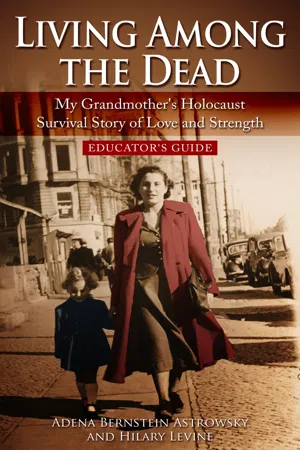
An Educator's Guide is now available to assist those teaching about the Holocaust by using the book, Living among the Dead. The Guide can be used chapter by chapter to enhance the student's understanding of the narrative. There are multiple suggestions and lessons to take us deeper into the history of the Holocaust and this story of strength, family love, community solidarity, and Jewish history.
eBook - ePub
Living among the Dead
My Grandmother's Holocaust Survival Story of Love and Strength - Educator's Guide
- English
- ePUB (mobile friendly)
- Available on iOS & Android
eBook - ePub
Living among the Dead
My Grandmother's Holocaust Survival Story of Love and Strength - Educator's Guide
About this book
Trusted by 375,005 students
Access to over 1.5 million titles for a fair monthly price.
Study more efficiently using our study tools.
Information
Topic
EducationSubtopic
Education Counseling1
Activities
- The author has fond memories of time spent with her grandmother, Mania, who she also refers to as “Bubbie,” the Yiddish word for grandmother. If you have relatives you have grown up around, share a story about your memories with one of them. Or, if you have visited a special relative who lives in another city, state, or country, write a letter to that person, thanking them for the time they spent with you.
- Music was a significant part of Mania’s life. Frederick Chopin was one of the most famous composers and pianists of the time. Expose your students to Chopin for an extra activity. Here are some resources: https://study.com/academy/lesson/frederic-chopin-lesson-for-kids.html
Vocabulary
- Bar Mitzvah
- Bat Mitzvah
- Shabbat
Discussion Questions
- Why is having children, grandchildren, and great-grandchildren so significant for Mania?
- The author is upset with her children when they say they are “starving” (6). Why does this bother her? Have your parents said similar things to you? Explain how trauma caused by hunger, homelessness or immigration, can be passed on through generations.
- Discuss the “presence of absence” (2). Do you identify with this, or are you surrounded by family? How did the Holocaust affect families for generations?
- The author ends this chapter with this: “By knowing your roots and remembering your history, I hope that we will all do our part to help achieve peace and to prevent further genocides” (13). How can knowing your roots and history help lay the foundation for a more peaceful future?
Resources
- A short video on the significance of Bar and Bat Mitzvahs: https://www.myjewishlearning.com/article/bar-and-bat-mitzvah-101/.
- Discuss the Jewish practice of leaving rocks on a grave: https://www.jewish-funeral-home.com/why-do-jews-place-stones-or-pebbles-on-a grave/
- A video explaining Shabbat:
- https://www.youtube.com/watch?v=vjmjZWHXKFY.
- How to make Challah: https://www.youtube.com/watch?v=yFD7_y9ux-U&ab_channel=TheCookingFoodie
2
Activity
- The website, https://maps.geshergalicia.org/, has a wonderful selection of maps from Europe, and the one below is just an example of what you can find.
This map shows where Mania lived and the distance to Lwow.
Using Google Earth, take your students on a tour of the area. There is lots to see.

Vocabulary
- Hasidic
- Orthodox
- kosher
- gymnasium
- Yiddish
Discussion Questions
- What did Mania do as a young girl that probably helped her later as a writer? What is the role of a school in teaching children reading?
- What is the role of men at the beginning of this chapter? What are attributes or “signs of the times” that are different now?
- Describe how Katya is both traditional and modern at the same time.
- Mania states, “Having sisters makes you important and makes you belong somewhere” (20). Explain what this means.
- Describe Rivka and what Mania admires about her. How is Rivka like her mother, Katya?
- Why do you think the author chose to include a description of Rivka in Mania’s words (21-22)? What does this add to the story so far? When was it written, and why is the date significant?
- Describe Nechamka. How is her relationship with Mania different from Rivka’s?
3
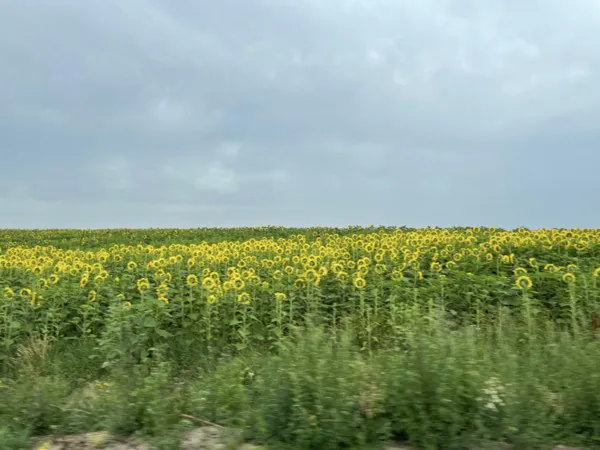
Sunflowers of Włodzimierz (Photo Credit: Adena Astrowsky, 2021)
This photo was taken driving through Ukraine. It was the most splendid thing thinking of Mania’s words as we passed fields and fields of sunflowers.
Words cannot express the contrast between the beautiful countryside filled with sunflowers and the mass graves spread throughout.
Activity
- Looking at the photograph on the first page, what do you notice? Does the photo look similar to any in your family’s collection of photos? This is a great place to help students make connections and add relevance to studying the Holocaust. So often, students see black and white pictures and think they are old and have nothing to do with them. But many of our students might have a photo (probably on their phones) taken at a beach or with a family member. Ask students to share a photo that reminds them of this one (literally, or the spirit of the photo) and discuss how people in earlier times and different places did many of the same activities we do today.
Vocabulary
- Yahrzeit glass
Discussion Questions
- Mania often talks of sunflowers. Have students research the symbolism of sunflowers and what they represent. Ask them to find the origin story for sunflowers. How and why have they been a symbol of happiness?
- This chapter is in Mania’s voice. Discuss the difference and why the author chose to include her grandmother's words.
- The chapter ends with two humorous stories about Nechamka. Why is humor important, even in a book about the Holocaust? Ask students to recall funny stories from their own childhoods and share, if they are comfortable doing so. Although we are reminded of Nechamka’s d...
Table of contents
- Cover
- Title Page
- Untitled
- Copyright
- Contents
- Adena’s introduction
- Hilary’s introduction
- Major Themes in the Memoir
- Glossary of Terms
- The Beginning: Why Teach the Holocaust?
- History and Social Studies Standards for California
- Timeline of the Holocaust
- Chapter Guide
- Chapter 1
- Chapter 2
- Chapter 3
- Chapter 4
- Chapter 5
- Chapter 6
- Chapter 7
- Chapter 8
- Chapter 9
- Chapter 10
- Chapter 11
- Chapter 12
- Chapter 13
- Chapter 14
- Chapter 15
- Chapter 16
- Chapter 17
- Chapter 18
- Chapter 19
- Chapter 20
- Chapter 21
- Notes
Frequently asked questions
Yes, you can cancel anytime from the Subscription tab in your account settings on the Perlego website. Your subscription will stay active until the end of your current billing period. Learn how to cancel your subscription
No, books cannot be downloaded as external files, such as PDFs, for use outside of Perlego. However, you can download books within the Perlego app for offline reading on mobile or tablet. Learn how to download books offline
Perlego offers two plans: Essential and Complete
- Essential is ideal for learners and professionals who enjoy exploring a wide range of subjects. Access the Essential Library with 800,000+ trusted titles and best-sellers across business, personal growth, and the humanities. Includes unlimited reading time and Standard Read Aloud voice.
- Complete: Perfect for advanced learners and researchers needing full, unrestricted access. Unlock 1.5M+ books across hundreds of subjects, including academic and specialized titles. The Complete Plan also includes advanced features like Premium Read Aloud and Research Assistant.
We are an online textbook subscription service, where you can get access to an entire online library for less than the price of a single book per month. With over 1.5 million books across 990+ topics, we’ve got you covered! Learn about our mission
Look out for the read-aloud symbol on your next book to see if you can listen to it. The read-aloud tool reads text aloud for you, highlighting the text as it is being read. You can pause it, speed it up and slow it down. Learn more about Read Aloud
Yes! You can use the Perlego app on both iOS and Android devices to read anytime, anywhere — even offline. Perfect for commutes or when you’re on the go.
Please note we cannot support devices running on iOS 13 and Android 7 or earlier. Learn more about using the app
Please note we cannot support devices running on iOS 13 and Android 7 or earlier. Learn more about using the app
Yes, you can access Living among the Dead by Adena Bernstein Astrowsky in PDF and/or ePUB format, as well as other popular books in Education & Education Counseling. We have over 1.5 million books available in our catalogue for you to explore.