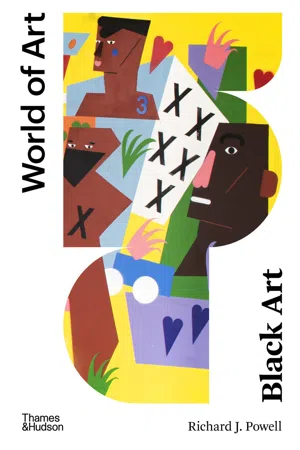
The African diaspora a direct result of the transatlantic slave trade and Western colonialism has generated a wide array of artistic achievements, from blues and reggae, to the paintings of the pioneering African American artist Henry Ossawa Tanner and video creations of contemporary hip-hop artists. This book concentrates on how these works, often created during times of major social upheaval and transformation, use black culture both as a subject and as context. From musings on the souls of black folk in late nineteenth-century art, to questions of racial and cultural identities in performance, media, and computer-assisted arts in the twenty-first century, this book examines the philosophical and social forces that have shaped a black presence in modern and contemporary visual culture. Now updated, this new edition helps us understand better how the first two decades of the twenty-first century have been a transformative moment in which previous assumptions about race, difference, and identity have been irrevocably altered, with art providing a useful lens through which to think about these compelling issues.
- 360 pages
- English
- ePUB (mobile friendly)
- Available on iOS & Android
eBook - ePub
About this book
Trusted by 375,005 students
Access to over 1 million titles for a fair monthly price.
Study more efficiently using our study tools.
Information
Topic
ArtSubtopic
History of ArtChapter 1
Art, Culture, and “the Souls of Black Folk”
Turn-of-the-Century Representations
At the end of the nineteenth century a proposal for a gathering of men and women in London to discuss the status of peoples of African ancestry living in Europe, North and South America, the Caribbean, and on the continent of Africa captured the imaginations of black intellectuals and activists the world over. In France the Haitian diplomat Benito Sylvain had initially hoped that the assembly would denounce the scientific community and its allegations of “Negro inferiority”: an issue that was being hotly debated among many white ethnologists during this period. In the United States the famous African American educator and spokesperson Booker T. Washington, although generally unsympathetic to political agitation and assertiveness by blacks, gave his tacit approval for such a conference and urged those “colored Americans” who were able to attend to do so. And, in England, the Sierra Leonean Anglican cleric, Bishop James Johnson, leaving to take up his appointment as the church’s spiritual leader in the Lower Niger Delta area of West Africa, proclaimed that the “Pan-African Association” and its congress of black people from all over the world was “the beginning of a union I had long hoped for, and would to God it could be universal!”
This call for black people throughout the world to meet and discuss their collective condition at the dawn of the twentieth century was an extraordinary event. The 1900 Pan-African Conference and the context that produced it—the cultural and psychological colonization of African peoples worldwide, their economic exploitation, and rampant racism and genocide from the Belgian Congo to the southern United States—all suggested that, at this early stage in the formation of a post-Emancipation black identity, there was the sense among many peoples of African ancestry that they had certain concerns, fears, aspirations, and even cultural values in common.
Indeed, in the months just prior to London’s Pan-African Conference the Exposition Universelle in Paris had rallied scores of black visitors to see and take pride in the “American Negro Exhibit” on the Rue des Nations. Comprising photographs, books, industrial and fine arts products, handmade objects, miniature architectural models, machine patents, and other materials made by independent black artisans and students from historically black US schools, this display served as a shining example of what was possible for any oppressed people, whether in Africa, Europe, or the Americas, once the veil of slavery had been lifted, and they had a chance to do something for themselves.
The belief that black people, apart from physiognomic and genealogical ties with the inhabitants of Africa, had comparable experiences, identical struggles for full acceptance in society, and shared destinies, was widely held by social commentators and thinkers in the second half of the nineteenth century. For ethnographers, the lowly status of black peoples in the United States, the Caribbean, and Latin America, and what was considered the “primitive” culture of their African forebears, were “evidence” that all blacks were cut from the same coarse “biologically-determined” cloth, and that the policies of white paternalism and social control were necessary for world order and Western progress.
In contrast, there were a few nineteenth-century thinkers who took a position that might be described as “Pan-Africanist” or “black nationalist.” For them, the same historical “facts”—the shared African origin, the social dissolution that afflicted African peoples through the transatlantic slave trade, the hope (and, in many instances, the futility) of universal emancipation, and the social/economic vacuum, which resulted from Western imperialism and white racism—all suggested that the world’s African peoples, in spite of having experienced different forms of slavery, dispersal, and economic exploitation by the West, had more in common with one another than with their white brethren. These various interpretations of an African-derived presence in the world created particular stereotypes and perceptions of black people and their cultures, which differed dramatically from either earlier pre-Emancipation representations of blacks or images of indigenous African peoples.
Several approaches in representing this African-derived, but new and distinct “black culture” reveal both the possibilities and the limitations of black life as perceived during this period. One tendency developed around a burgeoning African American performance tradition. Its roots in slave plantations, and in parodies of this culture by white blackface minstrels, and also in post-Civil War politics and social customs, spawned a whole commerce in comic, music-and-dance-oriented, and racist representations of black people.

8 Cover of sheet music for “All Coons Look Alike to Me” by Ernest Hogan, 1896
Like many literary and visual portrayals, whose principal incentive is a satirical or “humorous” view of “the other,” these images took the form of outrageous characterizations of blacks, their communities, and their alleged cultural practices. These grotesque, garishly dressed beings, with black skins, protruding red lips and bulging eyeballs, were usually shown in impoverished settings with yard fowl, watermelons, and so on. Alternately backward, shiftless, ridiculous, childish, criminal, these characterizations faithfully appeared in turn-of-the-century European and American theatrical productions, popular literature, advertisements, children’s toys, and other cultural documenta. Countless graphic artists and illustrators established themselves in this field of commercial art. Edward W. Kemble, literally created his own one-man Negro-stereotype industry, with dozens of racist illustrations for books and journals, including his 1896 “classic,” Kemble’s Coons.
Ironically, among those most responsible for putting the pejorative word “coon” into common usage was the black American vaudeville performer and composer Ernest Hogan. His celebrated (and notorious) 1896 song, “All Coons Look Alike to Me,” catapulted the “coon” craze and racist representations of blacks into worldwide popularity.[8]
An entirely different approach invested black people with a more truthful humanity, as in the novels of French and American writers, such as Emile Zola, Guy de Maupassant, Henry James, Stephen Crane, and Theodore Dreiser. American visual artists such as Thomas Hovenden, Thomas Eakins, Winslow Homer, and Henry Ossawa Tanner, developed a similar realism, which also challenged the prevailing assumptions of black inferiority, shallowness, and bestiality.
Tanner, who based himself in Paris, was one of a small number of African American artists, including sculptor May Howard Jackson, painter Alfred Stidum, and photographer C.M. Battey, who were producing new images of black life at the turn of the century. Tanner’s early training at the Pennsylvania Academy of the Fine Arts (under Thomas Eakins) and in Paris at the Académie Julian (with John-Joseph Benjamin-Constant and Jean-Paul Laurens) gave him the painting skills and realist credentials which, with his innate talent, imagination, and interest in morally charged subject matter, led to the creation of such early masterpieces as The Banjo Lesson (1893).[9] In Tanner’s hands this familiar scene of an old man teaching a young boy how to play the banjo, set in the domestic warmth and genteel poverty of a hearth-lit cabin, was transformed into a painted Negro spiritual: a luminous, pictorial narrative about learning, cultural nourishment, and cross-generational affection. Tanner was principally a painter of Biblical allegories, and during the fifty-odd years of his career only intermittently explored these sympathetic themes featuring black subjects. Yet these loving and remarkably sober images of blacks have long been paragons of positivism for the African American popular imagination in the welter of cultural stereotyping and ridicule.
A third source of representations of black culture at this time was what Richard A. Long has described as the “folk-rural” tradition. Both the racist and realist/idealist strains of black imagery emerged from artists and perceptions outside typical black communities; in contrast, the folk-rural orientation developed from within them. The memory of an African legacy, the institution of slavery, confinement within a socially instituted caste system, and a position on the margins of the economy—all these influenced the self-taught and vernacular style, like many of the crafts that were on display in the “American Negro Exhibit” for the 1900 Exposition Universelle in Paris.
The Bible Quilt (c. 1895–98) by the Georgia seamstress Harriet Powers had its genesis in this culturally insular, folk-rural world, conditioned by Bible stories, subconscious affinities for West African design sensibilities, and the politics of race, gender, and class.[10] Powers did not explicitly portray black culture or black people, but expanded the representational discourse through sign-like, heraldic emblems and her own description (written at her dictation) of each appliquéd panel of the quilt. Although masked by standard Biblical narratives, Powers’s Bible Quilt and her earlier version of 1886, covertly interrogated the worldly affairs of women and men who, like those in Powers’s tiny community outside Athens, Georgia, had their own share of Old and New Testament-like temptations, trials, betrayals, and sacrifices.
The clashing and colliding sentiments in Hogan’s “coon” imagery, Tanner’s impressionistic scenes of black life, and Powers’s rural folk artistry showed what was being flaunted by 1900 in the popular imagination as “Negro.” What was harder to discern were the underlying significations of black culture, both in its actual forms and in its representational constructs.

9 Henry Ossawa Tanner, The Banjo Lesson, 1893

10 Harriet Powers, Bible Quilt, c. 1895–98
Lifting Every Voice
Part of the answer surfaced at this time in the writings of the African American educator, attorney, diplomat, and author James Weldon Johnson, who is best known for his 1900 song “Lift Ev’ry Voice and Sing” (commonly referred to as the “Negro National Anthem”). His 1912 novel, The Autobiography of an Ex-Colored Man, published anonymously and remaining so until 1927, traced the racial and cultural evolution of the protagonist, from his “illegitimate” and mixed racial beginnings in the segregated South, to his equally “illegitimate” end as an African American who tragically “passes” for white at the novel’s conclusion. The ex-colored man’s anxieties about having sold his birthright “for a mess of pottage” are framed by his admiration for the various African American cultural idioms of the day—ragtime music, Negro spirituals, African American religious oratory, and the popular black dance known as “the cakewalk.” He saw them as ultimately on a par with the very best of European art, and felt that their originality, evocative nature, and universal appeal (as indicated in the revealing caption of H. M. Pettit’s 1899 photomontage of cakewalkers for Leslie’s Weekly) gave “evidence of a power that will someday be applied to the higher forms.”[11]
But how does one reconcile Johnson’s eloquently articulated celebration of black popular culture with the legion of racist “coon” images that usually accompanied the era’s ragtime music and cakewalking black dancers? Can the black theater scene of this time, with its roots in black-face minstrelsy and background of post-Civil War disenfranchisement and white-on-black violence, be redeemed with the universalizing and humanizing language of art and cultural relativism?
The black cultural demi-monde with its stereotypes, portrayed in The Autobiography of an Ex-Colored Man, was well known to Johnson. As the lyricist for such ragtime hits as “Under the Bamboo Tree” and “Congo Love Song,” Johnson used many of the standard black clichés of the day, seeing great mastery in the cakewalk and ragtime music, and praising a range of cultural expressions from the “racist” to the “authentic.”
Of course, Johnson did not view his theatrical activities and those of his fellow black vaudevillians as “racist” or necessarily disparaging to black people. Rather, he recognized the importance of the African American musical and performance tradition, and und...
Table of contents
- Cover
- Title Page
- About the Author
- Acknowledgments
- Contents
- Introduction: The Dark Center
- Chapter 1: Art, Culture, and “the Souls of Black Folk”
- Chapter 2: Enter and Exit the “New Negro”
- Chapter 3: The Cult of the People
- Chapter 4: Pride, Assimilation, and Dreams
- Chapter 5: “Black is a Color”
- Chapter 6: Culture as Currency
- Chapter 7: Through a Glass, Diasporally
- Chapter 8: Fin-de-Siècle Blues
- Chapter 9: The Price of Blackness
- Biographical Notes
- Select Bibliography and Sources
- List of Illustrations
- Index
- Copyright
Frequently asked questions
Yes, you can cancel anytime from the Subscription tab in your account settings on the Perlego website. Your subscription will stay active until the end of your current billing period. Learn how to cancel your subscription
No, books cannot be downloaded as external files, such as PDFs, for use outside of Perlego. However, you can download books within the Perlego app for offline reading on mobile or tablet. Learn how to download books offline
Perlego offers two plans: Essential and Complete
- Essential is ideal for learners and professionals who enjoy exploring a wide range of subjects. Access the Essential Library with 800,000+ trusted titles and best-sellers across business, personal growth, and the humanities. Includes unlimited reading time and Standard Read Aloud voice.
- Complete: Perfect for advanced learners and researchers needing full, unrestricted access. Unlock 1.4M+ books across hundreds of subjects, including academic and specialized titles. The Complete Plan also includes advanced features like Premium Read Aloud and Research Assistant.
We are an online textbook subscription service, where you can get access to an entire online library for less than the price of a single book per month. With over 1 million books across 990+ topics, we’ve got you covered! Learn about our mission
Look out for the read-aloud symbol on your next book to see if you can listen to it. The read-aloud tool reads text aloud for you, highlighting the text as it is being read. You can pause it, speed it up and slow it down. Learn more about Read Aloud
Yes! You can use the Perlego app on both iOS and Android devices to read anytime, anywhere — even offline. Perfect for commutes or when you’re on the go.
Please note we cannot support devices running on iOS 13 and Android 7 or earlier. Learn more about using the app
Please note we cannot support devices running on iOS 13 and Android 7 or earlier. Learn more about using the app
Yes, you can access Black Art by Richard J. Powell in PDF and/or ePUB format, as well as other popular books in Art & History of Art. We have over one million books available in our catalogue for you to explore.