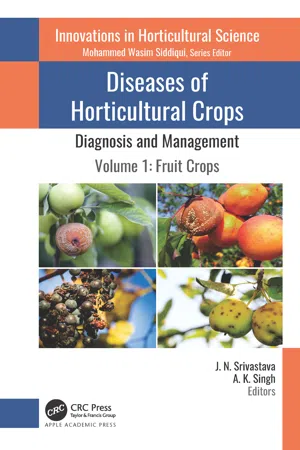
Plant diseases cause serious threats to the successful cultivation of horticultural crops, resulting in huge losses in their yields. These plant diseases are known to affect horticultural crops at various growth stages and reduce the yield as well as quality of fruits and vegetables. Diseases also cause subsequent postharvest transit and storage losses. This 4-volume set provides the latest diagnostic information along with effective management solutions to the problems of diseases of field crop plants caused by phytopathogens.
In volume 1, each chapter includes an introduction, disease symptoms, causal organisms, disease cycles, epidemiology, and management of economically important plants. With contributions from national scientists who are engaged in teaching, research, and extension services who share their experiences here, the chapters explore apples, amla (or Indian gooseberry), avocado, Indian bael, banana, Indian jujube, citrus, grapes, guava, hazelnut, and more.
The volumes provide an abundance of information for understanding and managing plant diseases, with emphasis on diagnostic techniques. The collection includes: Volume 1: Fruit Crops Volume 2: Vegetable Crops Volume 3: Ornamental Plants and Spice Crops Volume 4: Important Plantation Crops, Medicinal Crops, and Mushrooms
Fruits are very important for human beings, and they are not only delicious but also have many nutrients that are necessary for human health. Fruit crops play an important role in the human diet. Because of their ingredients fruits are very healthy and protective against a number of diseases. They are known to contain several health-promoting components, such as vitamins, essential minerals, antioxidants, and prebiotics (fibers).
India is the second largest producer of fruits in the world after China. India has diverse climates and soil for cultivation of horticulture crops, providing ample opportunities for the development of the fruit industry, but the greatest challenge at present is to produce sufficient fruit to feed the ever-increasing human population. This demands infusion of technology for an efficient utilization of resources for deriving higher output per unit of input while rataining excellent quality of the produce within short span of time.
In the present era of open economy, it has become increasingly necessary that our produce is competitive, both in the domestic as well as in international markets. This would be possible only through deployment of high-tech applications and precision farming methods, but diseases are one of the important constraints for productivity of fruits all over the world, including India.
Hence, understanding the fundamental components of disease, that is, symptoms, causal organisms, disease cycles, and epidemiology, is essential for the effective management of diseases and to avert significant losses in the yield of fruits.
It is in this context this book, Diseases of Horticultural Crops: Diagnosis and Management, Vol. 1: Fruit Crops, contains elaborate descriptions of all important diseases of fruit crops and is a valuable addition to the literature on fruit pathology in the country.
A commendable effort has be made by Dr. J. N. Srivastava, Bihar Agri-cultural University, Bhagalpur, Bihar, and Dr. A. K. Singh, Sher-e-Kashmir University of Agricultural Sciences and Technology, Jammu, (J&K), in planning, compiling, and editing this publication.
I am sure the book will be found very useful not only by the students studying at undergraduate and postgraduate levels, researchers, and teachers of Plant Pathology but also by the planners, administrators and growers, and various organizations dealing with the export of fruits from the country.
I give compliment to the authors, Dr. J. N. Srivastava and Dr. A. K. Singh, for their effort on bringing out this publication and wish them success in this and future endeavors.
— Panjab Singh, DSc
President, National Academy of Agricultural Sciences;
Chancellor, RLB Central Agricultural University, Jhansi (U.P.);
President, FAARD Foundation, Delhi, India
FOREWORD 2
Fruit growing is one of the important and age old practices, practiced in India since ancient times. Cultivation of fruit crops plays an important role in overall status of the mankind and the nation. The standard of living of the people of a country depends upon the production and per capita consumption of fruits. Fruit crops also play an important role in the human diet. Because of their ingredients fruits are very healthy and protective against a number of diseases. They are known to contain several health-promoting components, such as vitamins, essential minerals, antioxidants, and prebiotics (fibers). There is a great potential of export of fruits from India, which can be achieved not only by improving the quality of fruits but also through judicious management of diseases. Diseases are one of the important constraints for productivity of fruits all over the world including India.
Hence, understanding the fundamental components of disease i.e. symptoms, causal organism, disease cycle and epidemiology is essential for effective management of diseases and to avert significant losses in the yield of fruits. It is in this context the book “Diseases of Horticultural Crops: Diagnosis and Management, Vol. I: Fruit Crops” contains elaborate descriptions of all important disease of fruit crops and is valuable addition to the literature on fruit pathology in the country. A commendable effort has be made by Dr. J. N. Srivastava, Bihar Agricultural University, Bhagalpur, Bihar and Dr. A. K. Singh, Sher-e-Kashmir University of Agri-cultural Sciences and Technology, Jammu, (J&K) in planning, compiling, and editing this publication.
I am sure the book will be found to be very useful not only by the students studying at undergraduate and postgraduate levels, researchers and teachers of plant pathology but also by the planners, administrators and growers, and various organizations dealing with the export of fruits.
I congratulate Dr. J. N. Srivastava and Dr. A. K. Singh for their efforts in updating and including information about fruits in the new edition of his book.
— C. D. Mayee, PhD, DSc
Adjunct Professor, Indian Agricultural Research Institute, New Delhi, India;
President, ISCI, Mumbai, India
FOREWORD 3
Fruits are very important in human diet, as they are the major source of vitamins and micronutrients. India provides ideal climatic conditions for growing a wide variety of fruits. The varieties of fruits, which are grown in India, are unmatched with any other part of the world.
In India, fruits production provides nutritional security but major constraints in improving the productivity of fruits in India are the pests and diseases. These constraints not only adversely affect the production but also impede export of fruits from India. There is a great potential of export of fruits from India, which can be achieved not only by improving the quality of fruits but also through judicious management of diseases.
It is in this context the book “Diseases of Horticultural Crops: Diagnosis and Management, Vol. I: Fruit Crops” contains elaborate descriptions of all important disease of fruit crops and is valuable addition to the literature on fruit pathology in the country.
The book deals with fruits crop diseases caused by fungi, bacteria, and viruses. The management practices included in the book are easy to follow and will certainly be useful in minimizing the losses caused by diseases of fruits in the country.
It is a commendable effort has be made by Dr. J. N. Srivastava, Bihar Agricultural University, Bhagalpur, Bihar, and Dr. A. K. Singh, Sher-e-Kashmir University of Agricultural Sciences and Technology, Jammu, (J&K), in planning, compiling, and editing this publication.
I am sure the book will be found very useful not only by students studying at undergraduate and postgraduate levels, researchers and teachers of plant pathology but also by the planners, administrators and growers and various organizations dealing with the export of fruits from the country.
I heartily congratulate the editors/authors, Dr. J. N. Srivastava and Dr. A. K. Singh, for bringing out this useful publication that provides comprehensive information about fruits crop diseases.
Ex-Director General, Tea Research Association India;
Ex-Director, Biopesticide Division, Super Agro India Pvt. Ltd., Kolkata, India
PREFACE
Fruit crops cultivation is one of the important and age old practices, practiced in India since ancient times. Fruit crops cultivation plays an important role in overall status of the mankind and the nation. The standard of living of the people of a country is depending upon the production and per capita consumption of fruits. Fruit growing has more economic advantages. Fruits crops are capable of giving higher tonnage of yield per unit area than other field crops.
According to recent research findings, many phytochemicals are found in fruits and act as powerful antioxidants protecting cells and organs from damage caused by free radicals, neutralizing their damaging effects. They are the biologically active substances in plants that give them color, flavor, odor, and protection against not only diseases affecting the plants but also provide health benefits to human beings. Consequently hundreds of such plant substances are being investigated now for their role in preventing cancer and other degenerative diseases. Some of the promising phytochemicals that act as antioxidants are bioflavanoids (vitamin P), phenolics, lycopene, carotenoids, antioxidant vitamins (C and E), and glucosinolates. Oranges, lemons, limes, and grape fruits in addition to being principal sources of vitamin C and folate are rich in a class of phytochemicals called limonoids. This antioxidant has been found to be very effective against cancer.
The potential of fruit crops in the growth of national economy is noteworthy. The prosperity of the country lies in building-up its foreign exchange reserves. Being a country having varied climatic conditions ranging from tropical to subtropical and to temperate, India has very immense potential for the production of different fruits and their export. Recent policies of the Government of India to encourage export of fruits and their products by announcing concessions to the fruit industry, such as reduced air freight charges and exemption for storage charges for refrigerated air cargo at international airports, have encouraged a number of private entrepreneurs and corporate bodies and NRIs to go in for planting larger areas under fruit crops with an aim to export fruits and fruit products.
The foregoing account is given with a view to emphasize the growing importance of the fruit industry. As could be seen from the details given therein, the fruit culture is vital to the health and economy of the nation, from the standpoint of increased food production, nutrition, trade, and fruit-based industries.
In spite of all above facts, the production of fruits in the country is less as compared to advanced countries because of different reasons; the most important being the prevalence of diseases in fruit crops. The management of any disease successfully involves its detailed study regarding symptoms, casual agent, disease cycle, and epidemiology.
This book, Diseases of Horticultural Crops: Diagnosis and Management Volume-1 Fruit Crops, presents with 23 chapters. Each chapter has detailed account of introduction, symptoms, causal organisms, disease cycles, epidemiology, and management of economically important diseases. The book chapters have been contributed by the authors who are engaged in teaching, research, and extension services and are well-known national scientists in their respective field. The authors, while writing the chapters, have incorporated their experience and knowledge with recent developments in the field of plant diseases.
It is hoped that the book will cater to the needs of students studying at undergraduate and postgraduate levels, researchers, teachers, planners, administrators, and growers, not only in the discipline of plant pathology but also in other fields of agriculture.
We sincerely acknowledge our thanks and gratitude to the esteemed scientists who have spared their time and contributed valuable chapters for this book. We are also heartily thankful to Apple Academic Press for publishing this book.
— Dr. J. N. Srivastava
Dr. A. K. Singh
CHAPTER 1 CURRENT STATUS OF APPLE SCAB DISEASE AND MANAGEMENT STRATEGIES IN UTTARANCHAL HIMALAYAS
K. P. SINGH* and J. KUMAR
Department of Plant Pathology, College of Agriculture, Govind Ballabh Pant University of Agriculture & Technology, Pantnagar, Udham Singh Nagar, Uttarakhand, India
Loss from apple scab over a period of years is greater than that from any other disease of apple. Scab reduces leaf areas, defoliation, and poor spur development, fruit size, shelf life, and quality of the fruit. Yield losses during epidemic years can go up to 70% or even more. In Uttarakhand Himalayas, control of apple scab is achieved primarily through a protectant fungicides spray program. In a protec...
Table of contents
Cover Page
Half Title Page
Title Page
Copyright Page
Dedication
Innovations in Horticultural Science
Books in the Series
About the Editors
Table of Contents
Contributors
Abbreviations
Foreword 1
Foreword 2
Foreword 3
Preface
1. Current Status of Apple Scab Disease and Management Strategies in Uttaranchal Himalayas
2. Important Diseases of Apple (Malus domestica L.) and Their Management
3. Aonla (Emblica officinalis Gaertn.): Key Diseases and Their Management
4. Avocado (Persea americana Mill.) Diseases and Their Management
5. Important Diseases of Bael (Aeglemormelos L.) and Management Strategies
6. Current Status of Banana (Musa paradisiaca L.) Diseases and Their Management
7. Ber (Ziziphus mauritiana Lamk.): Key Diseases and Their Management
10. Status and Strategies for Managing Quick Decline/Tristeza Disease Of Citrus In India
11. Diseases of Grapevine (Vitis vinifera L.) and Their Management
12. Guava (Psidium guajava): Key Diseases and Their Management
13. Major Diseases of Hazelnut (Corylus avellana L.) and Their Management
14. Important Diseases of Jackfruit (Artocarpus heterophyllus Lank.) and Management Strategies
15. Important Diseases of Karonda (Carissa carandas Linn.) and Their Management
16. Diseases and Physiological Disorder Spectrum in Litchi (Litchi chinensis Sonn.)/Longan (Dimocarpus longan Lour.) and Their Management
17. Major Diseases of Coorg Mandarin (Citrus reticulata) and their Management
18. Mango (Mangifera indica L.) Diseases In India: Perspective And Management Strategies
19. Status and Strategies for Managing Mango (Mangifera indica L.) Diseases
20. Muskmelon (Cucumis melo L.): Major Diseases And Their Management
21. Important Diseases of Papaya (Carica Papaya L.) and Their Management
22. Important Diseases Of Walnut (Juglans Regia L.) and Their Management
23. Watermelon [Citrullus Lanatus (Thunb) Mansf.]: Key Diseases and Their Management
Index
Trusted by 375,005 students
Access to over 1.5 million titles for a fair monthly price.
Study more efficiently using our study tools.
Frequently asked questions
Yes, you can cancel anytime from the Subscription tab in your account settings on the Perlego website. Your subscription will stay active until the end of your current billing period. Learn how to cancel your subscription
No, books cannot be downloaded as external files, such as PDFs, for use outside of Perlego. However, you can download books within the Perlego app for offline reading on mobile or tablet. Learn how to download books offline
Perlego offers two plans: Essential and Complete
Essential is ideal for learners and professionals who enjoy exploring a wide range of subjects. Access the Essential Library with 800,000+ trusted titles and best-sellers across business, personal growth, and the humanities. Includes unlimited reading time and Standard Read Aloud voice.
Complete: Perfect for advanced learners and researchers needing full, unrestricted access. Unlock 1.5M+ books across hundreds of subjects, including academic and specialized titles. The Complete Plan also includes advanced features like Premium Read Aloud and Research Assistant.
Both plans are available with monthly, semester, or annual billing cycles.
We are an online textbook subscription service, where you can get access to an entire online library for less than the price of a single book per month. With over 1.5 million books across 990+ topics, we’ve got you covered! Learn about our mission
Look out for the read-aloud symbol on your next book to see if you can listen to it. The read-aloud tool reads text aloud for you, highlighting the text as it is being read. You can pause it, speed it up and slow it down. Learn more about Read Aloud
Yes! You can use the Perlego app on both iOS and Android devices to read anytime, anywhere — even offline. Perfect for commutes or when you’re on the go. Please note we cannot support devices running on iOS 13 and Android 7 or earlier. Learn more about using the app
Yes, you can access Diseases of Horticultural Crops: Diagnosis and Management by J. N. Srivastava,A. K. Singh in PDF and/or ePUB format, as well as other popular books in Biological Sciences & Biology. We have over 1.5 million books available in our catalogue for you to explore.