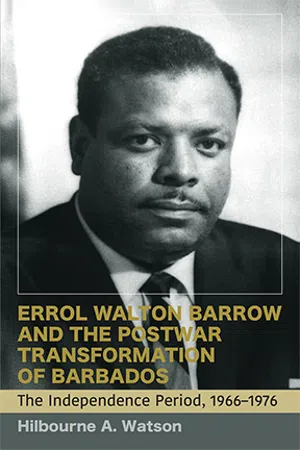
This companion volume to Errol Walton Barrow and the Postwar Transformation of Barbados: The Late Colonial Period, which covered the social and political forces between the 1920s and 1966 that shaped the trajectory of working-class struggles in Barbados and led to its decolonization, addresses mainly the first two decades of Barbados's independence as a sovereign monarchy under Errol Barrow and the Democratic Labour Party.
"[An] incisive and rigorous left analysis of the conundrum facing a peripheral capitalist Caribbean society. Watson explains why Barbados, unable to break decisively with its colonial past and hamstrung by the deceit of the promise of sovereignty, is forced to make compromises with imperialism and its domestic representatives of capital."
–Linden Lewis, Professor of Sociology, Bucknell University, Lewisburg, Pennsylvania
"[A] masterful exploration of Barbados's political development.... [Watson] offers a skilful critique of Barbados's quest for 'development', ever unable to be pro-working class, in the shadows of colonialism and the spectre of the United States.... A must-read for anyone seeking a sophisticated and nuanced understanding of Barbados, the Caribbean and world politics, not only between 1966 and 1976 but in the present.
–Kristina Hinds, Senior Lecturer in Political Science (International Relations), the University of the West Indies, Cave Hill, Barbados
"Meticulously researched and brilliantly written.... All of the major influences that helped to fashion the young state are carefully catalogued, analysed and associated with their relevant theoretical underpinnings.... Watson lays bare the intricacies and contradictions that made the [independence] period and its main actors so important to the shaping of modern Barbados."
–Harold Codrington, Deputy Governor (retired), Central Bank of Barbados