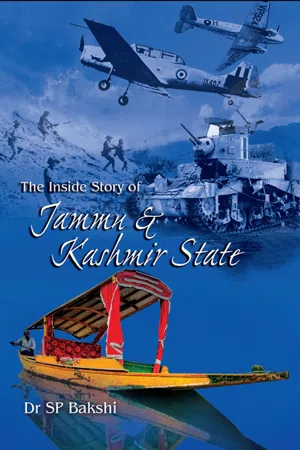
This is a unique and path breaking book about the invasion and accession of the J&K state to India and its aftermath. The author, who was the Chief Education Officer of the J&K State Forces in Maharaja Hari Singh's times, was very well placed to watch history unfolding. He was very close to the Royal family and has, for the first time, provided some radical new inputs and insights into that exciting period. He has highlighted the Role of a Rasputin like Monk called MahantJi, who had begun to wield inordinate influence on the Maharaja. He filled his head with delusions of grandeur, and prevailed upon him to stay independent and accede neither to India or Pakistan. This prompted Pakistan to muster thousands of Tribal raiders and mount a brutal invasion of the J&K state. The tribesmen were recruited on the simple promise of loot and rape and they set the kingdom to fire and sword. This was a rather strange way of "liberating" the shocked people of the state. The heavily outnumbered State Forces fought heroically to save the state but the odds were simply overwhelming. After the war, the author was asked to compile the official history of the State Forces role in that conflict. In this book he recounts the grim and riveting saga of how the outnumbered state forces fought a tenacious battle to save the state. Finally Brig Rajinder Singh, the Chief of staff of the State Forces, personally sallied forth with a handful of men to stop the Raiders march on to Srinagar. He blew up the strategic Uri Bridge and held the Tribals off for three crucial days which enabled the Indian Army to fly in and save the valley. The subsequent exploits of the Indian Army liberated two-thirds of the state and completely overshadowed the heroic role of the state Forces. This book gives a first person account of that grim battle against impossible odds. The author provides a unique, personal and firsthand account of an historic era and of the issue of accession that has become a subject of so much controversy and conflict. It is amazing that this brutal tribal invasion orchestrated by Pakistan has today been completely erased from the minds of the people of Kashmir by Jihadi propagandists. They need to revisit that shocking period to understand that Pakistan has no love lost for the people of Kashmir and covets only the river waters of the state. It recounts the horrors of rape and massacre that Pakistan had visited upon the hapless people of J&K. This book is a must read for all scholars, statesmen and soldiers dealing with the nettlesome subject of Kashmir. The riveting first person account would equally interest the layman and documents a vital period of our nation's history.
- English
- ePUB (mobile friendly)
- Available on iOS & Android
eBook - ePub
The Inside Story of Jammu & Kashmir State
About this book
Trusted by 375,005 students
Access to over 1.5 million titles for a fair monthly price.
Study more efficiently using our study tools.
Information
1
Kashmir and Kashmiris
Kashmir is Kashmir. There is no place to match Kashmir in beauty and grandeur. Born from the womb of an ocean, Kashmir is uniquely blessed with numerous lakes and springs with their own distinctive charm and beauty. The ever-spreading carpet of green, undulating meadows, sparkling streams, young mountains aspiring to rise higher and higher, looking up to the sky-kissing mountains crowned eternally with snows, are impressive sights.
The azure blue sky with some trailing clouds is aptly mirrored in crystal clear lakes. There are no tornadoes, no storms here. Nature seems to be serenely peaceful, smiling benevolently on the growth of life everywhere. Nature here is ever new, ever fresh and ever changing all the year round. Each season has its own complexion, colour and charisma; its own stamp and its own atmosphere.
Winter is the end of the year. When winter comes, all activity ceases, and everything goes to sleep. Then, nature pulls a blanket of snow over everything to ensure undisturbed sleep, and blissful rest for all life.
When spring comes, all life awakens. The white blanket of snow is slowly withdrawn from everything, and life peeps out from every crack, and every orifice. Tiny buds open up everywhere, proclaiming the advent of spring. You had your back on a sleeping bud; you turn, and find it smiling at you! Sudden spurt of activity everywhere, that is spring! The tree branches shake off the lethargy of sleep, and break out into a million buds everywhere. All over the land young blades of grass come out from nowhere, heralding the new time. Fruits ripen and are tempting and luscious to taste. Spring is spring, fresh blood, fresh life and activity filling up with a new thrill of joy.
Change is the law of life. Spring merges into summer. The blend is so overlapping that you cannot say when spring ended, and when the summer began. Full of sunshine and sensuous warmth around, there is an irresistible urge for water sports, for shady trees, for cooler heights. Most people come to Kashmir mostly in summer to escape from the scorching heat in the plains.
Kashmir has no rainy season. All the monsoons unburden themselves, unable to cross, the Pir Panjal range of mountains. When the swollen rivers sweep everything before them, causing havoc everywhere to houses, crops, life, and property, Kashmir is basking in the summer sunshine because of the Pir Panjal range, standing like a sentinel not allowing any monsoon clouds to cross over and stealthily drift into the valley.
The summer, gradually, transforms itself into a golden autumn. It is as if the summer had its innings and was eager for a breath of cool breeze. There is a nip in the air. The leaves which were a deep green turn into myriad shades of yellow and red. The fruits ripen and wait to be plucked. It is a season of abundance for fruits of all variety, taste and hues. They are luscious, juicy, sweet and intoxicating. The landscape reminds one of Shelley’s ‘Ode to the West Wind’ for the rich riot of flaming red and yellow colours, splashed everywhere on the hills, the lakes and the sky with picturesque abandon.
My most favourite season in the valley is the tasty, crisp, colourful and fruitful autumn. The breath of autumn is the breath of life. When autumn retires, winter takes over and Nature goes to sleep. Every breeze of autumn smacks of the wine of life, and gives all things a deep sleep during the icy cold nights of freezing winter.
Once again, comes the Spring, and all Nature springs to life, blossoming! And the cycle of life and seasons goes on, forever and ever, in that heavenly spot on earth, called Kashmir.
The Kashmiris
The people of Kashmir are as beautiful as the valley itself in which they live. They are fair, handsome and good looking, with wellchiselled features, sturdy and tall like the Deodars. Kashmiri women are exceptionally beautiful and charming. Indeed, nature has been extremely partial to them.
The people of Kashmir are known the world over for their excellence in arts and crafts. They are creative artists who draw inspiration directly from nature, and recreate breath-taking scenes and designs of infinite variety. When winter puts a blanket of snow on all outdoor activity, the Kashmiris with their “kangrees”, their unique personal heaters, sitting around the burning hot “Samavars” and sipping their own native brand of tea, churn out nature’s own designs, with artistic skill and genius, on media of every description.
Kashmir is famous for its silk, shawls, embroidery, papier mache, wood carving, willow work, pottery, copper, and silver ware, etc. During the summer months, richly decorated Shikaras and the spacious, well-furnished mobile “House Boats” are the chief attraction for the tourists from the world over. As a matter of fact, the chief source of earnings of Kashmiris is from the rich and art-loving tourists. Tourism is the biggest industry of J&K State, which provides a world-wide market for the arts and crafts of Kashmir.
The people of Kashmir are not only blessed by Nature with good things, but they also know how to enjoy the good things of life. The Mughal rulers and the elite believed with Omar Khayyam, in the full enjoyment of life. They were great connoisseurs of food. The Kashmiri ‘Wazas’ (Chefs) make hundreds of tasty meat and fish dishes, some of which are popular as rare delicacies all over India and abroad.
Kashmiris are mostly Muslims belonging to the Sufi Cult. They are peace loving by nature and have a spiritual bent of mind. Kashmir has a liberal and syncretic tradition. Nyunda Rosh – a Sufi peer and mystic is regarded as a “Rishi” – a sage by the Hindus of Kashmir. There are many Darghas of Sufi peers and shrines called Sharifs (eg – Chrar-e-Sharif). The most holy cave of Amarnath was discovered by a Muslim Gujjar and his inheritors are still the custodians of that holy shrine. The women of Kashmir have always played an active role in its social life and the arts. Kashmir has a tradition of poetry and beautiful poetesses. Habba Khatoon was a beautiful Kashmiri poetess who became the mistress of the King of Kashmir. Habba Khatun gave the Kashmiri language a literary form and encouraged a synthesis of Persian and Indian musical styles. She gave women the freedom to decorate themselves as they wished and revived the old Circassian tradition of tattooing the face and hands with special dyes and powders. The clerics were furious. They saw in her the work of Iblis, or Satan, in league with the blaspheming, licentious Sufis. While Yusuf Shah remained on the throne, however, Habba Khatun was untouchable. She mocked the pretensions of the clergy, defended the mystic strain within Islam and compared herself to a flower that flourishes in fertile soil and cannot be uprooted.
The King later invoked the wrath of the Mughal emperor. In 1583, the Mughal Emperor, Akbar, despatched his favourite general to annex the Kingdom of Kashmir. There was no fighting: Yusuf Shah rode out to the Mughal camp and capitulated without a struggle, demanding only the right to retain the throne and strike coins in his image. Instead, he was arrested and sent into exile. The Kashmiri nobles, angered by Yusuf Shah’s betrayal, placed his son, Yakub Shah, on the throne, but he was a weak and intemperate young man who set the Sunni and the Shia clerics at one another’s throats and before long Akbar sent a large expeditionary force, which took Kashmir in the summer of 1588. In the autumn, the Emperor came to see the valley’s famous colours for himself.
Habba Khatoon had to flee for her life. She spent the last years of her life writing sad and nostalgic poems of her love and her lost life as a princess. There is a hill in Gurez sector that is named “ Habba Bal” after her (Habba’s Hill). Today, even after the lapse of a few centuries, it is still known by the same name.
Lal Ded was another Kashmiri poetess whose handsome, but vain husband had deserted her to spend his time in the company of courtesans. Her poetry reflects her pain and loneliness of rejection by her husband.
2
Kashmir – That Was An Ocean
Jammu & Kashmir State had a highly prestigious, more than a century old college located in Jammu, known as the Prince of Wales College. This was, perhaps, the only college in northern India in those days, where the science of Geology was taught up to the M.Sc. level. After Independence, the college has been renamed as Gandhi Memorial College.
As students of Geology, we were taught that the Himalayas are the youngest mountains in the world, and that the whole of Kashmir was once under an ocean. As I had seen the Kashmir valley, I found it very difficult to believe that the Kashmir valley and the high snow-covered mountains could once have ever been lower than even the sea level.
During those days, the Scout Movement was very popular in schools and colleges. I had been a very good scout at school, and was an enthusiastic Rover Scout, as the scouts were called at the college level then. One of the essential parts of the training of scouts was to go out on long hikes, excursions and camps which were helpful in fostering love of nature, and all round development of mind and body among school and college students.
We were about eight or ten Rover Scouts who planned a hike to the holy cave of Amarnath. The distance involved was nearly 200 kms by road from Jammu to Srinagar and about 75 kms by road from Srinagar to Pahalgam, beyond which up to the Amarnath cave, there was a bridal path, and the journey had to be done on foot. To cut the road travel as much as possible, we crossed the Pir Panjal range by bus passing through Jawahar tunnel, the longest tunnel at a height of nearly 9000 ft, and reached Qazi Gund. The first important place we reached was Verinag, the source of the river Jhelum, which, meandering through the Kashmir valley, enters Punjab and is one of the famous five rivers which give this vast mainland the name – Punjab. Verinag is a small town set in pleasant surroundings with undulating hills full of lush greenery.
At Verinag, there is a big fountain with crystal clear water billowing over in gentle ripples gracefully passing through a spacious garden with exquisitely laid out flower beds of multicoloured hues. The garden is cordoned off by a high wall running all around it. There is an imposing structure with huge old wooden doors which formed the entrance.
It is said that a Mughal Emperor was so fond of the Verinag garden that he would be spending quite some time there with his Empress. At that time, no one was allowed entry into the garden, and the Gates would be closed to all outsiders. Once, it so happened that while a local visitor who wanted to go out, was still in the middle of the garden, the gates were closed and barred. Not knowing what to do, he climbed up a tree and hid himself in the dense foliage above. It so happened, that both the Emperor and the Empress strolled in the garden and finally settled down under the same tree, on the top of which that person was hiding. As they lay under the tree enjoying themselves, suddenly the Empress noticed someone hiding up on the tree.
He was ordered to climb down. Trembling with fear, he explained how he could not get out of the garden before the gates got closed. The Emperor thundered, ‘Tell me what did you see?’ ‘My lord’, said he trembling, ‘It was as if I had seen my parents loving each other.’ The Emperor was pleased with the answer, and he not only excused him, but also rewarded him with a Jagir in Verinag town itself.
We rested for the night at Verinag and left for Pahalgam, the next morning. En route, there was a village called Aish Mukaum. We were trudging along one by one, with our kits and haversacks on our backs. I was attracted by a peculiar rock formation on the hillside which I went to look at a little more closely. There was some freshly dug ground by the villagers, perhaps needing earth to repair their mud houses. Suddenly my eyes fell on a sharp piece of stone, a bit earth-covered. ‘Oh,’ I still remember my excited cry, ‘it is a fossil.’ It was a distinct deep sea fossil, the like of which I had examined in my College Laboratory. It was a hard stone specimen, each line and stratum of which was so clearly marked. I could not share my joy at this remarkable find, for there was no other Geology student with me in the hike. Here was an indisputable proof of this entire region having been under a deep ocean, once upon a time, some millions and millions of years ago.
‘If I am lucky, I might find some more of these fossils,’ I thought. So I searched and searched and collected quite a number of them. I got a good extra weight to carry, and I realised that I had spent two hours or more in the search. I reached Pahalgam alone, very late, but quite glad that I was carrying fossils which provided a clinching proof that the Kashmir valley was once the bed of an ocean, which neither I nor others believed, until I discovered the fossils myself. The entire staff of the Geological Department was pleased to see the fossils, which may still be found in the old archives of the Geological museum of the old Prince of Wales College.
These seem to provide the basis for the mythological legend that Kashyap Rishi, an ancient sage had created Kashmir by draining a huge lake. It is mentioned in the Nilamat Purana that at the beginning of this Kalpa, the entire Kashmir valley was under a massive lake called Satisaras (Sati being one of the names of the consort of Lord Shiva). In this lake lived a mighty Dragon called Jalodbhava who was terrorising the Nagas, the local inhabitants of this area. They called upon sage Kashyapa to save them from this dragon. This Dragon was said to be invincible as long as he remained in the water. The sage called upon the gods to slay him. As per the sacred texts, Vishnu then drained the lake by piercing the surrounding ring of mountains at Baramulla. The waters were thus completely drained out from the Sati Saras and Vishnu now fought with the dragon and killed him. The dry lake bed then became the beautiful valley of Kashmir. When you see the mountains in J&K today, it is difficult to believe that all this was once under the deep blue sea! Geologists support this legend. Observing the Lacustrine deposits, they confirm that the valley was indeed under water. Post the ice age, an earth quake shattered the mountains and caused the massive waters to drain out possibly along the course of the present-day Jehlum river.
3
Zojila Pass
The Director of Mining Dept. of J&K state was much impressed with my work in Geology. He promised to take me in his department after my studies were over. Several years passed by. Once he met me and said he had a job for me if I were prepared to take it. By then, I had been well fixed up. I suggested the name of my younger brother who had then just finished his B.Sc. with Geology. He accepted the proposal and my brother got the job.
The first assignment given to him was to go with the Mining Expedition beyond Zojila Pass, far into the north and to return before the advent of winter. It was both a good adventure and practical experience. To boost his morale, I promised to receive him upon his return at Zojila Pass which is at a height of 11,000 ft above sea level.
Summer went by, winter was closing in. I was all the time reminded of my promise. I could hardly get two days leave which I combined with Sunday. I set off from Srinagar and reached Ganderbal, as far as the bus could have taken me. Beyond Ganderbal was the bridle path to Zojila Pass. So, I took a horse and started the upward journey. It was a good sturdy pony, and the muleteer was nice too. There were tall trees around and I enjoyed the moon shining brightly in the sky. I spent the night in the Dak Bungalow. I have a dim recollection of the two adjoining rooms, where there were two foreigners, a lady and a gentleman who seemed to be her suitor.
The next morning, it was a whole day’s journey ahead to Sonamarg, “Lovely Sonamarg”, of which I had heard so much. There are many rare spots in the Kashmir valley, but the most beautiful one of them is Sonamarg. Not connected by motorable road then, it was not easy to access. But for those in search of beauty, this was no arduous task. There was a slow and steady climb. Sometimes going down, but mostly up and up, through thick green forests, which seemed to be getting thinner and thinner. One could notice gradual change in the fauna and flora with the change in altitude. We reached Sonamarg by late afternoon.
Here the narrow gorge, along which we came, slowly opened out into a wide panoramic view of the undulating spread out meadows, which were really breathtaking in their beauty. Sonamarg has such a befitting name. Sonamarg means the “Meadows of Gold”. We have places in Kashmir, well known for beauty like Gulmarg, Khilanmarg, but Sonamarg is a place apart, more beautiful than all of them. Was it not Dr. Nieve, in Kashmir residency who wrote, ‘If I build a house, I will have its face towards Sonamarg.’ I had wondered how beautiful Sonamarg could be. Seeing is believing, and here was Sonamarg in front of you. It was enchanting! Completely out of the world! Sonamarg lies at the foot, on this side of Zojila Pass. Parallel to it, on the other side is Dras – a small village with a Post & Telegraph Office (for there were no telephones then in such far flung places). I tried to get in touch with Dras and find out if my brother had reached. I had come all the way to meet him at Zojila Pass, as per our pre-arranged programme.
I was glad to know that my brother had reached Dras t...
Table of contents
- Cover
- Half Title
- Title
- Copyright
- Contents
- Prologue
- 1. Kashmir and Kashmiris
- 2. Kashmir – That Was An Ocean
- 3. Zojila Pass
- 4. State Forces Officers Training School
- 5. The Last Dogra Ruler
- 6. The Rebel Leader
- 7. Jammu & Kashmir State Forces
- 8. Birth of National Conference
- 9. The Reign of Rasputin
- 10. Turning of the Tide
- 11. The Fast Pace of Events
- 12. 15th August 1947
- 13. The Fall of Gilgit
- 14. South-Western Jammu & Kashmir Border
- 15. Brigadier Chattar Singh Ambushed
- 16. Operation Gulmarg
- 17. Muzaffarabad
- 18. Lieutenant Labh Singh’s Column
- 19. Massacare of Bhatika Garrision
- 20. The Burning of Baramulla
- 21. The Instrument of Accession
- 22. The Arrival of the Indian Army
- 23. Crisis in Southwestern Part of the State
- 24. India’s Plea to UNO and Pakistan’s Denial
- 25. The Refugees
- 26. The Fall of Skardu
- 27. India’s Approach to UNO
- 28. A Bird’s Eye View
- 29. Nature’s Wrath and Fury
- 30. The Spirited Defence
- 31. J&K State – A Jigsaw Puzzle
- 32. Jammu & Kashmir State and the Two Nation Theory
- 33. The Kashmiri Pandits: Ethnic Cleansing
- 34. The Stone-Pelting Brigade
- 35. India, China and Pakistan
- 36. Pakistan’s Jihad And Jihadi Tanzeems
- Epilogue
- Annexure I: Instrument of Accession
- Annexure II: His Highness’ Letter to Lord Mountbatten
- Annexure III: Lord Mountbatten’s acceptance of Instrument of Accession
- Annexure VIII: Excerpts from Kashmir and its Solution by Justice S.M.N. Raina, Rtd Judge of the High Court of Madhya Pradesh
Frequently asked questions
Yes, you can cancel anytime from the Subscription tab in your account settings on the Perlego website. Your subscription will stay active until the end of your current billing period. Learn how to cancel your subscription
No, books cannot be downloaded as external files, such as PDFs, for use outside of Perlego. However, you can download books within the Perlego app for offline reading on mobile or tablet. Learn how to download books offline
Perlego offers two plans: Essential and Complete
- Essential is ideal for learners and professionals who enjoy exploring a wide range of subjects. Access the Essential Library with 800,000+ trusted titles and best-sellers across business, personal growth, and the humanities. Includes unlimited reading time and Standard Read Aloud voice.
- Complete: Perfect for advanced learners and researchers needing full, unrestricted access. Unlock 1.5M+ books across hundreds of subjects, including academic and specialized titles. The Complete Plan also includes advanced features like Premium Read Aloud and Research Assistant.
We are an online textbook subscription service, where you can get access to an entire online library for less than the price of a single book per month. With over 1.5 million books across 990+ topics, we’ve got you covered! Learn about our mission
Look out for the read-aloud symbol on your next book to see if you can listen to it. The read-aloud tool reads text aloud for you, highlighting the text as it is being read. You can pause it, speed it up and slow it down. Learn more about Read Aloud
Yes! You can use the Perlego app on both iOS and Android devices to read anytime, anywhere — even offline. Perfect for commutes or when you’re on the go.
Please note we cannot support devices running on iOS 13 and Android 7 or earlier. Learn more about using the app
Please note we cannot support devices running on iOS 13 and Android 7 or earlier. Learn more about using the app
Yes, you can access The Inside Story of Jammu & Kashmir State by S P Bakshi in PDF and/or ePUB format, as well as other popular books in Politics & International Relations & International Relations. We have over 1.5 million books available in our catalogue for you to explore.