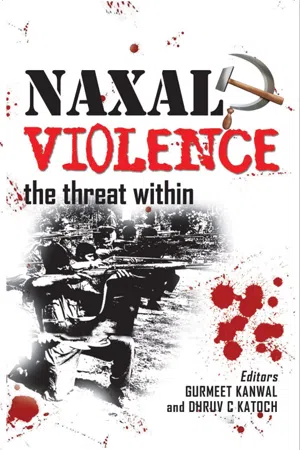
The causative factor for the existence of the Naxal movement in India is ideological. Today, 196 districts are affected by it. Of these districts, 35 have been seriously impacted where the writ of the state is either weak or almost nonexistent. The spread of Naxalism is an indication of the sense of desperation and alienation that has swept across large sections of India. Naxal violence in the red corridor and beyond has increased owing to the failure of the central and state governments to satiate the needs of the locals and meeting their basic expectations. Outreach efforts of Naxalites for arms, training, finance, ideology, drugs trade, and to forge a broad front against the 'common enemy' –India, are a matter of concern. They have established linkages with the Maoists of Nepal, militant groups operating in northeast India, anti-India actors both state and non-state based in Pakistan, and umbrella organisations at regional and global levels. The military might of the CPI (Maoist) has grown to a sizeable force of the People's Liberation Guerrilla Army (PLGA) and continues to challenge the Indian state. The series of violent incidents against the state agencies and abduction of government personnel highlights the degree of concern that the problem demands. This volume is a compilation of papers that aims to address the various perspectives of what the Prime Minister of India has oft declared to be the most serious internal security challenge facing the nation. An in-depth study of the characteristics of the Naxal movement, the book covers the genesis, causative factors, strategy, linkages of the movement and the options and challenges for the Indian state. Recommendations for conflict resolution are also charted out in the book. Now is the time to systematically deal with the threat before it transforms into a potent force.
eBook - ePub
Naxal Violence
The Threat Within
- English
- ePUB (mobile friendly)
- Available on iOS & Android
eBook - ePub
About this book
Trusted by 375,005 students
Access to over 1.5 million titles for a fair monthly price.
Study more efficiently using our study tools.
Information
Subtopic
Politics1
Naxal Violence: An Overview
Dhruv C Katoch
The causative factor for the existence of Left Wing Extremism (LWE) in India is ideological. At its core, this ideology seeks to overthrow the democratic structure of India through the use of armed force. The spread of Naxalism is an indication of the sense of desperation and alienation that has swept over large sections of India. The area under some form of Naxal influence is spread over 196 districts and has affected a total of 1,068 police stations. These districts are mostly located in the eastern half of the Indian landmass stretching from West Bengal to Andhra Pradesh. The extent of Maoist influence in these areas varies greatly and ranges from ‘low presence’ to ‘very seriously affected’ districts. When seen on a map, the geographical space occupied by these areas appears as a contiguous mass running from north to south and is popularly referred to as the “Red Corridor” (Map 1). The seriously affected areas are located in 35 districts across the Red Corridor. These contain the heart of the Maoists movement and would need to be neutralised if peace is to be restored to the area (Map 2). The states having the maximum incidents of Maoist violence are Bihar, Orissa, Jharkhand, and Chhattisgarh. Partially affected states are Andhra Pradesh, West Bengal, Maharashtra and Madhya Pradesh. When viewed on a map, the 35 most affected districts form four distinct faultlines. These can be further sub-divided into two distinct groups.
The first is the southern group, consisting of the southern Chhattisgarh faultline and the Orissa-Andhra faultline (see Maps 3 and 4). The southern Chhattisgarh faultline comprises the five districts of Bastar Division viz Kanker, Bastar, Narayanpur, Dantewada and Bijapur and the adjoining district of Balaghat in Madhya Pradesh and Gadchiroli in Maharashtra. The Orissa-Andhra faultline comprises 12 districts seriously affected by LWE violence. Seven of these districts are in Orissa and five are in Andhra Pradesh. The affected districts in Orissa are Rayagada, Nabarangapur, Koraput, Malkangiri, Gajapati, Nayagarh and Nuapada. The five districts in Andhra Pradesh are Khammam, Srikakulam, Vizianagaram, Vishakhapatnam and East Godavari.
The second is the northern group consisting of the Jharkhand faultline and the south Bihar faultline (see Maps 5 and 6). The Jharkhand faultline consists of nine districts in Jharkhand which are seriously affected by LWE. These are Garhwa, Gumla, Lohardaga, Purbi Singhbhum, Palamu, Latehar, Pashchimi Singhbhum, Giridih and Simdega. For reasons of contiguity, the West Midnapur district of West Bengal has been included in the Jharkhand faultline. The south Bihar faultline comprises the districts of Rohtas, Aurangabad, Gaya, Nawada, Jamui and Jehanabad in south Bihar. While there is Naxal influence in northern Bihar, this is limited, despite its proximity to Nepal. Militarily, the southern and northern groups can be addressed simultaneously or sequentially. However, military operations within each group would require the two faultlines in each group to be addressed simultaneously.
Genesis
The birth of the Communist movement in India from which the Naxal movement emerged, traces its origins to the formation of the Communist Party of India (CPI) in 1925 in Tashkent. In 1935, Mr. PC Joshi became the first General Secretary of the Party. The Party’s role in the freedom movement was insignificant. Post independence, its influence was confined to parts of Andhra Pradesh and West Bengal and a few other areas in the country. In 1964, the Party split on ideological grounds and the Communist Party of India (Marxist) or CPI (M) was formed. The CPI (M) decided to participate in elections, postponing armed struggle over revolutionary policies.
Map 1: The Red Corridor - Naxalite Affected Districts in India (2007)

Map 2: LWE Affected Areas: 35 Districts of Concern

Map 3: Southern Chhattisgarh Faultline

Map 4: Orissa-Andhra Faultline

Map 5: Jharkhan Faultline

Map 6: South Bihar Faultline

In the 1967 elections to the West Bengal Assembly, two broad-based fronts were formed against the ruling Congress Party. These were the United Left Front (ULF) and the Progressive United Left Front (PULF). The CPI (M) was the major constituent of the former and the Bangla Congress of the latter. The Congress was defeated and both these fronts joined hands to form the United Front government in the state. Ajoy Mukherjee of the Bangla Congress became the Chief Minister and Jyoti Basu of the CPI (M), the Deputy Chief Minister of the state. Though the United Front government was in power, there were schisms within the CPI (M), with Charu Majumdar, one of its younger cadres, adopting a hard line and accusing the Party of betraying the revolution. On 2 March 1967, a peasant youth armed with a judicial order was not permitted by the local landlords to plough the land allotted to him. This incident was the spark which ignited a wider agitation in which the peasants took to forcible occupation of land from the land owners. The police intervened to restore order but in a standoff with the agitators in May 1967, a policeman was killed. On 25 May, a larger police contingent arrived and in the firing that ensued, nine adults and two children were killed in Bengai Jote village in the Naxalbari block in Siliguri. Thereafter, the movement lost its agrarian character and became a militant movement. As per one of the local leaders of that time: “There is no peaceful way to establishing rights for the poor. The gun is where the answer lies.”
The United Front government cracked down on the uprising and succeeded in crushing the movement in 72 days. But the nascent Naxalite movement which was spawned was destined to grow. From the remote villages of Naxalbari in 1967, the movement spread in menacing proportions over the years and by 2011, had affected 196 districts of India, forcing the Prime Minister to declare it as “the biggest internal security challenge facing the nation.” The peasant uprising in Naxalbari, organised by the Charu Majumdar-led wing of the Party, precipitated the first showdown between the two strategic perspectives and tactical lines within the CPI (M). Magazines that would later become organs of the CPI (ML) such as Deshabrati, (a Bengali weekly), Liberation, (an English monthly) and Lokyudh (a Hindi weekly) were first published during this period.
After the Naxal uprising of 1967 was put down, many of the Communist groups from Tamil Nadu, Kerala, Uttar Pradesh, Karnataka, Orissa and West Bengal met in November 1967 and formed an organisation they called the All India Coordination Committee of Revolutionaries in the CPI (M) or AICCR. In May 1968, this committee was renamed the “All India Coordination Committee of Communist Revolutionaries” (AICCCR). It decided to boycott all elections. Two important Communist groups remained outside the AICCCR. The Maoist Communist Centre (MCC) chose not to participate because of differences over the Party-building line. And a group from Andhra Pradesh under the leadership of Tarimala Nagi Reddy was excluded because it disagreed that sufficient preparations had been made to launch an immediate people’s war.
In 1969, the AICCCR unanimously decided to form a new Communist Party under Charu Mazumdar called the Communist Party of India (Marxist-Leninist) or CPI (ML). The sub-groups which formed the CPI (ML) had already begun setting up guerrilla zones in Debra-Gopiballavpur in West Bengal, Musahari in Bihar, Lakhimpur Kheri in Uttar Pradesh and Srikakulam in Andhra Pradesh. The government subsequently cracked down on the Party and it went underground. In 1971, the Army was employed to crush the movement in West Bengal and several guerrilla zones suffered reversals. Amidst severe setbacks, the Party split into smaller groupings. In July 1974, the Central Organising Committee of the CPI (ML) was reconstituted and Subrata Dutt was elected as its General Secretary. It was thereafter renamed as CPI (ML) Liberation.
In April 1980, the CPI (ML) People’s War Group (PWG) was founded in Andhra Pradesh under the leadership of Kondapalli Seetharamaiah. He discarded total annihilation of “class enemies” as the only form of struggle and stressed on floating mass organisations. On 01 January 1982, two CPI (ML) groups, the CPI (ML) Unity Organisation and Central Organising Committee CPI (ML) merged to form a new party called Party Unity (PU). In the following years, three other CPI (ML) groups joined the PU. The PU and PWG merged in August to form the CPI (ML) People’s War (PW). These groups were semi-anarchist in the sense that they still had one foot back in the CPI (ML) tradition of anti-feudal struggle even as they were moving in the direction of progressi...
Table of contents
- Cover
- Half Title
- Title
- Copyright
- Contents
- Contributors
- Foreword
- 1. Naxal Violence: An Overview
- 2. The Heart of our Darkness
- 3. A War-Fighting Strategy for the Maoist Conundrum
- 4. Growth of the CPI (Maoist)
- 5. No Longer “Indigenous”: External Linkages of Indian Maoists
- 6. People’s Liberation Guerrilla Army of CPI (Maoist)
- 7. India’s Response to Maoist Growth: Tactics and Strategies
- 8. Dealing with a Major Threat
- 9. Envisaged Roles for the Army
- 10. The Long Road to Peace
Frequently asked questions
Yes, you can cancel anytime from the Subscription tab in your account settings on the Perlego website. Your subscription will stay active until the end of your current billing period. Learn how to cancel your subscription
No, books cannot be downloaded as external files, such as PDFs, for use outside of Perlego. However, you can download books within the Perlego app for offline reading on mobile or tablet. Learn how to download books offline
Perlego offers two plans: Essential and Complete
- Essential is ideal for learners and professionals who enjoy exploring a wide range of subjects. Access the Essential Library with 800,000+ trusted titles and best-sellers across business, personal growth, and the humanities. Includes unlimited reading time and Standard Read Aloud voice.
- Complete: Perfect for advanced learners and researchers needing full, unrestricted access. Unlock 1.5M+ books across hundreds of subjects, including academic and specialized titles. The Complete Plan also includes advanced features like Premium Read Aloud and Research Assistant.
We are an online textbook subscription service, where you can get access to an entire online library for less than the price of a single book per month. With over 1.5 million books across 990+ topics, we’ve got you covered! Learn about our mission
Look out for the read-aloud symbol on your next book to see if you can listen to it. The read-aloud tool reads text aloud for you, highlighting the text as it is being read. You can pause it, speed it up and slow it down. Learn more about Read Aloud
Yes! You can use the Perlego app on both iOS and Android devices to read anytime, anywhere — even offline. Perfect for commutes or when you’re on the go.
Please note we cannot support devices running on iOS 13 and Android 7 or earlier. Learn more about using the app
Please note we cannot support devices running on iOS 13 and Android 7 or earlier. Learn more about using the app
Yes, you can access Naxal Violence by Gurmeet Kanwal Dhruv C Katoch, Gurmeet Kanwal & Dhruv C Katoch in PDF and/or ePUB format, as well as other popular books in Politics & International Relations & Politics. We have over 1.5 million books available in our catalogue for you to explore.