![]()
Chapter 1
The Demon of Procrastination
Faire et se taire*
Gustave Flaubert
* Just shut up and do it
I have a confession to make: I’ve been putting off writing this chapter for a long time. Putting off a chapter about procrastination… I guess you could call it method writing.
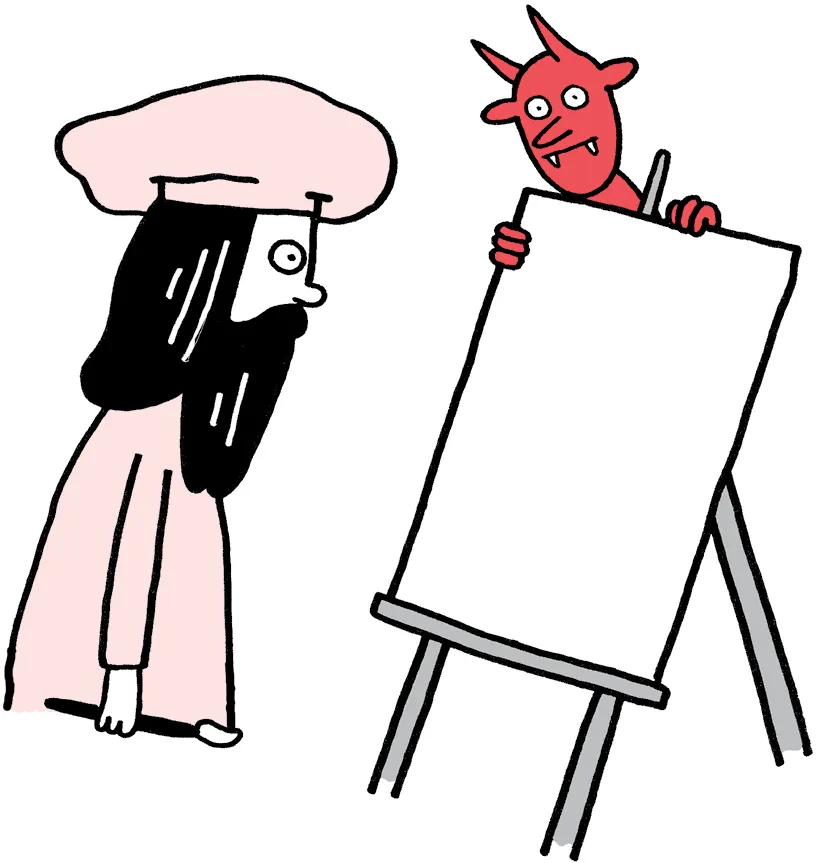
Even now, as each word reluctantly appears on my screen, I notice how dusty the corner of my desk is. The Demon of Procrastination purrs in my ear, ‘Hey you, maybe this whole writing thing would work out better with a clean desk? And those pencils look a bit blunt too. Why not get them nice and sharp and crack on tomorrow? Oh, and when was the last time you checked Instagram?’
It’s easy to think of the Demon of Procrastination as a rather innocuous creature. All he’s asking you to do is delay putting pen to paper or brush to canvas until tomorrow. He’s not saying never, is he? But how many poems, plays, paintings, even entire artistic careers, have been lost to his beguiling ways? The seconds become minutes, the minutes become hours, and – before you know it – the hours have become years.
The Demon of Procrastination draws his maleficent power from the dark pool of your personal and private fears.
There is the fear, shared by anyone who ever tried to create anything exceptional, that you’re just not up to the task in hand. The feeling that you’re an impostor, a pretender, a deeply deluded soul who will be unveiled the moment you attempt to transform your dream of being a writer or painter or performer into a reality.
There’s the fear about the work you hope to produce. What if it’s no good? What if it’s worse than no good and makes you look ridiculous for imagining you had any creative talent in the first place?
Then there’s the fear that the journey itself, from writing the first line to placing a full stop on the final scene, will be too arduous. You look around you at the creative works you admire – the novels, the plays, the movies, with all their exquisite detail and intricate refinement – and think it’s going to be too damn hard.
So you put the whole thing off until tomorrow.
And the dream remains a dream.
To defeat the Demon of Procrastination, we must confront the fears on which he feeds, one by one. So what of the first, the fear that you’re nothing more than a pretender?
Well, you may find it reassuring to know you are not alone. To delve into the biographies of any of our most esteemed creators is to discover that almost all of them have, at different points in their lives, been on intimate terms with self-doubt. If you are an artist, you are someone who is particularly attuned to what it means to be human. And one of the truths of what it means to be human is that somewhere along the way, on our journey through life, we’re bound to lose faith in ourselves.
One of the masterpieces of 20th-century fiction is The Grapes of Wrath by John Steinbeck, first published in 1939. It’s a tale of loss, heartbreak and endurance set against the backdrop of the Great Depression in America. The novel won the Pulitzer Prize and was instrumental in its author being awarded the Nobel Prize for literature. It has become a classic. Yet, as he was writing it, Steinbeck confessed his doubts privately in his journal: ‘I’m not a writer. I’ve been fooling myself and other people. I wish I were… no one else knows my lack of ability the way I do.’ This was not a temporary lapse of confidence. Almost every hard-won page of his magnum opus was a soul-sapping struggle against the feeling of his own inadequacy.
Few would question the accomplishment of the painting on the vault of the Sistine Chapel in Rome, perhaps one of the greatest artistic achievements of all time. But its creator Michelangelo did. Midway through, the artist wrote a poem to his friend Giovanni da Pistoia describing his struggle: ‘My painting is dead… I am not in the right place. I am not a painter.’
There are really only two kinds of successful creators – those who admit to insecurity and those who deny it – but everyone experiences it. It’s a prerequisite of being good. To be free of self-doubt is to lack the critical acuity you’ll need when it comes to evaluating and refining your work. The trick is to avoid letting your insecurity stop you from producing the work in the first place.
Remember that no matter how ill at ease you may feel with your own flaws and limitations, you are in a very privileged position. No other writer or artist sees the world as you do, because no other writer or artist is you. As Dr Seuss once sagely wrote, ‘Today you are you! That is truer than true! There is no one alive who is youer than you!’
You’re only a pretender for as long as you’re pretending to work. Pick up your brush and paint, and you become an artist. Pick up your pen and write, and you become a writer. And don’t let anyone tell you otherwise.
What of the second of our fears, that it’s fruitless to attempt to outwit the Demon of Procrastination because, even if we do produce any work, it’s bound to be a disappointment?
When a creative idea is just an idea, it’s untainted by the prosaic demands of execution. It’s soaring, beautiful, perfect. Naturally, you’re afraid that if you try to bring that idea into being, you’ll be faced with all kinds of practical challenges that must inevitably diminish it.
And you’re absolutely right.
There’s no way to sugar-coat this particular pill.
Your first draft or first sketch will, probably, suck. Maybe it will feel derivative, too close in style to the work of your heroes. Perhaps it will seem clumsy and blunt, with an apparently unbreachable distance between the insight that inspired you and the insipid rendering now before you. Almost certainly it could be simpler.
But at least you have something. Something to work with. Some lines, some words, a series of notes that had never been put together before you put them together today. Of course, if you compare this first draft to the classics in your genre, it will come up pitifully short. But remember: those masterpieces you’re judging your own imperfect efforts against may well have begun life in an equally meagre state. Their creators have crafted, refined, tweaked and redrafted them, and you will be able to do the same to your own work too, once it exists as an object in its own right.
If you set out with the intention of creating a masterpiece, you may as well hang a welcome banner over your door inviting the Demon of Procrastination to come on in. The empty vanity of making work purely for acclaim or approval is unlikely ever to carry you beyond that first hurdle of discovering your own failings as an artist.
Yet if you accept that you’re going to begin by making something that’s not great, that may even be pretty terrible, then it will be a whole lot easier to get started.
I used to work as a creative director in the world of design and advertising. On those occasions when my team and I needed to come up with a good idea quickly, when the clock was ticking loudly in the corner, I’d ask them for the worst possible idea they could think of in response to the brief. The mood would switch immediately. With the quality-control filter switched off, ideas would flow. We’d relax, laugh, have fun. And pretty soon we’d stumble, almost by accident, into a really fruitful concept. If you want to begin, set the bar low.
What of the third fear to fuel the Demon of Procrastination, the expectation that the creative journey will be too overwhelming?
Well, you know that old expression of not being able to see the wood for the trees? When it comes to getting started on a creative project, it’s okay not to be able to see the wood. In fact, it’s better not to think about the wood at all. It’s too big, too dark, too unknowable. Instead, pick a single tree. Get close to the tree, examine it, explore it and start there.
The only way Steinbeck got through the pain of producing The Grapes of Wrath was to set himself the task of writing it line by line, page by page, day by day. To consider the whole was too daunting. He showed up at his desk and got a few words down daily, whether he felt they were any good or not.
There’s a great line by the American novelist E.L. Doctorow about the process of writing being ‘like driving a car at night. You never see further than your headlights but you can make the whole trip that way.’ Don’t worry if you’re unsure of your destination – when it comes to the creative process, this can be an advantage. As the artist Bridget Riley observed, ‘People feel that it is very important for artists to have an aim. Actually, what is vital is to have a beginning. You find your aim in the process of working. You discover it.’
As an artist or writer, the responsibility for building momentum in your work lies with you. You’ll probably feel an inertia born of fear, doubt, laziness, whatever – this you have to overcome. Initiating the process is often the part that requires the most effort, like spinning a large wheel. But once you’ve generated some momentum, you may find that the work itself carries you somewhere you could never have expected, perhaps somewhere even better than you imagined.
If you’re really lucky, there may come a time when your characters write themselves, when the melody flows through your fingers without you knowing where it’s coming from, or the painting appears on the canvas in front of you, almost as if you’re not there. When this happens, it’s a kind of creative nirvana. The world falls away and you’re lost for a moment in something bigger than yourself. As a creator, this feeling is as good as it gets (and it’s one we’ll return to in later chapters); it will more than make up for those countless hours of bruising self-doubt. But give in to the Demon of Procrastination, allow it to feed on your fears, and this rare and glorious ecstasy will never be yours.
So what’s it going to be?
Are you going to continue to let this particular demon squat on your shoulder, whispering his hollow distractions in your ear?
Or is now the time to knock him off and take the first step on your creative journey by simply putting one foot, or one word, or one brushstroke, in front of the other?
![]()
Chapter 2
The Demon of the Blank Page
If I knew where the good songs came from, I’d go there more often.
Leonard Cohen
To be an artist is to confront some of life’s most fundamental questions…
Who am I?
Why are we here?
And where the hell did all my good ideas go?
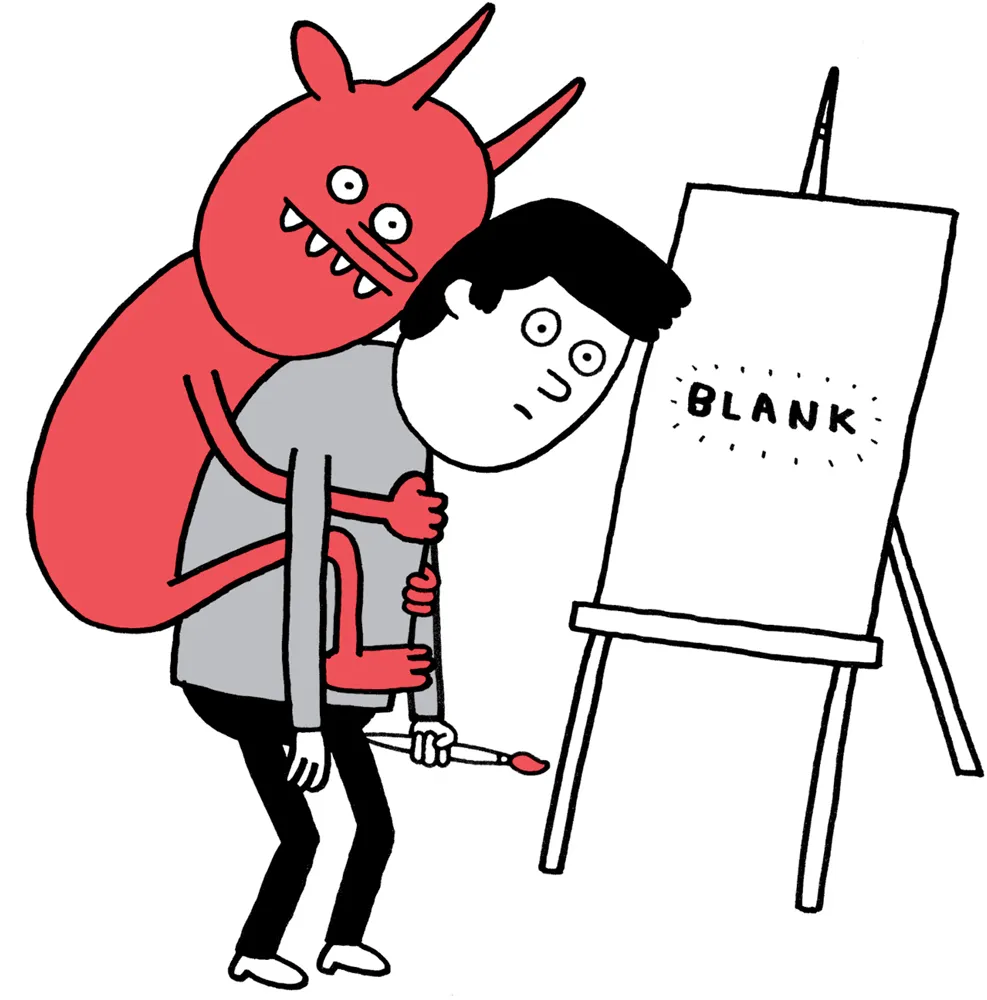
The Demon of the Blank Page is a capricious creature who strikes mercilessly, with no regard for the dedication, ambition or past achievements of his victims. Where you will encounter him you cannot predict, but if you choose to engage in a creative pursuit, sooner or later your paths must cross.
When Dylan Thomas was at the height of his fame, in the late 1940s and early 1950s, packing out theatres and concert halls across the USA and enjoying the kind of international su...