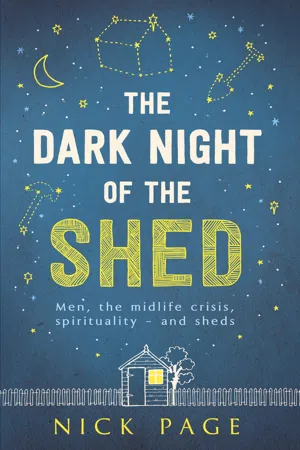
Men, the midlife crisis, spirituality - and shedsA new bike - running the marathon - splashing out on a sports car - having an affair - taking up triathlon - upping sticks and moving to the country - getting divorced - even going into the church...There's a point in a man's life where he looks around him and asks whether this is really where he wants to be - what he wanted to do with his life. And even if he's achieved all his childhood dreams, maybe that's not enough any more.Nick Page has been there, and he decided to build a shed. Not to answer the question, but so that he'd at least be able to get some peace to think about it properly. Join him on a journey of discovery, into what the midlife crisis really is, and whether there's a better way to go at it than frittering away time and money trying to pretend you're really younger than you are.
- 192 pages
- English
- ePUB (mobile friendly)
- Available on iOS & Android
eBook - ePub
About this book
Trusted by 375,005 students
Access to over 1.5 million titles for a fair monthly price.
Study more efficiently using our study tools.
Information
Topic
MedicineSubtopic
ChristianityPART ONE
THE INVITATION
Midway upon the journey of our life
I found myself within a forest dark,
For the straightforward pathway had been lost.
Dante, Inferno
1
OF MEN, MIDDLE AGE AND SHEDS
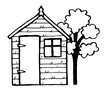
The brotherhood of the shed
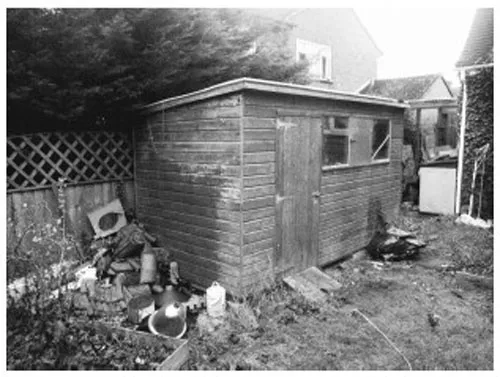
The family might have scoffed, but as the days went by and I started to plan and research, I realised just how stunningly insightful my vision had been.
First, there was the reaction of my male friends. When I told them of my plans to build the shed of my dreams, they didn’t scoff. They nodded thoughtfully. Some grew tearful and could only give me a manly shake of the hand. They understood. I discovered Oxford Wood Recycling – an Aladdin’s cave of pre-used timber, where I stocked up on hardboard for the floor. At one point I was joined at the pile of old boards by another man, tape measure in hand, and we divided the best bits between us.
‘You building something?’ he asked.
‘A shed. Well, rebuilding it.’
‘Me too.’
We nodded at each other. There was nothing more to say. We were shed brothers. In former lives we might have joined forces, roaming the ancient ridgeway and hunting a mammoth or two. Today we were hunting for the perfect bit of wood.
A brief history of sheds
Sheds have a long and magnificent history, it turns out. The Wife, showing either a surprisingly supportive nature or, more probably, taking the mickey, bought me a magnificent book called The Joy of Sheds. Author Frank Hopkinson has gathered together everything you could want to know about sheds, not to mention quite a lot that isn’t worth knowing.
According to English Heritage, there are fifty-two Grade 2 listed sheds in England and Wales.2 Even the name is appropriate. The word ‘shed’ comes from the Anglo-Saxon word sceadu, meaning ‘shade’, or ‘comparative darkness’ as the Oxford English Dictionary puts it. It comes from the same root as the word for ‘shadow’ (a word which we will be seeing more of later). It’s the type of shade you find in a forest.* And what better place to think about the shadows of middle age than in the sceadu of a shed?
Sheds have had a massive impact on male culture. The Black & Decker Workmate® was invented in a shed. As were Ferodo tyres, Harley-Davidson motorcycles and Mercedes-Benz. Not to mention the Pot Noodle, which was cooked up, literally, in a shed by a Taiwanese inventor called Momofuku Ando. He was 61 at the time and lived to 96 – mainly on a diet of chicken noodles.
For the writer, particularly, sheds are furnaces of creativity. There are the famous ones: Roald Dahl’s writing hut and George Bernard Shaw’s revolving summerhouse, the small octagonal hut just twelve feet across that Mark Twain worked in. Philip Pullman wrote Northern Lights in a shed. Daphne du Maurier wrote My Cousin Rachel in a shed in the garden of her beloved Menabilly House in Cornwall. Best of all, for a man of my generation, Oliver Postgate and Peter Firmin created Noggin the Nog, Bagpuss, The Clangers and Ivor the Engine in a shed owned by Firmin. That one, surely, ought to be put on the English Heritage list. Virginia Woolf used a converted toolshed in her garden at Rodmell, Sussex. She called it a Writing Lodge. It looked over the Ouse Valley. Sadly, it was there that she wrote her last words in spring 1941, before walking into the river, her coat pockets loaded with stones. So, perhaps not the most encouraging example.
I couldn’t help noticing links between sheds and the kind of stuff I wanted to explore in the book. When Churchill was affected by what he called ‘the black dog’ of depression, he would retreat to his shed to paint. The troubled songwriter Nick Drake wrote a song called ‘Man in a Shed’. It’s one of his cheerier numbers – which is not saying a great deal – and as far as I can make out, it seems to be about the danger of an inadequate shed roof. More positively, Dylan Thomas wrote in a small ‘wordsplashed hut’ overlooking the Taff Estuary. It was there that he composed that theme tune to recalcitrant old age: ‘Do not go gentle into that good night.’
The King of Shed Writers, though, is Arthur Miller, who, after the success of All My Sons on Broadway, moved to a new house – and decided to build a shed to go with it. ‘It was a purely instinctive act,’ he later said. ‘I had never built a building in my life.’ As he built, he began to think about an idea for a play about a man whose dreams had never turned out to match the reality, and whose life was being torn apart. When he finally sat down at his desk (which he made from an old door), the play poured out of him. It was Death of a Salesman – of which more later.
Thoreau, one of my heroes, lived and wrote in a 10 foot by 15 foot hut of his own construction on the bank of Walden Pond in Connecticut. It was there, in 1845, that he wrote Walden, his classic of simple living. ‘I went to the woods,’ he wrote, ‘because I wished to live deliberately, to front only the essential facts of life, and see if I could not learn what it had to teach, and not, when I came to die, discover that I had not lived.’3 Surely this is the desire which drives the questions of mid-life. We want to know what life is for. We want to be sure that we have truly lived.
A brief history of middle age
Throughout the majority of human history the most pressing issue about middle age for most people was simply the challenge of living that long. Even as recently as 1900, the average life expectancy in Britain was about 47 for a man and 50 for a woman, although this figure is skewed because of the high rates of infant mortality. It was only later in the twentieth century that things changed. By the 1950s life expectancy had risen to about 65; by 1971 life expectancy for a man in Britain was 68 and for a woman, 72.4 Today life expectancy at birth is 77 for a man in the UK and 81 for a woman and, according to some bloke on the radio I was just listening to, one in three of our children will live to be 100.
Middle age, though, is not a precise chronological event. It’s more a state of mind. In fact the earliest mention of middle age comes from – well, the Middle Ages, actually. And it occurs in a poem which is all about the search for a meaningful life.
According to the Oxford English Dictionary, the first use of the term comes in 1400 in a poem called Piers Plowman by William Langland. The poem is all about the quest to find the true Christian life. It starts with the narrator falling asleep on the Malvern Hills (understandable: this is cider country). In the second half of the book, the narrator goes on a dream-quest to find the three figures who can tell him how to live. They are called Do-well, Do-better and Do-best. At one point the poet/dreamer is met by a figure representing imagination who, rather unimaginatively, is called ‘Imagination’. He advises the narrator to ‘make amends in middle age before your strength fails; for old age can ill endure the hardships of poverty and the life of penance and prayer’.5
This is the first use of the phrase ‘middle age’. And, appropriately, it occurs in a story full of middle-aged stuff, a story which begins with the idea that life could be better, and is driven by the desire to find the real meaning of life. And most of all, it’s a story that begins with a long nap.
The Jung Ones
For the first serious analysis of the problems of middle age, we have to wait until the early twentieth century and the works of the psychologist Carl Jung.
Jung’s work emerged from a mid-life crisis of his own. In July 1913, Jung turned 38. He was married, he had a family, he had professional status. His work in the relatively new field of psychotherapy had brought him to the attention of Sigmund Freud, who anointed Jung his spiritual heir. But all was not right in Jung’s world. He had personal problems at home. And he had come to realise that he differed from Freud in some very significant ways. He could not pretend otherwise, even to his mentor. Freud could not countenance his disciple going in a different direction and there was an acrimonious split between the two. It plunged Jung into a kind of breakdown, which lasted four or five years. Jung described it as a ‘confrontation with his unconscious’ and later compared this period to the nekyia – Odysseus’s visit to the land of the dead in Homer’s Odyssey.
He became socially isolated and introspective. He had powerful dreams – sometimes disturbing, sometimes empowering. Yet it was a period which liberated him and led to his most influential ideas. ‘It was then that I ceased to belong to myself alone, ceased to have a right to do so,’ he wrote later. ‘From then on my life belonged to the generality . . . I loved it and hated it, but it was my greatest wealth.’6 He emerged more whole, more complete. In 1921 he published Psychological Types. And the following year he built a shed.
Well, I say a shed. A tower. A retreat. A small castle, in fact. In 1922 he bought some land by Lake Zürich at Bollingen, and on an outcrop built a simple round tower. He added to it over the course of his life. He had seen this tower in a dream when he was young and never forgot it. It was his place of refuge. And right in the middle of what became a suite of rooms, he had a room which was his alone, which only he was allowed to enter. ‘At Bollingen I am in the midst of my true life, I am most deeply myself,’ he wrote.7
In his influential essay The Stages of Life, Jung claimed that mid-life was a portal, a crucial stage in self-development. Jung believed there was a first and second half of life. Our ‘youth’ is the first half. According to Jung, this lasts until ‘between the thirty-fifth and fortieth year’. In this part we are concerned with achievement, with building a career, a home, a useful place in society, with attaining our ‘social goal’. We gather around us all the things which society says are important. In order to do this, we develop what Jung termed a persona – the face which we present to society. But...
Table of contents
- Cover
- Title Page
- Imprint Page
- Contents
- INTRODUCTION
- PART ONE
- PART TWO
- CONCLUSION
- TOOLBOX
- NOTES
- THANKS
- Visit
Frequently asked questions
Yes, you can cancel anytime from the Subscription tab in your account settings on the Perlego website. Your subscription will stay active until the end of your current billing period. Learn how to cancel your subscription
No, books cannot be downloaded as external files, such as PDFs, for use outside of Perlego. However, you can download books within the Perlego app for offline reading on mobile or tablet. Learn how to download books offline
Perlego offers two plans: Essential and Complete
- Essential is ideal for learners and professionals who enjoy exploring a wide range of subjects. Access the Essential Library with 800,000+ trusted titles and best-sellers across business, personal growth, and the humanities. Includes unlimited reading time and Standard Read Aloud voice.
- Complete: Perfect for advanced learners and researchers needing full, unrestricted access. Unlock 1.5M+ books across hundreds of subjects, including academic and specialized titles. The Complete Plan also includes advanced features like Premium Read Aloud and Research Assistant.
We are an online textbook subscription service, where you can get access to an entire online library for less than the price of a single book per month. With over 1.5 million books across 990+ topics, we’ve got you covered! Learn about our mission
Look out for the read-aloud symbol on your next book to see if you can listen to it. The read-aloud tool reads text aloud for you, highlighting the text as it is being read. You can pause it, speed it up and slow it down. Learn more about Read Aloud
Yes! You can use the Perlego app on both iOS and Android devices to read anytime, anywhere — even offline. Perfect for commutes or when you’re on the go.
Please note we cannot support devices running on iOS 13 and Android 7 or earlier. Learn more about using the app
Please note we cannot support devices running on iOS 13 and Android 7 or earlier. Learn more about using the app
Yes, you can access The Dark Night of the Shed by Nick Page in PDF and/or ePUB format, as well as other popular books in Medicine & Christianity. We have over 1.5 million books available in our catalogue for you to explore.