'Seldom will you encounter such a fine combination of historical scholarship, interesting reading, and clever humour in one Biblical study. And then filled with faith and hope besides! Peter Enns does it again!' Richard Rohr, author of Falling Upward For many Christians, the Bible is a how-to manual filled with literal truths about belief that must be strictly followed. But the Bible is not an instruction manual or rule book but a powerful learning tool that nurtures our spiritual growth, argues Bible scholar Peter Enns. It does not hold easy answers to the perplexing questions and issues that confront us in our daily lives. Rather, the Bible is a dynamic instrument for study that not only offers an abundance of insights but provokes us to find our own answers to spiritual questions, cultivating God's wisdom within us.'The Bible becomes a confusing mess when we expect it to function as a rulebook for faith. But when we allow the Bible to determine our expectations, we see that Wisdom, not answers, is the Bible's true subject matter', writes Enns. This distinction, he points out, is important because when we come to the Bible expecting it to be a textbook intended by God to give us unwavering certainty about our faith, we are actually creating problems for ourselves. The Bible, in other words, really isn't the problem; having the wrong expectation is what interferes with our reading.Rather than considering the Bible as an ancient book weighed down with problems, flaws, and contradictions that must be defended by modern readers, Enns offers a vision of the holy scriptures as an inspired and empowering resource to help us better understand how to live as a person of faith today.
How the Bible Actually Works makes clear that there is no one right way to read the Bible. Moving us beyond the damaging idea that 'being right' is the most important measure of faith, Enns's freeing approach to Bible study helps us to instead focus on pursuing enlightenment and building our relationship with God - which is exactly what the Bible was designed to do.
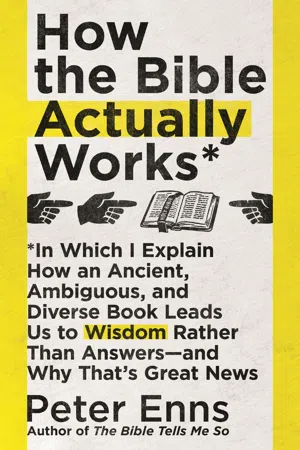
eBook - ePub
How the Bible Actually Works
In which I Explain how an Ancient, Ambiguous, and Diverse Book Leads us to Wisdom rather than Answers - and why that's Great News
- 304 pages
- English
- ePUB (mobile friendly)
- Available on iOS & Android
eBook - ePub
How the Bible Actually Works
In which I Explain how an Ancient, Ambiguous, and Diverse Book Leads us to Wisdom rather than Answers - and why that's Great News
About this book
Trusted by 375,005 students
Access to over 1.5 million titles for a fair monthly price.
Study more efficiently using our study tools.
Information
Topic
Theology & ReligionSubtopic
Christianity
Oh Good. Another Book on the Bible.
To clear the air, let me just put this out there. I am a left-brained academic of German heritage with control issues and marginal social skills. I’m leaving out a few steps, including hours of therapy and self-help seminars, but since I fear you might be losing interest already, let me get to my point.
I’ve been studying, teaching, and writing about the Bible since the Reagan administration, and—funny thing—I’ve noticed the same questions keep coming up, not only for me but for plenty others, like:
What is the Bible, exactly?
Who cares?
What do I do with it?
and especially:
How does this ancient, distant, and odd book work for people who look to it today for spiritual guidance?
These questions keep coming up because they are not easy to answer. They mean a lot to me, though. They drive what I do.
My last two books lay out common beliefs many Christians have about the Bible that are actually wrong, are not at all biblical, and cause all sorts of spiritual problems. In The Bible Tells Me So, I look specifically at the mistaken belief that the Bible is something like a divine instructional manual, a rulebook, so to speak—just follow the instructions as printed and you’re good to go. In the follow-up book, The Sin of Certainty, I look at a related mistaken notion, namely, the idea that having strong faith is the same thing as feeling certain that the beliefs we hold are correct, and thus periods of doubt or spiritual struggle reveal a weak faith.
When we come to the Bible expecting it to be an instructional manual intended by God to give us unwavering, cement-hard certainty about our faith, we are actually creating problems for ourselves, because—as I’ve come to see—the Bible wasn’t designed to meet that expectation. In other words, the “problems” we encounter when reading the Bible are really problems we create for ourselves when we harbor the misguided expectation that the Bible is designed primarily to provide clear answers.
Starting with these mistaken notions causes the whole Christian enterprise to go off course. It causes anxiety and stress about following the Bible’s fine print as if it were the “Terms and Conditions” for your latest Apple download, whereas Jesus promises rest to weary pilgrims. And all that stress about needing the Bible to provide certainty about God, life, and the universe is rich soil for cultivating a defensive attitude about our beliefs and therefore an angry and combative posture toward those who see things differently—just another thing to argue about on Facebook, like politics, sports, or who should have won the Oscar.
And maybe that’s why a faith that celebrates someone known for his radical agenda of loving one’s enemies and turning the other cheek has a public image, according to a number of opinion polls, for being judgmental, condescending, and nasty.
So that’s what the other two books are about, and I can’t recommend them highly enough. In this book, however, I want to focus not on mistaken beliefs about the Bible and the problems those beliefs cause. Instead, I want to look more closely at the how the Bible actually works. I want to explore how I think God intended the Bible to be used and so to find deeper spiritual benefit in its pages.
Of course, I don’t for one minute claim to know what God actually “intends” about anything. I’m not a televangelist or cult leader, claiming special access to the Creator that the rest need to pay for. All I’m going on is what I see the Bible doing, how it behaves when I pay attention to the words in front of me. And when I do that, I see some pretty conspicuous characteristics—three, to be exact—that are not tucked away in a few corners of the Bible, but that are baked into its pages, though they don’t always get the airtime they deserve, since they wreak havoc with the aforementioned view that the Bible is a source book for certainty in matters of faith.
Three Surprising Things That Make the Bible Worth Reading
This might be a good time to tell you what these three conspicuous yet often suppressed characteristics of the Bible are: the Bible is ancient, ambiguous, and diverse.
That might sound a bit obscure. I don’t blame anyone for expecting me to have used words like holy, perfect, and clear—terms more worthy of the Bible. And those words are fine, I suppose, but not if they paper over how the Bible actually works.
The spiritual disconnection many feel today stems precisely from expecting (or being told to expect) the Bible to be holy, perfect, and clear, when in fact after reading it they find it to be morally suspect, out of touch, confusing, and just plain weird. And they are further told that anything they come across while reading the Bible that threatens this lofty view is either actually no big deal or unfortunate evidence of their own poor reading skills, and neither should get in the way of said lofty view. (Denying the obvious is a great way to create a stressful life for yourself.)
But these three characteristics—ancient, ambiguous, and diverse—are not rough patches along the way that we need to “deal with,” so we can get on with the important matter of reading the Bible properly. They are, rather, what make the Bible worth reading at all.
They are not hiding but on full display. They are not obstacles to faith, but characteristics that, if we allow them to chart our course, will let us come to know the Bible in new and spiritually refreshing ways. By embracing these characteristics, we will find a Bible that:
Challenges and cheers us on as we walk our own difficult path of faith;
Doesn’t close windows and lock doors to keep us in, but invites us to risk, to venture forth beyond what is familiar to us, and to seek God directly;
Gently urges us to see through and past the words on the page to what God is up to right here and now;
Encourages and helps us to step out and find God for ourselves.
So what of these three conspicuous yet often suppressed characteristics of the Bible? To say the Bible is ancient might seem mundane and unnecessary to point out, but I find the opposite is true. The Bible, because it is a constant companion of faith, is often thought of as “God’s personal love letter to me” or the like. But that familiarity risks obscuring how old the Bible really is.
We are as distant from the time of King David (three thousand years ago, about 1000 BCE) as we are from the far distant future time of 5000 CE. Go back another thousand years earlier if you want to start at the time of Israel’s most ancient ancestors, Abraham and Sarah. On one level, when we read the Bible, we need to bridge that distance, which is fine, but we still need to respect that distance. Otherwise the Bible can become too familiar, too much like us—too comfortable.
We can open the Bible almost at random and begin reading, and it won’t take long before we see how deeply embedded the Bible is in this distant and utterly foreign world. In fact, any decent study Bible (a Bible that comes with explanatory footnotes) will point that out by the time we get through the first two sentences of the Bible (Gen. 1:1–2). The ancient writer describes the “beginning” not as a “nothing” or a “singularity,” as cosmologists call the pre–big bang state, but as a dark primordial chaos, called the deep, which is something like a threatening vast cosmic ocean that God has to tame.
And that sounds weird—which is my point.
If we’re paying attention, turning a blind eye to the Bible’s ancientness cannot be sustained for long; the distance between now and then needs to be respected as a key character trait of the Bible we have. The writers of the Bible lived long ago and far away, intent on asking their questions and seeking their answers, oblivious to our own questions and concerns. Now this may seem as if the Bible is locked forever in its ancient moment, but that is most definitely not true.
As we will see, the Bible’s antiquity shows us the need to ponder God anew in our here and now. Indeed, it gives us permission to do so.
And that’s nothing new. As we will see later in the book, Jews and Christians throughout history have always known that this ancient Bible cannot simply be “followed” like a recipe. It takes creative imagination to bridge the ancient and modern horizons. And, as we will see in due course, that process is already happening—I can’t stress this enough—within the pages of the Bible itself. So instead of trying to pretend this time gap between our day and biblical times doesn’t exist, we should embrace this characteristic and let it chart our path.
By ambiguous I mean that the Bible, perhaps surprisingly, doesn’t actually lay out for anyone what to do or think—or it does so far less often than we have been led to believe. When it comes to the details of what it means to live a life of faith, the Bible doesn’t hand out answers just because we are pounding at the door.
Rather, when reading the Bible for spiritual guidance, we find we are usually left to work things out for ourselves at the end of the day. This isn’t a drawback or a problem. This is by design. And the thing is, the need to work things out has always been the case, ever since there has been a Bible. So instead of being fed up and frustrated with a Bible that refuses to tell us clearly what to do, maybe we should step back and ask why this is so and what benefit we might derive from it.
And the Bible is diverse—meaning it does not speak with one voice on most subjects, but conflicting and contradictory voices. It may feel shocking or disloyal to speak of the Bible this way, but the diversity is actually hard to miss, especially if we read large sections of the Bible in one sitting.
This diversity exists for one simple reason: the Bible was written by various writers who lived at different times, in different places, and under different circumstances and who wrote for different purposes. Their writings demonstrate to us with blinding clarity that they were human beings like us whose perceptions of God and their world were shaped by who they were and when they lived. People of faith have walked this same spiritual path ever since.
So instead of going though painful intellectual contortions pretending this diversity does not exist i...
Table of contents
- Cover
- About the Author
- Also by Peter Enns
- Title Page
- Imprint Page
- Contents
- Maps and Timeline
- 1 The Bible’s True Purpose
- 2 The Bible Doesn’t Really Tell Us What to Do—and That’s a Good Thing
- 3 God’s Laws: Evasive and Fidgety Little Buggers
- 4 Wisdom = Time + Diversity
- 5 When Everything Changes
- 6 What Is God Like?
- 7 Imagining and Reimagining God
- 8 Interlude: Jesus and All That
- 9 Seriously Updating the Ancient Faith
- 10 Treasures Old and New
- 11 Reimagining God the Jesus Way
- 12 Dying and Rising for Others
- 13 Figuring It Out
- 14 Grace and Peace to You
- Acknowledgments
- Notes
Frequently asked questions
Yes, you can cancel anytime from the Subscription tab in your account settings on the Perlego website. Your subscription will stay active until the end of your current billing period. Learn how to cancel your subscription
No, books cannot be downloaded as external files, such as PDFs, for use outside of Perlego. However, you can download books within the Perlego app for offline reading on mobile or tablet. Learn how to download books offline
Perlego offers two plans: Essential and Complete
- Essential is ideal for learners and professionals who enjoy exploring a wide range of subjects. Access the Essential Library with 800,000+ trusted titles and best-sellers across business, personal growth, and the humanities. Includes unlimited reading time and Standard Read Aloud voice.
- Complete: Perfect for advanced learners and researchers needing full, unrestricted access. Unlock 1.5M+ books across hundreds of subjects, including academic and specialized titles. The Complete Plan also includes advanced features like Premium Read Aloud and Research Assistant.
We are an online textbook subscription service, where you can get access to an entire online library for less than the price of a single book per month. With over 1.5 million books across 990+ topics, we’ve got you covered! Learn about our mission
Look out for the read-aloud symbol on your next book to see if you can listen to it. The read-aloud tool reads text aloud for you, highlighting the text as it is being read. You can pause it, speed it up and slow it down. Learn more about Read Aloud
Yes! You can use the Perlego app on both iOS and Android devices to read anytime, anywhere — even offline. Perfect for commutes or when you’re on the go.
Please note we cannot support devices running on iOS 13 and Android 7 or earlier. Learn more about using the app
Please note we cannot support devices running on iOS 13 and Android 7 or earlier. Learn more about using the app
Yes, you can access How the Bible Actually Works by Peter Enns in PDF and/or ePUB format, as well as other popular books in Theology & Religion & Christianity. We have over 1.5 million books available in our catalogue for you to explore.