Your heart, my heart, everyone's heart, is a noisy room full of voices. These voices can come deep from childhood, or from our culture, or from habits embraced in adulthood. These voices run our lives. They can even ruin them. But if we face them, they can also save us. We all have inner stories we tell ourselves - voices that seem inseparable from who we are. They can be crushingly negative, telling us we'll never amount to anything. Or they can be positive - and keep us addicted to achievement. Either way, if we stay oblivious to them, these inner voices will run our lives. But when we know how to relate to them, they can become our friends and our guides.In this ruthlessly practical and inspiringly visionary book, Ronald Boyd-MacMillan teaches us how to identify our inner voices - whether negative or positive - and gives us five tools to engage with them, leading us into lives of deeper freedom, fullness and joy.
eBook - ePub
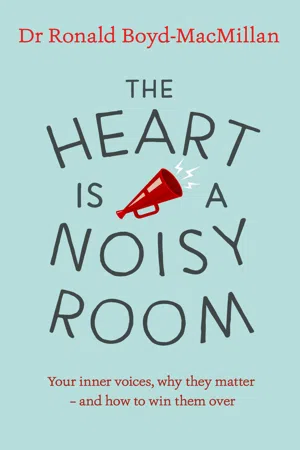
The Heart is a Noisy Room
Your inner voices, why they matter – and how to win them over
- 208 pages
- English
- ePUB (mobile friendly)
- Available on iOS & Android
eBook - ePub
The Heart is a Noisy Room
Your inner voices, why they matter – and how to win them over
About this book
Trusted by 375,005 students
Access to over 1.5 million titles for a fair monthly price.
Study more efficiently using our study tools.
Information
Topic
Theology & ReligionSubtopic
Christianity1
The Heart as a Noisy Room Full of Voices
This is not your usual Christian book. I’ll start with a confession: I struggle to read most Christian books anymore. I’m busy, and I get irritated with books that start with cringing personal stories which go on so long it’s thirty pages before you get a sniff of the point. Then, after you get this hint, you have to wade through a couple of hundred pages of worthy padding, bug-eyed stories, a fund of testimonies, and promises of wholeness, fullness and power to rival Jesus himself.
This is not that kind of book.
These next few pages – with the minimum of testimony and story – share what this book is about. Take your shot at it now. Don’t waste your time. Decide now whether it’s worth the price of perseverance or not.
It’s about our voices. What they are doing to us. What they are taking away from us. What they can give to us . . . if we know how to deal with them.
It starts with this: our heart is a noisy room full of voices. It’s a party in there. You can hear the pop of corks, shouts, laughter and dialogue. Some voices are raised in anger. Some voices are sad. From a distance it is hard to distinguish. But the heart is the place from which all our controlling voices emanate, where our essential inner dialogues occur, where our self-consciousness reverberates. That self-consciousness is what makes us unique as humans. Or at least, dolphins – if they have self-consciousness – haven’t written any books about it yet. Your heart, my heart, everyone’s heart, is a noisy room full of voices. These voices can come deep from childhood, or from our culture, or from habits embraced in adulthood. Some even come from God, and some from the very pit of hell. The ones we immediately remember tend to be negative:
‘I’m no good.’
‘I’ve missed my chance . . . I’ll never make it now.’
‘I wish I was more like her, but I’ll never be because I’m stupid/ugly.’
‘You’re doomed to fail . . . you’ve always messed up.’
But voices can also take positive forms:
‘Things are sure to get better.’
‘Come on, you can be the best in the world at this.’
‘I will prevail because I’m special.’
‘I will leave a great legacy.’
OK so far? These voices are essentially strings of sentences recurring in our heads that seem to have a distinct personality that ‘monologue’ to us, sometimes so fast we just feel them rather than hear the words spelled out. These voices are asking us to adopt a certain perspective on life.
You are not weird because you have them. Most people have them. They are normal. What might be a bit weird is if you hear them audibly, a lot, and feel you have to do what they want. But that is very rare, and not always a sign of schizophrenia.
These voices run our lives. Our heart is a debating chamber that runs our lives. Our inner dialogues determine whether or not we will fulfil our dreams, keep us sane or not, enable us to enjoy God . . . or not. They are the arena where our deepest desires meet our conscious intentions, and these voices – and how we respond to them – either cramp or create a life of fullness. Although these voices are not who we are, they try to take over who we are . . . and frequently succeed. They are persistent, permanent and powerful enough to lay down rails upon which we run our lives.
These voices generally ruin our lives. Our voices usually try to tear us away from our deepest identity in God. It’s easy to see how negative voices ruin us. Take a harsh parental voice that has left you with the voice, ‘That’s not good enough.’ So no matter what you achieve (and people with this voice usually achieve a lot), the voice robs you of all joy from it.
Yet even positive voices can have the same ruinous effect. I knew someone who had a strong voice that essentially was, ‘I will be the best doctor in the world.’ Sounds marvellous. Sounds altruistic. Sounds Christian even. But only when you forget that your deepest identity is to enjoy God, not to have a profession. This man had substituted an achievement addiction for knowing God. When he contracted a disease that meant he could no longer perform surgery, he went to pieces. He had lost his identity, but he had lost a false one, not a true one. It took him years to prove the truth of an old Celtic saying: When the false gods go out, the true God comes in.
Most catastrophically, these voices prevent us from experiencing God with the fullness we deserve and the fullness God desires. Because they are located in the heart, they are well placed to rob us of our intimacy with God. Intimacy is a heart-to-heart knowing, and when it comes to God, that intimacy takes a unique form. He is actually resident within our heart, but his voice is not inclined to shout. The fact is, we are creatures who say we want a heart-to-heart meeting with God, yet will do everything in our power to avoid it. Why? Probably because if you go into the heart and meet your voices, you are going to meet three people – the person you really are (ugly); a devil who hates you (nasty) and God, your maker, who knows absolutely everything about you (fearful). That’s scary.
So scary most people don’t go there. Maya Angelou said that most people don’t grow up, they just grow older. Even if you have the courage and desire to break the unconscious power of these voices, where’s the door? What is the door to the noisy room? It’s the very opposite of what keeps us away from the room of the heart. Busyness keeps us on the superficial level of life. Stillness takes us deep. Stillness is the door. It doesn’t still the voices. It just enables us to hear the voices all the more clearly: no longer a babble. We have to still the other voices to listen. Most of us don’t know how! It’s fascinating that one of the most popular therapies for dealing with our voices today is mindfulness-based cognitive behavioural therapy (MCBT), a so-called third wave of treatments that seek to use stillness to negate the clamour of the voices.
Most vitally, these voices contain terrible lies, and they do not represent who we are. We are not the same as our voices . . . however much we may think we are. You are not that terrible person when a parent or guardian screamed, ‘YOU’RE DEFECTIVE!’ No, you are not. Or when they crooned, ‘You’re my perfect little angel.’ Nor are you perfect. But the danger is we fuse our self to the voices, because we lack the confidence and self-knowledge to know the difference. Relax. You are not the same person as the voices inside you, however much they pretend you are!
Most delightfully, if we face our voices, they can also save us. Our voices are not something we can get rid of. They are too deep. You might as well tear out your heart. But if handled correctly, our voices can actually provide guidance. They turn from terrorists to avatars, and show us the way to be whole and, ultimately, the way to an enjoyment of God. I’m going to propose five ways to interact with our voices so that they no longer ruin us, but rather assist us in our renewal. Keep going on automatic pilot with these voices, and your identity will be shrunk down to their noisy, warring fragments of selfhood. Confront them, befriend them, ask God to defang them, relativise them, and even surround them with a culture of contradiction, and you will win – win through to a larger, better person. After all, there are seven billion people on the planet, but only you can be you.
Most frighteningly, our voices are hardly ever talked about. You’ll never hear a sermon about them. There are few Christian books about them. A strand of self-help literature foolishly pretends to fix them. They usually concentrate on the negative voices and expect you to come up with the strength to see them off. Wrong strategy. You might as well try to sink an ocean liner with a pea shooter. The voices will win every time. We can’t get rid of them. But we can shrink them, or even use them. Sure, the world of psychology has some insights. There is an emphasis on ‘self-talk tapes’ that can reprogram us, and a whole new school of treatment – CBT – has evolved to assist with the fight. Help us it does, especially the so-called third wave of CBT, which adds mindfulness into the mix, a form of stilling and detaching from the power of the voices rather than trying to alter their content. But this is mostly technique, like removing the chemical dependence of alcoholism, without providing the meaning or impetus to fill a life of sobriety. Here we are talking about the goal of life, which is to enjoy God, and our voices are – until we know how to handle them – out to offer a false identity in anything else but God. Ultimately, we do not have the resources in ourselves to deal with our voices. The goal is not merely to manage our voices, but use them to transform our lives . . . in a Godward direction.
Fabulous verse this: Isaiah 30:21, which in the NIV reads, ‘Whether you turn to the right or to the left, your ears will hear a voice behind you, saying, “This is the way; walk in it.” ’ God’s voice called Israel to return to their primary identity – to be a distinct people in his image, and show the world the love of God. Be who I made you to be, says God.
That’s what the voice of God does, should you hear it in the neighbourhood of your noisy heart. It’s an invitation to go back to your primary identity, one where there is a balance between being and doing, not just being. Where you live out your uniqueness, and your living is an overflow of the love you feel from your Creator.
So that’s what this book is all about. Simple, but massively complex, the more so because it’s a subject rarely treated. Your mind is full of voices. You have a running dialogue with the universe. You have a subtext running like a ticker tape across the bottom of your vision. Like it or not, they are running your life. Face it – they are probably ruining your life. But what do you do? Hold on to the key idea which drives this book – those voices that are ruining your life are also the same voices that will save your life . . . if you know how to deal with them!
So be careful if you want to keep reading. Here is your warning: your inner dialogue will never be the same again!
Was that a promise of transformation that snuck in there? I’m not sure what the promise is. I’m just not one of those Christians who ‘count it all joy’. I have found the Christian life a struggle, but a worthwhile one. The face of God comes and goes, and most of the time I have to push myself to see his face in the rain at sunset, or the wind rustling through trees. In fact, maybe God is so everywhere it looks like he is nowhere, if you can keep track with that. Of course, if you are the type of person who gets seven resurrections before breakfast, this book is not for you. You shouldn’t be reading any books at all. But I do find the Christian life epic after a fashion. It’s a drama of love, crucifixion, emptiness, weakness, grief, passion and joy that I choose to experience on a daily basis. But the drama is often disguised. It’s a drama that does not look like a drama, especially not the Hollywood version. More like an Andrei Tarkovsky film than a Stephen Spielberg. Tarkovsky was famous for holding his film shots of ruins, forest or fire until you grew bored, and then you got this magical moment when you saw afresh, and wonder was renewed at the spiritual in the ordinary. It takes a certain kind of eye to see it. And a disciplined patience. It’s not easy. Not always fabulous. But always, in a way, filling enough of reality to make it the best kind of way to get through this world as we find it.
As for your voices, yes, most of them will always be there. You can’t get rid of them on the whole. But you can definitely turn around from being invisibly dominated to being helpfully guided by them.
And that could save your life.
Or give you a new one.
Or, at least, a better one.
2
What is a Voice Anyway?
OK, what is a voice? Where might it come from? Why is it so powerful? How might we say it actually has the power to run our lives?
When I first started teaching on this, this was my first pass on the subject. I defined a voice this way: ‘A voice is a persistent, powerful message, from yourself to yourself, that prevents and keeps you from embracing your true self.’
The idea here was to show these things through the elements of this definition:
Persistent. It’s part of your identity. It feels familiar. Even if it is never named, it is a companion over time.
Powerful. We tend to believe it. We rarely question its truth, and we have an emotion every time the voice goes off.
Message. It’s ...
Table of contents
- Cover
- About the Author
- Title Page
- Imprint Page
- For Eolene – who gives me the best vision
- Keep your heart with all vigilance;
- Contents
- 1 The Heart as a Noisy Room Full of Voices
- 2 What is a Voice Anyway?
- 3 How Voices Worked in Me
- 4 How Voices Mess Us Up
- 5 How to Identify Your Voices
- 6 How Voices Can Renew Us
- 7 #1 Talk Back to the Voice
- 8 #2 Befriend the Voice
- 9 #3 Ask God to Share the Burden
- 10 #4 Shrink the Voice
- 11 #5 Create a Community of Contradiction
- 12 God and Our Voices
- 13 Voices and World-Changing
- Notes
- Acknowledgements
- Do you wish this wasn't the end?
Frequently asked questions
Yes, you can cancel anytime from the Subscription tab in your account settings on the Perlego website. Your subscription will stay active until the end of your current billing period. Learn how to cancel your subscription
No, books cannot be downloaded as external files, such as PDFs, for use outside of Perlego. However, you can download books within the Perlego app for offline reading on mobile or tablet. Learn how to download books offline
Perlego offers two plans: Essential and Complete
- Essential is ideal for learners and professionals who enjoy exploring a wide range of subjects. Access the Essential Library with 800,000+ trusted titles and best-sellers across business, personal growth, and the humanities. Includes unlimited reading time and Standard Read Aloud voice.
- Complete: Perfect for advanced learners and researchers needing full, unrestricted access. Unlock 1.5M+ books across hundreds of subjects, including academic and specialized titles. The Complete Plan also includes advanced features like Premium Read Aloud and Research Assistant.
We are an online textbook subscription service, where you can get access to an entire online library for less than the price of a single book per month. With over 1.5 million books across 990+ topics, we’ve got you covered! Learn about our mission
Look out for the read-aloud symbol on your next book to see if you can listen to it. The read-aloud tool reads text aloud for you, highlighting the text as it is being read. You can pause it, speed it up and slow it down. Learn more about Read Aloud
Yes! You can use the Perlego app on both iOS and Android devices to read anytime, anywhere — even offline. Perfect for commutes or when you’re on the go.
Please note we cannot support devices running on iOS 13 and Android 7 or earlier. Learn more about using the app
Please note we cannot support devices running on iOS 13 and Android 7 or earlier. Learn more about using the app
Yes, you can access The Heart is a Noisy Room by Ronald Boyd-MacMillan in PDF and/or ePUB format, as well as other popular books in Theology & Religion & Christianity. We have over 1.5 million books available in our catalogue for you to explore.