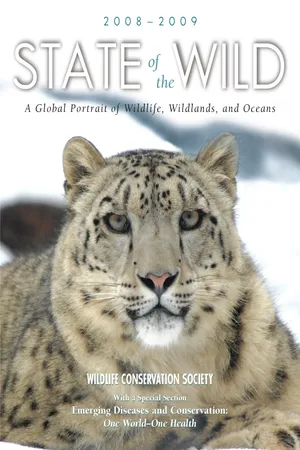
State of the Wild is a biennial series that brings together international conservation experts and writers to discuss emerging issues in the conservation of wildlife and wild places.
Each volume in the series combines evocative writings with a fascinating tour of conservation news highlights and vital statistics from around the world. One-third of each volume focuses on a topic of particular concern to conservationists working to protect wildlife and our last wild places. This 2008–2009 edition considers the integration of wildlife health, ecosystem health, human health, and the health of domestic animals—a “One World–One Health” approach to disease and conservation.
This focus is complemented with essays clustered into sections that address other key issues—conservation of species; conservation of wild places; people, culture, and conservation; and the art and practice of conservation. Essays cover a broad range of topics, from restoring biodiversity on the prairies to mapping the state of the oceans to the conservation impacts of lawlessness and coca cultivation in Colombia. Essay contributions come from people directly involved in on-the-ground conservation efforts and offer a unique and valuable perspective on often-overlooked topics.
State of the Wild’s accessible approach educates a wide range of audiences while at the same time presenting leading-edge scientific overviews of hot topics in conservation. Uniquely structured with magazine-like features up front, conservation news in the middle, and essays from eminent authors and experienced scientists throughout, this landmark series is an essential addition to any environmental bookshelf.
The state of the wild is at once fascinating, because there is so much to learn about each region and type of wild, and concerning, because all human endeavors impact the wild in some way. The contributions in this section provide an overview of several areas of concern, as well as glimmers of hope for the current state of the wild.
James Hansen’s contribution, “Tipping Point: Perspective of a Climatologist,” gives us a truly global assessment of what climate change will do to our planet’s wildlife. From this overarching view, the focus narrows to “Global Conservation News Highlights,” a section containing brief updates on regional conservation victories and losses since the publication of State of the Wild 2006.
In “Discoveries,” Margaret Kinnaird discusses new species discovered since 2006 and reminds us of the richness that still remains to be explored. In “The Rarest of the Rare,” contributors from three conservation organizations—Wildlife Conservation Society, World Wildlife Fund, and The Nature Conservancy—profile some of the world’s rarest animals and ecosystems and pinpoint where extinctions are imminent. We hope “The Rarest of the Rare,” rather than serving as an epitaph, serves as a poignant time capsule to spur further conservation efforts.
Harkening back to the theme of State of the Wild 2006, which featured a special section on hunting and the global wildlife trade, Elizabeth L. Bennett provides a sobering update on the species threatened by trade in “Continuing to Consume Wildlife.”
These entries are meant to provide context for and enrich the in-depth essays that follow in parts II and III of this book.
Source: Alexander Hatemann
Tipping Point
PERSPECTIVE OF A CLIMATOLOGIST
JAMES HANSEN
“Animals are on the run. Plants are migrating too.“1 I wrote those words in 2006 to draw attention to the fact that climate change was already under way. People do not notice climate change because it is masked by day-to-day weather fluctuations, and we reside in comfortable homes. Animals and plants, on the other hand, can survive only within certain climatic conditions, which are now changing. The National Arbor Day Foundation had to redraw its maps for the zones in which tree species can survive, and animals are shifting to new habitats as well. Are these gradual changes in the wild consistent with dramatic scientific assessments of a crystallizing planetary emergency? Unfortunately, yes. Present examples only hint at the scale of the planetary emergency that climate studies reveal with increasing clarity.
Our home planet is dangerously near a tipping point at which human-made greenhouse gases reach a level where major climate changes can proceed mostly under their own momentum. Warming will shift climatic zones by intensifying the hydrologic cycle, affecting freshwater availability and human health. We will see repeated coastal tragedies associated with storms and continuously rising sea levels. The implications are profound, and the only resolution is for humans to move to a fundamentally different energy pathway within a decade. Otherwise, it will be too late for one-third of the world’s animal and plant species and millions of the most vulnerable members of our own species.
JAMES HANSEN is director of the National Aeronautics and Space Administration Goddard Institute for Space Studies, but the perspectives here are his own. Hansen is also Adjunct Professor of Earth and Environmental Sciences at Columbia University’s Earth Institute, and he appeared in An Inconvenient Truth. He has also criticized the Intergovernmental Panel on Climate Change for not adequately addressing the danger of large sea level rise.
We may be able to preserve the remarkable planet on which civilization developed, but it will not be easy: special interests are resistant to change and have inordinate power in our governments, especially in the United States. Understanding the nature and causes of climate change is essential to crafting solutions to our current crisis.
Tipping Point
Earth is heated by sunlight and, in balance, reaches a temperature such that an amount of heat equal to the absorbed solar energy radiates back to space. Climate forcings are imposed, temporary changes to Earth’s energy balance that alter Earth’s mean temperature. Forcings include changes in the sun’s brightness, volcanic eruptions that discharge sunlight-reflecting particles into the stratosphere, and long-lived human-made greenhouse gases that trap heat.
We are at the tipping point because the climate state includes large, ready positive feedbacks provided by the Arctic sea ice, the West Antarctic ice sheet, and much of Greenland’s ice.
Forcings are amplified or diminished by other changes within the climate system, known as feedbacks. Fast feedbacks—changes that occur quickly in response to temperature change—amplify the initial temperature change, begetting additional warming. As the planet warms, fast feedbacks include more water vapor, which traps additional heat, and less snow and sea ice, which exposes dark surfaces that absorb more sunlight.
Slower feedbacks also exist. Due to warming, forests and shrubs are moving poleward into tundra regions. Expanding vegetation, darker than tundra, absorbs sunlight and warms the environment. Another slow feedback is increasing wetness (i.e., darkness) of the Greenland and West Antarctica ice sheets in the warm season. Finally, as tundra melts, methane, a powerful greenhouse gas, is bubbling out. Paleoclimatic records confirm that the long-lived greenhouse gases—methane, carbon dioxide, and nitrous oxide—all increase with the warming of oceans and land. These positive feedbacks amplify climate change over decades, centuries, and longer.
The predominance of positive feedbacks explains why Earth’s climate has historically undergone large swings: feedbacks work in both directions, amplifying cooling, as well as warming, forcings. In the past, feedbacks have caused Earth to be whipsawed between colder and warmer climates, even in response to weak forcings, such as slight changes in the tilt of Earth’s axis.2
The second fundamental property of Earth’s climate system, partnering with feedbacks, is the great inertia of oceans and ice sheets. Given the oceans’ capacity to absorb heat, when a climate forcing (such as increased greenhouse gases) impacts global temperature, even after two or three decades, only about half of the eventual surface warming has occurred. Ice sheets also change slowly, although accumulating evidence shows that they can disintegrate within centuries or perhaps even decades.
The upshot of the combination of inertia and feedbacks is that additional climate change is already “in the pipeline”: even if we stop increasing greenhouse gases today, more warming will occur. This is sobering when one considers the present status of Earth’s climate. Human civilization developed during the Holocene (the past 12,000 years). It has been warm enough to keep ice sheets off North America and Europe, but cool enough for ice sheets to remain on Greenland and Antarctica. With rapid warming of 0.6°C in the past 30 years, global temperature is at its warmest level in the Holocene.3
The warming that has already occurred, the positive feedbacks that have been set in motion, and the additional warming in the pipeline together have brought us to the precipice of a planetary tipping point. We are at the tipping point because the climate state includes large, ready positive feedbacks provided by the Arctic sea ice, the West Antarctic i...
Table of contents
About Island Press
About The Wildlife Conservation Society
State of the Wild
Title Page
Copyright Page
Table of Contents
BY THE NUMBERS - Emerging Diseases and Conservation
FOREWORD - The Value of Conservation
Introduction: Future States of the Wild
PART I - STATE OF THE WILD
PART II - FOCUS ON THE WILD
PART III - EMERGING ISSUES IN THE WILD
Acknowledgments
Notes
Index
Island Press Board of Directors
Trusted by 375,005 students
Access to over 1.5 million titles for a fair monthly price.
Study more efficiently using our study tools.
Frequently asked questions
Yes, you can cancel anytime from the Subscription tab in your account settings on the Perlego website. Your subscription will stay active until the end of your current billing period. Learn how to cancel your subscription
No, books cannot be downloaded as external files, such as PDFs, for use outside of Perlego. However, you can download books within the Perlego app for offline reading on mobile or tablet. Learn how to download books offline
Perlego offers two plans: Essential and Complete
Essential is ideal for learners and professionals who enjoy exploring a wide range of subjects. Access the Essential Library with 800,000+ trusted titles and best-sellers across business, personal growth, and the humanities. Includes unlimited reading time and Standard Read Aloud voice.
Complete: Perfect for advanced learners and researchers needing full, unrestricted access. Unlock 1.5M+ books across hundreds of subjects, including academic and specialized titles. The Complete Plan also includes advanced features like Premium Read Aloud and Research Assistant.
Both plans are available with monthly, semester, or annual billing cycles.
We are an online textbook subscription service, where you can get access to an entire online library for less than the price of a single book per month. With over 1.5 million books across 990+ topics, we’ve got you covered! Learn about our mission
Look out for the read-aloud symbol on your next book to see if you can listen to it. The read-aloud tool reads text aloud for you, highlighting the text as it is being read. You can pause it, speed it up and slow it down. Learn more about Read Aloud
Yes! You can use the Perlego app on both iOS and Android devices to read anytime, anywhere — even offline. Perfect for commutes or when you’re on the go. Please note we cannot support devices running on iOS 13 and Android 7 or earlier. Learn more about using the app
Yes, you can access State of the Wild 2008-2009 by Eva Fearn in PDF and/or ePUB format, as well as other popular books in Biological Sciences & Zoology. We have over 1.5 million books available in our catalogue for you to explore.